

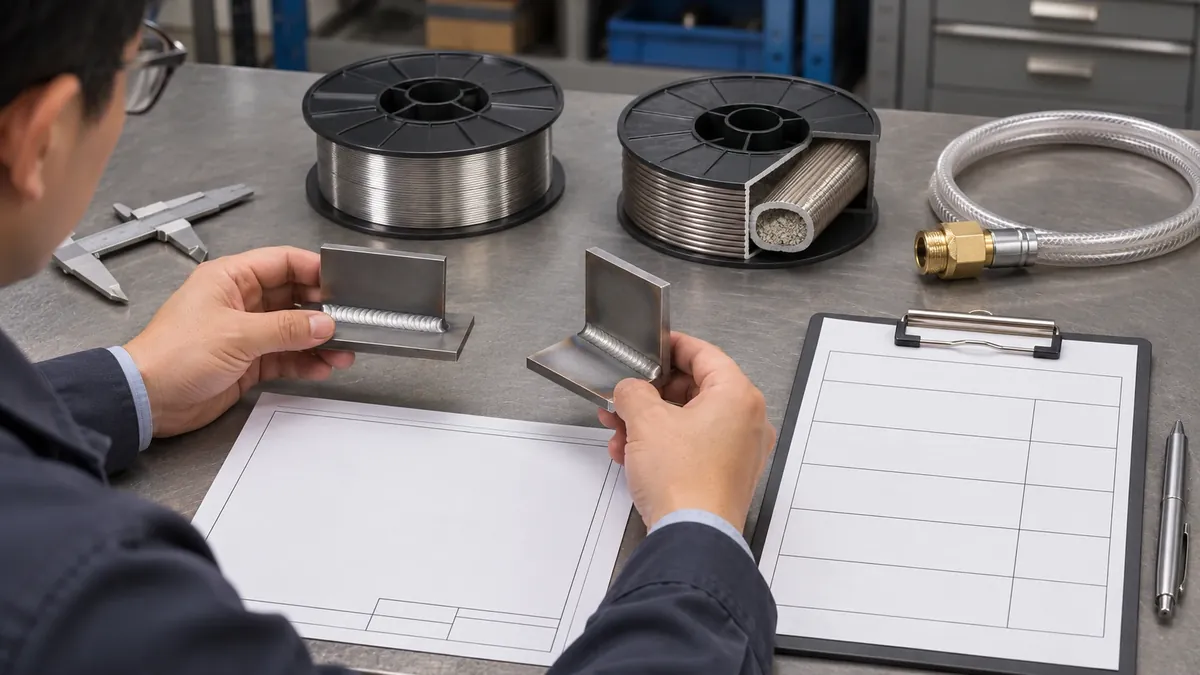
Flux core vs MIG is not a choice between one universal “gasless” method and one universal gas-shielded method. In common shop language, MIG usually means solid-wire gas metal arc welding (GMAW) with externally supplied shielding gas, while flux-cored arc welding (FCAW) uses a tubular wire containing flux; some flux-cored wires also require external shielding gas. For an importer reviewing a welded bathroom or home-storage hardware part, the useful first question is therefore what wire and shielding arrangement the supplier actually proposes. The process name alone does not establish joint strength, corrosion resistance, appearance, or suitability for the approved drawing. For an importer, flux core vs mig is a practical scope question: identify the actual proposal, then compare it with the product requirement and evidence.
What problem does flux core vs MIG help a hardware buyer solve?
The comparison helps a buyer understand a process proposal without treating familiar shorthand as a complete manufacturing specification. A sourcing conversation may use “MIG,” “wire welding,” or “flux core” loosely. Those labels can refer to different consumables and shielding arrangements. If the buyer approves a sample based only on a process nickname, the production record may still leave unanswered what wire construction, external shielding, joint geometry, finishing sequence, or acceptance evidence applies.
The distinction matters when welded metal parts later receive grinding, polishing, plating, powder coating, or another finish. A process can leave different surface residues and finishing needs. That does not mean one route is automatically better: actual results depend on the part material and thickness, joint design, access, consumable, process control, operator capability, and downstream finishing. The importer should identify the actual route and tie it to the agreed part revision and representative sample.
This is a buyer-education comparison, not a welding procedure. It does not provide machine settings, a qualified procedure, safety instructions, or a strength ranking. A technical supplier or qualified welding professional must determine the appropriate method for the actual product and applicable requirements.
What is the basic difference between MIG and flux-cored welding?
In the common comparison, solid-wire GMAW feeds a continuous solid metal wire through a welding gun and uses externally supplied shielding gas. Flux-cored arc welding feeds a tubular wire whose core contains flux ingredients. Depending on the specific wire, shielding may come from the flux system alone or from the flux system together with external gas. “Flux core” therefore describes wire construction and process family; it does not always mean “no shielding gas.”
MIG is widely used as an informal name for solid-wire GMAW, although technical documents may use GMAW. FCAW is a separate process family. The cleanest way to compare a supplier’s proposal is to separate three questions:
| Route being discussed | Consumable form | Shielding arrangement | Buyer should confirm |
|---|---|---|---|
| Solid-wire GMAW, often called MIG | Solid continuous wire | External shielding gas | Wire identity, gas arrangement, joint access, and finish preparation |
| Gas-shielded FCAW | Tubular wire with flux | External gas plus the wire’s flux system | Exact wire type, external gas requirement, and post-weld surface treatment |
| Self-shielded FCAW | Tubular wire with flux | Wire’s flux system is designed to provide shielding without external gas | Exact product instructions, residue/slag handling, and finish compatibility |
This table is a vocabulary aid, not a universal technical selection chart. Consumable products differ, terminology can be used inconsistently, and the correct specification depends on the actual job. A buyer should ask for the process and wire information that applies to the production part rather than infer it from a machine photo, a spool shape, or a verbal shorthand.
Why does “flux core” not always mean “gasless”?
Flux-cored wire is tubular, and its internal flux contributes to the welding process. Some FCAW consumables are designed for self-shielding; other FCAW consumables are designed for use with external shielding gas. A wire feeder by itself does not identify which arrangement is being used. Nor does the phrase “flux core” tell the buyer whether a specific product is compatible with the material, joint, position, finishing plan, or acceptance requirement.
This distinction is particularly useful in supplier evaluation because a buyer may receive a proposal that says “flux core” and assume a gas-free setup. That assumption can produce an incomplete process record. The more precise questions are: What is the exact wire product or specification? Does the process require external shielding gas? What is the approved joint and material? What surface condition is expected before finishing? Which evidence will be used to accept a representative sample?
The answer should come from the responsible process supplier and the applicable consumable information. An importer should not substitute a generic internet explanation for the technical documentation that governs a specific production process.
How can the process affect a finished bathroom hardware component?
The process name is only one part of the manufacturing chain. Consider a hypothetical welded support bracket for a towel rack or a welded joint in a storage basket. The buyer may care about geometry, alignment, visible surface, fit-up, corrosion-related finish performance, and repeatability. Each concern has to be connected to the product’s drawing and agreed inspection criteria.
The wire and shielding arrangement can influence process behavior and the surface left for later work. For example, some flux-cored workflows create slag that has to be removed before the next operation; the exact requirements depend on the specific product and process. Solid-wire GMAW does not become suitable simply because a surface appears cleaner. A clean-looking bead cannot by itself prove fusion, strength, absence of internal defects, or finish durability. Similarly, a visible residue does not on its own prove that a joint is unacceptable; it shows that the specified surface-preparation and finishing sequence matters.
Buyers should distinguish the evidence each check can provide:
- A drawing revision identifies intended geometry; it does not prove that the part was manufactured to it.
- A process or consumable record identifies what was specified or used; it does not independently prove finished-part performance.
- A representative sample can show agreed appearance and fit for the reviewed sample; it does not automatically establish the consistency of every production unit.
- A visual inspection can identify visible conditions; it cannot reveal every hidden or internal characteristic.
- A finish sample can help align color and appearance; it does not establish corrosion performance unless an appropriate requirement and evidence support that conclusion.
When a joint is important to fit, safety, or product function, the buyer should define the required evidence with the responsible engineering and quality parties. The article does not set acceptance limits or claim that Koitor performs a particular test.
What should importers ask before approving a welding route?
Start from the product requirement, not from a presumed “better” process. A concise supplier discussion can reduce ambiguity before sample approval or production release.
- Identify the actual process. Ask whether the proposal is solid-wire GMAW, gas-shielded FCAW, self-shielded FCAW, or another process. Ask the supplier to correct shorthand where needed.
- Identify the consumable. Record the wire type or product designation used for the reviewed part. Do not infer it from a photo of a spool or from a generic statement.
- Confirm the shielding arrangement. If external gas is used, confirm that this is part of the proposed process. If it is not used, confirm that the exact consumable is intended for the stated arrangement.
- Tie the process to the drawing. Identify the part revision, joint location, visible faces, access limits, and any critical fit or alignment requirements.
- Review the finishing sequence. Ask what post-weld preparation is required before polishing, plating, coating, or assembly, and which party is responsible for it.
- Define sample acceptance. State which attributes the buyer will inspect on a representative sample and what evidence is needed for attributes that cannot be judged visually.
- Control changes. If the process, wire, material, joint design, or finishing supplier changes, agree whether the buyer must review a new sample or updated documentation.
These questions are proportionate to a sourcing review. They do not turn an importer into a welding engineer. The goal is to make the proposal traceable and prevent a category label from being mistaken for a complete product specification.
How do materials, structure, finish, and packaging affect the decision?
A welded hardware part is a system of material, geometry, joining, finishing, assembly, and packaging decisions. The process comparison should be evaluated within that system.
Material and section geometry. Base material and thickness influence what joining approaches may be feasible, but a buyer should not assume that a process family has one universal thickness range. The actual material identity, part shape, access, and approved drawing matter. For stainless hardware, the buyer should also separate base-metal selection from surface finish and exposure requirements. No welding process name substitutes for a material specification.
Joint design and access. The drawing should identify where parts meet and which faces are visible. If an assembly places a joint near a cosmetic surface or makes it difficult to reach for finishing, that is a design and process-planning concern. A supplier can review a drawing or physical sample and discuss a feasible manufacturing route, but the buyer should approve any geometry change that affects fit or appearance.
Finish and post-weld preparation. A polished, plated, or coated part may need a defined preparation sequence. The buyer should clarify whether the joint area will be ground, blended, cleaned, or otherwise prepared, and how the agreed sample represents the finished product. Visual smoothness alone does not establish coating adhesion or corrosion performance. Those require suitable requirements and evidence.
Assembly and packaging. Joining can affect alignment and how components nest or fit during assembly. Packaging then has to protect exposed surfaces and prevent movement or contact damage in transit. The process choice does not guarantee packaging outcomes. Buyers should review the final assembled product and the pack-out configuration separately.
| Buyer requirement | What to check | Pourquoi est-ce important ? |
|---|---|---|
| Correct process identity | Solid wire or tubular flux-cored wire; external gas or self-shielding arrangement | Prevents a shorthand term from hiding a different workflow |
| Drawing conformity | Current revision, joint location, alignment, visible faces, and fit | Connects a process proposal to the actual product |
| Finish readiness | Required surface preparation and agreed finished sample | Makes downstream appearance requirements explicit |
| Acceptance evidence | Visual, dimensional, functional, or other agreed checks | Avoids treating one observation as proof of every characteristic |
| Contrôle des modifications | Approval path for wire, route, design, material, or finish changes | Helps keep sample and production expectations aligned |
What mistakes should buyers avoid?
Treating “MIG” and “flux core” as complete specifications. These names do not necessarily tell a buyer the exact wire, shielding setup, or product requirements. Ask the supplier to identify the route in precise terms.
Assuming flux-cored always means gasless. Some flux-cored consumables use external shielding gas. Confirm the specific wire and its technical instructions.
Ranking processes by name. Neither MIG nor FCAW is universally stronger, cheaper, cleaner, faster, or more appropriate. Those outcomes depend on the defined application and evidence. The article intentionally avoids generic superiority claims.
Using bead appearance as a performance certificate. A visually acceptable sample is useful for the visible criteria it was approved against. It does not demonstrate every hidden property or production control.
Ignoring the finishing stage. A process that is discussed without its downstream preparation may be an incomplete proposal for a polished, plated, or coated consumer-facing part. Put the finished appearance and preparation requirements in the sample review.
Changing consumables without review. A change in wire construction or shielding arrangement may alter the process and finish sequence. The buyer should agree which changes require notification and renewed approval.
Relying on a hypothetical example as an engineering instruction. A bracket or basket example helps organize buyer questions. It is not a welding specification or a recommendation for a particular joint.
How can a small-batch OEM factory help without replacing technical qualification?
A family-owned custom metal hardware factory can help buyers connect drawings, samples, joining access, finishing, assembly, and packaging questions. Small-batch OEM production can be useful when a buyer needs to explore a product concept, review a custom geometry, or clarify requirements before a larger order. That practical coordination is different from claiming to operate a particular welding process, certify welders, qualify a procedure, or provide laboratory testing.
Koitor Hardware’s approved positioning is as a specialized OEM manufacturer and bathroom and home storage hardware factory. Buyers can provide a drawing or physical sample and ask which manufacturing details need clarification for the proposed product. Depending on the order and confirmed scope, the discussion can include joint location, cosmetic faces, assembly sequence, sample requirements, finish expectations, pack-out, and the information that should be fixed before quotation or sampling.
A buyer should keep responsibility clear. The factory or process supplier responsible for the actual joining route must confirm the consumable and process details. The buyer must define intended use, applicable requirements, critical dimensions, finish expectations, and evidence needed for acceptance. If a project requires engineering review or formal process qualification, that work must be assigned to a competent and authorized party. A generic blog article cannot perform that review.
Small-batch flexibility also does not mean that every design can be produced without trade-offs or that a trial order proves long-term production consistency. It means buyer and manufacturer can discuss the real drawing, sample, order scope, and changes. The commercial value is clearer communication before the parties commit to a specification.
For more context about product scope, see the live page on fabrication sur mesure de quincaillerie de salle de bains. Buyers preparing a request can review OEM home storage hardware and then send the actual product information through contacter Koitor.

Liste de contrôle à l'intention de l'acheteur avant de demander un devis
Before asking a supplier to quote a welded bathroom or home-storage hardware product, prepare the information that lets the supplier respond to the real specification rather than to a generic process label:
- Product type, intended application, target market, and order quantity range.
- Current 2D drawing and, where available, 3D model or physical reference sample.
- Material grade or buyer-approved material options; do not leave a critical material assumption unstated.
- Joint locations, visible faces, alignment requirements, and any restricted access.
- Finish, color, surface preparation, and the appearance criteria that can be judged on a sample.
- Required process documentation or acceptance evidence, identified by the responsible technical party.
- Sample quantity, sample review participants, and which changes require resubmission.
- Assembly requirements, included hardware, and packaging configuration.
- Private-label, logo, carton, instruction, or labeling requirements, if applicable.
- The process and consumable details the supplier is responsible for confirming.
A buyer does not need to prescribe a weld procedure to ask for a clear quotation. The buyer needs to state product requirements and ask the responsible supplier to identify the proposed process and any open assumptions. If a drawing or sample leaves the joint, finish, or acceptance criteria unclear, resolve that gap before treating a process name as a commitment.
Technical references
Technical background: Référence technique principale. Consult the source in its stated scope; it does not establish Koitor-specific capability or acceptance.
Foire aux questions
Is flux-cored welding always gasless?
No. Some flux-cored consumables are designed to operate with external shielding gas, while others are designed for self-shielding. The specific wire information and process supplier’s instructions determine the arrangement.
Is MIG always better for thin bathroom hardware?
No universal conclusion follows from the label. Suitability depends on the material, section, joint geometry, access, product requirements, finishing sequence, and qualified process decision. A buyer should not use this article as a procedure or settings guide.
Does a clean weld bead prove a strong finished part?
No. Surface appearance can support a visual review, but it does not establish every hidden characteristic or performance requirement. Define the evidence required for the actual product.
What should an importer put in a request for quotation?
Provide the current drawing or sample, material and finish requirements, critical dimensions or visible faces, quantity range, sample expectations, packaging details, target market, and any specific process documentation requirement. Ask the supplier to identify assumptions and the proposed joining route.
Work with Koitor Hardware
For a custom metal bathroom or home-storage product, share the drawing or sample, intended use, finish, quantity range, and the unanswered manufacturing questions. Koitor Hardware can review the defined OEM product scope and clarify which details need confirmation with the responsible process supplier.
How should a buyer handle a proposed process change?
A process proposal can change during development as a supplier learns more about the part, access, material, or finishing sequence. Buyers should distinguish a manufacturing adjustment that preserves approved product requirements from a change that could affect the accepted sample. Before approving the first production lot, define who must notify whom when a joining route, wire product, shielding arrangement, joint location, or finishing operation changes. The agreement can state whether the buyer needs a revised sample, updated process description, or other evidence. The appropriate response depends on the product and purchase agreement; there is no universal change-control form that fits every order.
Keep the record specific enough to connect the decision to the relevant drawing revision and sample. If a supplier proposes an alternative, ask what changed, why it is proposed, which buyer requirements remain unchanged, and which characteristics need renewed review. Do not assume that an unchanged appearance means every process input stayed the same, and do not assume every process adjustment automatically makes a part unacceptable. The useful outcome is a documented, mutually understood decision tied to the actual part.
How should buyers connect the process to a sample review?
A buyer reviewing a first article or production sample can use the process discussion to decide what to ask, but should keep the sample review anchored to written criteria. Start with the approved part revision and identify the specific joint or surface that matters. Then determine which visible attributes can be compared directly, such as position, alignment, surface transition, or fit with a mating component. If the buyer needs information about the process or consumable, request it from the responsible supplier rather than trying to infer it from a photograph.
The sample review should also record what was not examined. A buyer may approve a sample for appearance and assembly while leaving a process qualification or hidden characteristic to another technical review. That distinction prevents later disagreement about what “approved” meant. If a new sample is produced after a process or design change, compare it with the same criteria and make the change history explicit.
For repeat orders, keep a reference that connects the accepted sample to its drawing revision, finish, packaging state, and relevant process description. Do not assume a sample remains representative after an unreviewed change in material, joining route, finishing supplier, or geometry. The buyer can specify which changes require notification and what evidence is needed to evaluate them. These controls support clearer sourcing communication; they do not replace the technical judgment of the qualified process owner.
Discuss Your Metal Hardware Specification
Send the controlled drawing or sample and the actual product requirements so the relevant joining, finishing, and pack-out questions can be scoped for your project.
Fabrication pour compte de tiers / Marque de distributeur
Transformez ce guide d'approvisionnement en cahier des charges
Indiquez-nous le produit souhaité, ses dimensions, sa finition, la quantité commandée et vos exigences en matière d'emballage. Votre équipe recevra une analyse pratique de la faisabilité de la fabrication avant l'établissement du devis.


 English
 Español
 Português
 Français
 Deutsch
 العربية