
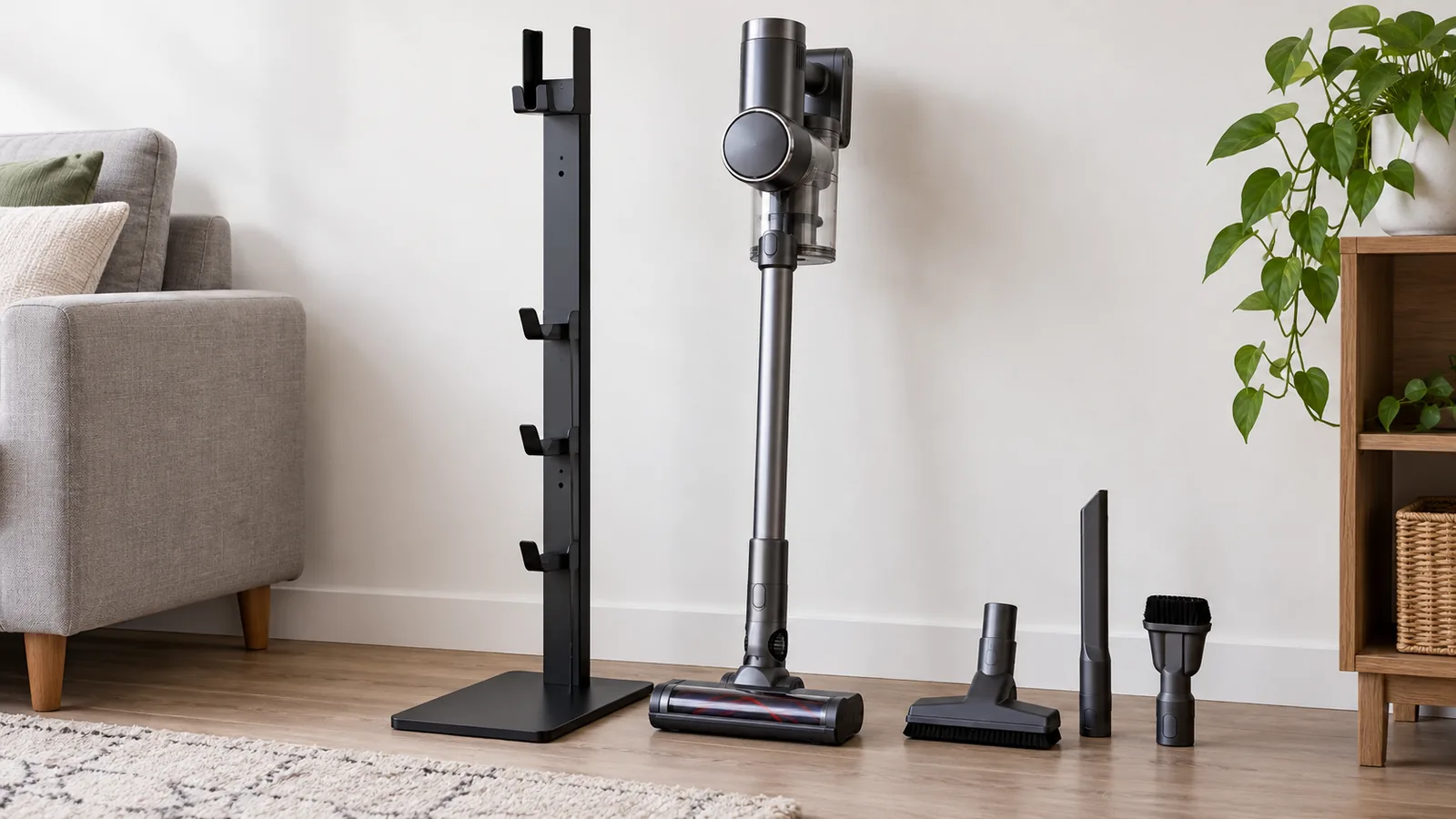
A freestanding vacuum stand is not specified completely by saying “metal floor stand.” One offer may support a vacuum body or floorhead directly; another may hold a named wall dock or organize attachments around an upright. Those layouts change the footprint, clearances, included hardware and sample checks. For importers, the useful comparison is the complete assembly against the appliance configuration the product is intended to organize, followed by an agreed pack-out and instruction review. This guide treats vacuum stands as a defined buyer decision and ties the review to the specific product, configuration and evidence available.
This article concerns passive storage. It does not establish compatibility with every vacuum, a safety rating, a load limit, charging capability or any current Koitor product. Manufacturers show different model-specific architectures: for example, LUMI’s appliance-mount series distinguishes floor-standing arrangements, while Yamazaki Home’s steel stand specifies fit details for its particular product. Treat those pages as examples of model-level variation, not transferable specifications.
Define the stand architecture before requesting a quote
Start by explaining what the stand physically supports. Is the appliance body supported by the stand, does a floorhead rest on a defined base, or does the upright carry a separately purchased dock? Is the design intended to store attachments on hooks or slots, or only to hold the main appliance? These are different product configurations; a buyer should not combine them into one vague “universal” request.
If the proposal uses an original dock, identify its exact manufacturer, model and revision, and clarify whether that dock is included, buyer-supplied or merely shown as a reference. An official parts page such as Dyson’s model-specific support listing illustrates why an appliance brand’s dock or component can be tied to a named model. It does not show that an aftermarket passive stand is electrically compatible or authorized. Keep charging and electrical questions outside the passive metal stand specification unless the responsible appliance supplier has separately established them.
The RFQ should also state the intended sales configuration: stand only, stand plus selected accessories, or stand packaged with a customer-supplied appliance/dock. List what is included and excluded. Avoid relying on a product image to define the bill of materials because images may show optional accessories or a reference appliance not supplied with the item.
Specify the base, upright and connection details
Provide a controlled drawing or dimensioned reference for the base footprint, overall height, upright position, support interfaces and any plate or cross-member that carries a dock. Mark which surfaces are visible after assembly and which clearances matter in the intended room layout. If the base has pads, feet or protective components, identify whether they are included, their location, and whether their material or color is specified. Do not assume that a heavier or larger base proves stability; geometry, connection details, floor conditions and intended use all matter.
For a stand built from several metal parts, the buyer should identify the required connections and the expected assembly sequence. A drawing can show the interface between the base and upright, hole locations, fastener access and orientation. If the product is designed for repeated assembly by the end customer, the instructions and supplied hardware should match the actual configuration. A changed hole pattern, bracket thickness, finish or fastener can affect fit or assembly and should trigger a controlled review rather than an informal substitution.
Use the product’s intended constraints to set the inspection plan. A buyer may compare the actual footprint and overall envelope with the approved drawing, confirm that the upright aligns with the base, and check whether supplied hardware reaches the intended connection. The supplier should identify any measurement method or tolerance that is important. These checks confirm the stated geometry only; they do not establish a load rating, long-term durability or safe use under untested conditions.
| RFQ / approval item | What to record |
|---|---|
| Architecture | Direct appliance support, floorhead support, or a named dock attached to the upright |
| Reference configuration | Actual appliance, dock, revision and accessories used for review |
| Base and frame | Footprint, height, support points, part interfaces and visible faces |
| Included contents | Stand parts, pads, fasteners, hooks, dock or other accessories |
| Assembly | Connection sequence, tools, access and customer-facing instructions |
| Delivery condition | Fully assembled, partly assembled or knock-down, plus protective pack-out |
Check fit with the actual appliance and attachments
An importer should give the supplier a real reference configuration when practical: the appliance model and revision, original dock if used, floorhead, extension tube and attachments expected in the range. Record whether these are physical sample parts, controlled drawings or dimensions supplied by the buyer. A generic silhouette or a list of brand names may not capture changes between product generations.
Review the assembled stand on a level surface under project-defined conditions. Confirm that the intended components can be placed in and removed from their storage positions without unintended interference. Check the clearances around nearby attachment hooks, the route of a handle or tube, the user’s access to the stored parts, and whether the expected floorhead or body reaches its support surface. If an accessory should be retained by a hook or slot, check that interface with the approved part rather than inferring fit from a photograph.
Document fit results narrowly. “Fits the supplied reference appliance and accessories in the reviewed arrangement” is more defensible than “fits all cordless vacuums.” The sample may represent one model, a limited revision range or a buyer-defined envelope. If the product is intended for several models, list each verified configuration, what part was used, and what remains unreviewed. A successful sample fit is not an endorsement from the appliance brand and does not establish charging behavior, electrical compatibility, or use with untested accessories.
Review the assembled sample without inferring a safety rating
During sample approval, record the stand’s revision and the configuration being reviewed. Look for loose or mismatched connections, interference between parts, visible finish damage and discrepancies from the controlled drawing. Assemble it using the proposed included hardware and instructions. If the stand rocks or joints appear loose during the buyer’s review, document the condition and request a supplier evaluation; do not replace a defined test method with an informal push or visual impression.
Any structural or stability requirement should be specified by the responsible product owner and evaluated by a qualified party under an agreed method and conditions. The base’s apparent mass, a single model fitting in the stand or a stand remaining upright during a short demonstration does not establish performance in all floors, appliance combinations or handling situations. Do not publish a load claim or safety statement without appropriate project evidence and authorization.
Use sample approval to freeze the bill of materials and revision: stand geometry, material/finish as specified, fasteners, pads, hooks, reference model parts and instructions. If a later change affects one of those inputs, ask whether it changes fit, assembly, appearance or pack-out and decide if a new sample or documented review is needed. A production-intent sample helps make the decision visible, but it does not by itself prove that every later production unit matches; production controls remain a separate requirement.
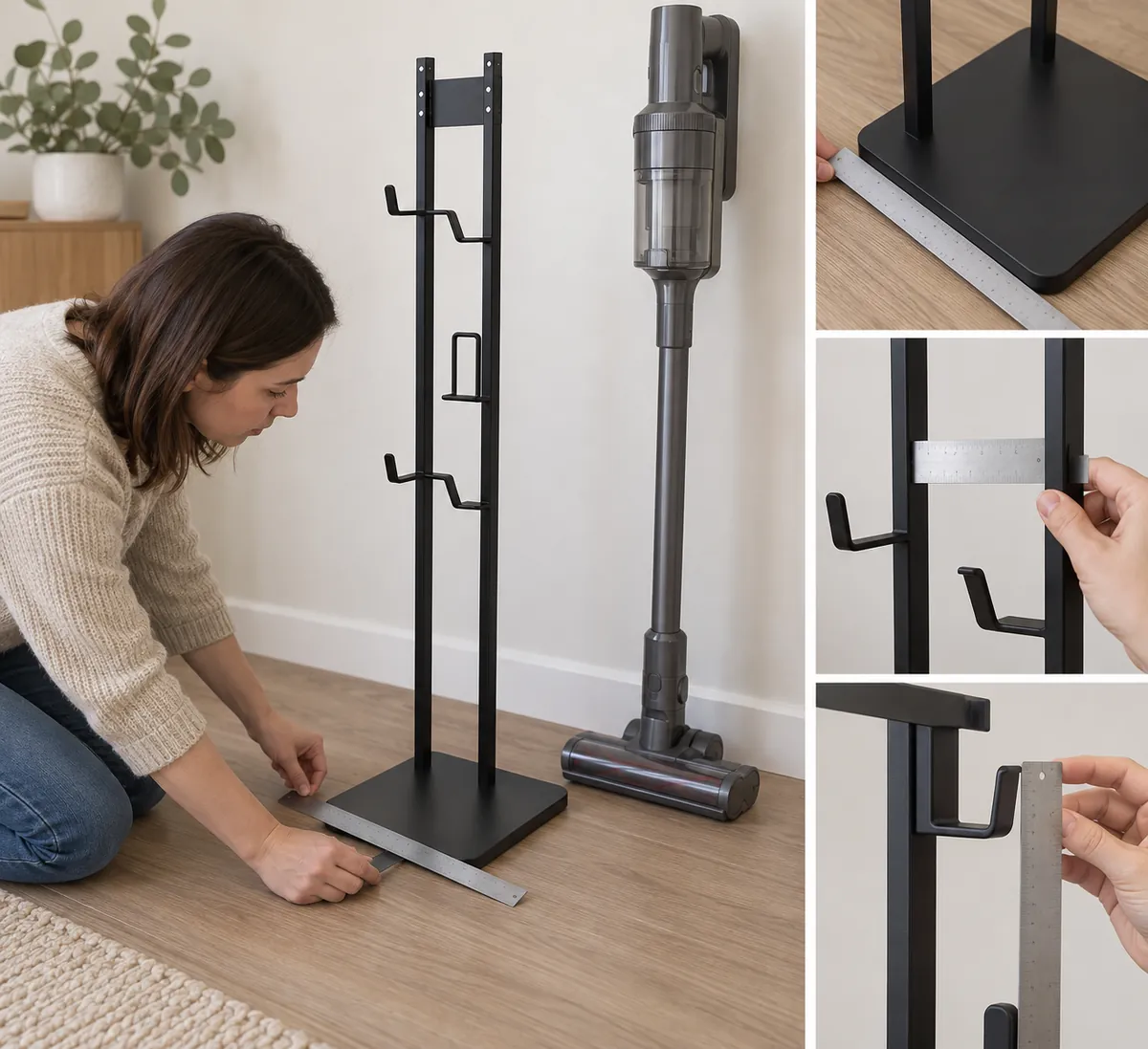
Decide between assembled and knock-down pack-out
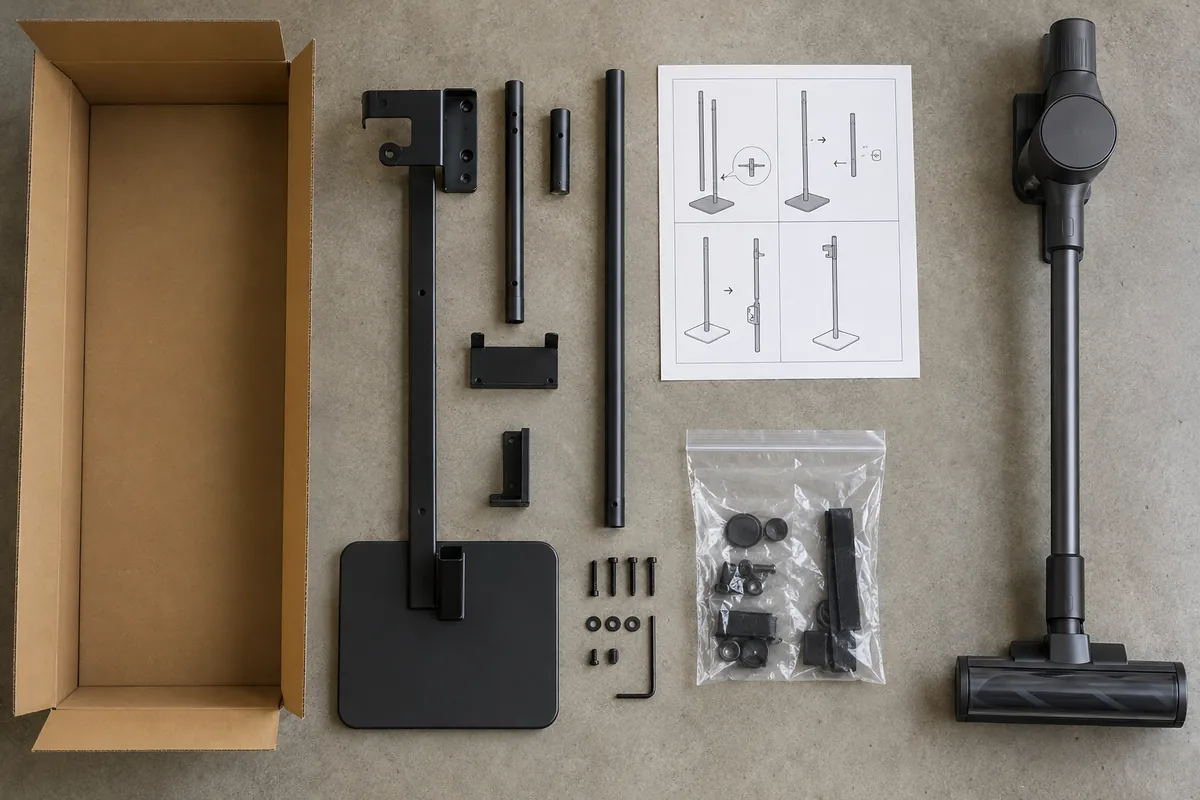
The delivery format affects the carton, protection, assembly labor and customer experience. A fully assembled stand may require a larger package and protection around protruding hooks or finished surfaces. A knock-down version may reduce the shipping envelope but introduces a parts kit, assembly steps and a need to keep small hardware associated with the correct unit. A partly assembled configuration can fall between these choices. There is no universal cheapest format; compare the total packing and receiving requirements for the buyer’s route and channel.
Ask for a pack-out sample or a documented packing layout showing the actual frame parts, fasteners, pads, instructions and any dock or reference component that is sold with it. Check that parts do not rub or strike visible finishes during handling within the agreed packaging review. Verify the carton dimensions, gross and net weight where needed for the buyer’s logistics planning, and that SKU/carton identification matches the purchase documents. These are project details and should be measured from the proposed package, not estimated from a product-page photograph.
For a knock-down pack, decide who creates and approves the instruction content. Show the correct orientation and order of connections, identify the included hardware without ambiguity and make the illustrations match the frozen revision. If an appliance or dock is not included, say so in the sales and package material. Do not depict a compatibility configuration that has not been approved or imply an accessory is included merely because it appears in a sample photo.
Build a comparable RFQ and approval record
To compare supplier responses, send the same reference appliance configuration, drawing revision, accessory list, intended finish, assembly expectations and delivery format to each candidate. Ask each supplier to confirm its proposed scope and identify exceptions: which dock or appliance components it expects the buyer to provide, which parts are included, what sample it can review, and which testing or performance evidence it can actually supply. Do not assume that an OEM/ODM catalog offer means a manufacturer has quoted this exact stand or has agreed to every requested capability.
The purchase record should link the quote, BOM, drawing, sample photos or measurements, pack-out and any approved changes. If a requirement is still open—such as a model’s revision, accessory dimension or carton arrangement—mark it as an open item with an owner and resolution date. This prevents an early concept rendering from silently becoming the production specification.
Koitor’s documented knowledge of metal fabrication, finishing, basic assembly and packaging can support a project-specific discussion about a metal storage concept. It does not confirm that Koitor currently makes vacuum stands, supports any named appliance model, or provides a tested product in this category. A buyer exploring an adjacent product can share the desired architecture, reference parts, drawing and volume assumptions through the OEM manufacturing page ou contacter Koitor for feasibility review.
Foire aux questions
Is a list of compatible vacuum models enough for approval?
No. The list should identify what was actually checked and the revisions or components represented. A model name alone may not specify the dock, floorhead, extension tube or attachment configuration. Sample approval should record the real setup reviewed and any limitations.
Does a heavier base prove the stand is more stable?
No. Weight by itself does not establish stability or safety. Base geometry, stand layout, connection details, floor conditions and intended use are relevant. Define the required evidence and have the appropriate responsible party evaluate it under agreed conditions.
Should the buyer include the original charging dock?
Only if the intended product architecture uses it, and only after documenting the exact model and revision. A passive stand holding an original dock does not automatically provide charging or electrical compatibility. Confirm all electrical aspects with the responsible appliance manufacturer or qualified party.
What should be included in a knock-down package?
Specify the exact stand components, fasteners, pads, hooks, instructions and any optional or buyer-supplied parts. Tie the pack list and instructions to the approved revision so receiving and assembly can identify what is present.
Can one stand be described as universal?
Only if the product owner has defined and substantiated the full compatibility envelope. A few successful fits do not prove universal compatibility. State named, reviewed configurations and explain what remains outside the evidence.
Is an assembled sample proof of mass-production consistency?
It is evidence about the sample reviewed, not a guarantee for future production. Keep the approved revision and sample record, and define the controls that will be used to check production against them.
Keep vacuum stands tied to the named product or order configuration, and record which revision and requirements the supplier actually reviewed.
Approval should cover the whole storage configuration
A useful importer approval package connects the passive stand architecture, base and upright drawing, actual reference appliance or dock, accessory layout, fasteners, instructions and pack-out. Each decision should identify the revision, included items, review scope and responsible approver. This makes supplier quotes more comparable and exposes unknown compatibility or packaging issues before a larger order is committed.
The article’s comparisons are buyer-planning guidance, not a claim about a specific Koitor product. For a metal storage project, share the target use, reference parts, dimensional envelope, drawing, finish and packing requirements with the prospective manufacturer. Koitor’s OEM manufacturing page et contact page are available for a feasibility discussion; capability and testing scope must be confirmed for the actual design.
Discuss a Metal Storage Concept
Share the intended stand architecture, reference appliance or dock, accessories, drawing, quantity and pack-out needs. Product feasibility, model fit and any test scope must be confirmed for the actual design.
Fabrication pour compte de tiers / Marque de distributeur
Transformez ce guide d'approvisionnement en cahier des charges
Indiquez-nous le produit souhaité, ses dimensions, sa finition, la quantité commandée et vos exigences en matière d'emballage. Votre équipe recevra une analyse pratique de la faisabilité de la fabrication avant l'établissement du devis.


 English
 Español
 Português
 Français
 Deutsch
 العربية