
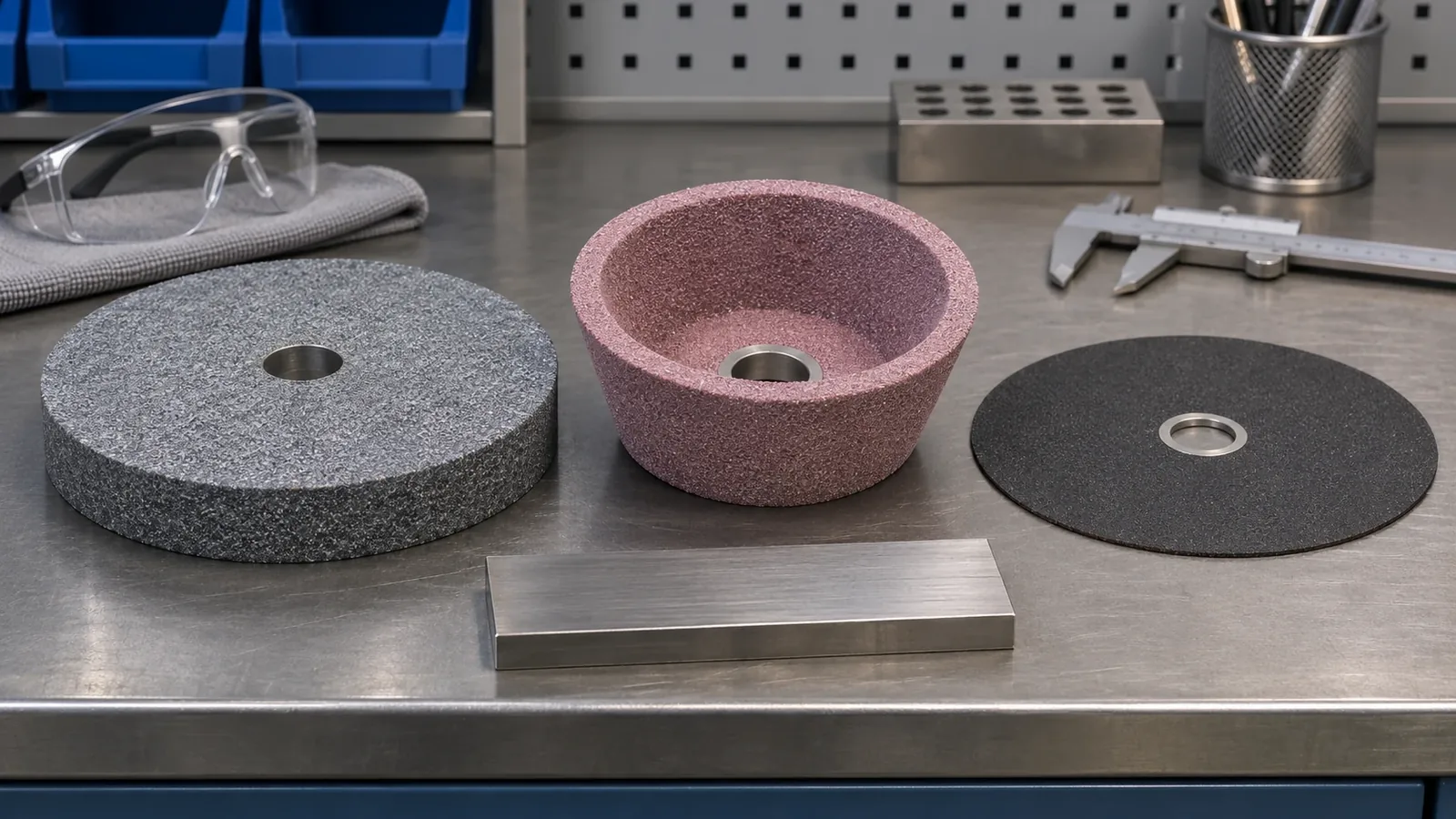
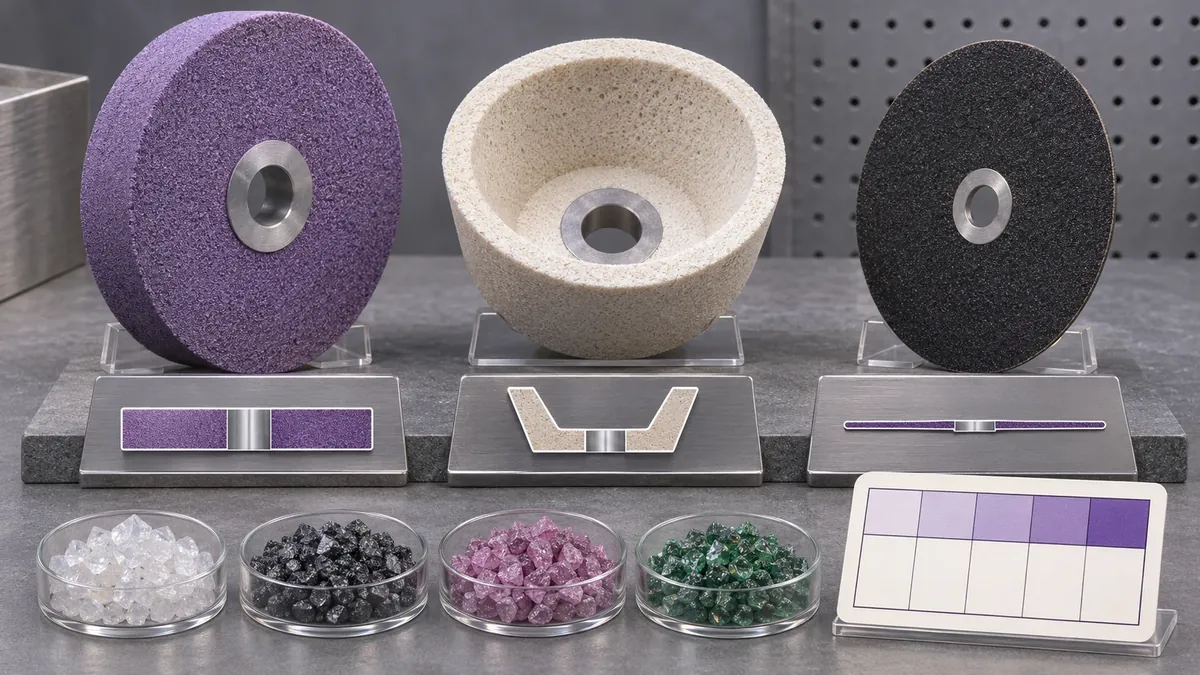
Grinding wheel types are easier to compare when buyers read five separate attributes: wheel shape, abrasive grain, grit size, grade, and bond. The shape describes the wheel’s form and intended contact geometry; the grain identifies the cutting material; grit describes particle-size classification; grade concerns how firmly the bond holds the grain; and bond identifies the material that holds the abrasive structure together. A product label may encode several of these attributes, but no single letter or color should be interpreted without the manufacturer’s current chart. For metal hardware procurement, request the full product code, dimensions, machine interface, work material, operation, and acceptance target.
What do grinding wheel types classify?
The phrase “grinding wheel types” can refer to the wheel’s shape, abrasive grain, grit, grade, bond, reinforcement, or application category. These attributes are connected, but they answer different questions. A buyer who compares a cup wheel with aluminum oxide, for example, is comparing shape with grain family. A request for “a harder wheel” may refer to grade, the workpiece, or the wheel’s bond retention and needs clarification.
A grinding wheel is a bonded abrasive product. Abrasive grains are held in a bond matrix and separated by pores. During grinding, grains remove small chips from the workpiece; the wheel’s construction and operating conditions determine how the abrasive renews, wears, or needs dressing. The wheel’s shape affects how it contacts the part and whether a face, edge, or side is used. The grain family and grit affect the cutting surface. Grade and bond add further design variables. Manufacturer instructions remain the source for interpreting a specific product designation.
A buyer can think of the label as a compact specification rather than a universal performance guarantee. Two wheels with the same outside diameter can differ in thickness, bore, recess, abrasive, bond, grade, speed rating, or intended machine. Two wheels with similar grain labels may behave differently because their product construction and operating conditions differ. The exact product code and data sheet should therefore travel with the quotation and approved sample.
| Attribute | What it describes | Buyer clarification |
|---|---|---|
| Shape or type number | Wheel profile and contact arrangement | Full shape code, dimensions, and intended contact surface |
| Abrasive grain | Cutting material held in the wheel | Exact grain family and manufacturer product code |
| Grit | Abrasive particle-size class | Applicable grading convention and target operation |
| Grade | Relative holding action of the bond on abrasive grains | Product maker’s definition and application guidance |
| Bond | Material system holding the wheel structure | Type, manufacturer code, and wet/dry or process limitations |
| Wheel dimensions | Outside diameter, thickness, bore and recess details | Exact dimensions and machine interface |
| Operating limits | Marked maximum speed and any product instructions | Confirm machine and operating conditions with the responsible operator |
Norton Abrasives’ selection guide explains that wheel choice involves the work material, amount to remove, required shape and finish, machine, operating conditions, contact area, wet or dry process, grinding severity, and dressing method. That list is a useful reminder: wheel selection is an application decision, not a shopping list of attractive catalog terms.
How do wheel shape and profile affect the job?
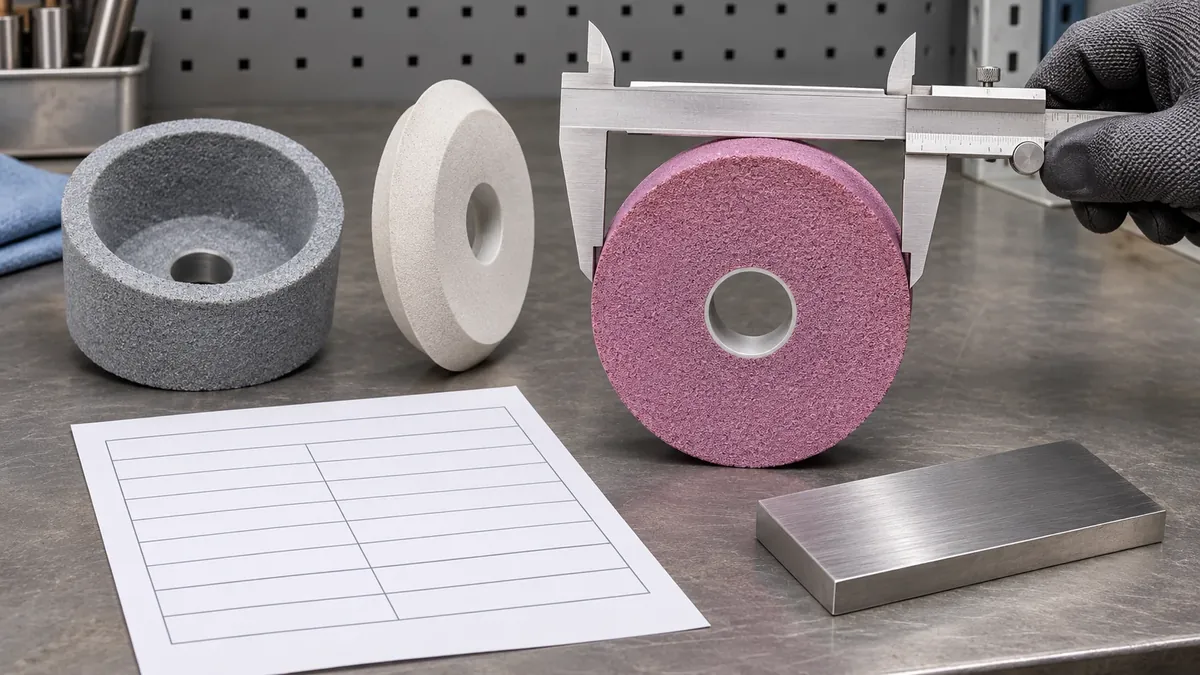
Wheel shape is a physical profile that influences the way a wheel reaches a surface and makes contact. A shape name or type number should be matched to the wheel drawing and manufacturer’s current specification. Similar-looking wheels can have different recesses, thicknesses, mounting arrangements, and approved uses. A buyer should request the dimensions and product datasheet rather than relying on a catalog thumbnail.
A straight wheel has a simple flat-sided profile and is commonly used on a grinding machine for peripheral grinding. A cylinder or ring-shaped wheel has a different contact arrangement and is used in specialized machine setups. A tapered wheel changes thickness across its profile and may be designed for defined grinding operations. A recessed wheel includes a relieved section that provides clearance around the mounting area, but the exact recess geometry must be read from the maker’s shape drawing. A cup wheel presents a cup-like form; depending on the machine and product, the rim or face may provide the working contact. A dish wheel has a shallow concave profile that can serve tool-room or other specialized operations. A cut-off wheel is thin and used for cutting rather than general surface grinding; it should not be treated as a thicker grinding wheel simply because both are round.
Shape numbers and catalog conventions vary by standard and manufacturer. A number often refers to a recognized wheel form, but the complete specification still needs dimensional details. Never infer exact recess depth, rim width, bore, or safe mounting from a diagram remembered from a different supplier. Ask for a current profile drawing that matches the offered item.
For metal bathroom or home-storage hardware, a purchaser may encounter grinding in weld cleanup, edge deburring, fixture repair, or preparation before a later finishing operation. The part’s geometry matters. A large wheel may not reach an internal corner, while a cup or smaller profile may bring the contact surface closer to a feature; however, tool suitability and operation safety must be assessed by the qualified process owner. The buyer’s role is to identify critical surfaces and fit features on the part drawing, not to prescribe an unverified wheel setup.
| Common profile description | What to confirm | Typical buyer risk if left vague |
|---|---|---|
| Straight wheel | Full diameter, thickness, bore, grade, bond and use | A nominally similar wheel may not fit or contact as expected |
| Recessed wheel | Recess style and dimensions from the exact drawing | Mounting clearance or contact width may be misunderstood |
| Cup or dish wheel | Contact face, profile drawing, machine and application | The image may hide an important profile difference |
| Thin cut-off wheel | Thickness, intended cutting use, machine, mounting and marked limit | It may be confused with a wheel for side grinding |
| Tapered or special shape | Manufacturer shape code and exact cross-section | The catalog name alone may not identify the offered geometry |
A good supplier comparison includes a wheel cross-section or dimensional drawing. It also states whether the quotation concerns a grinding wheel, a cut-off wheel, a mounted point, or another abrasive product form. If the drawing or catalog classification differs between suppliers, compare the actual dimensions and intended operation, not just a shared English label.
What do grain, grit, grade and bond mean?
The abrasive grain is the cutting material. Common grain families include aluminum oxide, silicon carbide, zirconia alumina, and ceramic alumina. Different manufacturers offer specific formulations and product variants. Do not infer a universal ranking from grain names. The maker’s product data needs to connect the grain with the work material and operation.
Grit is a particle-size classification. In general terms, coarser and finer abrasive sizes are used for different operations, but the result also depends on the wheel, contact, work material, and process. A finer grit number should not be turned into a promise of a particular roughness or visible finish without an agreed test or sample. A specification needs to identify the applicable grading system and the product’s actual code.
Grade is often misunderstood. In a grinding wheel, grade does not simply mean how hard the abrasive grain is. It relates to the relative holding power of the bond that retains the grains in the wheel. The wheel maker’s selection guidance may relate grade to the workpiece, contact area, operation, and other variables. A phrase such as “hard wheel” is ambiguous; ask whether the buyer means the workpiece material or the grade designation on the wheel.
Bond is the material system that holds abrasive grains together. Bond families and formulations affect wheel construction and behavior. A code letter on a wheel label needs to be interpreted using that product maker’s key. A bond should not be chosen from an isolated online list without confirming the specific wheel, conditions, and manufacturer instructions.
The wheel’s pore structure, reinforcement, and dimensions also matter. Pores provide space between grains and bond, and the complete design is engineered for the intended product and operation. This article does not translate every designation into a universal use rule; suppliers and manufacturers should provide a current data sheet for the selected item.
When a quotation lists a wheel code, ask the supplier to decode the code in writing. Capture the manufacturer, exact code, shape drawing, dimensions, grain, grit, grade, bond, marked maximum operating speed, machine type, and whether the planned operation is wet or dry. This allows a purchasing team to compare actual products and to maintain an approved consumable record.
How should buyers select a wheel for metal hardware finishing?
A buyer should start with the task and workpiece, then review a manufacturer-supported wheel proposal. The essential context includes the material and its condition, amount and location of material to remove, required geometry, target surface, contact area, machine, wheel speed, wet or dry conditions, severity, and dressing method. Those factors cannot be replaced by a generic claim such as “for stainless steel.”
For a welded bracket or towel-rack support, the finishing objective might be to blend a visible weld, remove a sharp edge, or prepare a surface before coating. Each operation has a different output. The drawing should mark visible faces, functional mating areas, thread openings, and dimensions that must not be changed. A grinding step can alter an edge, flatten a feature, or produce a transition that matters cosmetically. A wheel selection should be reviewed with a representative sample and the approved finishing route.
If the operation is intended to remove a large amount of material, the process owner may review a different grit or wheel construction than for a small cosmetic blend. That is not a universal coarse-versus-fine rule: the work material, wheel, contact area, machine and finish requirement must be considered together. For a narrow contact area, reach and profile may matter; for an exposed cosmetic face, the finishing sequence and transition quality matter. A buyer should ask the supplier how the proposed wheel connects to the next process, especially polishing, coating or plating.
Do not change the wheel solely because a new product is described as faster or longer-lasting. Ask how the comparison was made, whether the test uses the same part and machine, and what acceptance criteria were used. If the business case is important, establish a controlled production trial and review the actual part results, operator feedback, changeover needs, and approved finish. Avoid turning a supplier’s general catalog statement into a guaranteed saving or quality outcome.
For surface preparation before coating, grinding is only one possible stage in a broader route. Cleaning, dust removal, contamination controls, and coating supplier acceptance remain separate. Koitor’s existing guide to surface dust and tape testing before coating covers a narrower verification topic. For tungsten electrode preparation specifically, a separate Koitor guide explains grinding direction and TIG electrode tip preparation; do not transfer that electrode-specific guidance to grinding a finished hardware part.
What makes a grinding-wheel quote comparable?
A quotation becomes useful when the wheel and operating context are described. Request enough information to identify the actual consumable and confirm that it matches the proposed work. The purchaser does not need to choose every process parameter, but should ensure the responsible technical party has addressed the specification.
How should a sample trial be documented?
Record the workpiece identity and drawing revision before comparing two wheel proposals. If the samples use different metal thicknesses, weld conditions, edge profiles, or starting finishes, the result may reflect the workpiece difference rather than the wheel. The supplier or process owner should identify the exact product code and state whether the sample was ground with the same machine and production route intended for the order. Buyers should not assume that a hand-held demonstration and a fixture-controlled production operation are equivalent.
Define the visible acceptance area and the condition that will be checked. A photo can preserve a view of the surface, but it may not reveal local geometry, dimensional loss, heat marks, or changes around an edge. If a dimension is critical, inspect the dimension using the agreed method. If a cosmetic surface is controlled by a reference sample, compare it under consistent lighting and viewing conditions and record which features are acceptable. A trial record should identify who assessed the sample and what the assessment did not cover.
Keep process responsibility clear. The importer may state the part and acceptance need; the finishing supplier or qualified operator reviews wheel compatibility and safe operation using the wheel maker’s current documentation. If the supplier later proposes a different wheel code, do not assume the approved sample automatically covers that change. Ask whether the route, appearance, fit, or inspection evidence may be affected and record the buyer’s decision. This approach creates a traceable comparison without pretending that one trial proves every production or service outcome.
| RFQ item | Supplier response to request | Buyer’s reason |
|---|---|---|
| Workpiece | Material, hardness or condition relevant to the proposed route | A wheel recommendation depends on the actual material |
| Operation | Rough grinding, weld blending, edge work, cutting, or another task | Separates different uses and product forms |
| Shape and dimensions | Manufacturer code plus profile drawing and full dimensions | Prevents confusion between look-alike wheels |
| Grain and grit | Exact grain family, size designation and product code | Identifies the cutting material and grade system |
| Grade and bond | Full designation decoded by the wheel maker | Prevents “hardness” shorthand from obscuring meaning |
| Machine | Machine type, interface, and operating conditions reviewed by qualified operator | Confirms compatibility and current instructions |
| Target surface | Drawing note, approved sample, or measurable criterion | Avoids vague promises such as “better finish” |
| Trial plan | Representative material and geometry with acceptance steps | Makes proposed changes reviewable |
| Contrôle des modifications | Notice and buyer review when product code or route changes | Protects repeat orders and approved samples |
For a repetitive component, keep the wheel manufacturer and product code in the process documentation if the supplier’s procedure depends on it. Record approved substitutions, including who accepted them and why. If the grinding is outsourced, identify the responsible finishing supplier and the evidence it will return. A buyer can ask for process traceability without claiming that a particular independent test or laboratory exists.
What mistakes should buyers avoid when reading wheel types?
The first mistake is treating a wheel’s shape as its material. Shape, grain, grit, grade and bond are separate label components. A second mistake is copying a code from an old quote without checking the current product data. Similar-looking products can vary by size, specification, and operating instruction. A third is assuming the wheel itself establishes the finish: the final surface also depends on the workpiece, process, contact, operator, and later finishing steps.
Buyers should avoid:
- selecting solely by the wheel’s color or catalog photograph;
- reading the grade as a direct hardness score for the abrasive grain;
- confusing a cut-off wheel with a wheel approved for grinding on its side;
- assuming one grit number predicts a particular surface texture;
- relying on a general grain chart instead of the exact product maker’s guidance;
- specifying a wheel without its bore, thickness, profile, or machine interface;
- allowing a supplier to substitute a “similar” wheel without technical review;
- accepting an appearance sample without recording the wheel and process route;
- using a wheel outside its marked product instructions or operating limits;
- inferring safety, performance, or service life from a broad category label.
A simple buyer checklist before approving a route:
- State the part material, revision, critical features, and finish surfaces.
- Describe the operation and the amount or location of material to remove.
- Ask for the exact wheel manufacturer and product designation.
- Request a dimensional profile drawing and full size.
- Confirm grain, grit, grade, bond, and the maker’s interpretation.
- Identify the machine and process owner who confirms operating compatibility.
- Define the finish reference and the inspection method.
- Tie a sample to the same part revision and downstream finish.
- Record the approved change route for substitutions and repeat orders.
For a metal hardware project, the most useful manufacturing discussion begins with the drawing or physical sample. Koitor Hardware is a family-owned custom metal bathroom and home-storage hardware factory; it can discuss the project scope and drawing/sample requirements within its approved manufacturing role. That positioning does not imply that Koitor manufactures grinding wheels or operates an independent abrasive laboratory.
Frequently asked questions about grinding wheel types
What are the main grinding wheel types?
The phrase can describe different wheel shapes, abrasive grains, grit sizes, grades, bonds, and constructions. A complete specification needs the exact product code and dimensions rather than a shape name alone.
What is the difference between wheel shape and wheel grade?
Shape is the wheel’s physical profile. Grade concerns how the bond retains the abrasive grains in the wheel. They describe different attributes and should not be compared as if they were one scale.
Does a harder wheel always last longer?
The term “harder” is ambiguous and should be tied to the maker’s grade system. Service life depends on the full product, workpiece, operation, dressing, contact and process conditions. Ask for a controlled trial rather than assuming a category label guarantees life.
Can a cut-off wheel be used for grinding?
Do not assume a cut-off wheel is suitable for grinding. Use only the product as marked and instructed by its manufacturer, and rely on the qualified operator to confirm the intended machine and operation.
Does finer grit always create a smoother hardware finish?
No universal finish can be inferred from the grit number alone. Work material, tool, pressure, contact, preceding surface, and following operations all matter. Use an agreed sample or measurable specification.
What information should be recorded for a repeat order?
Keep the manufacturer, full wheel code, shape drawing, dimensions, workpiece, operation, process owner, approved finish, sample revision, acceptance record, and change-notification history.
Sources
- Norton Abrasives: Which Grinding Wheel Should I Choose? — manufacturer guidance on wheel construction, grain, grit, grade, and selection factors. Product claims are not generalized beyond the source.
- Adgrind: Grinding Wheel Shapes — representative shape profiles and dimensional-description examples.
Review a Grinding and Finishing Specification
Share your controlled drawing or sample, substrate, finish requirement and proposed operation so the relevant manufacturing questions can be reviewed for your hardware project.
Fabrication pour compte de tiers / Marque de distributeur
Transformez ce guide d'approvisionnement en cahier des charges
Indiquez-nous le produit souhaité, ses dimensions, sa finition, la quantité commandée et vos exigences en matière d'emballage. Votre équipe recevra une analyse pratique de la faisabilité de la fabrication avant l'établissement du devis.

 English
 Español
 Português
 Français
 Deutsch
 العربية