

An install sheet can tell a buyer how to install a door peephole only after the packed optical-viewer family and the packed door thickness and opening are named from the supplier’s sheet. The family is a through-door optical peephole, not an electronic or camera viewer unless the packed kit is documented as that product, and not a door knocker.
The door-thickness range and the opening are the values the cited sheet actually documents, or named fields left honestly blank. This file is a first-hang leaflet for a standalone optical viewer. It is not a compatibility matrix, and it is not a knocker-body first-hang.
Matching a knocker body, a viewer, and a door thickness belongs on the live door knockers with viewers compatibility file. That neighbor should stay a selection matrix. This first-hang leaflet must not reprint it, and it must not treat that page as permission to drill.
This guide is for importers, distributors, and private-label teams approving a first-hang leaflet for a standalone optical door viewer already treated in the live knocker-and-viewer library. Koitor Hardware is a family-owned China OEM manufacturer of custom metal bathroom and home storage hardware.
That published-library context is not a claim that Koitor currently manufactures a named viewer SKU. Send the viewer drawing or install sheet and the finished door stack. We can review the wording. We will not issue a universal height or hole chart, a fire-door or code determination, or a smart-camera install presented as this leaflet.
What does a how to install a door peephole file actually freeze?
It freezes the packed optical-viewer family and the packed door-thickness and opening, or an explicit exclusion for those fields. It does not freeze a knocker-and-viewer compatibility RFQ, a knocker-body first-hang, or an electronic or camera-viewer install.
Searchers often arrive with a door-viewer question because a carton arrived without a named thickness range, or because a camera-doorbell video was the first result they saw. That demand is real. For an importer, the usable decision is whether a listing may say the peephole is easy to install, and which packed family and thickness or opening that sentence is allowed to assume.
A two-piece optical viewer is not a knocker body, even when both are sold for the same door. It is not a video doorbell or a smart viewer unless the packed kit is documented as that product. If the sheet does not say which family shipped, an easy-to-install line will be applied to the wrong opening and the wrong kit.
A fabricant de quincaillerie de salle de bains sur mesure can review whether a first-hang sentence and a packed optical family stay together for this adjacent door-hardware line. Matching a finish to a collection is not the same as inventing a default height, a default drill size, or a fire-door conclusion.
A published easy-to-install claim is only as complete as the named family and the named thickness and opening. If the photograph shows an optical viewer and the bag holds a knocker, the sheet has already failed. The same is true of a camera doorbell packed into the wrong panel, or of a compatibility table reprinted as if it were a first-hang sequence.
This file can precede a first-hang review. It should not be turned into a compatibility RFQ, a height chart, or a smart-camera manual. Those jobs already have, or should keep, their own files.
Which packed optical family and door thickness or opening must be named first?
Name the packed optical-viewer family first, in the supplier’s terms: a through-door optical peephole, or another documented optical kit. Do not start with a generic door-hardware sequence, and do not start with a camera or knocker question that has not been excluded.
Name the packed door-thickness range and the opening from the supplier’s current sheet, or keep those fields named and honestly blank. Do not invent a factory-universal height chart, a drill-size table, or a borrowed blog list of locations. If the data leaves a value to the buyer, the sheet should say that the value comes from that data, not from this page.
If the program packs an electronic or camera viewer in the same collection, the sheet must say whether that product is the packed kit. Unless the kit is documented as that product, treat the camera or electronic unit as not this family. Do not let a smart-viewer question rewrite this optical leaflet.
A prepared opening already in the door may be named as a condition. This file must not treat the live compatibility page as permission to drill a new opening, and it must not invent a height for that opening.

What belongs in the first-hang kit list, and what must stay out?
The kit list should name what the carton actually ships for this first hang, and what the cited sheet requires the buyer to supply. It is not a shopping list, and it is not a place to merchandize a drill as the thesis of the page.
If the two viewer halves, a sleeve, or a thickness card ships in the carton, say so in those terms. If a related part is sold separately, the sheet should say so on its own line. A hardware kit packing inspection checklist is useful only for that packing-honesty check, not as a substitute for the named family.
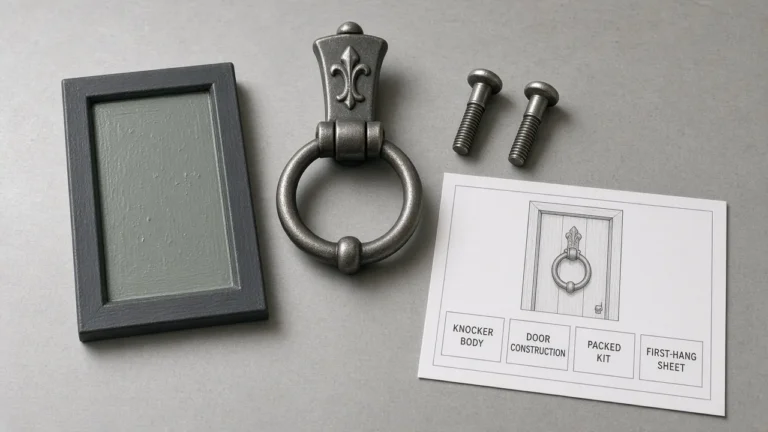
A knocker body stays off this kit list except as a clearly labeled exclusion. The companion knocker first-hang article in this batch, when published, stays a different file and should be named in prose until or unless a live lock-copy href exists.
Height marks, unofficial drill charts, and fire-door or code conclusions stay off the list. This leaflet must not invent a viewing height or issue a code determination.
| Field or claim | What must be named | What belongs in the kit or data | What this row is not |
|---|---|---|---|
| Packed optical-viewer family | The optical family the carton actually ships, in the supplier’s terms | The packed viewer halves and the matching first-hang instructions | A knocker body, a camera doorbell, or an invented Koitor SKU |
| Door thickness and opening | The packed thickness range and opening taken from cited data, or named fields left blank | Only the values the cited data actually supplies | A factory-universal height or drill chart |
| Easy to install | The family and thickness or opening the sentence is allowed to assume | Nothing beyond that named list and cited data | A compatibility matrix reprinted as a first-hang, or a fire-door determination |
| Neighboring selection | That knocker-and-viewer matching belongs on the live compatibility file | A link when the sentence is about that selection job | Permission to drill, or a knocker-body first-hang sequence |
The table is a decision map for the first-hang leaflet. It is not a height standard, a fire-door certificate, or a claim that Koitor manufactures a current viewer SKU. If a row cannot be filled from the supplier’s current data, leave the field named and blank rather than inventing a number.
Why are height charts and camera tutorials not this first-hang method?
Marketplace listings and blogs often print a remembered viewing height, or they show a camera doorbell as if it were an optical peephole. That wording is a real demand signal. It is not a method this sheet may teach, and it is not a reason to official a door-viewer synonym as a second official target.
A first-hang leaflet that prints an unofficial height will be copied onto kits that never intended it. The buyer then treats a remembered mark as if it were the packed thickness and opening. When the door stack is wrong, the listing still said the peephole was easy to install.
The honest response is to name the packed optical family and the packed thickness and opening, and to exclude unofficial height charts and electronic or camera installs that are not the packed kit. If the buyer’s job is a smart camera, this sheet should say it is the wrong file rather than improvising that install.
The live compatibility file can explain why a buyer arrived with a matching question. It is not permission to drill, and it is not a first-hang sequence for a standalone viewer. Brand videos are likewise demand evidence, not a Koitor height or hole standard.
Fire-door and code commentary stays off this method section. This file will not determine whether a labeled door may receive a viewer, or at what height a rule would require one.
Which neighboring door-hardware files should stay out of this sentence?
The live knocker-and-viewer compatibility file should stay a selection and matching file. This first-hang leaflet may link it when the sentence is about matching a body, a viewer, and a door thickness. It must not reprint the matrix, and it must not treat that page as a drill permit.
The companion article on how to install a door knocker, when published, stays a knocker-body first-hang. Name it in prose and do not invent an href if the official lock-copy list does not yet carry that slug. Do not merge the two first-hangs into one leaflet.
Electronic or camera-viewer questions stay off this optical leaflet unless the packed kit is documented as that product. Informal how to install a door viewer wording was no-data for officialing and must not be treated as official volume.
If a later file owns door construction, fire-door hardware, or finish selection, keep those questions there. A first-hang sentence that tries to settle every neighboring RFQ will be wrong for the carton that actually shipped.
What should be checked before a listing tells a buyer how to install a door peephole?
Use the list as a first-hang review, not as a shop sequence and not as a pass-fail audit grade. If a line cannot be answered from the drawing, the carton, or the cited sheet, keep the field named and unresolved rather than inventing a value.
- Name the packed optical-viewer family in the supplier’s terms before any install sentence is printed.
- Name packed door thickness and opening from cited data, or keep the fields named and blank; do not invent a height or drill chart.
- State clearly whether a sleeve, a card, or a related part is in the carton or sold separately; do not merge those states on one label.
- Exclude knocker bodies and undocumented camera or electronic viewers from this leaflet except as a clearly labeled not-this-family note.
- Keep the live compatibility file on its own page; link it for matching questions, and do not treat it as permission to drill.
- Name the companion knocker-body first-hang in prose; do not invent an href if the lock copy omits it, and do not merge the two files.
- Do not issue a fire-door or code determination, and do not claim a current Koitor viewer SKU.

If the listing still wants an easy-to-install line after this review, the line may only assume the family and the thickness or opening that were just named. A sentence that cannot point to those fields is not ready to print.
A missing thickness range is a data or wording defect, not a reason to publish a remembered height. The same is true of a photograph that shows a knocker, or of a bag that mixes an optical viewer with a camera doorbell.
A first-hang program that later changes the viewer family must revise the install card as well. A sentence written for an optical peephole will not travel safely onto a camera unit or a knocker body, even when the finish looks familiar.
Finished door stacks, cladding, and added weather layers can all change how a packed thickness range is reached. Those conditions may be named as conditions if the cited data actually addresses them. They are not a license to invent a Koitor hole chart, and they are not a license to treat the compatibility page as a drill permit.
If two products share a collection photograph, keep the first-hang map tied to the kit that actually shipped. A shared finish does not make an optical viewer and a knocker share a leaflet. The photograph should separate the exclusion.
Sales teams sometimes want a single sentence that covers compatibility, knocker first hang, and peephole first hang together. Resist that merge. The live compatibility file owns matching. This file owns the packed optical family as a standalone first-hang. The knocker companion owns the knocker body.
The question how to install a door peephole is a first-hang question about a packed optical family and a packed thickness and opening. It is not a second compatibility RFQ, not a knocker leaflet, and not a smart-camera manual. Keep those neighbors in their own sentences.
If incoming inspection is part of the program, inspect against the named family and the named thickness and opening, not against a remembered height from another brand. A lens that looks familiar can still be packed with the wrong thickness range.
When a later viewer is added to an existing door that already has a knocker, do not let the compatibility file become this first-hang. Matching can be reviewed on the live neighbor. The standalone optical kit still needs its own named family and opening.
A replacement viewer later in the program still needs the same named family and the same thickness and opening fields. A spare bag that drops those fields will recreate the original wording defect, even if the first carton was correct.
If the intended product is a fire-door viewer or a coded opening, this sheet is the wrong file for that determination and should say so. Point the buyer off this leaflet rather than improvising a code conclusion.
A private-label team can still use this page when the viewer is already treated in the live library rather than being introduced as a new named SKU. The usable service is a wording and kit-scope review. The unusable request is a universal height or a smart-camera install presented as this leaflet.
Hardware finish and lens style should be named only as packed-kit fields, not as a substitute for the family. A matching color chip does not tell the buyer which viewer family shipped, and it does not replace a missing thickness range.
If a project later asks for a thicker door or a different opening, treat that as a data-revision question, not as permission to stretch an old range. The first-hang sentence has to be rewritten against the new sheet, or it should stay off the listing until that sheet is named.
Weather layers, cladding, and added panels can all change how a packed thickness range is reached. Those conditions may be named as conditions if the cited data actually addresses them. They are not a license to invent a Koitor hole chart, and they are not a license to treat the compatibility page as a drill permit.
If the optical viewer is already in the live catalog, a private-label request can come here for wording and kit-scope review. This leaflet still cannot answer a universal mounting height, and it cannot turn a smart-camera install into the same packed peephole sheet.
If the carton includes both viewer halves and a sold-separately sleeve, those two states must stay visually and verbally separate. A merged label that reads as if the sleeve were already in every carton is the same class of defect as a merged kit photograph.
Do not let a doorbell or intercom conversation rewrite this optical leaflet. Those products may be honest neighbors in a broader entry-hardware conversation, but they are not this first-hang thesis unless the packed kit is documented as that product.
When a hotel or multi-door program wants one sentence for every opening, resist that shortcut. Each packed family still needs its own named thickness and opening, or the easy-to-install line will be applied to the wrong door.
A sample door coupon used in a review photograph is not a thickness standard. The photograph can show the family and a prepared opening. It cannot invent a height, a drill size, or a timed install for this leaflet.
Project documents that mention a knocker and a viewer in one schedule should still point each product to its own first-hang sheet, and should send matching questions to the live compatibility file. A schedule is not a license to merge those three jobs into the paragraph printed on this carton.
If a later file owns optical quality, viewing angle, or cover-cap style, keep those selection questions there. This first-hang leaflet may mention a cap as part of the packed kit. It should not become an optics catalog in order to fill a missing thickness range.
Spare bags sent to a job site should carry the same named family and the same thickness and opening fields as the original carton. A spare that arrives with only a photograph of the lens will recreate the wording defect this file is trying to prevent.
When the official lock-copy list already carries the live compatibility href, use it for matching sentences only. When it omits a later peephole-specific neighbor, name that neighbor in prose and stop. Inventing a URL is a worse defect than leaving the neighbor unlinked.
Foire aux questions
Can the listing say the door peephole is easy to install?
Only after the packed optical-viewer family and the packed door thickness and opening are named, and only if unofficial height charts and undocumented camera installs stay off the sentence. An easy-install line is not a substitute for a missing thickness range, and it is not a drill permit.
Is this the same file as the knocker-and-viewer compatibility page?
No. The live compatibility file owns matching a metal body, a viewer, and a door thickness. This file owns the standalone optical first-hang. Link the compatibility page for matching questions, and do not treat it as permission to drill.
Does this sheet also cover a door knocker?
No. A knocker-body first-hang belongs on the companion article in this batch. Name that neighbor in prose and do not invent an href if the official lock-copy list does not yet carry it. Do not merge the two first-hangs.
Can the sheet print a viewing height or a drill chart?
Only values taken from cited supplier data may appear, and even then this page must not become a factory-universal height or hole chart. If the data is incomplete, keep the field named and blank.
May this leaflet be used for a camera or electronic viewer?
Only if the packed kit is documented as that product. Otherwise treat the camera or electronic unit as not this family. This optical leaflet will not present a smart-camera install as its method.
Will Koitor determine whether a fire door may receive this viewer?
No. This file will not issue a fire-door or code determination. If the buyer’s job is a labeled door or a coded opening, this first-hang leaflet is the wrong place for that conclusion.
Collaborez avec Koitor Hardware
Review a door-peephole first-hang sheet
Send the viewer drawing or install sheet and the finished door stack. We can review the wording and the named optical-viewer family. We will not issue a universal height or hole chart, a fire-door determination, or a smart-camera install presented as this leaflet.
Fabrication pour compte de tiers / Marque de distributeur
Transformez ce guide d'approvisionnement en cahier des charges
Indiquez-nous le produit souhaité, ses dimensions, sa finition, la quantité commandée et vos exigences en matière d'emballage. Votre équipe recevra une analyse pratique de la faisabilité de la fabrication avant l'établissement du devis.
 English
 Español
 Português
 Français
 Deutsch
 العربية