
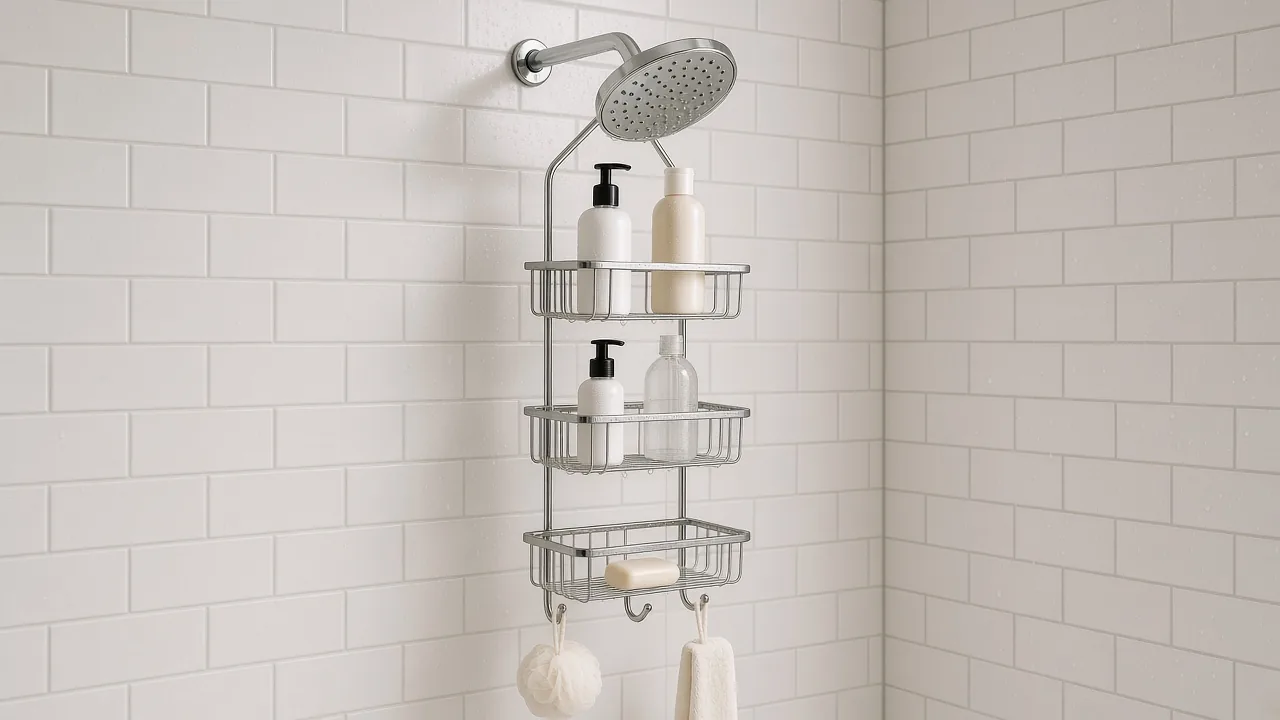
A hook that fits the arm does not answer how to keep a shower caddy from falling if the seated hook can still slide along the pipe. Axial slip after seating is a different failure from a hook that never fitted the arm, a hook that took a set and opened, or a basket that sagged mid-span. Freeze a named anti-slip feature, or remove the will-not-slip line.
The feature may be a hook return that resists travel along the arm, a friction sleeve, a separate stopper, or an explicit decision that no such claim will be printed. This file does not invent a safe shower-arm load, a universal arm size, or a test duration. It asks whether the seated hook is allowed to travel toward the showerhead or down a riser.
This guide is for importers and private-label teams buying hanging, pipe-hung shower caddies. It is not a suction, adhesive, or tension-pole article, and it is not a zip-tie tip sheet. Koitor is a family-owned custom metal hardware factory. We can review the hook drawing, any sleeve or stopper part, and the proposed sentence. We do not certify a load we did not observe.
Which falling complaints belong on this page?
This file is about one complaint: after the hook is seated, the caddy travels along the arm. The usual direction is toward the showerhead, or along a vertical riser if that is the hanging path the SKU uses. The hook may still be closed. The baskets may still look level. The product has slipped, not opened and not dropped because a cup lost vacuum.
A complaint that the hook will not go on the arm, or that the opening is too tight or too loose at first fit, belongs on the arm-and-hook compatibility file. That file already covers the fit envelope, couplings, and a seated condition. It may mention excess movement if the opening is too large. It does not freeze a sleeve, a stopper, or a will-not-fall claim. Do not rewrite it here.
A complaint that the hook opened or took a permanent set after a loaded-bottle check belongs on the hook-unbending file. Yield is not axial slip. A hook can take a set and still be a different failure from a hook that stayed closed and slid. Keep the yield protocol, and any implied hook rating, off this page.
Mid-span basket deflection belongs on the sag file. Hook clocking so the basket clears the controls belongs on the orientation file. A shower-arm structural load warning is a remaining neighboring topic and is not written here. If the arm itself is the concern, do not invent a safe load in this anti-slip brief.
Suction-cup or adhesive falling threads are also the wrong file. Those mounts fail at the wall or glass interface, not along a pipe. A tension-pole caddy that walks at the foot or at mid-span is likewise a different mount. Send those readers to the mount they actually bought, including the tension-pole shower caddy height-range specification when the product is a pole, not a hook-over arm.
An over-door caddy that sits on a glass door or a shower-door rail is another mount again. Use the over-door shower caddy glass-door fit guide for door-fit questions. Do not treat a door hook and a shower-arm hook as one falling file just because both products are called caddies.
Why can a hook that fits still slide along the arm?
Fit answers whether the hook can be placed on the arm and sit there without an obvious mismatch. A hook can pass that check and still be free to travel along a smooth, slightly sloped pipe once bottles are in the baskets. Water, soap film, and a downward slope toward the head all make axial slip more likely. None of those conditions are a hook-opening measurement.
Rotation around the arm is not the same as travel along the arm, though both can appear in the same poor seating. This file is about axial travel. If the basket also twists toward the controls, that is the orientation question. If the hook opening grows, that is the yield question. Write the motion you actually saw, then pick the file.
A dry fit on one arm diameter is a weak basis for a stays-put line. Arms vary, and a listing photograph often uses a short, dry pipe. The field complaint is usually a wet arm after a week of use, not a first hang in a showroom. If you only observed a dry seat, say so, or do not print a will-not-slip sentence.
Finish abrasion on the arm is a related field signal. A hook that creeps can polish or scratch the pipe. That mark is evidence of travel, not proof of a safe remaining load. Do not turn an abrasion note into a structural rating, and do not treat a clean arm in a factory photo as proof that the hook will not creep in service.
Drainage design can affect how long water sits in the baskets, which can change how the load hangs, but drainage is not an anti-slip feature. If standing water is the issue you actually want to specify, use the shower-caddy drainage-design file, not this anti-slip brief. Do not claim that a well-drained basket will not slide on the arm.
Which anti-slip features may be specified without inventing a rating?
Name the part that is supposed to resist travel after the hook is seated. Three common families are a hook return that wraps or catches the arm, a friction sleeve on the arm or at the hook interface, and a separate stopper or ring that limits travel toward the showerhead. You may specify one of these, a combination the drawing actually shows, or none, with the claim removed.

Describe the feature in construction language. Say where it sits, whether it is integral to the hook or a loose part, and whether it is intended to stay on the arm during normal use. Do not invent a sleeve compound, a durometer, a friction coefficient, or a number of days the caddy will stay put. If a project wants a named test method, write the method only when the project actually adopts it.
The observation should be along the arm, not a hook-opening growth check and not a mid-span sag reading. Agree how the caddy is seated, what is in the baskets for that observation, and how travel will be seen: a mark on the arm, a gap opening at the wall flange, or a stop against the named feature. Photograph the starting seat and the later seat on the same arm sample.
If the hook return is the feature, say so on the drawing. A shallow return that is only a styling radius may not do any anti-slip work. If the sleeve is the feature, treat it as a bill-of-materials part, including whether a spare is supplied and whether the listing may mention it.
If a stopper is the feature, say whether it is shipped on the hook, packed loose, or sold as an aftermarket extra. An aftermarket stopper in a consumer listing is not the same as a factory-specified part.
You can also freeze an explicit no-claim. That is a valid outcome. A hanging caddy may be sold as a hook-over product with a fit file and a yield file, and with no will-not-fall sentence at all. That is often cleaner than a slogan that the sample never supported.
If more than one arm sample will be used in the program, say whether the observation is limited to the arms you actually hung or is still a single-sample note. A sleeve that held on a rough, painted pipe may behave differently on a smooth chrome arm. Do not turn one quiet sample into a line that the caddy stays put on any shower arm.
Packaging should follow the same feature decision. A sleeve that can be lost in the carton, or a stopper that is easy to leave in the poly bag, should be called out in the pack list if the claim depends on it. First-article photographs should show the feature installed as the customer is expected to find it, not only a hook hanging bare on a dry pipe.
Customer-service scripts should use the same split as the artwork. If a shopper says the caddy slid, ask whether the hook opened, whether the mount is actually a suction cup, and whether a specified sleeve or stopper was still on the arm. A mixed diagnosis is how a fit file, a yield file, and this anti-slip file get rewritten into one unhelpful reply. Keep the questions separate so the reply can point to the correct observation.
When must a will-not-fall line be removed?
Remove or narrow the line when no anti-slip feature is named and no along-arm observation has been agreed. Artwork that says the caddy stays put, will not slip, or will not fall, after only a dry fit on one arm, is the usual over-claim. The safer fix is to drop the sentence, not to add a vague heavy-duty adjective.
The same rule applies to how to keep a shower caddy from falling when that phrase is used as listing language rather than as a search question. If the page or the carton answers that question with a promise, the promise needs the feature and the observation behind it. If you cannot name them, do not use the phrase as a claim.
Do not let a compatibility pass stand in for an anti-slip pass. A hook that assembled onto the sample arm has not been shown to stay at the seated position. Do not let a yield pass stand in either. A hook that did not open can still travel. Do not let a merchandising photograph of a caddy parked under a showerhead stand in for a travel check on a sloped, wet arm.
If the only field fix your customer-service notes can offer is a zip tie, a rubber band, or a third-party stopper the factory does not ship, treat that as testimony that the SKU as packed does not yet support the claim. You may change the product, change the kit, or change the sentence. You should not print the hack as if it were a factory method.
If a project later wants a load figure, that is a different file. This page will not invent one. A will-not-fall line that is actually a load line should be sent to the load-warning brief, not quietly answered here with an unofficial kilogram.
Why are zip-tie blogs not a factory method?
The search results for this question are largely forums, short videos, and household hacks: zip ties, rubber bands, aftermarket stoppers, or advice to buy a different caddy. Those titles are useful evidence that people are trying to stop a hanging caddy from sliding on the shower arm. They are not substantiation for a private-label claim, and they are not a process you should copy onto an instruction sheet as if Koitor had validated it.
A zip tie can mask a missing return or a missing stopper. It can also scuff a finish, leave a band of trapped soap, or become the only thing holding position when the hook was never designed to stay put. That may be a reasonable household improvisation. It is a poor substitute for a specified part and a honest sentence.
If a buyer still wants a field-service note, keep it out of the retail claim. A service note that says some households add a separate stopper is not the same as artwork that says the caddy will not slip. Do not photograph a zip tie in the pack shot. Do not let a Lifehacker-style tip become the factory answer to how to keep a shower caddy from falling.
Aftermarket stoppers sold as loose rings raise the same issue. If the program will include a stopper, put it in the bill of materials and in the observation. If it will not be included, do not tell shoppers the product stays put and then send them to a third-party ring. The claim and the kit have to match.
What should the importer freeze before the claim is approved?
Use a written anti-slip file for hanging SKUs only. The checklist and the matrix are reminders. They do not replace the hook drawing, the named feature, the arm sample you actually used, and the along-arm photographs.

- Confirm the mount is a hanging hook-over shower arm, not suction, adhesive, tension-pole, or over-door glass.
- Separate the complaint: axial slip after seating, not first-fit, hook yield, mid-span sag, or hook clocking.
- Name the anti-slip feature on the drawing, or freeze an explicit no-claim.
- If the feature is a sleeve or a stopper, say whether it is integral, packed in the kit, or not supplied.
- Agree an along-arm observation: starting seat, later seat, and how travel is seen on the same arm sample.
- Record whether the observation was dry or wet, and what was in the baskets, without inventing a load rating.
- Keep zip ties, rubber bands, and third-party hacks out of the claim and out of the pack shot.
- Do not print will-not-fall, will-not-slip, or stays-put language until the feature and the observation exist, or until the sentence is removed.
- Do not invent a universal arm millimetre, a safe shower-arm load, or a number of days the caddy will stay put.
- If a later lot changes the hook return, the sleeve, or the stopper, repeat the along-arm observation before the old sentence is reused.
| Impulse on the artwork | What to freeze | What the sample should show | What to keep off the sentence |
|---|---|---|---|
| Will not slip on the arm | Named return, sleeve, or stopper, plus an along-arm observation | The hook stays at the agreed seat on the arm sample you used | A stays-put line after a dry fit on one unpublished arm |
| Will not fall in the shower | The actual failure you are willing to address, which may be slip, not yield or suction | The hanging SKU and the feature that resists travel, or a decision to drop the line | A general will-not-fall slogan that also covers suction cups or a hook that opened |
| Fits standard shower arms | The fit file, not this anti-slip file | A compatibility review already done elsewhere | Fit language used as proof that the caddy will not travel |
| Heavy-duty hook | A split between yield, load warning, and axial slip | Only the observation this file actually ran | A kilogram, a day-count, or a hook rating invented to stop a sliding complaint |
| Includes a stopper | Whether the stopper is in the kit and on the drawing | The part present on the sample that was observed | An aftermarket ring implied but not shipped |
Send Koitor the hook drawing, any sleeve or stopper part, the intended arm sample, and the proposed will-not-slip sentence. We can review the construction and the wording as an acceptance brief. We will not certify a shower-arm load, and we will not adopt a zip-tie hack as a factory method. A fabrication de paniers de douche sur mesure review can still proceed while the claim is being narrowed.
If the program cannot name a feature and cannot run an along-arm observation, the safer path is to sell the hanging caddy without the slogan. Shoppers will still search for how to keep a shower caddy from falling. Your honest answer can be a specified part, a clear no-claim, or a pointer to the correct neighboring file, not a promise the sample never supported.
Foire aux questions
The hook fitted the arm. Does that clear a will-not-slip line?
No. Fit and axial slip are different files. A hook can seat and still travel along a smooth or sloped pipe. Freeze a named anti-slip feature and an along-arm observation, or remove the line.
Can we use a zip tie in the instruction sheet as the official fix?
Not as substantiation for a product claim, and not as a factory method copied from consumer blogs. If the packed SKU needs a zip tie to stay put, change the part, change the kit, or change the sentence.
What if the hook opened, rather than slid?
Use the hook-unbending or yield file, not this one. A permanent set is not axial slip. Do not answer a yield failure with a sleeve claim, and do not answer a sliding failure with a hook-opening check alone.
May we print a safe load so the caddy will not fall?
Not from this file. A load figure is a different decision, and this page will not invent one. If the sentence is actually a load warning, keep it off this anti-slip brief.
Does this apply to suction or tension-pole caddies?
No. This file is for hanging hook-over arms only. Suction, adhesive, tension-pole, and over-door glass mounts have their own failure modes and their own guides.
Can Koitor write the anti-slip sentence for us?
We can review the drawing, the sleeve or stopper if you have one, the arm sample, and your draft wording. We will not invent a load or a universal arm size. Send the hook drawing and the proposed sentence to Koitor when you want that review.
Collaborez avec Koitor Hardware
Need a hanging-caddy anti-slip brief reviewed?
Send Koitor the hook drawing, any sleeve or stopper part, the intended arm sample, and the proposed will-not-slip sentence. Our team can review the construction and the wording as an acceptance brief, without certifying a shower-arm load. MOQ can start from about 100 pcs depending on the product; samples usually take 5-7 working days after details are confirmed; bulk production usually takes 4-6 weeks depending on the project.
Fabrication pour compte de tiers / Marque de distributeur
Transformez ce guide d'approvisionnement en cahier des charges
Indiquez-nous le produit souhaité, ses dimensions, sa finition, la quantité commandée et vos exigences en matière d'emballage. Votre équipe recevra une analyse pratique de la faisabilité de la fabrication avant l'établissement du devis.
 English
 Español
 Português
 Français
 Deutsch
 العربية