
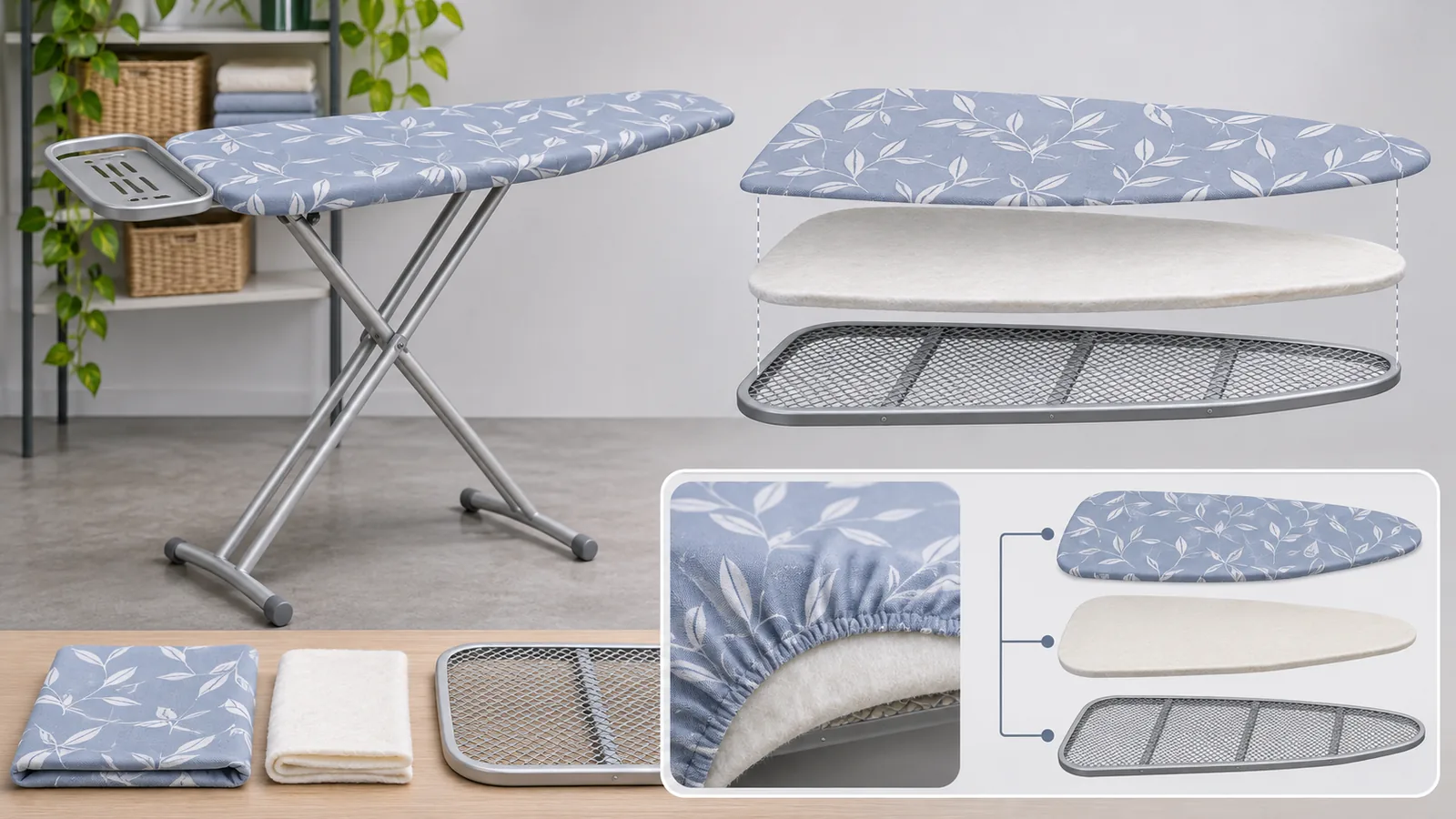
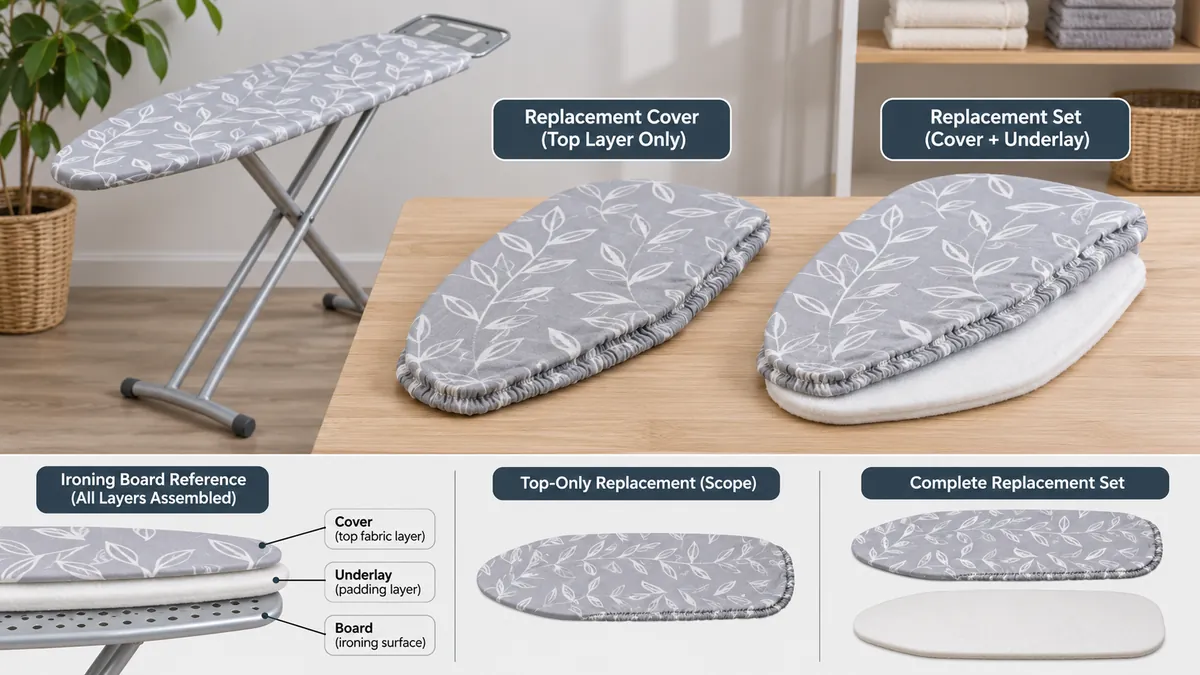
When an importer uses the search shorthand ironing board replacement cover size top layer complete set, the first question is what the quoted SKU actually replaces. A “top-only” item may still include a thin padded layer and depend on the existing underlay remaining in acceptable condition. A “complete set” may supply a different full underlay layer. Those are different replacement scopes, even when both suppliers name the same board model or nominal board size.
An "ironing board replacement cover size top layer complete set" request should name the intended board and every supplied or retained layer.
This guide is for homewares importers, laundry-accessory distributors and hospitality replacement-parts buyers. It helps define the product reference, supplied layer stack and sample approval record. It is not a textile cutting pattern, universal cross-brand fit guide, ironing instruction or heat-performance claim. Koitor’s current ironing-board, textile-cover, foam and thermal-testing capabilities are not confirmed. The relevant product maker and material suppliers must confirm fit, care and any use-specific requirements.
Ironing board replacement cover size top layer complete set: define layers
A replacement offer may provide the visible top fabric only, a top layer with attached thin padding, a separate underlay, or a combined cover-and-underlay set. The buyer should list each layer included in the quote and each layer expected to remain in the assembly. A generic phrase such as “replacement cover” does not settle the scope.
Brabantia’s service guidance distinguishes replacing a top layer from replacing the bottom layer, and says a complete set is an option when both layers are worn. This is the manufacturer’s guidance for its product range, not evidence that every brand sells separate layers. See Brabantia’s cover-selection help.
Two specific Brabantia product documents show why buyers should inspect the named SKU rather than depend on shorthand. A product sheet for a named C board describes a top-layer product with a thin foam component and use with an existing underlay that remains acceptable. A different sheet for a named C board identifies a complete cover-and-underlay set with a different underlay thickness. These are model-specific descriptions, not minimum thickness requirements or evidence that one construction is better for every board. The top-layer document and the complete-set document should not be combined into a generic textile specification.
Use a layer-scope table:
| Layer or component | Top-layer offer | Complete-set offer | Buyer confirmation |
|---|---|---|---|
| Visible textile | Included or not stated | Included or not stated | Exact SKU and material reference |
| Thin bonded pad | Included, if documented | Included, if documented | Confirm as part of the top component or separate |
| Main underlay | Retained or replaced | Included if product sheet says so | Identify the layer that remains or is supplied |
| Retention feature | Maker-specific | Maker-specific | Confirm on the named board |
| Board reference | Exact model required | Exact model required | Do not infer cross-brand fit |
| Care guidance | Source-specific | Source-specific | Use current supplier instructions |
The table is a procurement aid, not an equivalence claim. Two SKUs can share a nominal board name and still supply different stacks.
Treat the retained underlay as an explicit dependency
A top-layer replacement that relies on an existing underlay has a condition the buyer must check: the layer expected to remain must be identified, and its acceptability must be decided by the responsible product source or qualified reviewer. A worn, displaced or mismatched underlay may make the quoted top-only replacement incomplete for that project.
Do not assume that the buyer can simply retain any padding already on a board. The replacement supplier should confirm what existing layer its item is designed to work with and what model reference applies. If the buyer cannot identify the retained layer, record the uncertainty and request clarification before selecting the SKU.
The reverse assumption is also risky. A complete set does not automatically fit every board that shares a broad size label, and it is not automatically an upgrade for every use. The buyer still needs a named board and an approved assembly. A complete kit may include parts or retention features specific to the manufacturer’s model; those details should not be generalized.
For hospitality or distributor assortments, keep the layer dependency visible in the catalog record. If the product is top-only, the replacement part number should not be presented as if it replaces an underlay that it does not include. If the set includes multiple layers, list them accurately. Customer-service materials should help identify the board reference before suggesting a replacement.
Do not equate nominal board size with fit
A nominal size such as “124 × 45 cm” may identify a board family or product reference, but it is not by itself a textile cutting pattern. Different documents can label measurements differently: usable board top, fabric article dimensions, finished cover, or packed product. Do not subtract, average or reconcile values unless the responsible supplier identifies what each measurement represents.
The two Brabantia sheets referenced above use different article-width/depth conventions despite naming the same board size. This is a reason to request clarification, not a basis for calculating a universal sewing allowance. The buyer should keep these fields separate:
| Measurement label | Meaning to confirm |
|---|---|
| Board reference size | Maker’s name for the board or product family |
| Board working surface | How the maker defines the usable top area |
| Textile article dimensions | Whether measured before or after shaping/assembly |
| Finished cover dimensions | State and points used for measurement |
| Packed dimensions | Product as folded or packaged |
| Fit statement | Exact board model and source of compatibility |
Do not create a dimension recommendation from these supplier documents. If a quote needs measurements, ask the textile or system supplier to define measurement points and fit scope for the named board. A reseller listing or search result may omit the measurement state and should not overrule the current manufacturer’s sheet.
A different manufacturer, Joseph Joseph, lists a named Pocket ironing-board cover with its own board reference and a described top-and-underlay construction. That demonstrates another model-specific assembly and retention approach; it does not establish compatibility with a Brabantia or other brand board. See the Joseph Joseph Pocket cover specification.
Approve the assembly, not only the loose cover
Sample approval should match the product the buyer will actually stock. Identify the board, retained or replaced underlay, top layer, retention method and complete assembled stack. If the product is top-only, demonstrate or otherwise confirm the intended configuration with the specified retained layer. If the set replaces multiple layers, verify the supplied stack against the maker’s named scope.
The review is about identity and fit within the supplier’s instructions. It is not permission to add arbitrary padding, alter the cover, cut textile, or make a heat or steam test without a responsible supplier’s method. Do not infer thermal performance, fire protection, dryness, heat reflection or life expectancy from the fabric, thickness or image of a cover.
Record the exact sample ID, board model, cover SKU, layer list, source documents, date, reviewer and open conditions. If the sample label is missing, do not treat an unmarked sample as an approved model. If a supplier sends a different configuration from the quotation, hold it until the scope is reconciled.
A sample may show that the set can be placed on a particular board under an agreed method. It does not establish compatibility with all boards of similar dimensions, long-term retention, care suitability or performance during ironing. Those claims need current evidence from the responsible system and material suppliers.
Create a replacement-program matrix
A distributor or importer may manage multiple board models, cover constructions and replacement SKUs. Use a matrix with one row per approved pairing rather than a single broad compatibility statement:
| Buyer SKU | Board maker/model | Replacement scope | Retained layer | Supplied layer stack | Fit evidence | Care source | Status |
|---|---|---|---|---|---|---|---|
| Controlled reference | Exact model | Top only/complete set/other | Exact layer or not applicable | List each layer | Current supplier evidence | Current instructions | Approved/hold/excluded |
| Alternate variant | Separate model | Separate defined scope | Explicit dependency | Separate layer list | Separate confirmation | Named document revision | Separate decision |
This supports customer service and reorder control. If the board model changes, the buyer can find which cover reference is affected. If the cover SKU changes, the buyer can review the supplied layer scope and fit statement without assuming that the old record still applies.
Do not add a model to a compatibility table based only on shape, nominal size, reseller text or visual similarity. Ask the responsible manufacturer whether a family-level statement exists and what models it includes. If the supplier cannot confirm it, keep the pairing unverified or outside the offer.
Assign responsibility for textile, board and metal components
The product may involve different sources: the board maker, fabric or foam supplier, sewing/cover supplier, retailer or distributor, and packaging supplier. Assign responsibility for the board reference, replacement layers, retention system, care information and compatibility statement. The buyer should know which source provides each fact.
Koitor’s manufacturing profile supports metal bathroom and home-storage hardware, metal forming and component communication. It does not confirm ironing-board frames or tops, textile cutting/sewing, foam production, heat or fire testing, or full appliance manufacture. A buyer can ask whether a defined metal support or component is feasible, but any offer must be confirmed from the actual drawing and scope. Koitor should not be described as the source of a branded replacement textile cover.
Likewise, the cover supplier should not be presumed responsible for validating the metal board or any whole-product performance unless it expressly accepts that scope. Record any excluded responsibility in the RFQ and purchase order.
Keep care and performance statements with their source
A product sheet may contain claims about dryness, heat reflection, certification, washing, guarantees or product performance. This article does not adopt those claims as general facts. A buyer should reproduce only current, model-specific statements that are authorized and supported by the responsible maker.
Care information may differ by fabric, coating, padding and construction. Do not use a care instruction from one named cover for a different textile or brand. If product packaging needs a care statement, request the current version and ensure it matches the SKU. If the supplier’s current record is unavailable, omit the claim until verified.
The same applies to heat-related or safety language. Do not infer that a given foam thickness proves a temperature rating, that one fabric is safer, or that a cover is compatible with every board designed for domestic or hospitality use. Those questions require appropriate product-level evidence from the responsible source.
Handle SKU and supplier changes with revision control
Replacement programs can change when a board model is revised, a cover material is substituted, or a supplier offers a new set. Track the board reference and cover revision separately. A change in the visible textile may affect care or retention; a change in underlay may alter the supplied stack; a board change may affect the fit statement. The responsible supplier determines what needs reassessment.
Before reordering, compare the current quote and label with the approved matrix. Verify that the new item number retains the same scope. If the supplier says a replacement is equivalent, ask what the statement covers: layer construction, board model, retention, care or only packaging. Record the exact basis and limitation. Do not treat a successor number as proof of cross-brand compatibility.
A discontinued model should be handled as a new identification issue. Request a supported successor reference, confirm the layer stack, then sample the specified board or obtain other evidence accepted by the buyer. A catalog code that differs in one digit may represent a different set or board size; never resolve that by intuition.
Write an RFQ that answers the layer question
A useful RFQ should state the target board maker and model; whether the buyer wants a top-only replacement or complete set; which existing layer, if any, is expected to remain; and the requested quantity and packaging. Ask the supplier to list every included layer and identify any bonded pad or underlay separately. Require the fit statement and care source to identify the exact SKU.
If the buyer has a physical board or approved sample, record its identity and condition. Do not send confidential customer references or branded items without authorization. If the board model is uncertain, make identification a separate stage and do not ask for a guaranteed fit quote from a photograph alone.
The RFQ should keep measurements labeled. If the supplier provides article dimensions, ask how they are measured and whether they refer to a raw textile, finished cover or packed set. If a source’s measurements conflict, record the discrepancy and ask the supplier to resolve it. Do not convert those values into a cut pattern or universal tolerance.
Coordinate related storage and replacement guides
The Koitor pull-out ironing board cabinet envelope guide addresses the space required for an integrated board in a cabinet. The wall-mounted board swivel-clearance guide focuses on movement and clearance. The ironing-board hanger compatibility guide covers how folded legs engage with a storage hanger. These are different decisions from whether a replacement cover supplies a top layer, retained underlay or complete stack.
This guide connects those product discussions to a replacement-parts program without repeating cabinet envelopes or hanger geometry. A buyer may link them in a broader assortment workflow, but should keep each technical claim attached to its own model and evidence.
Approve a named replacement stack
Release a replacement SKU when the board identity is clear, the supplied layers are listed, the retained-layer condition is understood, fit is confirmed for the named assembly, and the buyer has a current source for care information. Hold the SKU if the cover/underlay scope is ambiguous, nominal dimensions are being used as a universal pattern, or the supplier has not confirmed the exact board pairing.
The approval should state what was reviewed and what was not. A fit review on one named board does not approve all boards with a similar outline. A top-only replacement that includes a thin bonded pad does not become a complete set if it relies on an existing underlay. A complete set is not automatically superior or compatible with every model. Keeping those distinctions visible makes a distributor’s assortment more accurate and its reorder process easier to control.
Carry the layer decision through stocking and customer service
The layer scope should remain visible after the buying team approves the sample. A warehouse SKU description that says only “cover” can cause staff to ship a top layer when the customer expects a complete stack. Add a concise scope phrase to the internal item record and make sure the carton label, pick list and catalog entry refer to the same item number. If the supplier’s original product name is vague, use a buyer-controlled description that distinguishes top-only from complete set without changing the maker’s model code.
For customer service, create a model-identification route before launching the replacement program. Ask the customer for the information the responsible manufacturer uses to identify the board and cover. Avoid promising a match from nominal dimensions or a photograph alone. If the reference cannot be confirmed, explain which source must identify the board and keep the recommendation provisional until that answer is available.
When a return or complaint arrives, first compare the ordered SKU with the original quote and approved layer matrix. Determine whether the customer received the intended scope, whether the board reference matches, and whether the retained underlay assumption was met. Do not immediately conclude that the textile was cut incorrectly or that the board is defective. Preserve the cover, packaging, board identification and supplier documents so the product maker can assess the specific case.
Use a simple exception record with the buyer SKU, customer-reported board reference, supplied cover code, stated layer scope, photographs or physical sample status, supplier response and disposition. Separate verified facts from customer descriptions and buyer inference. If the mismatch resulted from an unclear listing, correct the listing and downstream item records; if the product identity is unresolved, update the compatibility matrix rather than broadening the scope by guesswork.
Resolve measurement differences without inventing a cutting allowance
If supplier sheets show different textile dimensions for a similar board reference, preserve each value beside its measurement label and source. Ask whether the figure describes the board surface, the flat article before shaping, the finished cover, a packaged set, or another state. Also confirm the exact model and document revision. A measurement difference can result from different conventions or SKUs; it is not automatically a supplier error.
Do not average two product-sheet dimensions, apply one brand’s allowance to another, or convert a finished cover measurement into a cutting pattern. Those steps create an unsupported specification. The textile supplier should provide the production pattern or fit basis that it has approved, and the board/system maker should confirm the intended model pairing. If no one can reconcile the references, hold the replacement SKU or narrow the board scope until the evidence is clear.
Store the clarification with the artwork or technical file used for ordering. On a future revision, check that the measurement labels have not changed. This prevents an old nominal size from being copied into a new supplier record as if it were a verified finished dimension.
Keep those measurements out of consumer instructions unless the responsible product maker has approved their use. A buyer’s technical comparison may retain multiple labeled dimensions for traceability; a cutting or fitting instruction is a different document with a different owner. This distinction lets the importer resolve a supplier discrepancy without accidentally publishing an unverified textile specification.
If the buyer lacks a complete reference, list the missing data explicitly and return the request to the board or cover maker. Do not fill the gap with an estimated cutting dimension or an assumed shared pattern.
Buyer checklist before approval
Before releasing the order, record the following for the exact model and revision: Board identity and profile; measured dimensions and reference points; cover-only or full-set scope; retained underlay condition; fit and tension method; included components; care-claim evidence; SKU/revision matrix; supplier ownership; and packaging/listing language. Resolve any open point with the party responsible for that specification; do not treat an unanswered field as approval.
Foire aux questions
Does a nominal ironing-board size guarantee replacement-cover fit?
No. The cover profile, dimensions, tensioning method, underlay and actual board geometry can all affect fit.
Should the underlay be replaced with the cover?
Specify whether the sale is cover-only or a complete replacement stack. Treat a retained pad as an explicit, measured dependency.
What should an importer list in the SKU matrix?
Board reference, cover dimensions and profile, included layers, fit method, care claims, packaging, supplier responsibility and revision.
Sources
- Brabantia: Which ironing board cover do I need?
- Brabantia top-layer product sheet 132322
- Brabantia complete-set product sheet 134104
- Joseph Joseph Pocket cover product details
- Koitor pull-out ironing-board cabinet envelope guide
- Koitor wall-mounted ironing-board swivel-clearance guide
- Koitor ironing-board hanger compatibility guide

Discuss the K1497 buyer specification
Share the board reference, layer scope, measurements and metal-support requirements. Koitor can discuss confirmed metal hardware scope; textile fit, care and complete replacement-set claims remain with the responsible supplier.
Fabrication pour compte de tiers / Marque de distributeur
Transformez ce guide d'approvisionnement en cahier des charges
Indiquez-nous le produit souhaité, ses dimensions, sa finition, la quantité commandée et vos exigences en matière d'emballage. Votre équipe recevra une analyse pratique de la faisabilité de la fabrication avant l'établissement du devis.
 English
 Español
 Português
 Français
 Deutsch
 العربية