
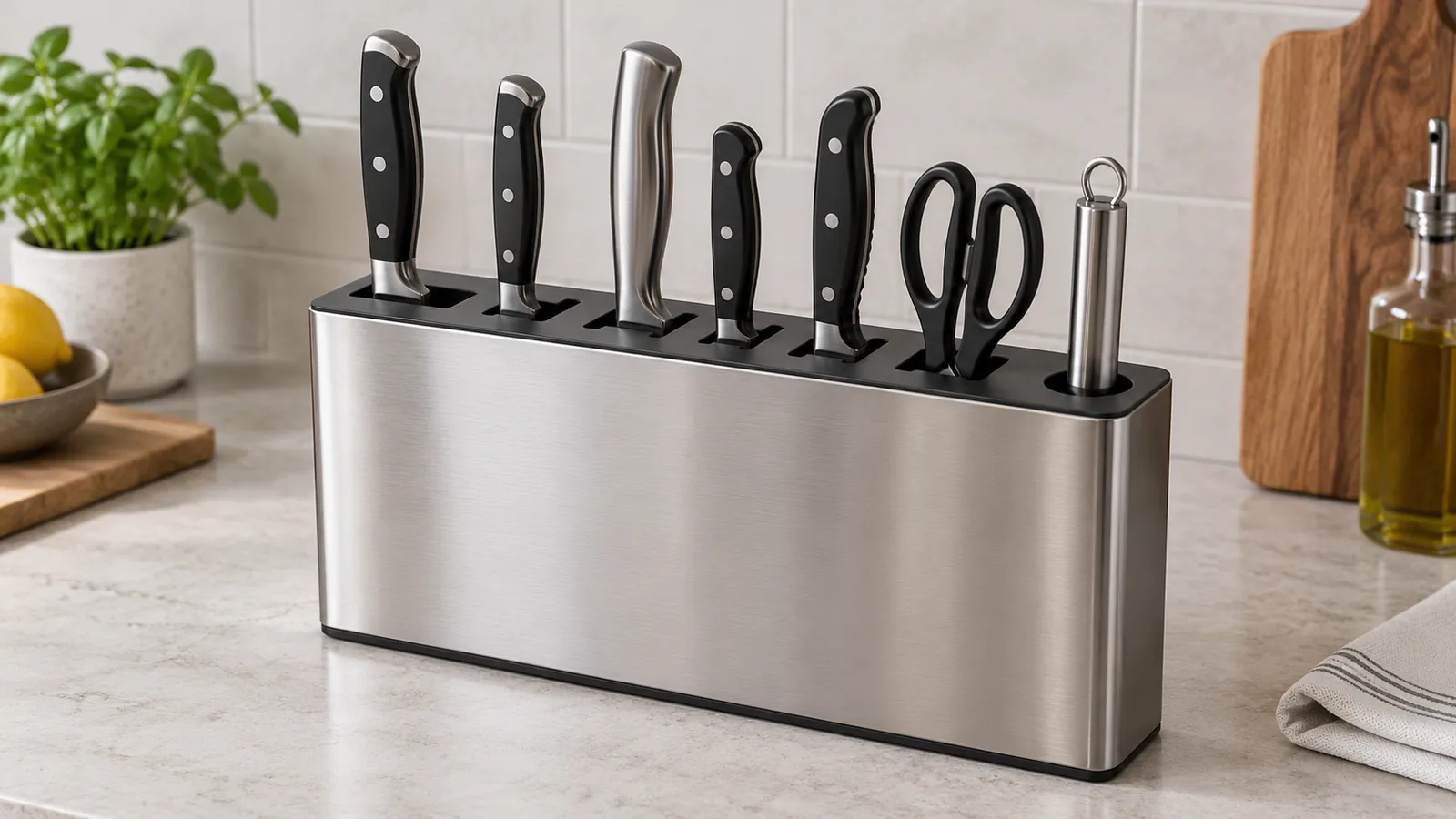
Kitchen knife rack slot clearance design starts with the actual knives and tools an importer intends to include, not a generic slot width copied from another product. Before sample approval, map the approved assortment to opening groups, record the controlling dimensions and usable depth, then test the reference items in a physical sample. That makes the advertised capacity traceable to a defined configuration.
For a commercial kitchenware buyer, the main question is not simply how many openings the rack has. It is whether each opening accepts its assigned item, allows the intended insertion and retrieval path, and supports the product description. The same process applies to a metal housing with a separate insert or a metal structure with openings formed into it.
Short answer: specify a slot map, not only a slot count
A useful specification identifies the item group assigned to each opening and the dimensions that control fit. It also separates knife openings from spaces intended for a sharpening steel, scissors, or another tool. A supplier can then quote and sample against the buyer’s assortment instead of interpreting a vague capacity statement.
Before requesting a quotation, prepare five inputs: the knife and tool models; the dimensions that affect fit; a numbered slot map; the expected entry and removal path; and a sample-approval checklist using the same reference items that define the product claim. These are project inputs, not a universal engineering standard. If the assortment changes, review the slot map and product description again.
In practical terms, kitchen knife rack slot clearance design connects the buyer’s selected items to opening groups, sample checks, and capacity wording.
Why slot count alone cannot define a knife rack
A product’s total opening count may combine several different uses. A rack can have narrow knife openings, a wider opening for a cleaver, a round channel for a sharpening steel, or positions created by a removable insert. A single count does not tell an importer whether each opening fits the intended set.
Manufacturer pages show why the distinction matters. Edlund describes a V-slot insert and publishes capacity by item group, including chef’s knives, smaller knives, a steel, and scissors. ALFA’s product page separately describes knife openings by width and a sharpening-steel opening. These are examples of model-specific specification choices, not dimensions to copy into another design. See Edlund’s knife-rack product information and the ALFA KNR product description.
When comparing a commercial knife rack listing, separate these fields:
| Field | What it tells the buyer | What it does not prove |
|---|---|---|
| Total openings | The number of openings shown on one model | That all openings accept the same item |
| Slot assignment | Which tool type each opening is intended to hold | That the buyer’s set was checked |
| Overall dimensions | The outer envelope for storage or installation | Usable opening width, depth, or retrieval clearance |
| Published capacity | A seller’s stated item mix | Capacity for a different assortment |
| Material description | The listed body or insert material | Certification, corrosion life, or cleanability |
| Sample approval | The configuration the buyer reviewed | That later changes can skip review |
Ask for the drawing or table connecting opening count to the intended item mix. A product photo helps identify a design, but cannot replace a dimensioned slot map.
Build the fit specification from the actual assortment
Build the buyer specification from the exact models in the product set, then assign each model to an opening group.
Start with the exact item set
List the reference models or representative items the product must accommodate. If a program covers a range, include the smallest and largest example in each group and any shape that is unusual. Record where each dimension came from: a controlled drawing, supplier specification, or physical item measured for the project. Do not combine dimensions from unrelated product families and describe the result as universal.
Blade length alone may not define fit. Depending on the design, blade height, spine thickness, bolster or guard shape, handle transition, and approach angle can affect insertion or removal. Identify the points that matter for the proposed rack and show them on a dimensioned profile. If the product uses an insert, record the insert revision alongside the housing drawing.
State what the rack is not expected to hold. Excluding a cleaver, an unusually wide profile, or a sharpening tool can be as important as listing included items. Clear exclusions make the capacity claim narrower and easier to check. Keep a controlled reference set with model identifiers so the buyer and supplier are using the same items during review.
Map each item group to an opening
Group items only when they share the relevant fit envelope and insertion path. For every group, define the opening profile, quantity, orientation, and usable depth. If several openings are meant to be interchangeable, say so and check the widest, thickest, and least typical reference item in every shared position.
This slot map is the core of kitchen knife rack slot clearance design: it ties each opening to a named item group and a sample check.
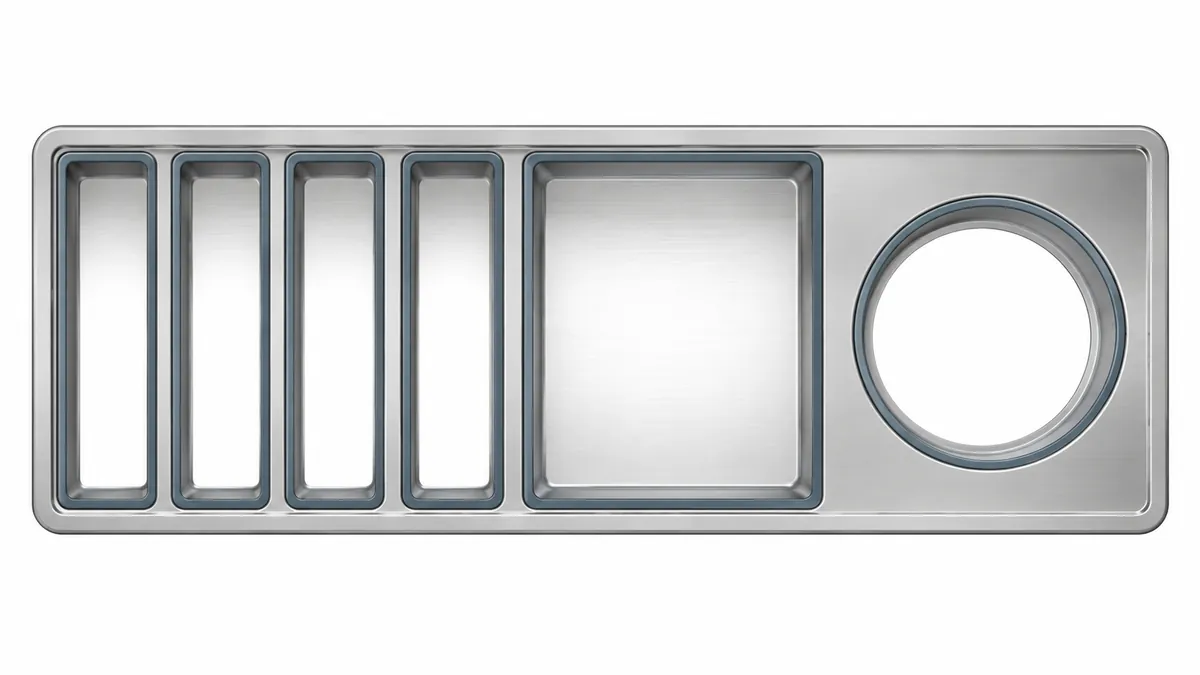
| Slot group | Assigned item or tool | Quantity | Opening profile | Usable depth | Contrôle d'échantillon |
|---|---|---|---|---|---|
| A | Buyer-defined knife group | Buyer-defined | Buyer-defined | Buyer-defined | Check smallest and largest reference items |
| B | Wider item group | Buyer-defined | Buyer-defined | Buyer-defined | Check widest profile and handle transition |
| C | Round tool group | Buyer-defined | Buyer-defined | Buyer-defined | Check diameter, insertion depth, and removal |
| D | Optional tool group | Buyer-defined | Buyer-defined | Buyer-defined | Confirm whether it counts toward capacity |
The table leaves dimensions blank on purpose. Choose them from the approved assortment and construction; do not treat one market listing as a standard. State where the measurement is taken. A tapered opening, V-shaped insert, rounded edge, or flexible divider can have a different usable envelope than a rectangular opening with the same nominal width.
Record usable depth separately from overall product depth. A back panel, internal stop, insert, or fastening structure can reduce the room available to an item. If an opening is angled or recessed, identify its intended path and where the item should stop. Put these details on the drawing or sample record rather than leaving them to interpretation from a perspective photo.
Check fit in three dimensions
A slot that accepts a flat outline may still be awkward in the finished rack. Consider width, profile, usable depth, entry angle, and clearance around the handle or guard. Insert and remove each assigned item along the intended path; check that the handle does not strike a neighboring feature, housing, wall, or other stored item.
Test adjacent positions together. One item may fit alone but interfere with a neighboring handle or the user’s grip when the planned set is loaded. Photograph the sample from the front and expected approach angle with the reference items identified. If a fit is borderline, pause for design review instead of widening every opening without checking appearance and structure.
For wall, counter, or cabinet installation, check the available envelope separately from slot fit. Mounting position and product depth can affect access even when the openings are unchanged. The buyer should provide the intended context and clearance; the supplier should not be expected to infer installation conditions from a product name.
Make construction, fit, and capacity agree
A rack may use a metal outer body with a separate insert, or a metal component may define the openings directly. State which construction is fixed and where the supplier may suggest alternatives. A listing that calls an item a metal rack does not establish that every component is metal.
The construction affects how an opening is made and measured. A folded edge, welded divider, attached insert, formed slot, and assembled partition each have different drawing references and possible variation points. Ask the supplier to identify the feature that controls usable fit and the measurement point used for samples or production. If an insert is part of the design, record its material and revision; a profile, supplier, or assembly change can alter the opening even when the housing drawing is unchanged.
Write the capacity statement to match the approved slot map. State the intended item mix and separate knife positions from spaces for other tools. Avoid “holds ten knives” if some positions are for a steel or scissors, and avoid “universal slots” if openings differ. If the product is sold without tools, make clear that capacity describes the intended configuration rather than included accessories.
A buyer can use this review sequence: count openings by group; assign each group to a defined item type; confirm the complete set in the sample; record exclusions; then approve the exact wording used in the product listing and package. Do not copy another brand’s dimensions or capacity into an OEM specification.
This is where an OEM manufacturing discussion is useful. Koitor Hardware is a family-owned custom metal hardware factory focused on bathroom and home storage products. Its custom kitchen storage rack manufacturing page explains the general OEM route for kitchen-storage projects. It is a starting point for a drawing or sample discussion, not evidence that a particular knife-rack SKU or insert is currently offered.
Put the slot decision into the RFQ
A complete RFQ should help suppliers understand both product form and buyer fit requirements. Separate fixed requirements from questions where the supplier may propose a manufacturable alternative. Because kitchen knife rack slot clearance design affects fit and product-page wording, carry the slot map as a controlled attachment rather than leaving it only in email comments.
| RFQ input | Buyer provides | Supplier confirms |
|---|---|---|
| Product scope | Rack type, mounting context, included and excluded items | Whether proposed construction matches the scope |
| Reference assortment | Model list, controlled dimensions, or physical samples | Which items will be used for sample fit |
| Slot map | Group, quantity, profile, orientation, opening and usable depth | Measurement point and design assumptions |
| Capacity wording | Intended item mix and draft sales language | Whether the sample supports the wording |
| Construction | Metal body, insert, dividers, or acceptable alternatives | Material and relevant forming or joining approach |
| Finish and appearance | Selected finish, visible faces, edge expectations | Details that may affect fit or appearance |
| Mounting | Installation context, available envelope, attachment position | Overall dimensions and supplied hardware scope |
| Emballage | Unit protection, retail pack, labels, and instructions | Pack-out proposal and buyer artwork needs |
| Change control | Who approves revisions and which record is the baseline | How sample, drawing, and production revisions are identified |
Provide a drawing when one exists. If the product is still being developed, send a clear brief and ask the supplier to identify missing dimensions before final quotation. Use one agreed unit system on the controlling drawing. If the buyer’s file and supplier drawing use different units, identify which document controls and who verifies conversion.
The RFQ should also define how the buyer will review the sample: reference items, measurement locations, photographs, and required records. A quotation based on unrecorded assumptions may produce a sample different from the buyer’s mental picture. For a broader metal storage project, the fabrication sur mesure de rayonnages métalliques de stockage information can help frame general structure and OEM questions; the knife-specific slot map remains a separate controlled attachment.
Approve the sample and control design changes
A sample review confirms the configuration the buyer examined. Keep the reference items, sample orientation, measurement points, and decision notes together so the next revision can be compared against the same baseline.
- Compare the sample with the latest approved drawing and slot map.
- Check the outer envelope and mounting points against the intended location.
- Use the smallest and largest reference items assigned to each group.
- Insert and remove each item along the agreed path.
- Load the planned assortment together to check adjacent-item interference.
- Check opening profiles at the documented measurement points.
- Review surfaces, edges, assembly, and insert position where relevant.
- Photograph the whole sample and close-ups with reference items identified.
- Record each group as accepted, revise, or on hold.
- Freeze the drawing, sample revision, capacity statement, and packaging description together.
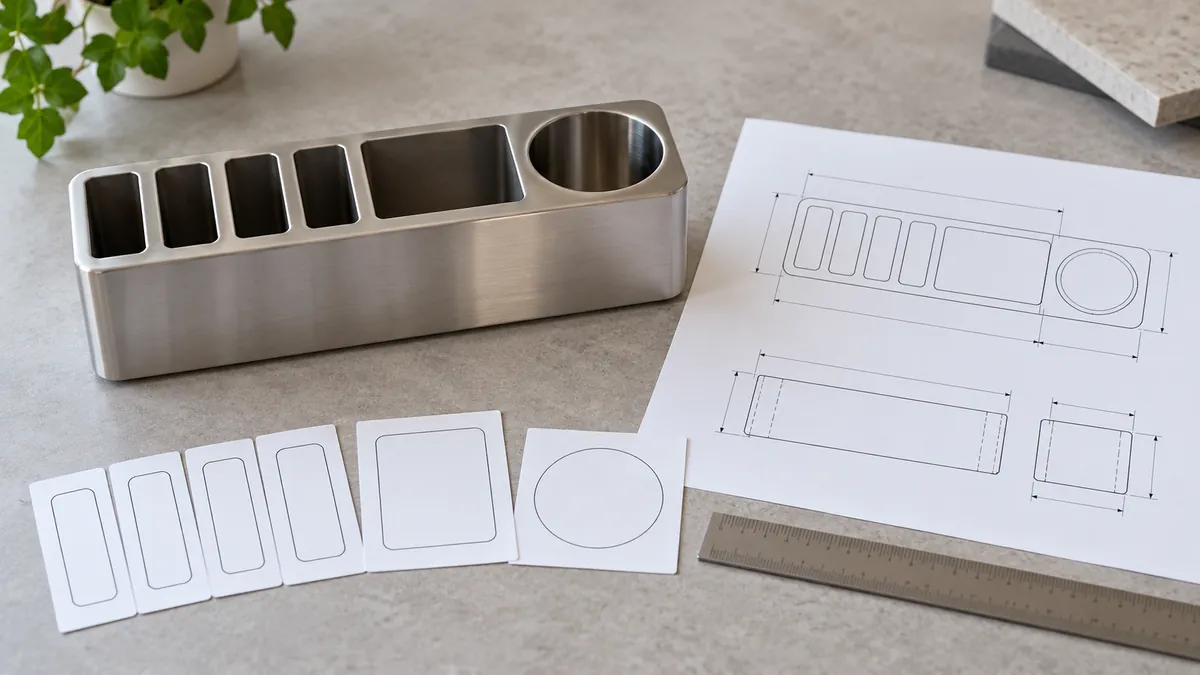
A sample does not automatically prove the fit of future production if material, insert, tooling, dimensions, or assembly may change. Agree separately on any first-article or lot-inspection plan and its acceptance records. A visual review is not a substitute for a dimensional check where fit depends on a defined opening.
If a supplier proposes a change, ask which slot groups it affects. A divider or insert revision may affect one opening, several positions, or usable depth. Recheck the affected reference items and capacity language. If mounting or packaging changes, include those checks in the same revision record. Use a status tied to the drawing number, sample revision, slot group, and reference item; “looks fine” is not a useful approval record.
Gaps to avoid before approval
Avoid a capacity number without an opening assignment, a fit decision based only on blade length, or a sample review using only one convenient item. Do not approve an unloaded sample when the product is intended to hold a full mix. Do not use a product photo as the controlling drawing: perspective and cropping can hide openings and dimensions.
Also avoid silently substituting an insert, accessory, or material after approval. Ask whether the change affects openings, surface contact, cleaning instructions, product description, or price. A change may be acceptable, but the buyer should decide against the revised sample or specification.
Questions to settle before quotation
- Which exact items are included in the product promise?
- Which references represent the largest or least typical profile in each group?
- Are any openings interchangeable, or does each have a specific assignment?
- Where are opening width, profile, and usable depth measured?
- Does stated capacity include a steel, scissors, or other accessory?
- Which drawing or sample revision controls if records conflict?
- What sample photographs or measurement notes must the supplier provide?
- Which changes require a new sample or written buyer approval?
Foire aux questions
Is there a standard knife-rack slot width?
Do not assume one. Commercial product pages describe model-specific opening patterns and capacities. Choose dimensions from the buyer’s reference set, state how they are measured, and verify them on the intended construction. A product listing is a comparison point, not a universal standard.
Is blade length enough to define fit?
No. Depending on design and use direction, blade height, spine thickness, bolster or guard shape, handle transition, usable depth, and retrieval path may also matter. Measure the features that control fit for the selected rack and identify the reference item.
Should every opening be the same size?
Only if the assortment and design make interchangeable openings useful and the sample confirms that the assigned items fit. A mixed set may need several opening profiles. The slot map should state whether positions are identical or grouped by item.
How should a product description count capacity?
State the intended item mix and separate knife positions from spaces for other tools. Use only wording supported by the approved sample and reference set. If accessories are not included, say so.
Does a metal body prove suitability for a commercial kitchen?
No. A material label does not establish performance, cleanability, regulatory status, or certification. Specify the customer and market requirements, request the needed documentation, and verify any compliance claim against product-specific evidence.
Does a prototype guarantee mass-production fit?
A prototype confirms the sample and revision the buyer reviewed. It does not automatically prove later production if materials, inserts, tooling, dimensions, or assembly can change. Record the accepted baseline and agree on production checks and change control.
Practical takeaway
A useful importer specification connects four records: the item assortment, the slot map, the sample-fit method, and the capacity wording. When all four agree, a supplier has a clear target and the buyer has a repeatable approval basis. When they do not, opening count and product photos leave room for different interpretations.
For a related kitchen-storage OEM discussion, review Koitor Hardware’s custom kitchen storage rack manufacturing page. Send the drawing or sample, target assortment, finish, mounting context, and packaging expectations through the contact page so the team can discuss whether the project fits Koitor’s verified product scope.
Product references
- Edlund — Knife Racks
- ALFA — KNR Wall-Mounted Knife Rack
- Metcalfe Catering — Edlund KR-50 product specification listing
Collaborez avec Koitor Hardware
Need help evaluating a custom kitchen-storage drawing?
Share the drawing or physical sample, target assortment, finish, mounting context, packaging plan, and expected order quantity. Koitor Hardware can review the stated scope and discuss relevant small-batch OEM options; a specific knife-rack SKU or certification must be confirmed separately.
Fabrication pour compte de tiers / Marque de distributeur
Transformez ce guide d'approvisionnement en cahier des charges
Indiquez-nous le produit souhaité, ses dimensions, sa finition, la quantité commandée et vos exigences en matière d'emballage. Votre équipe recevra une analyse pratique de la faisabilité de la fabrication avant l'établissement du devis.
 English
 Español
 Português
 Français
 Deutsch
 العربية