

A master bill of lading is the ocean-carrier-layer transport document in a layered shipment arrangement. In a common consolidation, the vessel-operating carrier issues the master bill to a forwarder or non-vessel-operating common carrier that arranged the ocean movement; that consolidating provider may issue separate house bills to its individual customers. The master and house documents describe different transport relationships, so an importer should identify each issuer, consignee, reference and cargo scope instead of treating every bill number as interchangeable.
What is a master bill of lading?
A master bill of lading, often abbreviated MBL or master B/L, is associated with the carrier-level movement. The ocean carrier’s document may cover a larger consolidated movement arranged by a forwarder or NVOCC. A house bill, by comparison, is issued by the consolidating intermediary to its customer for the relevant consignment. The master and house bills can therefore represent two layers of the transport arrangement, rather than duplicate copies of a single buyer-facing document.
The intermediary’s role depends on the actual arrangement. A freight forwarder can arrange transportation, and an NVOCC can issue its own house transport document while appearing as shipper toward the ocean carrier. Those role descriptions explain how master and house documents can coexist; they do not establish that a particular company is licensed or authorized, and they do not tell an importer which party has a specific legal responsibility under a specific transaction. Confirm the issuing entities on the actual documents and consult the responsible logistics provider for shipment-specific questions.
A master number does not automatically identify the buyer’s purchase order, a booking number, a container number, or a house-bill reference. Those identifiers may be related operationally, but they serve different purposes and can appear in different systems. Keep them in separate fields in a shipment record. If a forwarder provides a master reference without the buyer-facing house document or consignment cross-reference, ask how the individual shipment is associated with the consolidated movement.
The practical question is scope: which document covers which relationship and cargo information? A master bill may describe the larger carrier movement, while a house bill describes the intermediary’s relationship with the specific customer. This distinction can be important when a hardware importer needs to connect its PO, packing list and carton records to a transport update. It does not mean the master bill contains every customer detail or that a single number is sufficient for customs, payment, cargo release or ownership questions.
| Reference or document | Typical role in the shipment record | What the importer should verify |
|---|---|---|
| Master bill of lading | Carrier-level movement, commonly issued to the forwarder or NVOCC | Actual carrier issuer, named parties, scope and master reference |
| House bill of lading | Intermediary-to-customer document for an individual consignment | Actual issuing intermediary, customer details, house reference and cargo scope |
| Booking reference | Operational reservation or carriage reference | Which carrier or forwarder system issued it and how it links to the bills |
| Container number | Identifies a physical container | Whether the container is assigned to the relevant movement and consignment |
| Purchase order or invoice | Commercial order between buyer and seller | Whether product and quantity records reconcile to the shipment paperwork |
This is a relationship map, not a legal hierarchy or document-validity test. The shipment’s actual documents and contractual arrangements control the interpretation. A buyer should not use the word “master” alone to infer title, payment status, customs treatment or cargo release.
How do master and house bills relate?
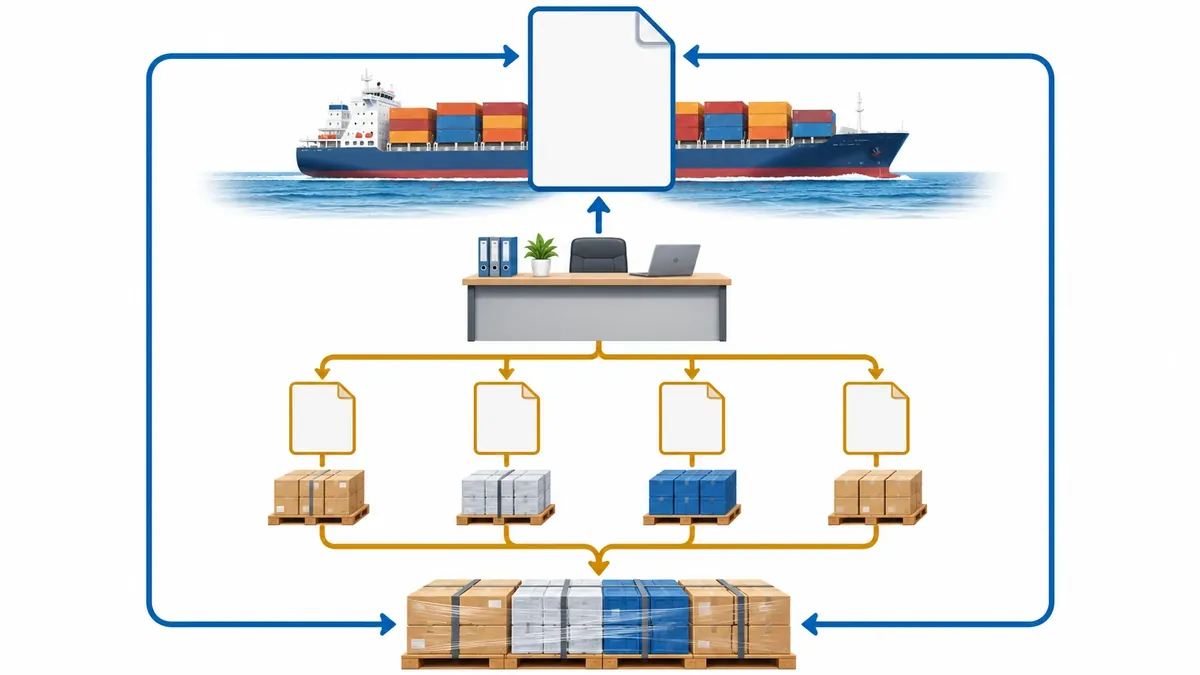
In a common consolidation, a provider collects or arranges multiple customer consignments within a larger carrier movement. The carrier issues the master bill for the carrier-facing relationship. The consolidating provider may issue a house bill to each customer or shipment party it serves. A simplified fictional mapping can show one master reference, M1, associated with two house references, H1 and H2. H1 represents one buyer consignment; H2 represents another. These labels are invented teaching placeholders, not real shipment numbers, a required number of house bills, or a claim about any Koitor shipment.
The mapping helps show that one master reference can relate to more than one customer-facing document in a consolidation. It should not be read as proof that every shipment uses exactly this pattern. A direct carrier movement may not use the same intermediary house-bill structure. A logistics provider’s role and document workflow may vary by service, route and contract. Ask the provider to identify which document set applies to the shipment being tracked.
For a bathroom hardware importer, the buyer’s order may include cartons of towel bars, shower baskets or metal storage racks. The commercial PO identifies what the buyer ordered from the seller. A packing list identifies how goods are packed. The house bill, if used, documents the intermediary’s transport relationship with that customer. The master bill documents the carrier-level movement. A carton tally or container record may provide another operational view. Those records can be reconciled, but one should not be substituted for another without confirming what it represents.
A working reference map can use rows for document level, issuing party, document number, named shipper, named consignee, cargo or consolidation scope, related buyer PO, and the party who can confirm the record. If H1 is the buyer-facing house document and M1 is the carrier-level master, the record should link them explicitly. If a provider has not supplied the cross-reference, note the gap instead of guessing from a booking number or container assignment.
Which parties issue or receive each document?
The carrier-facing document is issued by the ocean carrier for its transport relationship. In a common arrangement involving an NVOCC, that intermediary can issue its own house document for the customer relationship while acting as shipper toward the carrier. A forwarder that arranges transportation may be involved in collecting instructions, coordinating data and communicating status, but the exact document issuer must be read from the bill itself.
A seller or factory may supply accurate product, package, shipper and shipment information as requested in the agreed workflow. It should not be assumed to issue a carrier’s master bill or a forwarder’s house bill. A buyer may receive copies or references through the forwarder, NVOCC, carrier, customs broker or other parties, depending on the arrangement. The person who forwards an email is not necessarily the document issuer.
Use the issuer field and document source to identify the responsible party. A logo, email signature, booking portal, or file name alone may not establish who issued the bill. If the displayed company names differ across the master and house documents, ask the provider to explain the roles in that shipment. Avoid concluding that the discrepancy is an error until the transport arrangement is understood; also do not treat an unexplained discrepancy as verified.
A practical buyer communication can be specific: “Please confirm which party issued the carrier-level master bill, which house bill covers our consignment, and how the two references map to our booking and container.” This requests a relationship explanation without asking the factory to make a legal or release determination. Keep the answer with the shipment record.
How should an importer reconcile shipment records?
Start with the buyer’s own order and pack-out records. Identify the PO, product revision, carton count, SKU mix, packing list and any approved loading record. Then compare the house document for the specific consignment, where applicable. Ask the logistics provider to identify the related master reference and carrier-level movement. Record container and booking references in distinct fields, with source and date, so a later status update can be traced to the right system.
If a consolidated movement includes several customers, the master bill may describe the full carrier-level movement rather than a single buyer’s complete order details. The house bill may show the intermediary’s customer-facing consignment scope. The buyer should not assume that each bill repeats the same cargo descriptions, parties or reference numbers. The right question is whether the relevant shipment record can be traced through the parties and identifiers that apply to the actual arrangement.
When descriptions, quantities or parties differ, separate a data discrepancy from a document-layer difference. A master and house bill can name different transport parties because they represent different relationships. A mismatch in the buyer’s PO quantity or product description is a different issue that may need correction. Ask the party responsible for the document to explain or amend its own record; do not edit transport documents or infer a legal consequence from a formatting difference.
For advance cargo data, the manufacturer, forwarder and importer may each supply different information to different parties. The data fields, deadlines and responsible declarants depend on the destination regime and the current shipment. Koitor’s existing guide to EU ICS2 entry summary data roles addresses that separate filing and information question. A master bill definition does not determine who must submit a customs filing or what the latest filing deadline is.
What conclusions should buyers avoid?
A bill of lading has a transport-document role, but a reader should not infer every legal or commercial consequence from its title. The word “master” does not itself prove ownership of the goods, transfer of title, the right to take delivery, a bank’s payment condition, or the customs status of the cargo. Those conclusions can depend on the actual contract, document type, release arrangement, jurisdiction and transaction. This article explains a common document-layer distinction; it is not a legal, banking, customs or cargo-release opinion.
A master bill should not be confused with a sea waybill, an original bill, a surrendered bill, or a release instruction. Those are distinct document or process questions. Likewise, a master reference is not a booking confirmation, an arrival notice, an entry summary filing or a container number. A buyer should ask the relevant carrier, forwarder, NVOCC, customs broker, bank or legal advisor about the question within that party’s scope. Do not ask a factory to guarantee a release result based only on a number.
The phrase “one master to several houses” is a useful illustration of consolidation, not a rule that every master bill has two or more house bills. Some moves can be arranged differently. A forwarder may arrange carriage without issuing a house document in the same way as an NVOCC, while another provider may perform multiple roles. Determine the actual role from the contract, document and provider confirmation. Do not treat a generic role description as evidence that a named provider has a particular authorization.
The master may carry cargo descriptions or references that differ in detail from a house document because the documents serve different scopes. That difference is not automatically a mistake. But the buyer should still reconcile what matters for its own consignment: named parties, goods description, quantity or package count where shown, shipment identifiers and cross-references. If there is a genuine error, the party that issued the relevant document should advise on its correction process. Avoid changing a file yourself or circulating a revised copy without confirmation.
Common bill-of-lading tracking mistakes
Tracking only the master number. A master reference can help locate the carrier-level movement, but it may not identify the buyer’s individual house-bill consignment. Keep the house reference and the provider’s cross-reference in the same shipment file.
Treating booking, bill and container references as synonyms. These fields can be related, but they are not the same identifier. Record each label as shown by its issuing system and ask the responsible provider how it connects to the shipment.
Assuming every provider has the same role. “Forwarder,” “carrier” and “NVOCC” describe different functions, and a company may be involved at more than one layer. Read the actual issuer and ask for a role explanation rather than assigning a role from a brand name.
Putting the buyer’s PO number into a bill field without confirming its purpose. An internal PO, packing-list number, carrier booking and house-bill reference may all be used by different teams. Keep the identifiers distinct and put each in the field or communication channel requested by the responsible party.
Assuming the master bill is the buyer’s invoice or proof of payment. A transport document is not automatically a commercial invoice, bank record or payment release. Keep sales and payment records separate and ask the bank or contracting party about its conditions.
Assuming the bill alone determines who can collect cargo. Release arrangements can depend on the actual document type and instructions. Obtain shipment-specific confirmation from the carrier or provider; do not infer a release right from the word “master.”
Treating a house bill as a second copy of the master. The house bill can represent a different party relationship and a different consignment scope. Check its issuer and named parties.
Copying all references into one unlabelled note. A string of numbers without issuer and document type can create confusion when the shipment is consolidated or a status update uses only one identifier. Store the label and source alongside every reference.
Asking the factory to correct a document it did not issue. The seller may provide accurate cargo information, but the issuing carrier or intermediary controls its own transport document and correction channel. Identify the responsible issuer first.
A buyer’s document map for a hardware order
Consider a fictional import of mixed-SKU bathroom hardware. The buyer’s commercial order has PO B-100. The carrier-level master document is labeled M1, and the forwarder or NVOCC has issued a customer-facing house document H1 for the buyer’s consignment. Another customer’s fictional house document is H2. These labels are examples only; they are not actual shipment details and do not imply that a Koitor order used this structure.
The buyer should connect B-100 to the packing list and carton tally, then connect that consignment record to H1. The provider should explain how H1 maps to M1 in the consolidation. The container number and booking reference should be recorded in their own fields with the system that issued them. If the carrier portal displays M1 and the forwarder’s portal displays H1, the different references need not mean that the records conflict; the buyer should ask for the mapping.
If the carton tally shows 120 cartons and a transport document shows a broader consolidated movement, the buyer should not assume the master document must list every house customer’s carton breakdown in the same way. The relevant reconciliation question is whether the buyer’s own consignment, named parties and shipment identifiers can be traced through the applicable documents. If the buyer’s own house document shows a different quantity from the approved packing records, that is a separate discrepancy for the issuer and shipper to review.
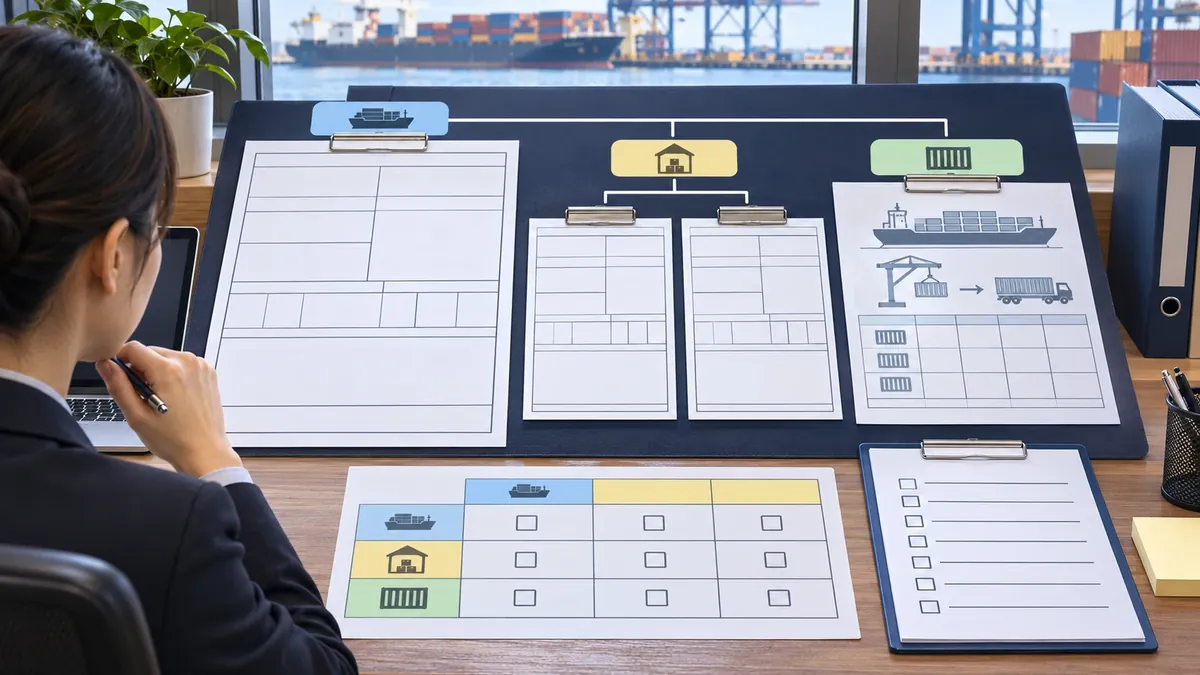
A tidy cross-reference table might record document type, number, issuer, named shipper/consignee, PO or consignment relation, related references, date received and confirmation source. For example, the M1 row can point to H1 and the carrier booking; the H1 row can point back to M1 and PO B-100. Record “confirmed by forwarder on date” if the provider has explained the mapping. If the mapping is still unknown, mark it open and request it. Do not invent a number or relationship to make the table appear complete.
Buyer checklist before filing a shipment reference
- Record each document’s exact type and the company that issued it.
- Separate master bill, house bill, booking reference, container number, PO and packing-list number.
- Ask the forwarder or NVOCC to map the customer consignment reference to the carrier-level master reference.
- Confirm which document covers the buyer’s own consignment and which covers a broader movement.
- Reconcile buyer-controlled product and packing records with the customer-facing transport document.
- Keep discrepancies open until the responsible issuer explains or corrects its own record.
- Store the date, source and person who confirmed a cross-reference.
- Ask the appropriate carrier, provider, customs broker, bank or legal advisor about release, filing, title or payment questions.
- Do not infer a legal or release outcome from the word “master.”
- Retain the document revision and approved correction history.
Foire aux questions
What does MBL stand for?
MBL commonly means master bill of lading. It is a shorthand for the carrier-level bill in a layered transport arrangement. Confirm that the abbreviation and document function match the actual document being used.
Who issues a master bill of lading?
In a common ocean movement, the vessel-operating carrier issues the master bill to the party arranging the carrier movement, often a forwarder or NVOCC. The actual issuer should be read from the document and confirmed with the provider.
What is the difference between a master bill and a house bill?
The master bill is associated with the carrier-facing movement. A house bill may be issued by the consolidating forwarder or NVOCC to its individual customer. The documents can describe different transport relationships and scopes.
Can one master bill relate to several house bills?
That can occur in a consolidation, where a larger carrier-level movement includes multiple customer consignments. It is an example pattern, not a rule for every shipment. Ask the responsible provider for the actual cross-reference.
Is a master bill the same as a booking number?
No. A booking reference and a bill number are distinct identifiers, even if systems connect them. Record the label and issuing system with each reference.
Does the master bill prove who owns the cargo?
Do not infer ownership from the document’s title alone. Ownership and title questions may depend on the transaction documents and applicable law. Ask the responsible legal or financial advisor.
Does a master bill tell me when cargo will be released?
Not by itself. Release depends on the actual document type, instructions and shipment arrangement. Confirm status and requirements with the carrier or provider responsible for release.
Should a factory provide the master bill number?
A factory may provide shipment information or references it receives as part of an agreed workflow, but it should not be assumed to issue the carrier’s bill. Ask the carrier-facing provider who owns the relevant document and which reference is appropriate for buyer tracking.
Sources and scope
The document-layer explanation draws on DP World’s master-bill glossary, DHL’s overview of bill-of-lading roles in a consolidation, the U.S. Federal Maritime Commission’s overview of ocean transportation intermediaries, and Maersk’s shipping terms glossary. These sources support the common master/house relationship and role descriptions. They do not establish universal ownership, bank-payment, release, customs, licensing or legal conclusions.
This is general shipment-document education, not legal advice or a release instruction. Confirm the actual document set and shipment process with the responsible carrier, forwarder or NVOCC and obtain qualified advice for legal, customs, banking or title questions.
Discuss a related hardware project with Koitor
Share the relevant drawing or sample, product revision, finish, order quantity, and packaging scope to clarify the manufacturing discussion.
Fabrication pour compte de tiers / Marque de distributeur
Transformez ce guide d'approvisionnement en cahier des charges
Indiquez-nous le produit souhaité, ses dimensions, sa finition, la quantité commandée et vos exigences en matière d'emballage. Votre équipe recevra une analyse pratique de la faisabilité de la fabrication avant l'établissement du devis.



 English
 Español
 Português
 Français
 Deutsch
 العربية