
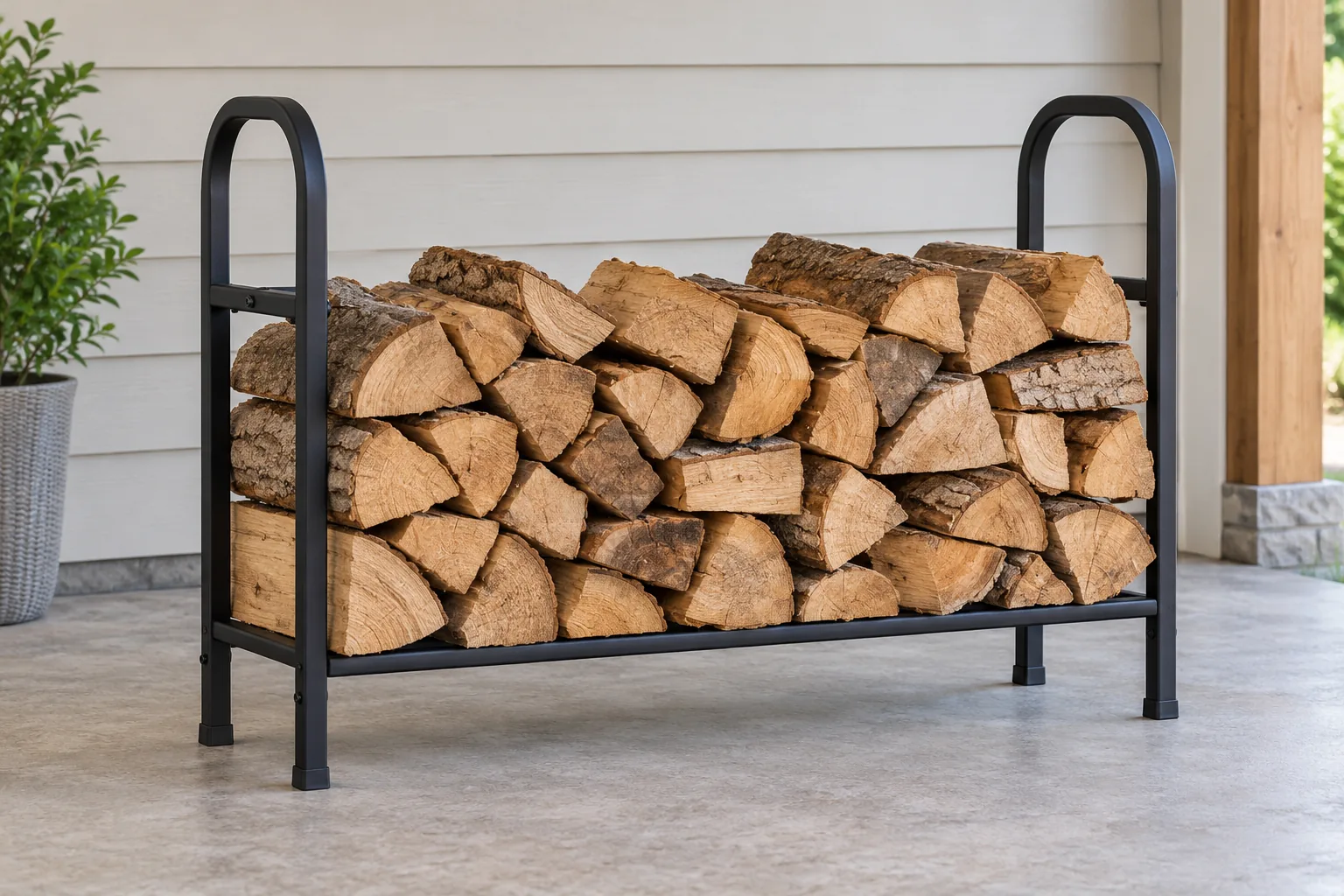
A firewood-rack specification should connect the buyer’s intended log length to the rack’s usable inside envelope, frame drawing, chosen environment, finish evidence, assembly parts and carton data. A product’s outside length alone does not show what wood fits, while a product photo cannot define the frame, joining details or pack contents. When evaluating a firewood rack manufacturer, ask for one production-intent drawing and a sample record that keep the quoted configuration and packed unit aligned.
This guide is for fireplace-accessory and home/garden importers, distributors and private-label teams. It explains what to request and compare; it does not establish capacity, stability, outdoor life or current Koitor production of a firewood rack.
What Should a Firewood Rack Manufacturer Quote Include?
The quote should identify the rack model and revision, its assembled envelope, the usable log space, the proposed frame and finish, supplied assembly parts, and the packed configuration. Those fields let the buyer compare a production-intent product instead of comparing two vague descriptions such as “metal log rack.”
Start by defining whether the planned item is for indoor use, a covered space or an exposed outdoor location. That buyer-selected environment affects which material and finish details need to be reviewed. It does not prove that a particular coating will withstand the buyer’s conditions. Ask the supplier to state exactly what is proposed and which evidence, if any, supports the intended claim.
A supplier page can help buyers understand what information appears in the category. Hank’s product page lists two rack lengths, dimensions, a material and finish description, carton quantity and gross weight, and notes that custom size, color and shape may be requested. These are that supplier’s published model details, not a category standard or a specification to copy without review. The page is a useful example of why a quote should keep product attributes and carton data together.
A useful quote should make it clear whether each field is confirmed, proposed, optional, buyer-supplied or still open. If a supplier returns a different profile, size, surface treatment or assembly method, keep the difference visible as a deviation. That prevents a buyer from treating a model photo, broad catalog description and production quote as equivalent records.
How Should Buyers Define Log Fit and Rack Dimensions?
Define the usable log envelope separately from the rack’s outside dimensions. The buyer should identify the length range of the firewood intended for the SKU, the way the logs will be placed, and the boundaries that must remain clear after assembly. The rack’s nominal length can include frame members, legs or end sections that do not contribute to usable storage space.
A buyer can measure a representative group of logs or bundles and record the range that matters to the assortment. Include the intended orientation and whether the product brief expects a consistent cut length or accepts a range. If the assortment includes more than one market or pack size, treat those as separate references until the buyer confirms that one usable envelope covers them.
Record at least three different dimension groups:
- Outside envelope: overall length, width and height of the assembled rack, with clear measurement points.
- Usable log envelope: inside length and any buyer-defined usable depth or height, excluding frame sections that obstruct placement.
- Packed envelope: carton length, width and height, whether the unit is assembled or knocked down, and the unit count per carton.
The drawing should show the reference points for each measurement and distinguish a tube or rail dimension from a usable opening. Where the product has adjustable or optional sections, identify the exact approved arrangement. Do not convert a supplier’s outside dimensions into an assumed wood capacity or volume unless the product specification defines how that figure is calculated and the buyer approves the claim.

Conceptual fit-planning scene; no dimensions, capacity or performance result is shown.
Which Frame and Finish Details Belong in the RFQ?
Ask the supplier to identify the proposed frame members, joints, feet or contact points, and any cross pieces shown on the drawing. A frame may be made from tube, rod, angle or another form, but no one profile is automatically right for every size or appearance. The buyer’s task is to compare the proposed construction with the product envelope, intended use and pack plan.
A clear RFQ can request:
- Profile or section callouts for the main frame members.
- Joint locations and the proposed joining method for the quoted design.
- The position and shape of feet or surface-contact parts.
- Any detachable, adjustable or optional member and its revision status.
- Material and finish descriptions for each different component, where applicable.
- The faces or edges that are visible and the appearance reference used for approval.
A manufacturer’s published listing for one metal firewood rack can provide a model-specific comparison point. Hank lists Q235 steel and a black powder-coated finish for its described configuration. Those statements apply to that supplier’s model and do not prove a particular coating thickness, outdoor life or compatibility with another buyer’s environment. Buyers should put their selected material and finish requirement into the RFQ and ask what evidence is available for the exact proposed part and process.
If the rack may be exposed to moisture, rain or a buyer-specified cleaning method, describe that environment in plain terms and ask the supplier to respond with the proposed material, finish, care information and any relevant test documentation. Avoid generic terms such as “rustproof” unless the supplier can define the tested sample, method, exposure and acceptance criteria. A color sample or attractive product image is appearance evidence only.
How Can Importers Compare Firewood Rack Offers Fairly?
Compare offers against one shared drawing revision, item set and package boundary. A firewood rack wholesale listing can advertise a model or price while omitting details that change the buyer’s product, such as packed length, included hardware or whether the unit requires assembly. The supplier comparison should preserve the unknowns rather than filling them with assumptions.
Ask each firewood rack manufacturer to return the same schedule and mark every field as confirmed, proposed, optional, buyer-supplied or still open.
Use a common schedule with fields such as:
| RFQ field | Supplier A | Supplier B | Buyer follow-up |
|---|---|---|---|
| Model and drawing revision | Confirm the exact file and revision | ||
| Overall assembled dimensions | Record datums and units | ||
| Usable log envelope | Verify against selected log references | ||
| Main frame members and joints | Request drawing callouts | ||
| Material and finish | Separate confirmed details from proposals | ||
| Assembly parts and instructions | List what is included and who supplies it | ||
| Carton size, gross/net weight and units/carton | Match the intended sales channel | ||
| Sample and pack deviations | Record owner and closure date |
The table makes unlike proposals easier to see. One offer may have a different outside size; another may offer a different material or finish. Those are design differences to review, not automatic proof that one product is stronger, safer or longer-lasting. If price, lead time or custom treatment is compared, keep each commercial assumption beside the product revision to which it applies.
For the buyer, a complete metal firewood rack quote makes it easier to evaluate whether the product suits an assortment and distribution plan. It does not settle every environmental or performance question. Make the supplier state which requirements are included in the quoted scope and which need separate technical review.
What Should a Production-Intent Sample Confirm?
Review the sample against its drawing, reference logs and parts list. The purpose is to confirm the selected product configuration and record any deviation before the buyer approves it for the next stage. A sample can show dimensions, finish appearance and assembly-part presence for the unit examined; it cannot by itself establish capacity, outdoor service life or every condition a buyer may encounter.
A structured sample review can record:
- Model code, drawing revision and supplier quote reference.
- Outside dimensions and the usable opening, each measured from named datums.
- Fit against the buyer’s representative logs or bundle references.
- Frame-member positions, joint appearance, feet and specified contact points.
- Finish appearance on the visible faces and any agreed touchpoint.
- Whether the unit is welded, assembled or intended to be knocked down.
- Fasteners, tools or loose accessories included with the sample.
- Instruction sheet and parts list revision, when assembly is part of the offer.
- Sample deviations, corrective actions and the person responsible for closure.
Do not use the sample review as a substitute for a separately agreed test. If a buyer needs to support a capacity, corrosion or other performance statement, define the product revision, test method, condition, sample count, acceptance rule and responsible party first. Record what the evidence establishes and what it does not. Keep claims on retail copy within the scope of those approved records.
Before approval, compare the physical sample, supplier drawing, quotation, instruction sheet and retail-facing description. If they use different dimensions, model names or assembly parts, pause the approval record and ask which item controls. A consistent product file gives later inspections and reorders a clear reference.
How Should Flat-Pack and Carton Data Be Approved?
Treat the flat-pack arrangement as part of the product configuration. The carton should be based on the actual component set and packing order, not on a suggested estimate from an assembled product photograph. If the rack ships knocked down, request a list of parts, hardware quantity, instruction version and packed dimensions for that exact revision.
Hank’s product page is an example of a listing that reports carton quantity and gross weight alongside product dimensions. Buyers should request those same fields for their own quoted configuration and verify them with the actual pack sample. A supplier’s weight or carton entry for another model does not apply to a custom size automatically.
The buyer should confirm:
- Whether the unit ships assembled, partly assembled or knocked down.
- Packed length, width and height for the production-intent carton.
- Net and gross weight, units per carton, and any pallet or master-carton plan required by the buyer.
- How frame parts and loose hardware are separated and identified.
- The number and revision of instruction sheets, labels and component bags.
- The protective materials and separators included in the approved pack.
- Which party provides final artwork and which sample version was approved.
A pack-out review should match the actual rack parts to the parts list and retail pack. Check that the carton is labelled for the right model and finish, and that the buyer’s SKU data agrees with the packed unit. The review does not guarantee that all shipments will arrive without damage; it gives the buyer a controlled record of the package that was approved.
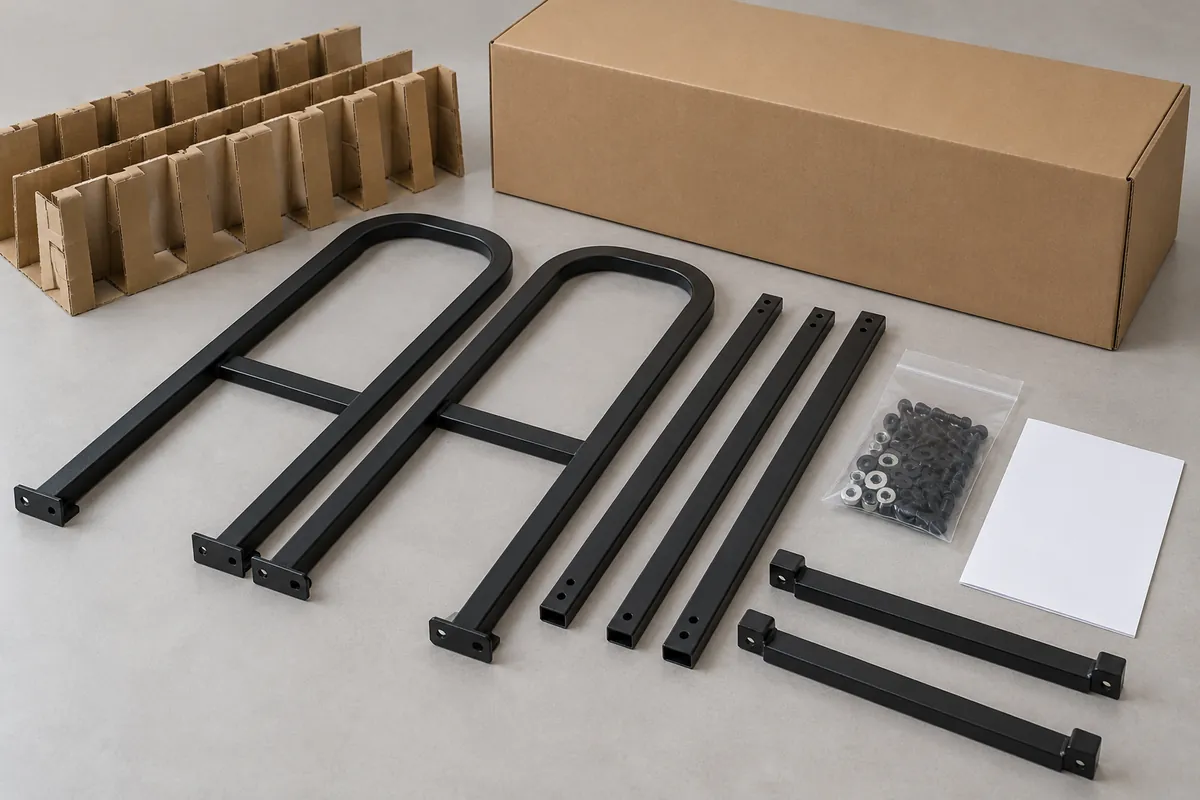
Illustrative pack-planning scene only; it is not a transit test or current Koitor product.
What Do Importers Ask About Firewood Rack Specifications?
Should the rack length equal the intended log length?
Not automatically. The outside length may include frame members that reduce the usable opening. Request both overall dimensions and the usable log envelope, then compare the latter with the buyer’s chosen logs.
Can a product listing’s gross weight be used for a custom version?
Only as an example from the listed model. A custom size, material, finish or assembly configuration can change the packed item. Request a current weight and carton schedule for the quoted revision.
Does a powder-coated finish prove outdoor suitability?
No. The term describes a finish but does not, by itself, establish service life or suitability for a particular exposure. State the intended environment and ask what product-specific evidence is available.
What should an importer receive with a knock-down rack sample?
Agree the frame parts, fasteners, tools if included, parts list and instruction sheet for the exact model. Record the assembly version and any missing or optional components before the buyer signs off.
Does sample approval prove capacity or long-term stability?
No. Sample approval confirms only the buyer’s stated review of that sample and its agreed criteria. Any performance claim requires its own defined evidence and conditions.
Discuss a Metal Storage Project with Koitor
Koitor Hardware is a family-owned custom metal hardware manufacturer focused on bathroom and home-storage hardware. Current firewood-rack production, outdoor test results, load ratings and cover sourcing are unconfirmed. Buyers considering an adjacent metal-storage category should send their drawings, target envelope, intended environment and packaging requirements so the requested scope can be checked before a quotation or sample is promised.
Review a Metal Storage Product Brief
Share the intended log range, dimensioned drawing, environment, finish direction, assembly plan and target carton limits. Koitor can first confirm whether the requested product scope fits its production facility before quotation or sample development.
Fabrication pour compte de tiers / Marque de distributeur
Transformez ce guide d'approvisionnement en cahier des charges
Indiquez-nous le produit souhaité, ses dimensions, sa finition, la quantité commandée et vos exigences en matière d'emballage. Votre équipe recevra une analyse pratique de la faisabilité de la fabrication avant l'établissement du devis.


 English
 Español
 Português
 Français
 Deutsch
 العربية