

For procurement, the tray racking trolley specification starts with the exact reference parts and intended arrangement. A tray racking trolley specification should identify the actual tray format, the direction it enters, the rail surfaces that support it and the clearance remaining when the tray is occupied. A tier count or outside trolley dimension does not tell a distributor whether a chosen tray slides into each level or whether its contents clear the level above. Approve the trolley with representative trays and the intended use arrangement.
This article covers a non-powered metal trolley with slide-in horizontal tray rails. It does not establish a food-contact claim, oven use, hygiene approval, capacity, caster rating, stability or current Koitor commercial kitchen equipment capability. The buyer’s decision is to control the tray-to-rail interface and confirm that the complete loaded arrangement meets a project-specific brief.
Why does the tray format matter more than the trolley name?
Commercial product catalogs distinguish bakery-format and gastronorm-style trolley assortments. Bartscher’s 2026 manufacturer catalog, for example, lists stainless bakery trolleys for 600 by 400 trays, notes trays are separately supplied, and describes retention features on certain models. The same catalog lists a separate canteen trolley format. Nisbets’ distributor assortment also separates GN and bakery racking trolleys. These product listings confirm that format is a real commercial selection dimension. They do not create a universal interchangeability rule or establish that every tray carrying the same nominal format fits every trolley.
Start with the buyer’s tray item number and drawing. Record its outside dimensions, flange or rim, corner shape, overall depth, orientation and any feature that bears on the rail. A tray’s nominal format may be a useful category label, but the actual supplier drawing and physical sample control the interface. If the buyer will use trays from more than one source, review each proposed tray model and identify any variation that affects support or insertion.
Clarify whether the trolley is intended for bakery trays, canteen trays or another fixed tray system. Do not infer compatibility from a product photograph, a generic “universal” phrase or a familiar format abbreviation. If the trolley is sold without trays, product pages should state that clearly. If trays are included, include their supplier identifiers and quantities in the BOM and pack list.
What should the rail interface show?
A controlled drawing should show the inside rail spacing, profile, depth, support surface, orientation and any end stop or retention part. The tray drawing should show the surfaces that meet those rails. The buyer can then compare both drawings at the same revision. Where a drawing is unavailable, use a physical sample and record the measurement method. Do not create a tolerance or rail allowance from a single promotional photo.
Check how the tray is inserted and removed. A tray may slide from the front, side or another direction depending on the trolley configuration. Identify the leading edge and its relationship to the rail. Check whether a flange sits above, within or below the support feature. A tray should not appear supported by a corner or unintended edge unless that is the approved design. Note whether an end stop, retaining bar or latch is included and what part of the tray it contacts.
| Avis des acheteurs | Trolley drawing or sample evidence | Acceptance record |
|---|---|---|
| Tray identity | Supplier, model, revision and dimensions | Approved tray reference |
| Tray orientation | Leading edge and insertion direction | Correct loading position |
| Rail geometry | Spacing, profile, support depth and stop | Actual bearing and retention points |
| Vertical pitch | Level spacing and occupied tray height | Clearance at each position |
| Use configuration | Empty or intended occupied condition | Agreed sample setup |
| Access path | Front, side or alternative approach | Insertion and retrieval observations |
| Mobility parts | Caster supplier, model and attachment | Responsibility and drawing reference |
| Saleable scope | Trolley, trays, retainers and hardware | Included and excluded items |
This is a buyer worksheet, not a universal equipment standard. The numeric values must be supplied by controlled product documentation or agreed sample measurements. A named tray format does not replace the physical interface review.
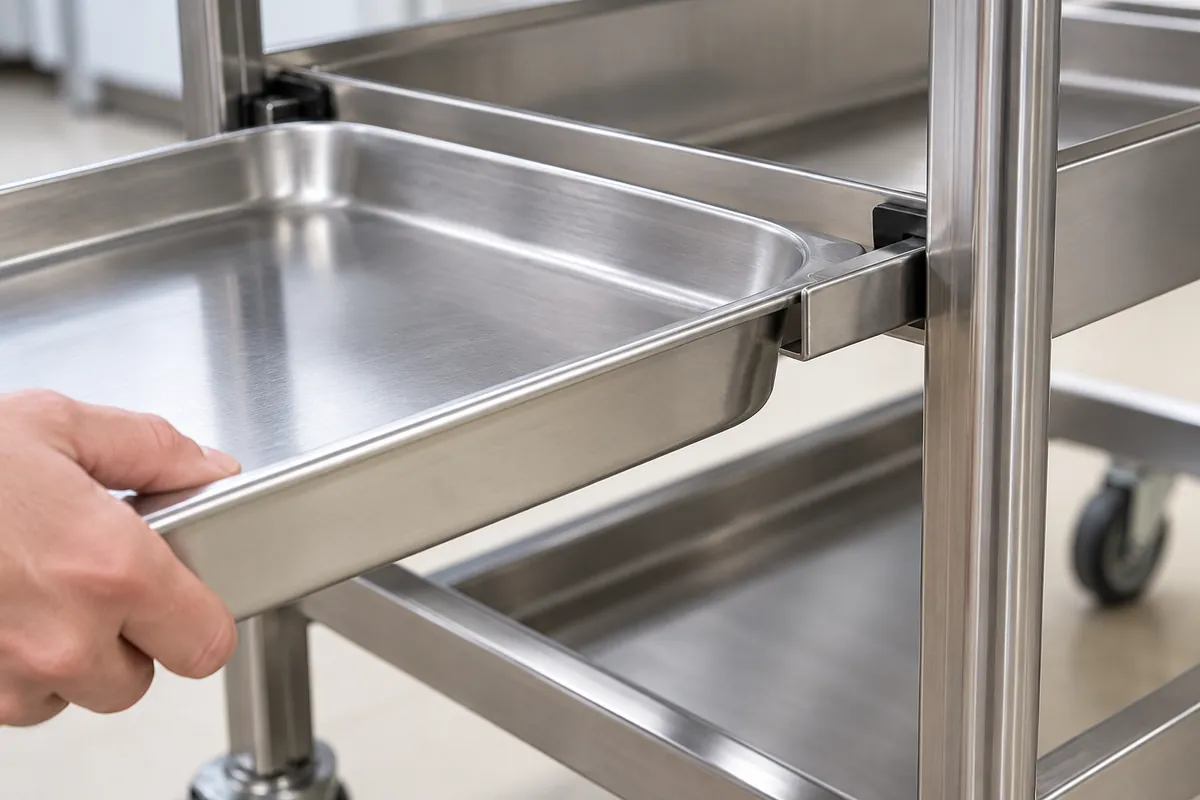
How should occupied clearance be assessed?
The clear space between rails is only one part of the usable vertical envelope. A tray may slide in when empty and still conflict with food pans, packaged goods, equipment or other material carried above its rim. Buyers should determine what will occupy the tray and how high that load extends above the tray surface. If the trolley is for empty trays only, state that. If contents or inserts are part of the workflow, define the reference configuration before sample approval.
Measure the tray itself and the occupied height in the actual orientation. Check the tier below, the tray above, the trolley frame and any handle or retention bar. The buyer should observe whether a loaded tray can be inserted without lifting or tilting it into the next level. If the tray is removed frequently, repeat the path with adjacent tiers occupied. Review the top and bottom levels too, because access and handling space can differ at the ends of the frame.
A sample review can follow a consistent sequence:
- Match the trolley and tray identifiers to their drawings and revisions.
- Confirm whether the trolley is delivered assembled or requires assembly.
- Inspect each rail pair for alignment and visible finish issues.
- Insert the empty tray in the approved direction at every intended level.
- Check the tray’s actual bearing and stop contact.
- Repeat with the buyer’s intended contents or a defined representative load.
- Measure the vertical envelope above the tray in that configuration.
- Remove a tray while neighboring levels remain occupied.
- Note any catching, interference, unwanted movement or blocked access.
- Record the actual configuration and approved exceptions.
The procedure produces observations about a sample; it is not a load, stability, wheel, impact or food-safety test. If the buyer requires a transport or load evaluation, define the trolley, casters, tray, contents, floor, movement and acceptance criteria with the responsible supplier or qualified project team. Do not create a capacity claim from how many pans fit in the rack.
What should be controlled on retention and mobility?
Some product listings show stops or retention features. Buyers should identify which part is included, how it engages the tray and whether it is part of the quoted trolley SKU. Check its position using the real tray. A retainer that contacts a different flange or a tray with a different corner can change the fit. Do not assume that a product advertised for one tray model retains another model in the same way.
Mobility is another separate interface. Identify the caster supplier, wheel type, attachment and any brakes included. A trolley’s ability to roll or remain in place depends on the whole product and the intended floor and use. This article does not establish a caster load rating, floor suitability, braking performance or stability. Ask the responsible supplier for the exact caster data and confirm the project requirements independently. Never infer the trolley’s safe capacity from rail count, frame appearance or the number of trays shown.
Inspect frame joints, rail alignment, exposed edges, finish and hardware on the assembled sample. If a rail is welded or fastened to a post, review the position relative to other levels. If the trolley is flat-packed, check that assembly does not alter the clear opening or rack alignment. The supplier should state which components are metal, which are purchased and who controls the revision. Do not imply Koitor makes commercial casters, trays or complete professional kitchen equipment.
For general context on metal storage components, buyers can review Koitor’s fabrication sur mesure de rayonnages métalliques de stockage et OEM home storage hardware pages. They do not establish a current tray-trolley catalog. Buyers may share an original drawing, tray sample and trolley interface through the contact page for a bounded metal-component feasibility discussion.
How do packing and operation change the SKU?
The product data should clarify whether trays, retainers, casters, fasteners and assembly tools are included. If trays are sold separately, say so in the item description and product images. If a trolley is shipped assembled, identify how rails and finish surfaces are protected in transit and what the receiving team should inspect. If flat-packed, provide an assembly sequence and identify each fastener. The buyer should compare actual packing contents against the BOM and final carton list.
Define where the trolley will be stored and how the buyer will access each level. Check whether the loaded trolley fits through the relevant passage and into the planned work area, but leave building access and safety decisions to the project owner. Identify the aisle, counter, equipment or door that constrains the route. A product being able to fit in an empty warehouse does not establish suitability for an operating kitchen or a project route.
If the trolley is intended for repeated movement, record the operational configuration and who validates it. Do not describe it as “easy rolling” or “stable” without an agreed, product-specific basis. If trays are used in a hot process or near heat, confirm the intended service and temperature limits with the responsible supplier. The Bartscher catalog example is not evidence for another brand, trolley or application.
What belongs in the RFQ and approval file?
Send the trolley supplier a controlled tray drawing or sample, use case, expected contents, number of levels, desired orientation, movement requirements, finish reference, packaging scope and target markets. Identify whether the buyer supplies trays or expects them in the quotation. Ask for the current frame drawing, rail profile, tier pitch, retention part and caster data. Request written clarification where a catalog term does not specify the actual interface.
A complete product record can include:
- Finished trolley SKU and drawing revision.
- Intended tray system and approved supplier models.
- Tray dimensions, rim profile and insertion direction.
- Rail geometry, support surfaces and retention parts.
- Level pitch and occupied-height sample record.
- Access checks for top, bottom and intermediate rails.
- Caster models, source and responsibility.
- Assembly instructions and hardware pack.
- Supplied and excluded trays or accessories.
- Sample approval date, owner and exceptions.
- Change triggers for tray, trolley, rail or caster substitutions.
Before reorder, compare the tray source, drawing revision, retainer, rail geometry, caster package and assembly version. If a supplier substitutes a tray or trolley part, repeat the affected fit check. Store an approved sample or controlled photos alongside the documents. Keep marketing descriptions tied to the product configurations actually evaluated.
A purchasing decision is ready when every tier has a named tray, the rails support its intended surfaces, the occupied envelope clears adjacent levels, removal and replenishment can be performed as planned and the quote states what arrives in the carton. If any part is unknown, mark it as pending rather than assuming the tier count is usable capacity.

Is this the same as a household baking-sheet organizer?
No. A domestic baking-sheet organizer usually separates flat boards or pans in a cupboard or on a counter, often with dividers. K127 owns that vertical storage and retention question. This article covers a mobile commercial-style trolley with horizontal slide-in rails, a specific tray format and an occupied-level operating envelope. Similar words such as “tray rack” do not make their purchase decisions equivalent.
It is also different from a service tray stand, which supports one tray during a set-down task, and a buffet display frame, which supports a presentation top. K1348 covers an individual service-tray and stand interface. K1341 addresses the seating of a removable buffet top in its display frame. Keep those owners distinct and focus this trolley page on multi-level rail engagement and loaded clearance.
How should the trolley configuration be controlled after approval?
Record whether the approved sample was evaluated with empty trays, occupied trays or both, and define exactly what was used to represent contents. Do not use an unspecified box or weight as a substitute for the buyer’s actual operating arrangement. If the buyer intends a route through doors or between work areas, the site owner must verify that route independently; the trolley sample does not prove clearance through a building.
Maintain a configuration matrix for tray model, trolley SKU, rail revision, retainers, caster source and packing scope. If a supplier proposes another tray or rail, identify the changed interface and repeat the relevant fit observations. If an alternative caster is proposed, request that supplier’s data and route any mobility or load criteria to the responsible technical reviewer. Do not equate the visual presence of more rails with a higher capacity. The product listing should distinguish trolley-only supply from any trays shown for demonstration.
Source basis: Bartscher 2026 manufacturer catalog et Nisbets racking-trolley assortment. Supplier product formats are examples only; no universal tray standard, capacity, caster or hygiene claim is made.
Keep the tray racking trolley specification tied to the named sample, drawing revision and included components.
Reviewing a Metal Tray-Racking Trolley?
Share the tray model and drawing, intended contents, rail layout, caster references, clearance needs and packaging scope for a bounded metal-component feasibility discussion.
Fabrication pour compte de tiers / Marque de distributeur
Transformez ce guide d'approvisionnement en cahier des charges
Indiquez-nous le produit souhaité, ses dimensions, sa finition, la quantité commandée et vos exigences en matière d'emballage. Votre équipe recevra une analyse pratique de la faisabilité de la fabrication avant l'établissement du devis.


 English
 Español
 Português
 Français
 Deutsch
 العربية