
The short answer
A metal watering can leak test should answer a specific buyer question: where did liquid appear, under what non-pressurized fill and orientation, and did the condition change after the agreed packing review? A wet outlet after pouring is not automatically a leaking seam. Water may remain around a detachable rose or spout fitting, flow along an exterior surface, or emerge from a body, base, handle, or spout joint. Record the location and conditions before assigning a cause.
Start by identifying the exact model, revision, capacity, construction, finish, intended use, and sample. Agree a safe fill-and-observe method with the responsible product supplier. Record fill level, hold period, orientation, pour observation, and before-and-after condition. Then review whether the actual packaging supports the can and protects its projecting parts. These are proposed project checks, not a universal test method or a guarantee about every shipment.
Keep the use boundary explicit. An indoor decorative watering can is not automatically suitable for freezing conditions, outdoor exposure, fertilizer solutions, drinking water, or food contact. Do not pressurize the can, apply an unknown repair sealant, or infer a root cause from a drip alone.
Identify the exact product and its intended use
Define what the supplier is selling
“Metal watering can” describes a broad product family. A can may have a formed body and base, a long or short spout, a removable rose, an attached handle, a painted or coated surface, and different joint constructions. A decorative indoor model may have a different intended use from a working garden product. A buyer should not transfer one model’s results or care instructions to a different design just because both hold water.
The product file should identify the SKU or project reference, drawing number and revision, body shape, nominal capacity, spout length and angle, handle construction, base design, rose or removable fitting, material declarations, surface finish, and packaging configuration. Include enough views to show where the body, base, spout, handle, and fittings join. If the supplier does not provide a drawing, agree how the approved physical sample will be identified and photographed.
Define intended use in buyer language. Is the item for indoor houseplants, an outdoor garden assortment, or primarily display? Is it expected to be stored full, emptied after each use, or used with an attachment? Does the product description mention a rose, precise pouring, or a specific capacity? The answer affects what the buyer should inspect and which statements require additional evidence. For example, an indoor-use statement does not support claims about freeze exposure or fertilizer compatibility.
Map the liquid path and component ownership
Trace the path from the opening through the body to the outlet. Note the body-to-base interface, spout attachment, any ferrule or fitting, and the rose or removable nozzle. Record whether the handle is welded, riveted, formed into the body, or attached another way if that information is available. Do not assume every visible joint is intended to retain water; confirm the construction with the supplier.
Ask which company manufactures the body and base, which makes or attaches the spout, who supplies any removable rose, and who applies the finish. One finished-product supplier may coordinate multiple component sources. The buyer needs a clear contact for a reported leak and a record of which parts and processes are controlled. If a component or sub-supplier changes after sample approval, establish whether that change needs a renewed review.
A product page from IKEA, for example, describes its specific VATTENKRASSE model as an indoor-use watering can and lists different materials for its body, spout, and handle. This is useful as a reminder to specify components separately. It is not a generic construction drawing, a performance standard, or evidence about another supplier’s model.
Locate the liquid instead of calling every drip a leak
Separate a joint escape from outlet residue
Before a check begins, make a simple location map or use a product photo with numbered zones. Mark the body-to-base junction, spout root, handle attachments, opening, rose or removable outlet, and any visible seam. During observation, note the first point where liquid appears and whether it forms a bead, a trail, or a continuing escape. A wet exterior below a joint may be where water collected rather than where it originated.
A detachable rose or outlet can retain water after use. A brief drip from that part while it drains should be described as outlet residue unless a controlled review shows liquid escaping elsewhere. Likewise, water on the table after setting down a wet can does not prove a body seam is open. Dry the exterior before the agreed observation and use a clean, dry surface so the reviewer can distinguish new liquid from residual water or condensation.
If liquid appears at the base or a seam, document the can’s orientation, fill condition, timing, and exact location. Photograph the first visible sign before wiping it away. Check whether the body is dented, the base sits differently, a spout has shifted, or another visible change is present. These conditions can be relevant evidence, but they do not establish why the issue happened or who is responsible.
Haws’ manufacturer guidance separates gradual wear, cosmetic changes, functional degradation, and physical damage for its own watering cans. It describes joint separation, base deformation, and spout damage as possible physical conditions and notes freezing or impact as examples of causes. That is model-maker guidance, not a universal warranty rule or a diagnosis for another product. For an importer, its practical lesson is to record location, appearance, timing, and functional effect before drawing a conclusion.

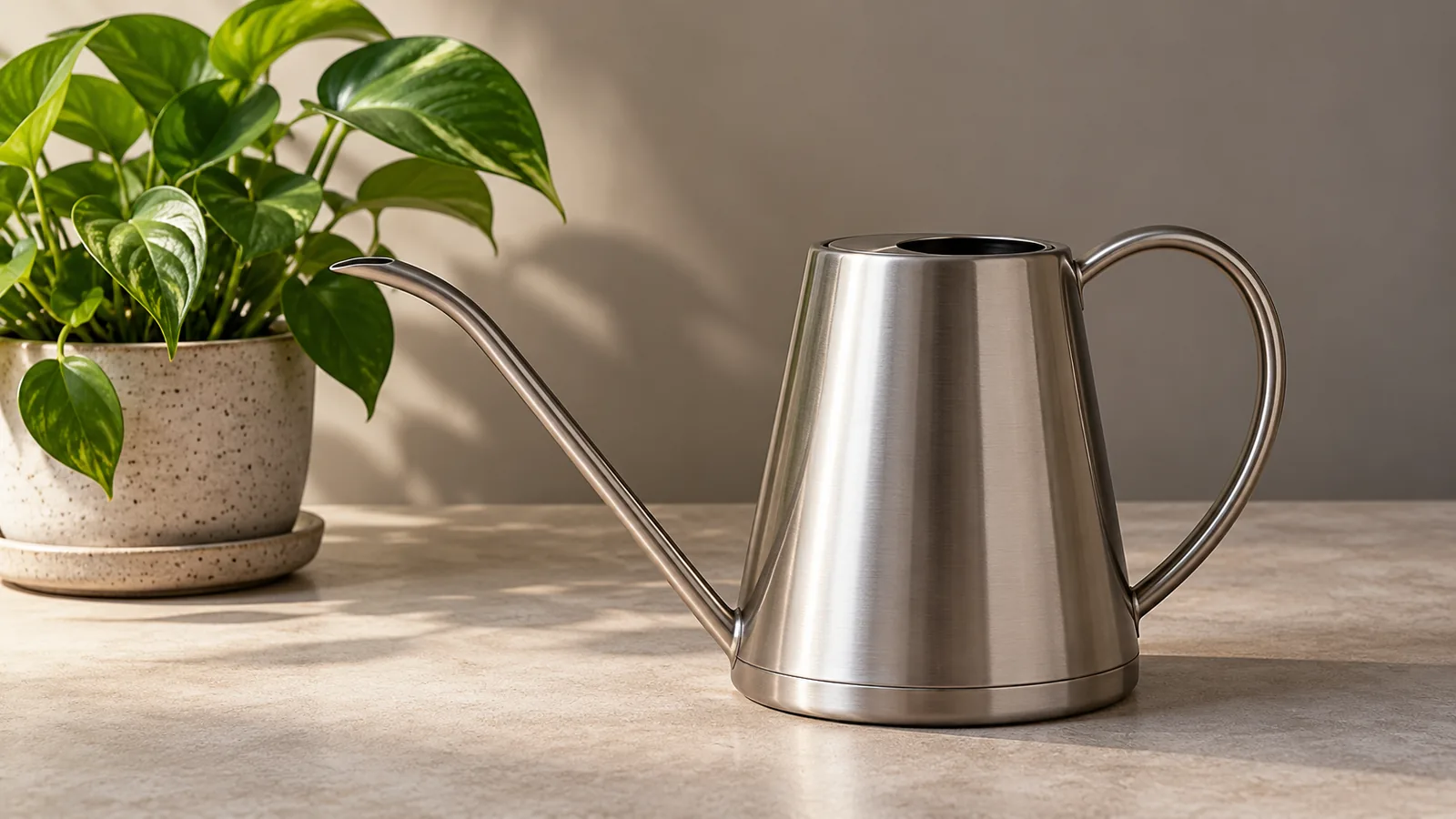
Illustrative review scene only: no pressure test or pass result is shown.
Agree a non-pressurized fill, hold, and pour observation
The buyer and supplier should agree a safe method for the exact item. Begin with a clean, empty sample in the approved configuration. Record the liquid used, fill condition or level, and orientation. Fill it normally through its opening; do not close it and apply pressure, attach a pump, or use a compressed-air setup. A watering can is not a pressure vessel, and this article does not propose a pressure test.
During a hold observation, place the can on a clean, dry surface and watch the mapped zones for the agreed period. The duration should be selected for the project and documented; this guide does not set a universal number of minutes or hours. Record whether a new bead or trail appears, where it first appears, and whether the result changes when the can is moved to another normal orientation. Avoid an uncontrolled sequence that makes it impossible to identify which condition produced the observation.
Next, conduct a normal controlled pour in the manner described for the product. Record the can’s orientation and whether the flow is intended to leave through the spout or a rose. Observe the body, base, spout root, and handle joints separately. After pouring, distinguish liquid that remains in the outlet from liquid that escapes through a structural joint. If the buyer’s concern is a particular orientation or use pattern, specify it in advance and do not treat an improvised demonstration as a formal qualification.
A useful report records:
| Review item | Information to capture |
|---|---|
| Sample identity | SKU, drawing/revision, supplier, date, finish, and configuration |
| Setup | Clean/dry condition, normal fill method, fill level or basis, and orientation |
| Observation zones | Body/base, spout root, handle joints, removable outlet, and other mapped locations |
| Timing | Start and observation times, including when a first sign appeared |
| Pour review | Normal orientation, outlet or rose configuration, flow observation, and residual liquid |
| Condition changes | Dents, shifted spout, altered base contact, finish damage, or other visible changes |
| Result and limits | What was observed, what was not checked, reviewer, and unresolved questions |
| Disposition | Accept, revise, reject, or request further product-specific review; owner and date |
If a leak appears, isolate the sample and preserve its condition for supplier review. Do not repair it with tar, household adhesive, or an unverified sealant. A proposed fix may affect water contact, coating, plant exposure, cleaning, or warranty terms. Ask the responsible product engineer or supplier to investigate construction and material compatibility. The buyer should avoid telling the market that a cause has been proven until the investigation supports that conclusion.
The exact keyword metal watering can leak test appears in supplier marketing and product discussions, but the phrase alone does not state what was checked. A useful question is whether the supplier can identify the test article, fill condition, orientation, observation zones, and result record. Do not treat “leak checked” as a complete acceptance criterion without those details.
A useful metal watering can leak test record ties each observation to a traceable sample and makes clear which conditions were not assessed.
Review the packed sample and projecting parts
A long spout, handle, rose, or decorative fitting can be exposed to contact during packing and handling. The pack should support the body while preventing unintended load or rubbing at those features. Inspect how the item is restrained, whether it can move inside the carton, and whether protective material touches a finish-sensitive surface. Packaging decisions depend on the exact product, carton, order configuration, and distribution route.
Ask for a representative packed sample or a documented pack review before final approval. Compare it with the approved loose sample. Confirm the spout angle and attachment, handle position, base contact, removable fittings, and finish condition after unpacking. If the buyer conducts or commissions a distribution simulation, agree the method and specimen configuration with qualified packaging personnel. A generic drop test, transit statement, or supplier photo does not prove every route or shipment.
After an agreed handling evaluation, repeat the non-pressurized fill and pour observations if the product’s projection or joints may have been affected. Record whether the same leak locations remain dry, whether the spout or handle has moved, and whether the can sits as before. Do not infer that a visible packaging scuff means a water-holding joint has failed, or that a can that appears unchanged has passed all possible transport conditions.
The included packaging illustration shows a concept: inserts hold the body and keep the spout and handle from floating unsupported in the carton. It does not represent an approved pack design, a transit simulation, or proof of shipment performance. The actual supplier should propose and validate the pack for the specified model and route.

Keep acceptance, use limits, and supplier changes distinct
Do not convert one sample into a universal claim
A sample review supports a decision about an identified sample under recorded conditions. It does not establish that all production units are identical, that every shipment will arrive undamaged, or that the product will remain leak-free throughout an undefined service life. Buyers should link the approved sample to the drawing, material and finish references, packing specification, and any test record. First production and incoming checks should reflect the product’s commercial risk and the buyer’s normal quality system.
Keep separate requirements separate. A water-holding observation does not prove corrosion resistance. A visually acceptable coating does not establish joint integrity. An indoor product’s successful demonstration does not establish suitability for outdoor freeze exposure, fertilizers, drinking water, or food contact. If one of those uses is required, the buyer should obtain relevant, product-specific evidence and review the applicable market requirements with qualified specialists.
The source material shows why limits matter. IKEA’s listed indoor model identifies its own component materials and use boundary. Haws discusses water expansion and possible base or spout damage for its own product guidance in freezing conditions. Neither source authorizes a claim for another design. Describe the actual model and evidence rather than copying a general statement across products.
Manage change and responsibility
The purchase specification should say which body, base, spout, handle, rose, finish, and packaging revision was approved. Define who may authorize a substitution and what evidence is needed before the supplier changes a joint construction, source, forming method, coating, attachment, or protective insert. Some changes may require only a drawing review; others may merit a new physical sample and repeat observation. The decision should be based on the affected feature and risk.
If a complaint occurs in the field, collect the same useful details: location, liquid behavior, product identity, when the issue first appeared, recent impact or storage conditions, and whether the can still holds and pours as intended. Preserve photos and, where practical, the actual unit. This creates a better supplier investigation than a message saying “the can leaks.” Do not pre-assign blame to the factory, packer, or carrier from a symptom alone.
For related home and garden hardware, a buyer may compare the specification and sample-review approach in Koitor’s garden hose-holder importer guide. It covers a different product and interface; it does not validate watering-can joints or water performance.
Buyer checklist and common questions
Before approving the order, confirm that the team has:
- Identified the actual SKU, drawing or sample revision, nominal capacity, body/base/spout/handle construction, finish, and intended use.
- Mapped likely liquid-exit locations and distinguished the outlet or rose from body and structural joints.
- Agreed on a normal, non-pressurized fill/hold and controlled-pour observation for the actual product.
- Recorded the sample condition, fill basis, orientation, observation timing, location, and reviewer.
- Kept the description of an observation separate from an unverified root-cause conclusion.
- Reviewed a representative packed sample and the support around projecting parts.
- Repeated appropriate observations after handling review if the product condition may have changed.
- Linked approval to the supplier, component, finish, and packaging change-control record.
- Avoided unsupported claims about outdoor/freezing, fertilizer, food, drinking water, or service life.
- Set a follow-up inspection plan suitable for the order rather than relying on one sample alone.
Does a drop from the rose always mean the body leaks?
No. A removable rose or outlet can retain liquid after pouring. Dry the can, observe the outlet separately, and map where new liquid first appears during the agreed fill and hold review. Record the conditions instead of diagnosing from a single drop.
Does “leak checked” tell an importer enough?
Not by itself. Ask which model and revision were checked, how it was normally filled, which joints were observed, how long and in what orientations, and what was recorded. The supplier’s wording is a claim until the underlying method and result are clear.
Should the buyer pressurize the can to find a small leak?
No. Do not treat a watering can as a pressure vessel or introduce a pressure test without an appropriate, qualified product-specific method. The project review described here uses normal non-pressurized filling and pouring only.
Does an indoor sample support outdoor or drinking-water claims?
No. Those uses may involve different exposure, material, coating, and regulatory considerations. Obtain relevant evidence for the exact finished product and intended market; do not infer it from a successful indoor demonstration.
Koitor scope and source limits
Koitor’s documented company information supports metal forming, finishing, basic assembly, and sample development for bathroom and home-storage hardware. That experience can inform a discussion about drawings, visible metal construction, finish, packaging interfaces, and sample records. It does not confirm current watering-can production, watertight brazing or soldering capability, water-contact validation, outdoor/freezing performance, or leak-test results. Those details must be qualified with the responsible product supplier and test provider.
For confirmed product scope, buyers can review the OEM home-storage hardware profile. For a feasibility discussion about a supported metal project, contacter Koitor with the drawing or sample, finish, target quantity, and packaging context.
Sources and evidence limits
- Haws: Telling the difference between wear and a genuine watering can fault: Manufacturer guidance about its own product; its classifications and warranty treatment are not universal rules.
- Haws: Care and Storage: Model-maker care information that discusses freeze-related examples; it is not a qualification for another brand.
- IKEA VATTENKRASSE watering can: First-party product listing for component materials and indoor-use scope of that model.
- Worth Garden watering-can supplier page et Century Household supplier page: Supplier descriptions were considered as existing commercial coverage, not independent proof of testing.
The checks in this guide are a buyer-supplier discussion framework, not an established universal leak standard. Any formal method, acceptance threshold, regulatory statement, or expanded use claim must be specified and substantiated for the actual product and market.
Discuss a Metal Hardware Project Within Koitor’s Confirmed Scope
Koitor works with buyers on custom metal bathroom and home-storage hardware from drawings or physical samples. Share the approved revision, metal-part requirements, finish, target quantity, and packaging concept for a feasibility discussion. Current watering-can production, water-contact validation, and watering-can leak-test results are not confirmed capabilities; those requirements must be qualified with the actual product supplier and test provider.
Fabrication pour compte de tiers / Marque de distributeur
Transformez ce guide d'approvisionnement en cahier des charges
Indiquez-nous le produit souhaité, ses dimensions, sa finition, la quantité commandée et vos exigences en matière d'emballage. Votre équipe recevra une analyse pratique de la faisabilité de la fabrication avant l'établissement du devis.

 English
 Español
 Português
 Français
 Deutsch
 العربية