
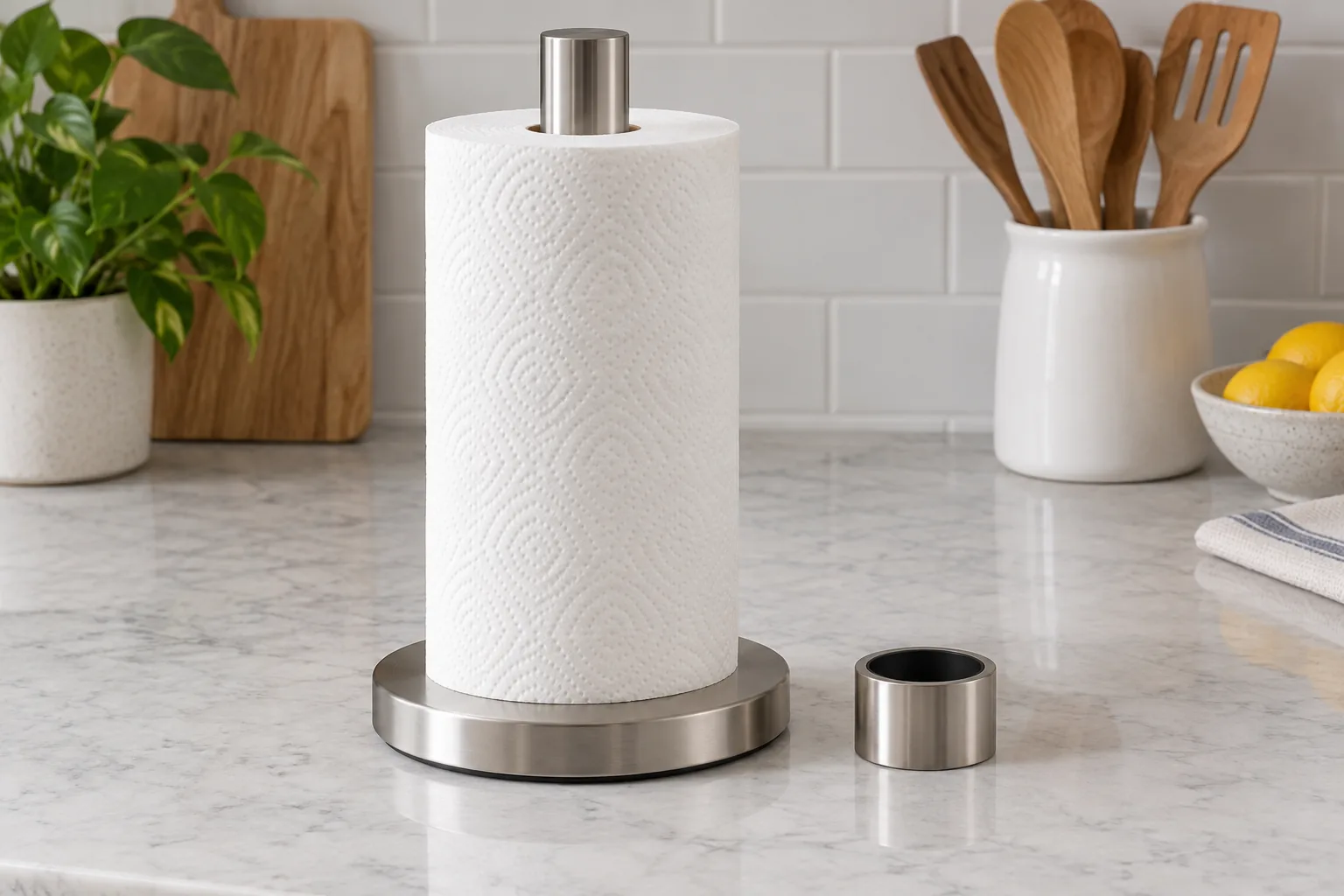
A paper towel holder tension mechanism should be evaluated across the roll conditions buyers expect, not by a single pull on a new full roll. Private-label product developers should compare the effort needed to dispense and tear a sheet, roll drag as diameter decreases, refill access, and whether the base shifts during use. Record the mechanism, roll type, test setup and acceptance decision on the sample so a supplier can reproduce the intended result without relying on an ambiguous word such as ‘tension.’
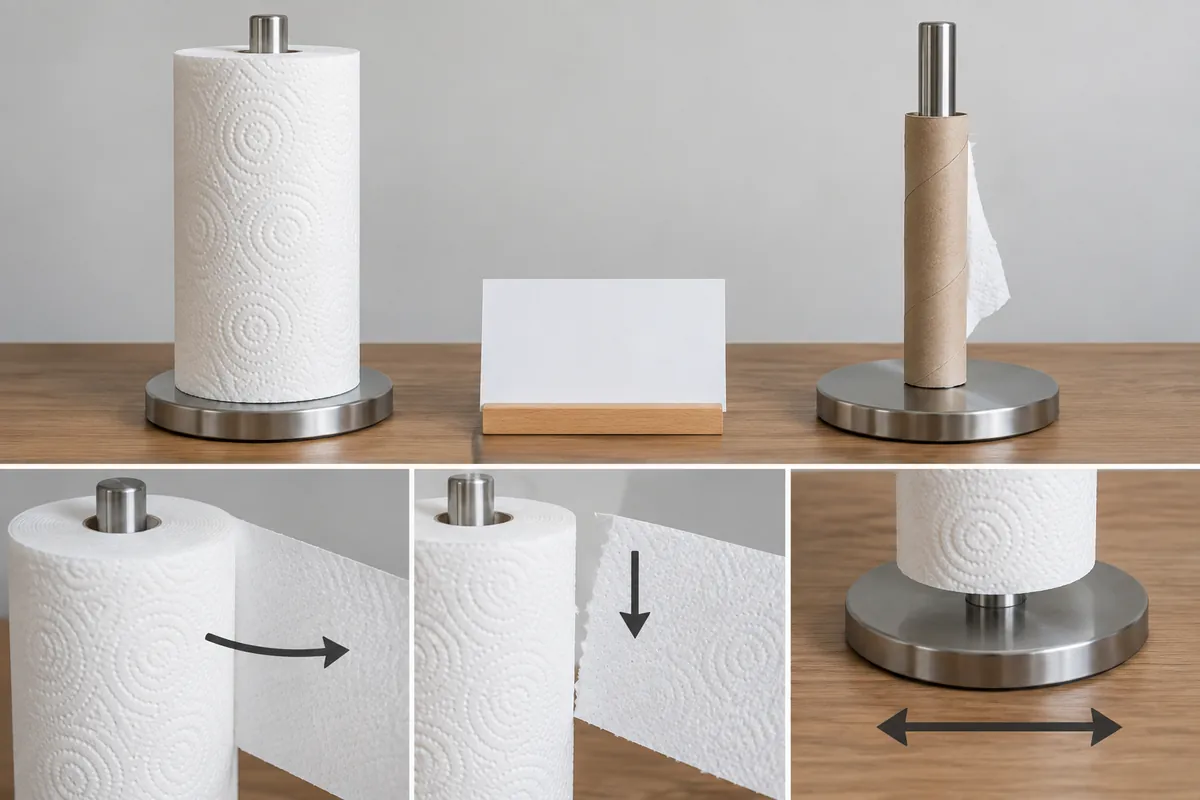
Why is tension a buyer specification rather than one universal feature?
The word tension can describe several different design behaviors. A spring arm may press against the roll, a collar may create friction around a spindle, a weighted base may resist movement, or the product may simply allow free rotation. These are not equivalent mechanisms. Each changes how the roll starts, turns and tears, and the buyer should decide which user problem the finished product is meant to address before the drawing locks in a concept.
The roll itself changes the interface. A full roll has a larger radius and more paper mass; a nearly empty roll presents a smaller radius and a different place for a user to grasp and tear. Core diameter, roll width, sheet perforation and paper texture also vary across retail formats. A mechanism that feels controlled with one roll cannot be assumed to behave the same with every private-label assortment.
Separate three outcomes during review: rotation drag, tear effort and base movement. A holder can control the roll but still make tearing awkward; a stable base does not prove that the roll dispenses smoothly. If reviewers combine all three under ‘works well,’ the sample feedback will be difficult to reproduce. Use a short observation sheet with a separate rating or pass criterion for each outcome.
The exact search phrase paper towel holder tension mechanism is therefore a useful umbrella for a buyer decision, not a request for a universal force value. The acceptable behavior depends on target rolls, installation context, user expectations and the selected design. Any numerical limit should come from the buyer’s product requirement and an agreed test method, not a generic article or another supplier’s product page.
Which mechanism concepts should a private-label buyer compare?
A free-spinning spindle is mechanically simple and can support quick roll replacement. Its trade-off is that the roll may continue turning after a sheet is pulled, depending on the product geometry and how the user tears. Buyers considering this route should check whether the intended sheet can be separated without the holder sliding or feeding more paper than expected. The review should not mistake low rotational resistance for successful one-handed use.
A friction collar or contact feature adds resistance at a defined interface. It may moderate free rotation, but contact pressure, surface condition, alignment and component variation can alter the feel. Ask the supplier to identify which surfaces create friction and how the assembly retains the relevant parts. The purpose is not to copy a named mechanism, but to make the concept and its controlled interfaces visible on the drawing and sample.
A spring-loaded arm can press on the roll and may be designed to accommodate changing roll diameter. It adds a moving part and a user interaction that should be reviewed for access, return behavior, pinch or snag concerns, packaging restraint and repeat assembly. Product-specific safety or performance claims require their own qualified review; a general visual sample check is not certification or a durability test.
Some products combine a dispensing feature with a heavier or wider base. The base affects resistance to sliding and tipping, while the contact feature affects roll behavior. Treating the base as the tension mechanism can hide the actual cause of a poor sample. A comparison table is useful only when all concepts are evaluated with the same rolls, surface, pull direction and acceptance criteria.
What belongs on the drawing and request for quotation?
Identify the mounting orientation first: this guide concerns a freestanding countertop concept. Show the base footprint, spindle axis, roll envelope and any arm or collar in a finished assembly view. Include a section or detail that identifies friction contacts, spring interfaces or retainers when those features are part of the concept. A render alone may not show how parts engage or what the supplier is expected to control.
List target roll samples or a defined roll envelope, including width, core fit and full-to-nearly-empty conditions. If the assortment includes more than one common format, identify representative samples and which are mandatory for approval. Do not write ‘fits all rolls’ unless the buyer has validated a defensible scope. A set of physical samples with IDs and photographs can help the supplier understand the user conditions behind the drawing.
Specify material and finish requirements only as supported by the project. The part may use formed or joined metal components and purchased elements, but the actual grade, thickness, finish route and source need confirmation. Mark the cosmetic faces, assembly interfaces and visible joints. Identify which features are controlled dimensions and which are visual references. If the supplier proposes a different friction material or process, request a change record and a new evaluation of affected behavior.
The RFQ should also state what is included in the sample: production-intent parts, fasteners or subcomponents, packaging, labels and any assembly instructions. Ask the supplier to quote tooling or fixtures separately where relevant, describe assumptions and note which specifications remain open. Avoid embedding an unapproved performance threshold in a template. The buyer and supplier should agree a measurable method before price or delivery depends on it.
How should buyers test full and nearly empty rolls?
Use the same countertop material and a consistent setup for each candidate. Confirm that the base is clean and positioned as intended, place the identified roll on the spindle and note the starting condition. Pull from the same direction and use the same sheet count or perforation location where practical. A simple controlled sequence is more useful than a dramatic demonstration because it makes differences between samples easier to discuss.
For a full roll, observe whether the roll starts smoothly, whether it unwinds farther than expected after release, and whether the user can separate a sheet without pushing the whole holder. Repeat the observation rather than drawing a conclusion from one pull. Record any visible rocking, sliding or contact with nearby surfaces, but do not translate those observations into a load or life claim.
Repeat with a nearly empty roll or core. The smaller diameter can change where the paper is grasped and how a spring or collar contacts the roll. Check whether the mechanism still behaves consistently, whether the core remains seated and whether refill or removal becomes awkward. If a mechanism no longer contacts the roll at this stage, note the observation and ask whether that condition is inside the intended product scope.
When reviewers disagree, capture the roll ID, surface, pull direction, sample revision and observed behavior before discussing a redesign. A short video can supplement the record if it shows the setup, but it does not replace the agreed acceptance method. Separate an observation (‘base moved during the pull’) from a diagnosis (‘base is too light’) until the cause has been checked. This distinction keeps supplier feedback actionable and avoids unsupported engineering claims.
How can a buyer compare the alternatives fairly?
A useful comparison table should list the mechanism, roll conditions, user action, refill steps, base behavior, assembly complexity and open questions. Compare concepts against a single intended use case. If one candidate is tested with a full roll on stone and another with a small roll on laminate, the result reflects a mixed setup rather than a controlled design comparison.
The paper towel holder tension mechanism should therefore be selected against the buyer’s named roll assortment and repeatable sample sequence, not a supplier’s unqualified description of smooth operation.
Look at the complete user sequence: loading a roll, locating the paper edge, pulling a sheet, tearing it, and replacing the roll. An added spring or collar may improve one moment while complicating another. Ask reviewers to describe what they did and where effort or hesitation occurred. This qualitative detail often yields better design feedback than a single overall score, especially while the product concept is still being finalized.
A concept that uses fewer parts may be easier to explain and assemble, but part count alone does not establish cost or reliability. Material, finish, joining, purchased components, packaging and inspection all contribute. A more complex concept may be appropriate if its user behavior justifies the added operations and the supplier can support the required controls. Request a costed design alternative only after both options share the same functional and finish requirements.
Use a sample approval matrix to distinguish must-have conditions from preferences. Define the target roll set and countertop setup, record what was observed, and identify which open question must be resolved before release. Approval should refer to a sample ID, drawing revision and date. If a later material, supplier or mechanism change can alter friction or assembly, state the change-notification and re-sample trigger in the project records.
What manufacturing and quality questions should be closed before release?
Ask how the assembly maintains alignment between the spindle, base and any moving or contact feature. The supplier can explain the proposed forming, joining, finishing and assembly route for the actual project. Buyers should review whether visible joints, edges and contact surfaces meet the approved sample. Do not assume that a visually similar finish means an internal interface or purchased component is unchanged.
For metal parts, clarify the material description and traceability expectation that apply to the order. If the mechanism includes a spring or polymer contact component, identify its specification and approved source separately. The article does not assert Koitor currently manufactures this countertop product or controls every specialist component. Confirm scope, sourcing responsibility and inspection evidence in the quotation and project documents.
Define incoming and final checks around the actual risk. A visual check can review finish and assembly orientation; a fit check can confirm the specified rolls load; a behavioral check can follow the agreed dispensing sequence. These checks answer different questions. If the buyer needs durability, safety, chemical or regulatory evidence, identify a qualified method and responsible party rather than treating a casual sample exercise as a substitute.
Packaging deserves a review because a projecting spindle or loose friction part may be affected by movement in the carton. Ask for the proposed component protection and assembly state, then inspect an unpacked sample for finish contact or missing parts. Packaging decisions should reflect the shipment configuration and buyer requirements. Do not promise that a particular insert prevents damage without an appropriate validation record.
Mechanism comparison
| Concept | Potential buyer benefit | Sample question |
|---|---|---|
| Free-spinning spindle | Fewer added contact features | Does the roll overrun or tear awkwardly? |
| Friction collar | Adjusts roll resistance at an interface | Does drag remain acceptable across roll sizes? |
| Spring arm | May maintain contact as diameter changes | Are loading, return and access acceptable? |
| Wider or heavier base | May influence movement on the counter | Does the base stay in place in the agreed setup? |
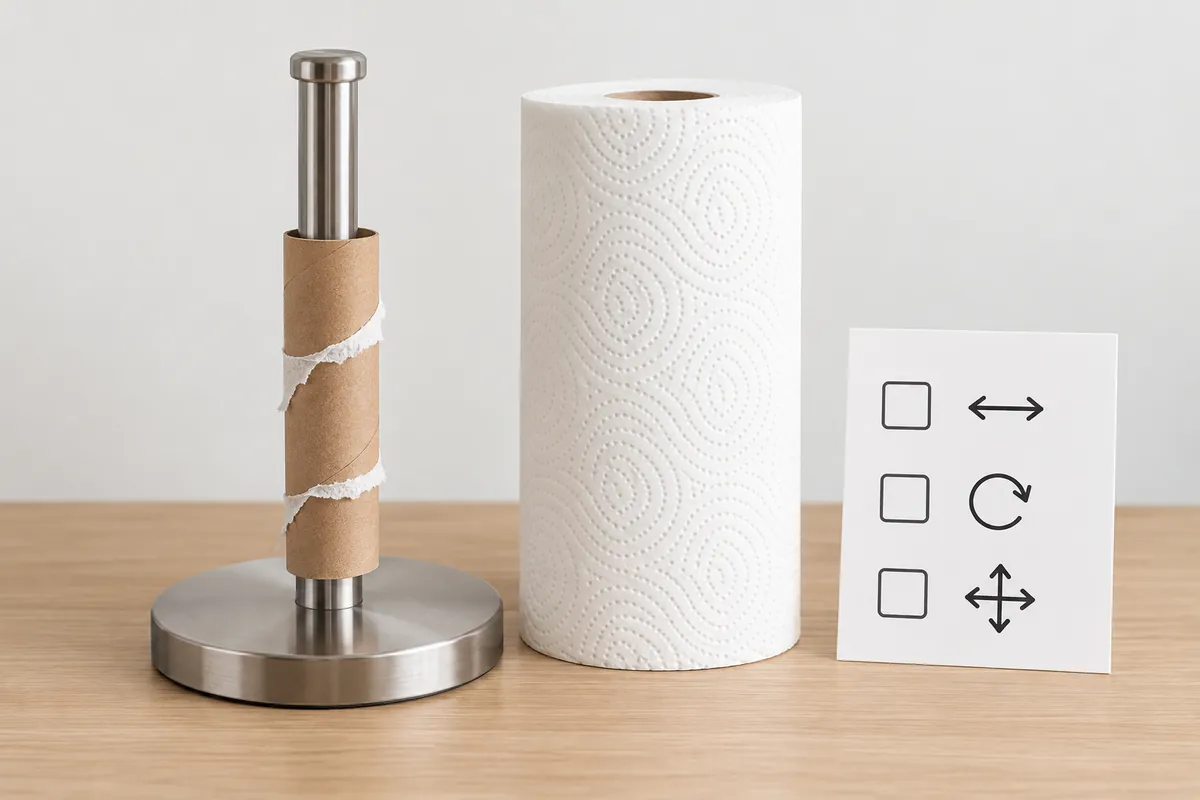
Buyer sample checklist
- Record drawing revision, sample ID, mechanism concept and target roll formats.
- Test a full and nearly empty roll on the agreed countertop surface and pull direction.
- Observe roll drag, tear effort and base movement as separate outcomes.
- Review loading, removal, contact points, assembly and finished appearance.
- Document open questions, evidence, acceptance decision and any re-sample trigger.
Foire aux questions
Does more tension always make a paper towel holder easier to use?
No. Additional resistance can reduce free rotation but may also increase pull effort. Buyers should evaluate drag and tearing separately on representative rolls.
Should the sample be checked only with a full roll?
No. Include a nearly empty roll or core if that condition is relevant to the intended assortment because contact and user access can change as the roll shrinks.
Can a heavier base replace a roll-control feature?
Not necessarily. The base affects movement on the counter; a collar, arm or other interface affects roll rotation. Evaluate the functions separately.
What should a buyer send with the RFQ?
Provide the drawing or concept, target roll samples or envelope, mounting context, finish expectations, quantity range, packaging needs and decision-specific sample checks.
Does this article confirm Koitor currently makes this product?
No. It is an adjacent sourcing and sample-evaluation guide. Confirm product scope, component sourcing and process route for each project.
For a related metal-hardware manufacturing context, see Koitor’s custom metal storage hardware page. Buyers can contacter Koitor with a drawing, roll samples and the behavior they want to evaluate. This does not imply a confirmed countertop paper-towel holder SKU.
Collaborez avec Koitor Hardware
Review a Metal Hardware Sourcing Brief
Share the drawing or sample, target quantity, material and finish requirements, target rolls and packaging expectations so the project scope and sample questions can be discussed. This article is adjacent sourcing guidance, not a claim of a current Koitor countertop SKU.
Fabrication pour compte de tiers / Marque de distributeur
Transformez ce guide d'approvisionnement en cahier des charges
Indiquez-nous le produit souhaité, ses dimensions, sa finition, la quantité commandée et vos exigences en matière d'emballage. Votre équipe recevra une analyse pratique de la faisabilité de la fabrication avant l'établissement du devis.
 English
  Español
  Português
  Français
  Deutsch
  العربية