
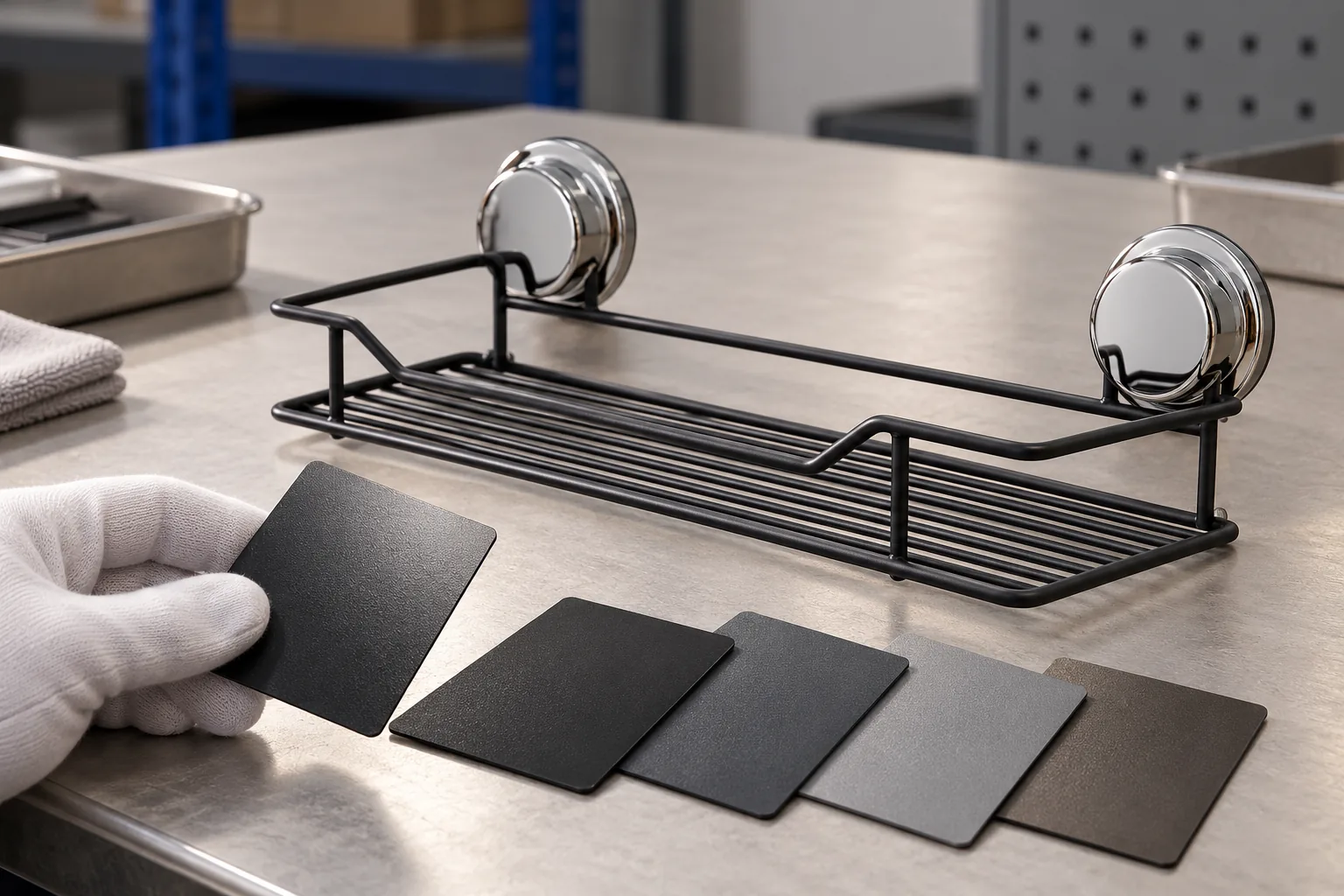
Powder coating texture fingerprint resistance cleanability should be approved together on a representative finished sample, not inferred from a color code or gloss description alone. For a coated bathroom basket, the importer should define the intended texture, the conditions in which fingerprints will be noticed, the cleaning method expected in service, and the evidence needed before production. Fine and coarse textures can look different, collect soil differently, and respond differently to wiping; the exact coating system and product geometry determine what is acceptable.
This topic is deliberately narrower than a general cosmetic-defect standard or a gloss-versus-reflection guide. It is about selecting and approving a texture when buyers care about handling marks and routine cleaning. The product sample should represent the actual wire, welds, mounting hardware, pretreatment, coating route and viewing conditions. A panel or catalog image can help start the discussion, but it cannot fully predict how the finish will look and feel on a three-dimensional wire basket.
Why should buyers link texture, fingerprints and cleanability?
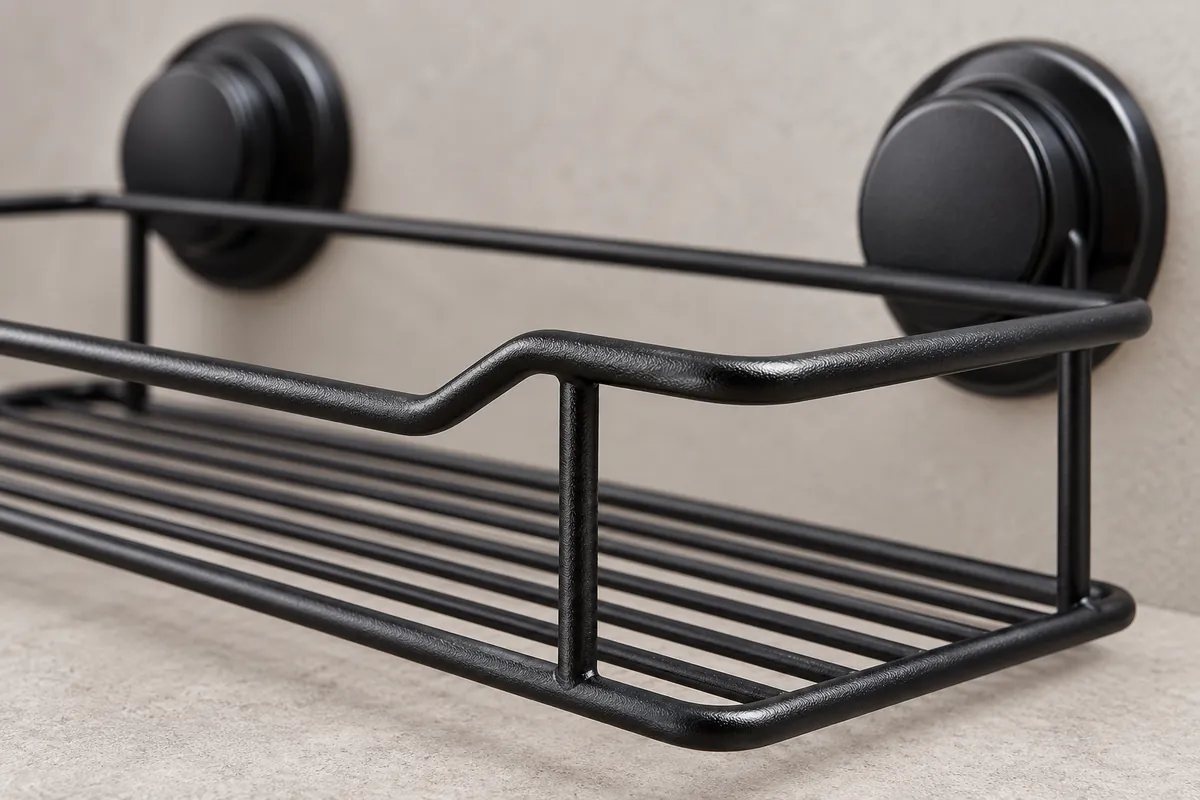
Texture is not only a visual style. The peaks, valleys and pattern of a coated surface influence how light reflects and how soil or handling marks appear. A matte or textured sample may make some marks less conspicuous from one angle, while a more pronounced texture may make residue harder to remove from grooves. These are design trade-offs to evaluate on the intended product, not universal performance rules. A texture that looks forgiving in a small swatch may feel too rough or look inconsistent across a basket’s bends and welds.
Fingerprint resistance is also a visibility question, not simply a claim that a coating prevents fingerprints. Skin oils, handling frequency, lighting direction, color, sheen, texture depth and cleaning interval all affect whether marks are seen. Buyers should define the relevant user journey: will the product be handled during installation, restocking, daily use or retail display? A distributor selling a private-label bathroom organizer may have a different appearance priority from a hospitality project or an e-commerce pack-out where the user first sees the product under bright photography lights.
Cleanability should be defined for the actual exposure. Bathroom products may encounter water droplets, soap residue, personal-care products and ordinary dust, but the buyer should list only the substances and cleaning agents relevant to the intended market and instructions. Do not assume that a texture tolerates abrasive pads, solvents or concentrated cleaners simply because it is a powder coating. Coating suppliers publish product-specific care information; the approved powder, cure and cleaning instructions should control.
The buyer’s decision is therefore a balance among appearance, tactile feel, handling marks and a realistic cleaning method. A sample approval should record all four rather than reducing the request to “matte black” or “easy to clean.” The goal is not to demand a laboratory test that Koitor or the supplier has not confirmed they can perform. It is to make the acceptance target and evidence owner explicit before a bulk order.
In practical procurement terms, powder coating texture fingerprint resistance cleanability is a combined finish-approval requirement: each word needs a visible reference or a defined observation condition. If the buyer only names a texture but never specifies handling or cleaning context, suppliers can deliver technically similar powders that still create different user impressions.
Which product and coating inputs should be fixed?
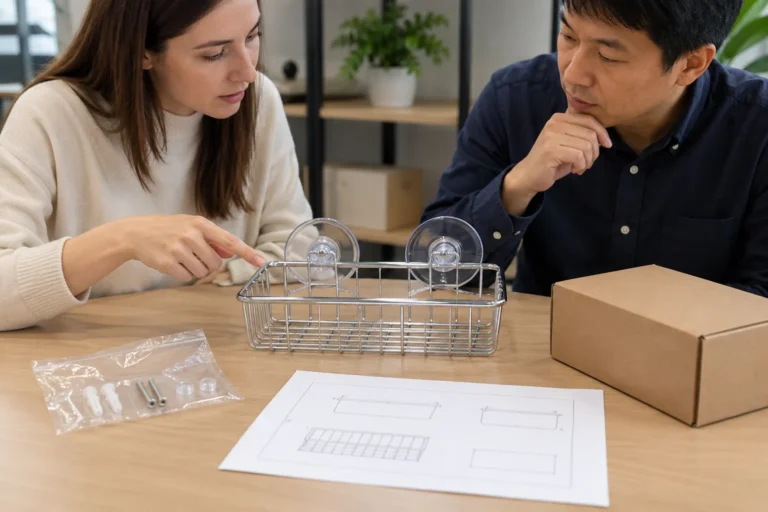
Begin with the product definition. Identify the item number, drawing revision, basket size, wire diameters or profiles, weld locations, mounting type and visible faces. A two-suction basket should be reviewed with both suction mounts installed because their nearby supports, contact points and shadows can change what the buyer sees. If the program includes several sizes, confirm whether the smallest and largest versions share the same visual target or need separate samples. Never approve a coating color or texture on one configuration and silently assume that all variants will present identically.
Record substrate and pretreatment at a useful level. Buyers should identify the base metal form and any agreed cleaning or conversion-preparation route that affects the coating interface. The source data sheet for the selected powder should be linked to the finish approval, including product name, code, manufacturer revision and approved color or texture reference where available. If the exact formulation is supplier-controlled, retain a controlled product code and change-notification obligation rather than an ambiguous verbal description.
Coating application and cure conditions can affect the appearance of textured products. TIGER Drylac’s textured-finish information explains that film build, cure heat-up profile and application equipment can influence the resulting texture; it also warns that a recoat can create a different textured effect. Those observations are specific to the manufacturer’s material guidance and should not be turned into universal numeric requirements. For a buyer, the useful implication is to ask what production variables are controlled and whether the proposed sample follows the intended route.
Geometry also matters. Straight wire, bends, intersections, inside corners and areas near mounting components may not present identically. A sample needs to include the most visually important and process-sensitive locations. If a product is assembled after coating, confirm whether assembly contact can mark or damage the visible surface. If coating is applied after welding, inspect weld transitions and the full path around joints. The approval should reflect the actual sequence, not a simplified demonstration coupon alone.
How should buyers compare smooth, fine and pronounced textures?
Compare options using the same substrate, color family, part geometry and review conditions. A smooth finish often gives a clear view of underlying surface variation and can be straightforward to wipe, but marks may be visible under some lighting. A fine texture can soften reflections and tactilely distinguish the product, but buyers should test whether the selected cleaner removes residue without leaving fibers. A pronounced texture may mask some visual variations, yet deep surface relief can complicate wipe-down. None of these options is automatically superior for every bathroom product.
| Finish direction | Potential buyer advantage | Trade-off to evaluate | Sample evidence to request |
|---|---|---|---|
| Smooth or low texture | Easy-to-read appearance and a direct comparison with color or gloss references | Handling marks or substrate variation may be more noticeable in certain light | Full finished part viewed from agreed directions and lighting |
| Fine texture | Can soften reflections while retaining a subtle tactile surface | Fine valleys may hold lint or show a different sheen than a flat swatch | Product sample plus a controlled wipe-and-dry comparison |
| Pronounced texture | Distinctive tactile effect and visual pattern | Cleaning access, residue retention and variation between wire orientations need review | Samples from representative curved, welded and exposed areas |
This is a selection framework rather than a performance ranking. A vendor’s description such as “fingerprint resistant” or “easy-clean” should be followed by a definition: compared with which reference, under what handling and lighting, using which cleaning procedure, and judged by whom? If the supplier has a product-specific data sheet or care instruction, ask the coating owner to identify its scope. Do not transfer a claim from a different resin, color, texture or substrate without confirmation.
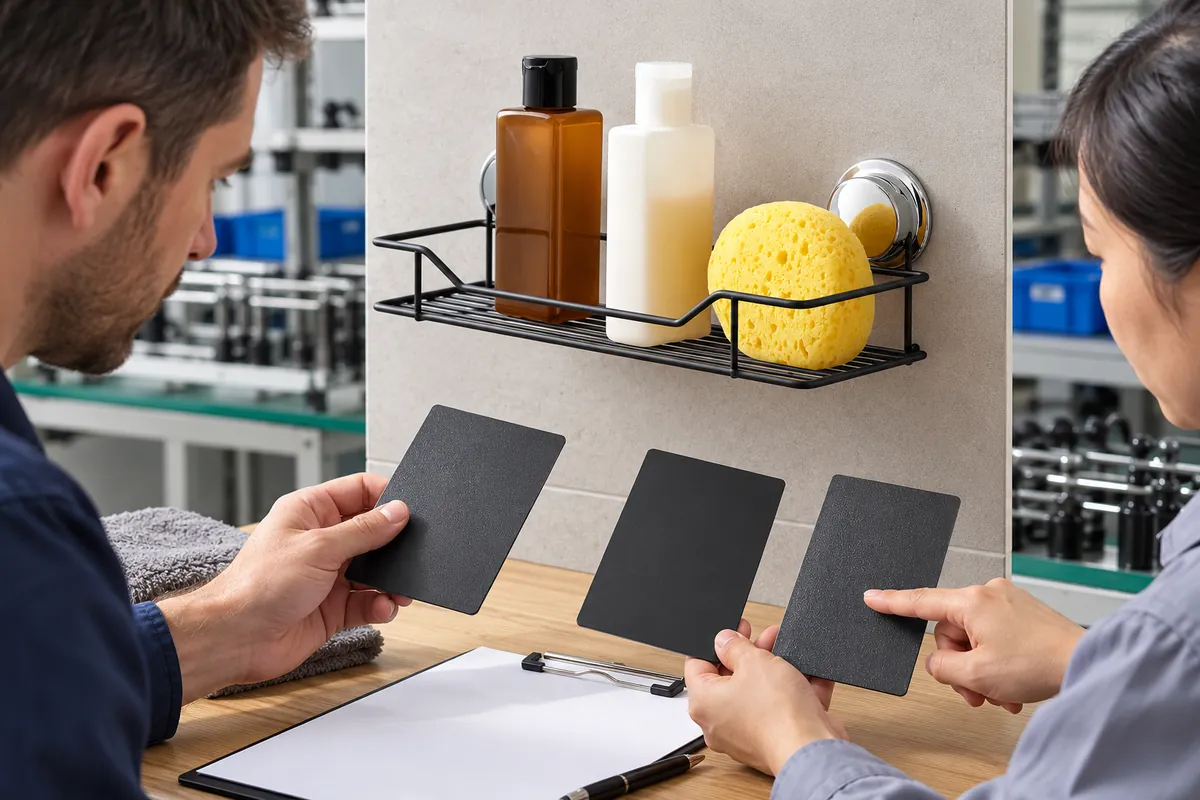
For a private-label program, let the marketing team see the same physical sample that quality and sourcing approve. If the product will be photographed for online listings, compare the sample under diffuse and directional light and against the planned background. If it will be displayed in a showroom, also consider side lighting and close viewing distance. Keep a note of the final sample ID and retain a reference part; digital images can support traceability, but monitor settings and camera processing make them an unreliable sole color or texture standard.
What sample evidence is useful before production?
Request at least one finished production-intent basket that includes the actual wire geometry, weld transitions, mounting system and coating sequence. If the decision is about texture, a flat coated panel is useful for comparing powder candidates but should be treated as a supplement. Ideally, keep a small set of panels made on a comparable substrate alongside the finished basket. The panels help isolate finish appearance; the product shows how coating coverage and texture present on curves, intersections and edges.
Agree the inspection conditions before the sample arrives. Record the lighting type or practical viewing setup, approximate distance, viewing directions, whether the sample is clean and dry, and whether fingerprints are evaluated before or after cleaning. Avoid relying on a single photograph taken at an uncontrolled angle. A buyer may use a simple photo record with the same background and lighting each time, but should keep the physical sample as the main reference for appearance and tactile review.
For fingerprint visibility, define a repeatable handling comparison without overstating it as a standardized test. The parties might agree who handles the sample, which visible area is assessed, how long it rests, and whether marks are reviewed before cleaning. The aim is to compare candidate finishes under the buyer’s scenario, not to claim a universal fingerprint rating. Keep skin oils and cleaning agents controlled enough that the two options are compared fairly, and document any deviation.
For cleanability, start with the coating manufacturer’s care instructions and the product’s intended cleaning language. Specify the approved cloth type, cleaning solution, dilution if the product owner provides one, wipe method and drying condition. Test only agents the supplier or coating manufacturer confirms are suitable. Record whether residue remains, whether lint is trapped, and whether the surface changes in appearance or feel. Do not improvise an abrasive or chemical challenge and then generalize its outcome to all coatings.
How can a buyer assess cleaning without inventing a test?
Separate a product-care evaluation from a coating qualification test. The coating supplier’s technical documentation may provide approved cleaner classes, prohibited chemicals or maintenance recommendations. Use those instructions as the first boundary. If a buyer needs an additional comparison because of a particular market or customer requirement, write a small, agreed protocol and have the coating owner review it before execution. A simple wipe demonstration can inform a choice, but it does not certify chemical resistance, corrosion performance or service life.
Use the same starting condition for each finish. Confirm that both samples are cured and conditioned according to the supplier’s process. Apply the same type and amount of residue, use the same dwell interval if relevant, wipe with the same cloth and motion, and assess the same locations after drying. If the residue is not representative of intended use, label the demonstration as exploratory. The article’s images show a sample discussion and texture review; they are illustrative and do not represent measured performance data.
Define what “clean” means to the buyer. It may mean no visible residue under agreed lighting, no retained lint, no obvious change in sheen or texture after routine cleaning, or a product-specific criterion reviewed by the finish owner. These outcomes should be written in plain language and agreed before comparing suppliers. If a healthcare, food-contact or regulated-cleaning environment is involved, do not assume a general bathroom accessory finish meets it; seek the necessary technical and compliance review for that use.
Consider product access. A basket with closely spaced wires, corners and mounting supports may be harder to wipe than a flat test panel even if the coating surface itself is compatible with a cleaner. Buyers can reduce avoidable cleaning frustration through geometry choices such as accessible junctions and adequate spacing, but those design decisions should be checked against the product’s storage and retention function. A finish is only one part of cleanability; the shape and assembly create the rest of the use condition.
When should the approved sample be reviewed again?
Reopen approval when a change could affect appearance, fingerprint visibility or cleaning behavior. Examples include a new powder product or product code, supplier or formulation change, a change in color or texture reference, altered substrate or pretreatment, a different film-build target, changed cure profile, different spray equipment, a recoat/repair process, or a revised part geometry that changes coverage and access. The coating manufacturer’s documentation notes that recoat can produce a different textured effect, so repair instructions should be agreed rather than assumed.
Ask for a concise change notice: what changed, why, which products and revisions are affected, whether the approved sample remains representative, what evidence is proposed, and whether shipment should pause until review. If the supplier cannot share proprietary process detail, an agreed system identifier, sample comparison and notification obligation can still help the buyer control risk. The buyer does not need to prescribe every oven setting, but should know which finish inputs are supplier-controlled and which require customer approval.
Retain the approved sample in clean, labeled storage with its project, part revision, coating identification and approval date. Keep an image record for retrieval, but do not let a photo silently replace the physical standard when tactile texture or cleaning is in scope. For repeat orders, compare a production sample to the retained reference under the same general conditions and record whether the appearance remains within the agreed range. If the reference has degraded, become contaminated or lost its identity, replace it through a documented approval process.
Buyer checklist for a textured-coating RFQ
Use this checklist to turn subjective finish words into a manageable procurement decision:
- Identify the part number, drawing revision, visible faces, mounting system and representative product size.
- Name the coating manufacturer and controlled powder product/code where available; confirm the revision or equivalent-change rule.
- Describe the desired texture in plain language and attach a physical reference or approved panel, not only a screen image.
- State how fingerprint visibility will be judged: handling context, viewing area, lighting and comparison finish.
- State the routine cleaning agents and cloth expected in use, and obtain coating-owner confirmation that they are appropriate.
- Request a production-intent sample containing curves, welds, corners and assembly interfaces.
- Agree sample identity, inspection conditions, cleaning procedure, observations and approval owner before testing.
- Define limit samples or acceptable variation where texture intensity can vary across locations or parts.
- Record the approved repair/recoat method and the conditions that require resubmission.
- Set change-notification triggers for powder code, supplier, substrate, pretreatment, application route, cure route and geometry.
For quotation comparison, ask each supplier to price the same finish scope: sample panels if needed, production-part sample, approved cleaning instructions, rework limits and evidence records. This avoids comparing one supplier’s generic color-match promise with another supplier’s complete sample-approval process. If the exact texture or cleaner compatibility is not yet known, mark it as an open development item with an owner and target approval milestone rather than hiding it in a vague line item.
The same rule applies when a project brief uses the phrase powder coating texture fingerprint resistance cleanability: define which finish sample is the reference, what handling mark is relevant, which cleaner is intended and who signs the final decision. This keeps a taste preference from turning into an unbounded warranty promise.
Frequently asked questions
Does textured powder coating always hide fingerprints?
No. Texture, color, sheen, oil transfer, lighting and handling all influence visibility. Compare the candidate finish under the buyer’s real viewing conditions instead of relying on the texture label.
Is a flat coating swatch enough to approve a wire basket?
No. A panel can help compare formulation and appearance, but a finished basket is needed to review curves, welds, corners, coverage and the actual mounting configuration.
Can a buyer use any household cleaner in a sample trial?
Not without checking the coating manufacturer’s care guidance. Agree on intended cleaning agents first and avoid making broad chemical-resistance claims from an informal wipe trial.
Should gloss readings decide texture acceptance?
Not by themselves. Gloss can be one attribute when appropriate, but texture changes surface reflection and tactile perception. Use the approved physical sample and agreed viewing conditions for the texture decision.
What should happen if a supplier changes the powder or recoats a part?
Notify the buyer, identify the changed finish system and review a representative sample. Recoat can produce a different textured effect, so the repair route should be approved for the specific product.
Koitor’s confirmed scope includes custom metal bathroom and home-storage hardware and powder coating, while the exact coating system, powder code and product-specific care performance must be confirmed for each project. Share the drawing or sample, finish reference, intended cleaning conditions and approval requirements through Koitor’s contact page, or review the OEM manufacturing overview.
Technical references: TIGER Drylac textured-finish technical information et TIGER Drylac cleaning recommendations. Confirm the current product-specific documentation with the coating supplier before use.
Discuss your coating specification
Share the part drawing, target texture, cleaning conditions and sample-approval requirements for a project-specific review.
Fabrication pour compte de tiers / Marque de distributeur
Transformez ce guide d'approvisionnement en cahier des charges
Indiquez-nous le produit souhaité, ses dimensions, sa finition, la quantité commandée et vos exigences en matière d'emballage. Votre équipe recevra une analyse pratique de la faisabilité de la fabrication avant l'établissement du devis.

 English
  Español
  Português
  Français
  Deutsch
  العربية