
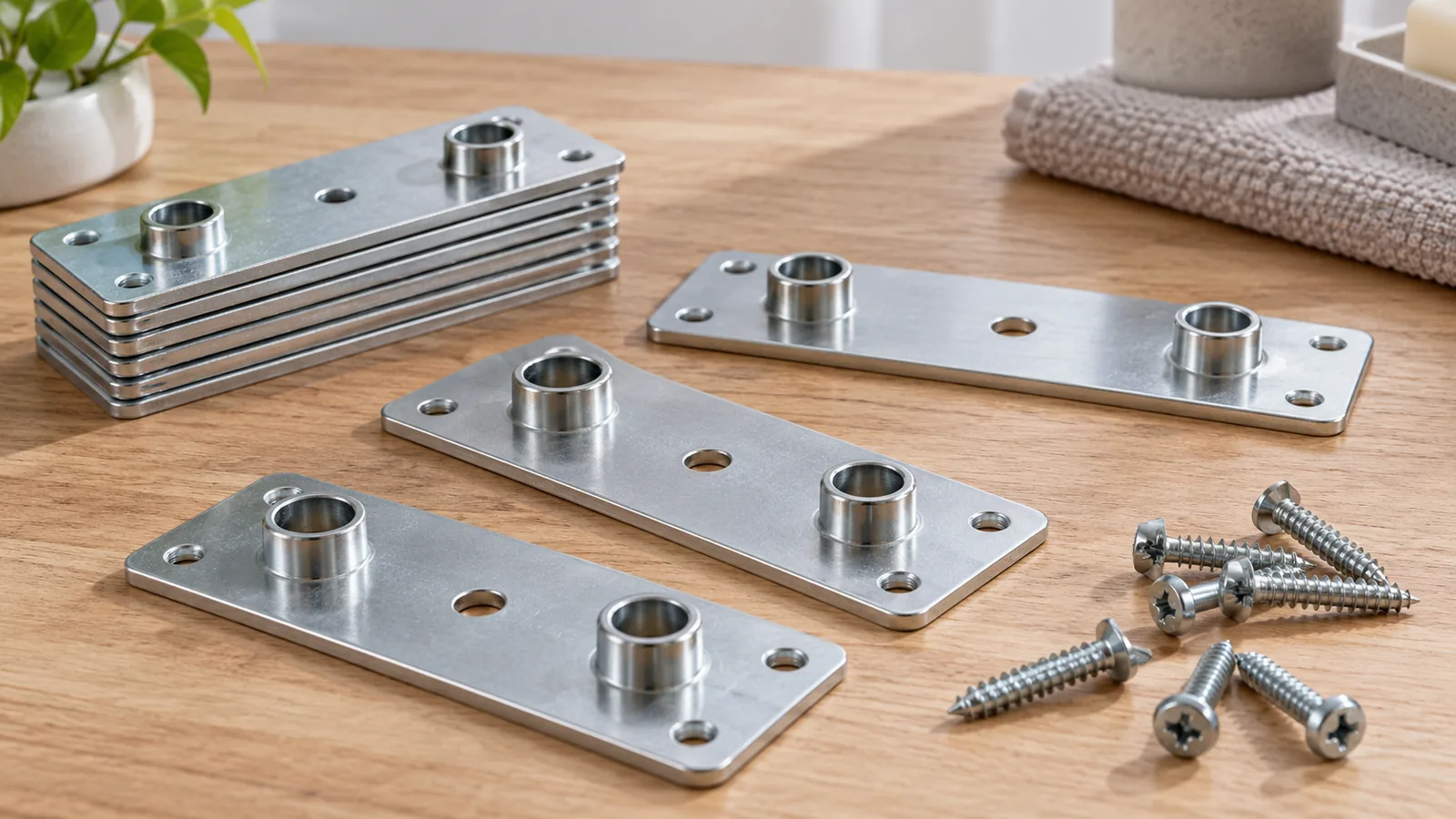
Why formed-hole details matter to a hardware buyer
Buyers reviewing punched extruded hole collar height thread engagement need to understand how a raised collar around a hole relates to the fastener and the complete mounting-base design. The feature may provide a longer material path for a threaded connection in a sheet-metal part, but its suitability depends on material, thickness, hole geometry, forming route, thread specification and the joint’s purpose. A collar drawing alone does not prove that the intended screw will assemble or hold as designed.
In bathroom and home-storage hardware, a mounting plate may connect a bracket, rail, cover or accessory to another component. A formed collar can be one candidate approach, while a plain punched hole, separate nut, insert or other joining method may be appropriate in other designs. This guide compares buyer questions and approval evidence; it does not prescribe a universal process or claim that every collar is suitable for every material or load.
The buyer’s task is to describe the mating fastener, required engagement and assembly condition, then review a sample made from the intended material and geometry. Keep thread engagement distinct from collar height: a taller feature does not automatically mean a correctly formed or functional thread. Both the formed feature and the completed joint should be evaluated against the actual design requirements.
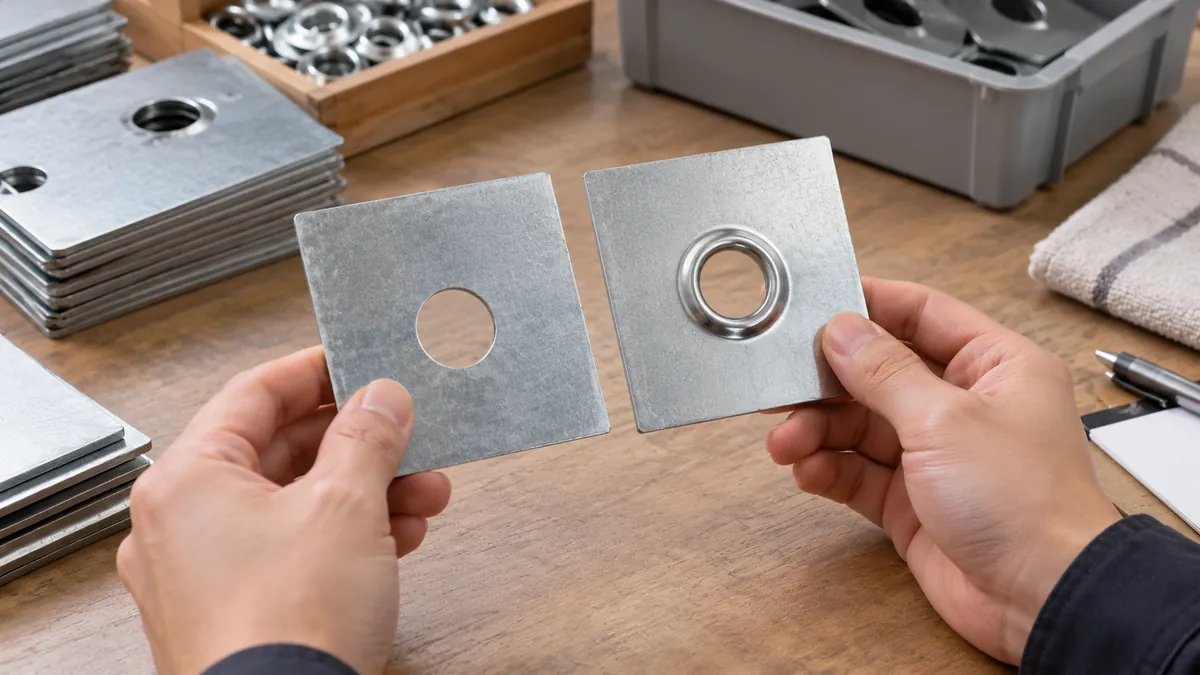
Distinguish collar height from usable engagement
Collar height describes a formed geometric feature relative to a defined surface. Thread engagement describes how the screw and internal thread interact when assembled. They are related, but they are not the same measurement. The buyer should define from which surface collar height is measured and how the thread is verified. If the drawing uses a section view, identify the reference plane and whether the dimension includes a radius or transition zone.
The fastener also matters. Record thread type and size, pitch where applicable, length, head style and the mating stack-up. A screw that is too short may not engage as intended; a long screw may bottom out or interfere with another feature. These risks depend on the entire assembly, not only the collar. Avoid treating nominal collar height as a substitute for an assembled fastener check.
Specify whether the screw is intended to be installed once, removed for service or repeatedly assembled. The functional requirement and service conditions should be established by product engineering and validated for the actual application. Do not insert unsupported values for torque, pull-out resistance or service life into a supplier request. If those characteristics are critical, define a qualified test method and acceptance criteria for the project.
Compare design routes without assuming equivalence
A punched hole with a separate nut or insert, a directly tapped sheet feature, a formed collar and other joining solutions have different design and process implications. The correct choice depends on available material thickness, geometry, access, quantity, assembly method, corrosion/finish requirements, cost and maintenance. A buyer should compare complete joint requirements rather than looking for a simple “strongest” route in the abstract.
| Buyer consideration | Formed collar with threaded feature | Separate nut or insert | Plain hole with separate fastener/nut |
|---|---|---|---|
| Part complexity | Integrates a raised feature into the sheet-metal design | Adds a purchased component and an installation step | Requires access to both sides or a retained nut arrangement |
| Design inputs | Material, thickness, collar geometry and thread must be reviewed together | Insert type, installation process and surrounding clearance matter | Hole size, fastener, nut access and anti-rotation needs matter |
| Inspection | Collar geometry and thread function need a defined check | Installation and retention require verification | Assembly access and fastener stack-up need checking |
| Finish/assembly | Coating sequence and thread protection may affect the finished interface | Insert material and coating compatibility may matter | Coating and fastener fit should be considered |
| Decision boundary | Suitability is project- and process-specific | Requires validated component and installation approach | Depends on assembly access and joint design |
This comparison is a discussion aid, not a universal ranking. A supplier may explain manufacturing considerations, but the buyer’s engineering specification must determine the joint’s required function. If the supplier proposes switching routes to improve manufacturability or cost, review the change against the product’s assembly, service and appearance needs before approval.
Inputs to specify on the drawing and RFQ
Identify the base material and thickness, part revision, hole location datum, collar direction, collar height reference, thread type and mating fastener. Show nearby bends, edges and obstacles that may constrain forming or screw access. If the screw engages another component, include its thickness and the full stack-up or reference the controlled assembly drawing.
State which dimensions are critical to fit and which are informational. Define how the collar height will be measured and how thread acceptance will be checked, such as an agreed gauge or assembly trial where appropriate. The method must match the thread form and the buyer’s product requirement. A visual inspection can reveal an obviously incomplete feature but may not confirm thread function.
Clarify whether inspection occurs before or after coating or plating. If finishing could affect thread fit, agree masking, post-finish inspection or another project-specific control with the supplier. Any masking or additional operation can influence appearance, cost and lead time; treat it as part of the approved specification rather than an informal shop-floor change.
Check forming feasibility and feature quality
The forming route for a collar depends on material, thickness, geometry and equipment. The buyer should ask the supplier to review whether the proposed feature can be produced without unacceptable cracking, distortion or interference with nearby geometry. A sample review should include the adjacent bends and edges because they can constrain forming access and later fastener installation. Do not infer feasibility from an image or a generic hole feature. Actual limits and process settings must be confirmed against the part and qualified supplier process.
The hole and collar should be reviewed as a functional feature. Look for visible tearing, incomplete formation, distortion that affects the mating surface, burrs or a collar that is not aligned with the intended axis. The acceptance criteria should state which conditions are unacceptable and how the supplier verifies them. Avoid using vague phrases such as “good collar quality” without describing the function or evidence.
Thread verification should use the agreed method and suitable mating component or gauge. If the assembly uses a production fastener, confirm that it is the specified fastener and that the trial reflects the finished condition. A sample screw that differs from the purchase specification can mask a fit issue. Record the tool or gauge identity if the buyer requires traceability, along with sample revision and inspection outcome.
Evaluate the complete mounting-base assembly
Review the plate with the actual screw and mating part. Confirm access for the tool, direction of installation, seating of the screw head, clearance to adjacent features and the intended clamping/retention behavior specified by product engineering. If multiple collars are used, check the pattern and whether the assembly can be started without cross-threading or forcing the components into alignment.
Use an assembly fixture or controlled mating part when it better represents the product. Identify the fixture, contact points and orientation. Do not distort a flexible base to make a screw start unless the design explicitly allows that condition. If the assembly requires alignment of several holes, assess the pattern and datums together rather than approving each collar in isolation.
The review record should distinguish dimensional results, thread checks and assembly observations. For example, the collar height can pass its drawing measurement while a thread gauge fails; or a thread may engage while the overall hole pattern prevents assembly. These are separate observations that should lead to a cause investigation, not a single generic pass/fail explanation.
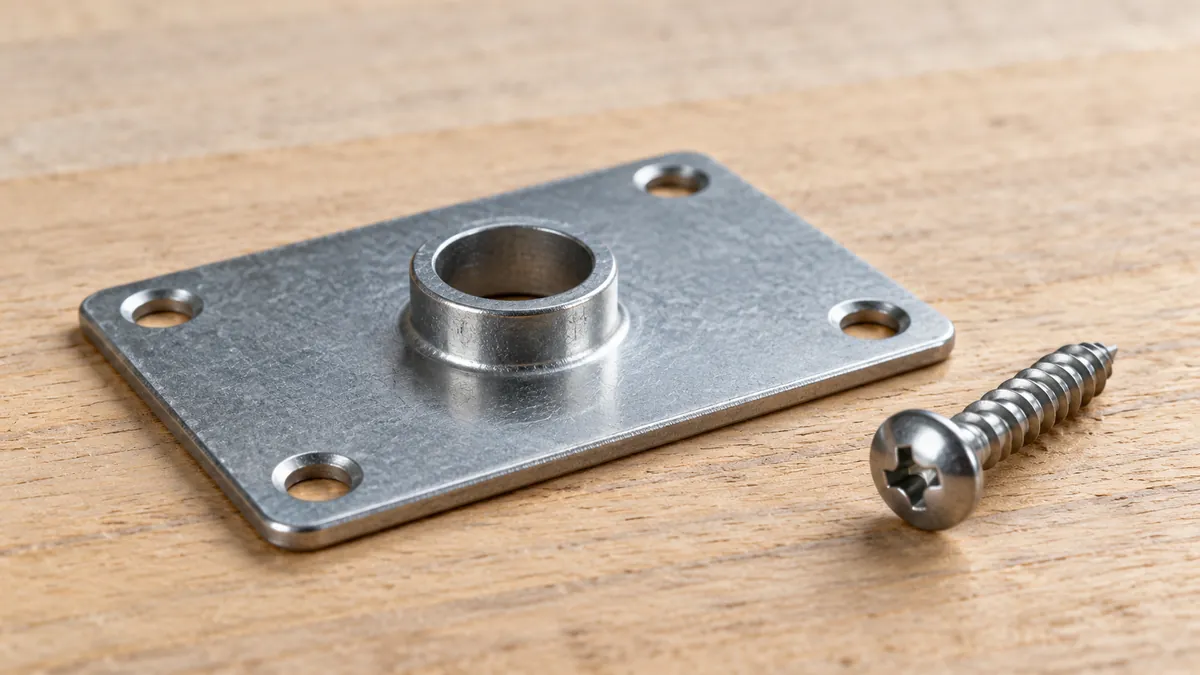
Common specification and sampling gaps
The fastener is not identified. Specify the mating screw and assembly stack-up. A collar cannot be evaluated in isolation from the part it must join.
Height has no datum. Show the reference face and measurement direction. Different interpretations of the base plane can produce disagreement.
Thread function is assumed from appearance. Define an appropriate thread check or assembly method and record the result.
The sample is unfinished when the final thread is coated. State whether approval is before or after finishing and how the thread is protected or verified in the final state.
A proposed process substitution is accepted without engineering review. Compare the joint function, fastener access, retention and service conditions before approving a different insert or hole solution.
The report checks a single feature but not the hole pattern. Include the datum relationship and trial assembly when multiple holes locate a mating component.
Questions to ask the manufacturer
Ask which material and thickness the proposed collar process assumes, whether the feature can be produced in the requested location, what drawing details are needed to evaluate it, and what sample evidence the supplier can provide. Ask how the collar height and thread condition will be checked and whether inspection occurs before or after coating.
Ask what changes would require a new sample review: material substitution, thickness change, a revised thread, altered collar dimensions, new finish route, changed fastener or a different mating part. Agree the reaction plan for a feature that fails measurement or assembly check. If the supplier suggests an alternative design, request a comparison of impacts and retain buyer approval before changing the drawing.
Koitor is a family-owned custom metal hardware manufacturer and can discuss drawing- and sample-based requirements for metal mounting components. Specific thread-forming equipment, process limits and performance must be verified for the project; this article does not imply a universal capability or accredited testing service. The punched extruded hole collar height thread engagement decision must remain tied to the actual selected route, the specified fastener and the approved material rather than a generic rule of thumb.
Sample approval checklist
- Identify part number, drawing revision, base material and thickness.
- Define collar direction, height datum and relevant location dimensions.
- Specify thread and mating-fastener details.
- Confirm coating or masking condition for the sample.
- Agree the collar measurement and thread verification method.
- Assemble with the intended fastener and mating component.
- Review access, pattern alignment and interference with nearby features.
- Record sample identity, results, deviations and approval owner.
- Document substitutions or changes that require renewed approval.
Foire aux questions
Does a taller collar always provide better thread engagement?
No. Engagement depends on the thread, material, geometry, screw and joint design. A taller feature by itself does not establish thread quality or joint performance. Define and verify the functional requirement for the actual assembly.
Is an extruded collar interchangeable with a rivet nut?
Not automatically. The design and process routes differ, and substitution may change access, cost, retention, finish and assembly conditions. Review the complete joint with product engineering before approving an alternate.
How should buyers inspect thread function?
Agree a suitable gauge or assembly check based on the specified thread and product requirement. Record the sample and method. Do not rely solely on a visual view of the collar.
Should the hole be checked after coating?
If finishing may affect thread fit, define a finished-state check or agreed protection process with the supplier. The acceptance condition should match the delivered product, not just the unfinished part.
Conclusion: specify the joint, not just the collar
A formed collar can be one way to integrate a threaded feature into a mounting base, but buyers should define the material, datum, thread, mating fastener, finish and assembly requirement together. Review a representative sample with the real mating parts and separate collar dimensions from thread and pattern checks.
For a custom shelf bracket or mounting plate, share the drawing revision and assembly stack-up before sampling. A punched extruded hole collar height thread engagement checklist can connect the forming review to the buyer’s actual fastener and assembly requirements. Learn about Koitor OEM home-storage hardware manufacturing or discuss a project through the contact page.
Review a Sheet-Metal Mounting Feature
Share the part drawing, thread requirement and mating assembly for a project-specific manufacturing discussion.
Fabrication pour compte de tiers / Marque de distributeur
Transformez ce guide d'approvisionnement en cahier des charges
Indiquez-nous le produit souhaité, ses dimensions, sa finition, la quantité commandée et vos exigences en matière d'emballage. Votre équipe recevra une analyse pratique de la faisabilité de la fabrication avant l'établissement du devis.
 English
  Español
  Português
  Français
  Deutsch
  العربية