
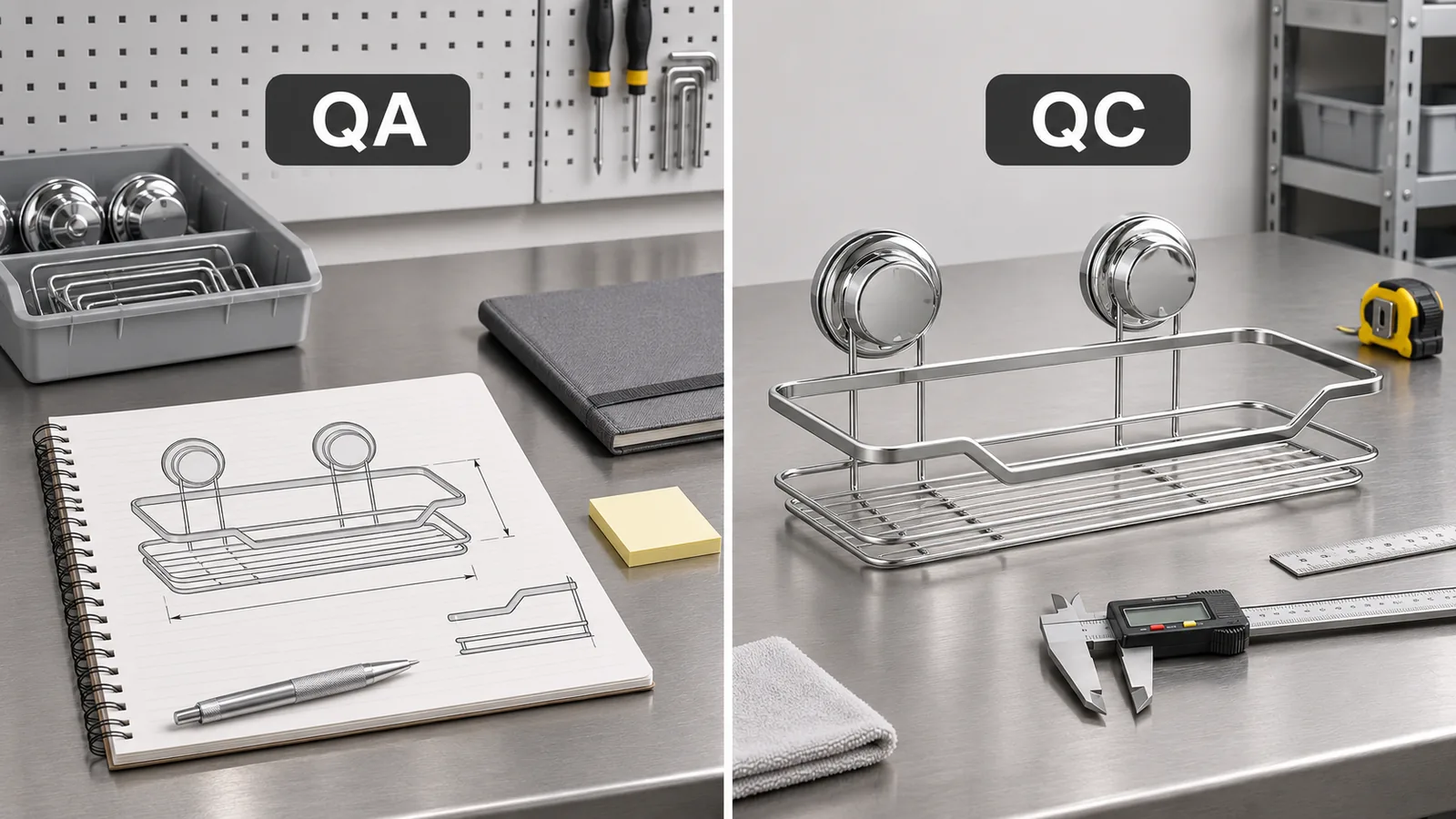
Quality assurance vs quality control is a comparison of related quality-management purposes, not a simple choice between “before production” and “final inspection.” Assurance concerns planned activity that gives confidence requirements can be fulfilled; control concerns operational activity used to fulfill those requirements. In bathroom and home-storage hardware sourcing, the buyer should identify the requirement, who acts on it, what is checked, and what evidence applies to the actual part or process. The two kinds of activity may overlap, and their labels alone do not prove that an order conforms.
What does quality assurance vs quality control mean for a hardware buyer?
Quality assurance (QA) and quality control (QC) describe different but connected ways of working with quality requirements. QA asks how the organization plans and manages work so that requirements can be fulfilled with confidence. QC asks what operational activities help fulfill a requirement and determine whether a defined product or process characteristic meets it.
Le American Society for Quality’s explanation of QA and QC notes that definitions are used differently in different settings, and that the activities can be interrelated. That matters to an importer because the letters on a supplier form, a job title, or a statement such as “we do QC” can conceal different scopes. A useful discussion starts with the actual requirement and the actual evidence, rather than a label.
Consider a hypothetical mounting plate on a bathroom hardware product. A buyer may require a hole location to match an approved drawing revision. Planning how the current revision reaches the people making and checking the part relates to assurance. Measuring the hole location on an agreed sample or production part against the specified drawing relates to control. Recording which revision and measurement method applied connects the two activities. This is an explanatory example only; it does not describe Koitor’s specific order records, staffing, equipment, or inspection system.
| Buyer’s question | Assurance-oriented view | Control-oriented view |
|---|---|---|
| What is the requirement? | Is the approved source clear and maintained through the relevant work? | What characteristic or operation can be checked against it? |
| Who is responsible? | Are roles and communication defined for this project? | Who performs or reviews the specified check? |
| What evidence is useful? | A controlled instruction, review record, or documented process may show how requirements are handled. | A measurement, examination, or other record may show what was checked and against which criteria. |
| What does it establish? | It may provide confidence in the way requirements are managed. | It may show the result of a specific check against stated criteria. |
| What does it not establish by itself? | It does not prove every unit or every requirement conforms. | One check does not prove the wider quality system or every untested characteristic. |
The table is a way to ask clearer questions, not a universal organizational chart. A single person may take part in both assurance and control activities. A check can inform a broader process review, while a planning activity can change what is checked. Organizations also use terminology differently, so buyers should ask what the supplier means when using either term.
Why is “before versus after” an incomplete distinction?
A common shorthand says QA happens before production and QC happens after production. It can help introduce the topic, but it is too narrow for a sourcing decision. Quality-related planning can continue while an order is being made, and operational control can take place at different points rather than only at final inspection.
A requirement may need to be clarified before a quotation, carried into a sample review, confirmed during an engineering change, and checked again when a relevant product characteristic can be observed. The timing depends on what is being controlled, the product construction, the order, and the agreement between buyer and supplier. A check at the wrong point may be unable to reveal a characteristic that is hidden after assembly or finishing. Conversely, a final appearance review cannot on its own establish that the correct drawing revision was used earlier.
For example, suppose the buyer’s approved sample has a particular rail position. The relevant sourcing question is not simply “Did QC inspect the finished rack?” Ask what criterion defined the rail position, which approved source controlled it, when the position could be measured reliably, and whether the measured part represented the relevant production condition. If the answer points to a particular in-process check, that is a control activity. Clarifying revision ownership, communicating the requirement, and deciding how a changed drawing is handled are assurance-related activities. These are connected parts of one requirement path.
The purpose distinction is more reliable than a rigid calendar split:
- QA-related activity is concerned with planned arrangements and confidence that requirements can be fulfilled.
- QC-related activity is concerned with operational actions that help fulfill requirements and evaluate specific outputs or operations.
- Inspection is one possible form of checking, but QC is not automatically limited to a single final inspection.
- A quality activity may contribute to more than one purpose depending on what it does and how it is used.
- The labels do not determine whether the activity is appropriate; the requirement, method, timing, and evidence do.
The buyer should therefore resist both extremes: “QA is only paperwork” and “QC is only a final pass-or-fail gate.” A document can be meaningful when it identifies the controlled requirement and its revision. A physical check can be meaningful when the characteristic, method, comparison criteria, and scope are clear. Either may be weak if the connection to the actual product or order is missing.
How can one hardware requirement involve both QA and QC?
A requirement becomes easier to discuss when it is followed from its source to the result. Use one characteristic at a time. A broad instruction such as “make it good” is difficult to verify. A useful requirement identifies the feature, the applicable product or component, the source of truth, and the condition under which acceptance will be judged.
For the hypothetical mounting plate, the buyer and supplier would first identify the relevant drawing revision and the hole-location requirement. They would clarify whether the drawing is the current approved file, whether any sample or other document changes the requirement, and who should receive updates. These are requirement-management questions. They help establish the conditions under which the requirement is expected to be fulfilled.
Next, the parties would decide what observable characteristic demonstrates the requirement. The hole location might be measured from a stated datum using an agreed method, if the drawing and product make that method appropriate. The criterion and any needed tolerance must come from the approved project specification, not from a general article. If the drawing lacks a datum or acceptance limit, a buyer should resolve that ambiguity before using a measurement as a pass/fail decision.
Then the parties would identify who carries out the check, at what point it can be made, what sample or production condition is relevant, and what record is retained or shared. A measurement may show the result for the part or sample measured. It does not automatically show that the same condition exists in every unit, every lot, or every later order. The sampling scope, timing, and record meaning must be stated separately if they matter to the buyer’s acceptance decision.
Finally, if the measurement does not meet the agreed criterion, the buyer and supplier need a defined way to contain the affected work, clarify disposition, and determine whether the requirement or process needs review. A correction to one part and a change to prevent recurrence are different actions. The appropriate response depends on the project, contract, affected scope, and risk. Do not infer a supplier’s corrective-action system from a single form or a short answer in a sales conversation.
A practical requirement-to-evidence map can look like this:
| Étape | Buyer and supplier clarify | Example evidence to request or review | Boundary |
|---|---|---|---|
| Define | Which feature, product, revision, and acceptance criterion apply? | Approved drawing or specification with revision identification | A file name alone may not establish approval or current status. |
| Communicate | Who needs the requirement and how are changes controlled? | Project-specific transmission, review, or acknowledgement record, where available | The presence of a document does not prove every recipient followed it. |
| Plan | At what stage can the feature be made and checked? | A project-specific process or inspection plan, if one exists and is relevant | A generic checklist may not cover this product or revision. |
| Vérifier | What characteristic is compared, by which agreed method, and on what item? | Measurement or examination record linked to the stated criterion | One observation does not establish all pieces or all features. |
| Respond | What happens if an observed result differs from the requirement? | A documented disposition or follow-up record, where applicable | Do not assume a correction proves a systemic cause was addressed. |
| Reconfirm | Did the approved source or agreed scope change? | Updated revision record and renewed approval or confirmation as required | A change can make prior evidence less relevant to the new configuration. |

This map explains how the two purposes connect without claiming that every project requires the same documents. A buyer may need a simple drawing confirmation for one low-risk component and a more formal evidence package for another project. The correct scope depends on the contract, the product, the market, the known risks, and the buyer’s own acceptance process. A supplier should not be asked to claim a record exists if it does not. Instead, ask what evidence is available, what it covers, and what must be agreed before an order begins.
What evidence should importers compare?
Evidence is useful when it can be tied to the requirement and scope being discussed. A document title is not enough. A buyer should inspect whether the evidence identifies the relevant product, drawing or sample revision, date or stage, characteristic, method, criteria, responsible party where relevant, and result or conclusion. Not every record contains every field, but missing context can limit what it proves.
For a bathroom wire basket or towel rack, the buyer may be discussing dimensional features, appearance, assembly, packaging, or another stated criterion. Each kind of requirement needs evidence appropriate to that requirement. A dimensional record does not prove surface appearance. A photograph can show visible condition but may not prove an internal joint characteristic. A product sample may show one configuration, but not necessarily confirm an updated specification or every piece in a later lot. State these limits plainly.
When comparing supplier responses, ask concise follow-up questions:
- Which exact requirement are you addressing?
- Which revision, approved sample, or other source applies?
- What characteristic or process was checked?
- What method and acceptance criterion were used?
- When was the check made, and what item or quantity does the evidence cover?
- Who prepared or reviewed the information, if responsibility matters?
- What does this record not cover?
- What happens if the requirement changes or the observed result differs?
A supplier’s answer may be verbal, recorded in a project document, or represented through a sample or other evidence. The format is less important than whether the answer is specific enough for the buyer’s decision. If the requirement is commercially critical, the buyer can state the needed record, approval point, scope, and acceptance rule in the RFQ or purchase documentation. The supplier can then confirm what can be supported for that project.
Auditing is related but should not be substituted for every product check. ASQ describes audits as assessments that compare actual conditions with requirements and report findings; see its explanation of auditing scope, which includes system, process, and product examples. An audit may help assess a defined area, while inspection checks characteristics of a product or service against requirements. The buyer should keep each activity’s purpose clear. A supplier visit or audit label does not automatically verify every unit; a measurement record does not automatically evaluate the supplier’s broader system.
A buyer may also receive certificates, test reports, or third-party documents. Such materials need their own scope review: who issued them, which product or organization they cover, which requirements or methods they address, the date and conditions, and whether they apply to the item being purchased. This article does not establish certification, legal compliance, test validity, or an audit result for any particular factory or product. A document’s existence is not proof that it applies to the buyer’s exact requirement.
How should buyers discuss QA and QC with an OEM supplier?
Start with a particular product or component rather than asking a supplier to endorse an abstract label. Share the current drawing or sample reference, intended use, relevant finish or assembly condition, and the feature whose conformity matters. For a custom metal bathroom or home-storage hardware project, a buyer may need to clarify a mounting point, basket dimension, visible surface, component relationship, or packaging condition. Only discuss the details that matter to the actual project.
A family-owned custom metal hardware factory such as Koitor can review drawings or physical samples within its approved product-development and manufacturing scope. That conversation should establish which requirement applies, what information is missing, and whether the project’s agreed evidence can be supplied. Product-specific questions about an unverified component or specialist test should be confirmed rather than assumed. Do not treat “OEM manufacturer,” “factory,” “QA,” or “QC” as evidence of a specific capability.
A practical conversation can proceed in this order:
- Describe the decision. Explain what the buyer is trying to accept, compare, or keep consistent between the approved sample and a later order.
- Identify the controlling source. Name the drawing, sample, written specification, or agreed record and its revision or date. If two sources differ, ask which one controls before quoting or production.
- Name the feature. Avoid broad judgments such as “better quality.” Specify which dimension, joint, finish, assembly relationship, marking, or package condition needs clarification.
- Define the evidence. Say what would help the buyer make the decision: a drawing review, sample comparison, specified measurement, visual examination, project record, or another relevant item. Do not request evidence unrelated to the requirement.
- State the scope. Clarify the sample, order stage, product variant, quantity, or lot represented. If the evidence is limited, keep that limitation with the evidence.
- Agree on changes. Decide how a revised drawing, changed finish, substituted component, or packaging adjustment will be reviewed and confirmed.
- Record acceptance. Make sure the approved criterion and the buyer’s acceptance authority are clear in the purchase or project documentation.
This approach also helps avoid transferring responsibilities by assumption. A manufacturer may be able to review a drawing or sample and explain relevant manufacturing considerations, while the buyer remains responsible for confirming market specifications, brand requirements, or acceptance criteria that only the buyer can define. If an external laboratory, certification body, or specialized engineering service is needed, its role and scope should be agreed separately. Do not imply that an ordinary product discussion includes such services.
For buyers comparing quotes, quality-related scope should be included alongside dimensions, material, finish, packaging, quantity, and delivery assumptions. Two quotations may use similar words while covering different inspection points or records. Buyers reviewing bathroom product scope can also see Koitor’s Page consacrée à la fabrication sur mesure d'accessoires de salle de bains; broader storage projects may fit the OEM home-storage hardware scope. Asking what each quote includes can reveal gaps before a purchase order is released. If one supplier promises an outcome without stating the requirement, evidence, or conditions, ask for clarification rather than treating a broad assurance as a measurable acceptance criterion.
How buyers can apply quality assurance vs quality control evidence
What are common mistakes when reading quality claims?
Treating QA and QC as two mutually exclusive departments. A smaller or larger organization may allocate responsibilities differently. The buyer needs to understand activities and responsibility for the order, not assume a fixed org chart from the terms.
Treating QA as paperwork and QC as a person with a gauge. Records can support assurance or control when they serve a defined purpose, while a person can perform activities related to either. The artifact and action need to be examined in context.
Assuming a final inspection covers every risk. The final view may not expose a hidden feature, an earlier process condition, a revision mix-up, or the scope of all pieces. What is visible at the end depends on the product and the agreed check.
Assuming a supplier’s label proves capability. A process name, job title, form heading, or statement of “100% QC” does not tell the buyer which requirement was checked, how it was checked, or what the result covers. Request the evidence relevant to the decision.
Treating one sample as proof of every later item. A sample can support design or appearance approval for its stated configuration. It does not automatically demonstrate how a subsequent run was controlled, whether a change occurred, or whether other characteristics match.
Comparing documents without checking their revision. A measurement tied to an obsolete drawing may be accurate but irrelevant to the current requirement. Link evidence to the approved source.
Using an acceptance limit that was never agreed. A buyer and supplier should not infer a tolerance, visual boundary, sampling plan, or performance threshold from an unrelated product or an article example. The requirement must come from the actual specification or be agreed by the responsible parties.
Asking for a certificate when a project-specific record is what is needed. Some requirements call for conformity documents; others call for a sample, drawing confirmation, measurement, or buyer-defined record. Choose evidence that answers the question and verify the scope of anything submitted.
Confusing an audit with product acceptance. Audits and inspections answer different questions. A supplier-system review may tell a buyer something about a defined system or process at a point in time. It is not automatically a release decision for a particular shipment.
Assuming quality can be proven by a single photograph. Images are helpful for visible geometry or finish discussion but cannot usually prove everything about hidden dimensions, material identity, an internal process, or order-wide conformity. Use them as one piece of appropriately bounded evidence.
What does a QA or QC statement not prove?
A statement that a supplier performs QA or QC does not, on its own, prove that all contractual requirements are met, that every unit has been checked, that a given test was performed, that the supplier holds a certification, or that a buyer’s particular market requirements are satisfied. It does not establish a defect rate or guarantee future production performance. Those conclusions require relevant evidence and an agreed scope.
A control result is also bounded by the item, characteristic, timing, method, and criterion represented. A measured dimension can be compared with a drawing if the measurement reference and method are appropriate. It cannot prove a coating’s chemical composition or a package’s transit performance unless those properties were specifically evaluated using suitable agreed methods. A passing result in one area should not be generalized to unrelated properties.
Likewise, an assurance plan is not a guarantee that a defect cannot occur. Plans can reduce ambiguity and help organize activity, but requirements may be misunderstood, conditions may change, and checks can have limits. The relevant question is whether the planned action is suitable for the project risk and whether there is evidence that the agreed actions were carried out. If the buyer needs a guarantee, warranty, acceptance condition, or legal remedy, that must be handled through the applicable commercial documents and professional advice—not inferred from the words QA or QC.
When evidence is missing, the appropriate response is to make the uncertainty visible. Ask whether a record exists, what it covers, and whether a project-specific agreement is needed before the order proceeds. Do not infer either success or failure simply because a document was not supplied. A supplier may have a relevant record that has not yet been requested, or a buyer may need to define a new check. The follow-up question should identify the information gap.
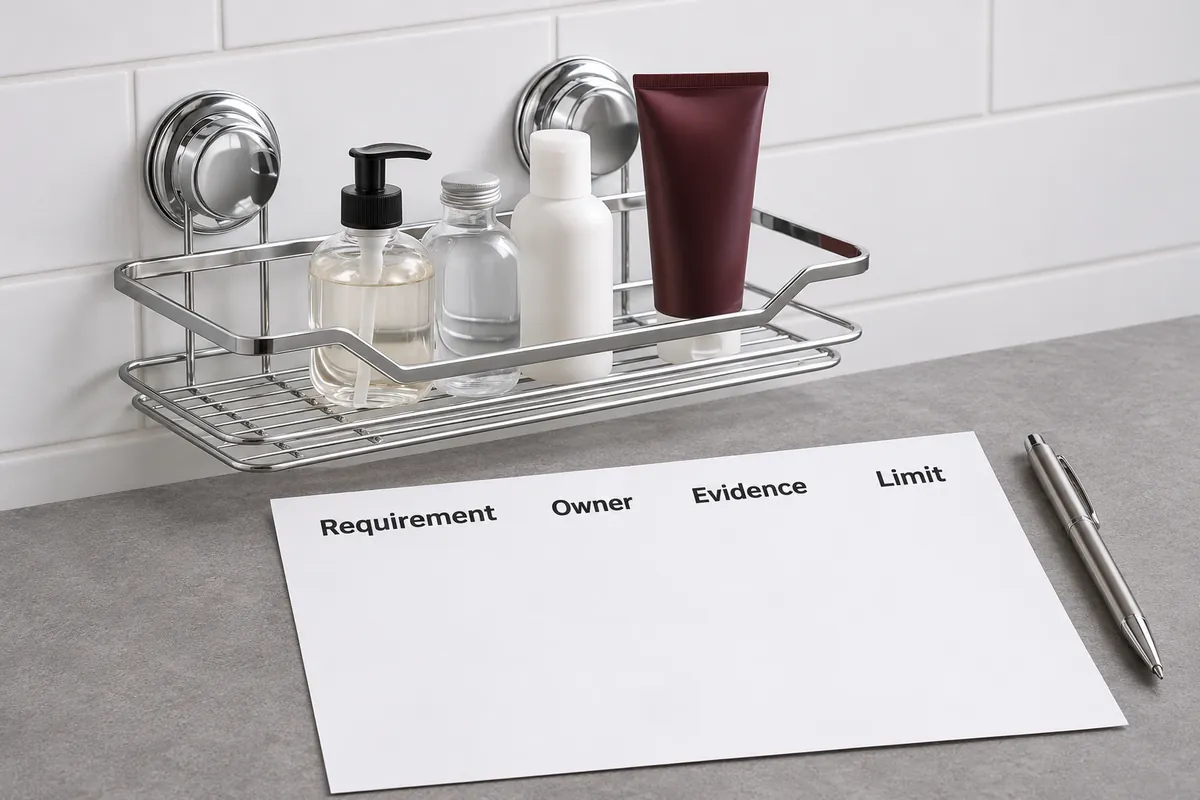
Buyer checklist before approving a hardware requirement
Before using a QA or QC statement to make a sourcing decision, confirm:
- [ ] The requirement is specific enough to interpret and is linked to the correct product or component.
- [ ] The controlling drawing, approved sample, specification, or other source is identified.
- [ ] The current revision or agreed change status is clear.
- [ ] The characteristic, process, or document being evaluated is named.
- [ ] The check method is suitable for the characteristic and is agreed where necessary.
- [ ] The acceptance criterion comes from the project requirement, not an unrelated example.
- [ ] The timing and stage of the check are known.
- [ ] The sample, quantity, variant, or lot represented by the evidence is stated.
- [ ] The evidence identifies enough context to connect it with the requirement.
- [ ] The evidence’s limits are understood and are not extended to unrelated features.
- [ ] Responsibility for reviewing the result and making the buyer’s acceptance decision is clear.
- [ ] A drawing, material, finish, component, or packaging change triggers the needed re-review.
- [ ] Any required laboratory, certification, legal, or specialist service is identified and separately confirmed.
- [ ] The agreed responsibilities and records are included in the appropriate RFQ, order, or project documents.
The checklist is a conversation aid, not a certificate or an acceptance standard. A buyer can adapt it to the product risk, order scope, contractual requirement, and records genuinely available from the supplier. A brief, precise request is usually more useful than asking for every possible form or report regardless of the feature under review.
Foire aux questions
Is quality control only final inspection?
No. QC refers to operational activities used to fulfill quality requirements, and a check can occur at a point where the relevant characteristic can be evaluated. Final inspection is one possible checkpoint, but it may not address every characteristic or the whole requirement path.
Can one activity support both QA and QC?
Yes. The terms describe purposes rather than mutually exclusive departments. For example, defining a project-specific measurement method may support confidence that a requirement is handled; taking and recording the measurement is a control activity. An organization may use different role names, so ask what the activity does and what evidence it produces.
Does a QA plan prove that every product conforms?
No. A plan can show how requirements are intended to be managed, but it does not itself prove that every item meets every criterion. Buyers need evidence appropriate to the actual requirement, item, stage, and quantity represented.
Does a QC report prove that the whole supplier is reliable?
No. A report normally has a limited scope, even when it is useful for a specific decision. Check which product, feature, sample or lot, method, criteria, date, and revision it covers. A report should not be treated as proof of unrelated capabilities or all future orders.
What is the difference between an inspection and an audit?
An inspection measures, examines, or tests specified characteristics and compares them with requirements. An audit is a planned assessment of a defined subject against requirements and reports findings. Their scope can overlap in quality work, but an audit label does not automatically accept a shipment, and an inspection result does not evaluate an entire management system.
What should an importer ask a bathroom hardware supplier first?
Name the product feature and its controlling drawing or approved sample, then ask what check or other evidence applies, what it covers, and what remains outside its scope. This gives the supplier a specific question to answer and helps the buyer decide whether the available evidence is enough for the project.
Should a buyer require the same QA and QC records from every supplier?
Not necessarily. The needed evidence depends on the product, contractual requirements, risk, market, and buyer’s acceptance process. State what the purchase requires and ask the supplier to confirm what it can provide. Avoid requesting records that do not answer the sourcing question.
Do the terms QA and QC have one universal meaning?
No. ASQ explains that terminology can be interpreted differently and activities can be related. Define what the buyer and supplier mean in the project documents by describing the specific actions, requirements, responsibilities, and evidence.
Clarify Quality Evidence for Your Hardware Project
Share the applicable product drawing or sample, the requirement you need to review, the intended use, and the unresolved evidence question. Koitor Hardware can discuss relevant bathroom and home-storage hardware manufacturing scope; project-specific inspection, records, and acceptance criteria should be confirmed directly.
Fabrication pour compte de tiers / Marque de distributeur
Transformez ce guide d'approvisionnement en cahier des charges
Indiquez-nous le produit souhaité, ses dimensions, sa finition, la quantité commandée et vos exigences en matière d'emballage. Votre équipe recevra une analyse pratique de la faisabilité de la fabrication avant l'établissement du devis.


 English
 Español
 Português
 Français
 Deutsch
 العربية