

A sanding sponge combines abrasive material with a foam support, while sandpaper is an abrasive sheet whose working support depends on how the operator holds it or whether it is used with a separate block. The useful answer to “sanding sponge vs sandpaper” starts by identifying that support arrangement. That distinction matters more than the shortcut “sponge is soft, paper is rigid.” A sheet can be folded, held freely, or mounted to a support; a sponge integrates its support into the abrasive product. For a metal hardware sample, compare the complete abrasive-and-contact arrangement with the required surface result, rather than selecting by product name or grit number alone.
The abrasive grain, bond, backing or foam, workpiece material, existing finish, geometry, and method all influence what happens at the contact area. Manufacturer information for named abrasive sponges includes flat, contoured, and irregular surfaces, and a named 3M product lists metal among its applications. That supports a limited statement about those products. It does not prove that every sponge is suitable for every metal or finish, that a sponge cannot alter an edge, or that it will produce a specified appearance. The actual product and process must be qualified for the actual part.
What Is the Difference Between a Sanding Sponge and Sandpaper?
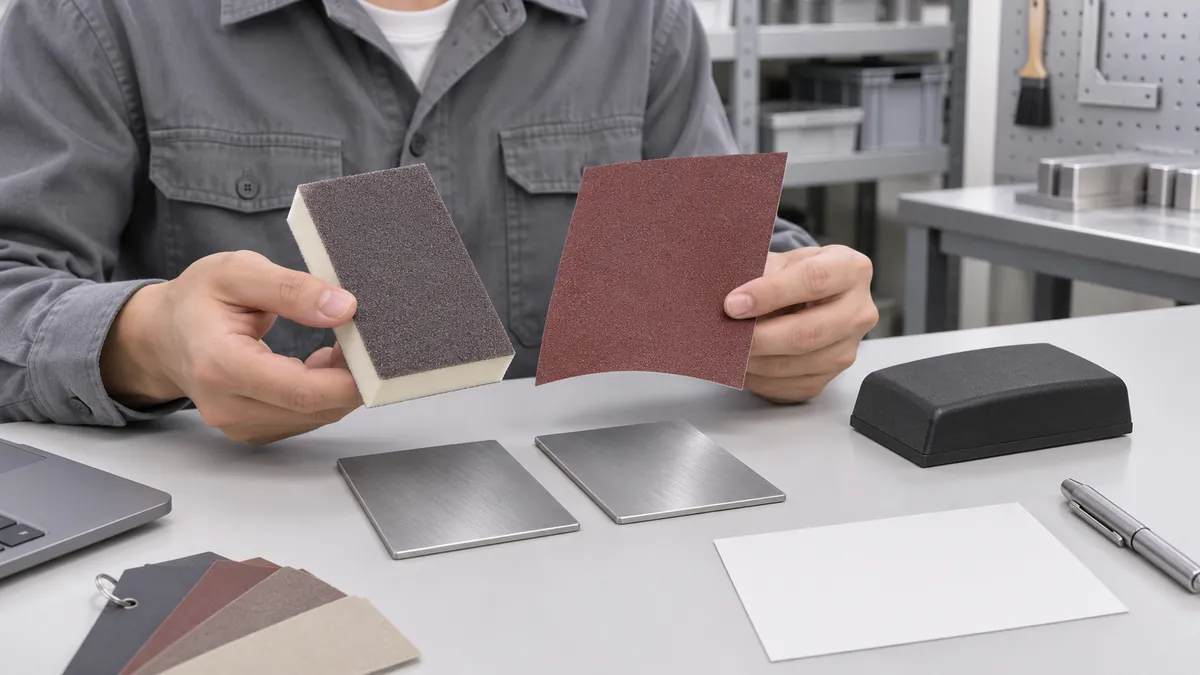
The basic difference is where the support comes from. In a sanding sponge, abrasive is attached to or carried by a foam body. In sheet abrasive, the abrasive layer is carried on a sheet backing, but the user may supply additional support by holding the sheet in the hand, folding it, wrapping it around a block, or using a purpose-designed holder. Therefore, the comparison is not simply foam versus a rigid sheet. It is integrated foam support versus a sheet used in a particular configuration.
When comparing sanding sponge vs sandpaper, this three-case map makes the support distinction clearer:
| Case | Abrasive format | Support at the work | What a buyer can infer |
|---|---|---|---|
| A | Abrasive sheet on a separate block | The chosen block contributes shape and support | The block is part of the contact system |
| B | Abrasive sheet held freely or folded | Hand position and sheet flexibility shape contact | “Sheet” does not automatically mean rigid contact |
| C | Abrasive bonded to a foam sponge | Foam is integrated with the abrasive product | The product has a compliant support, subject to its construction |
The table classifies the support arrangement; it does not rank cutting action, finish quality, life, or precision. Grain type, grit, coating, bonding, foam firmness, workpiece material, and user technique remain product-specific. A label such as “fine” or a color used by one brand should not be treated as a universal grade code for all abrasives.
Abrasive sheets are often called sandpaper even when the sheet backing is not literally paper. Buyers should check the product description for the actual backing and intended application. Likewise, a sanding sponge is not a household cleaning sponge: its abrasive construction and use instructions belong to the named product. The word “sponge” alone does not establish material, grit, wet-use permission, compatibility, or a finish outcome.
Why Does the Support Change Contact on a Part?
Support influences how the abrasive meets a surface. A separate block can contribute a particular contact shape; a freely held sheet can flex according to how it is held; and a foam-backed abrasive can conform to some contours because its support is integrated and flexible. Those are construction and contact observations, not performance guarantees.
For example, a product developer reviewing a curved metal hook may ask whether the proposed abrasive/support can follow the intended contour. On a flat mounting plate, the buyer may instead need to preserve the agreed planar face. A different part can present both kinds of surface in one assembly. These examples help identify the question to test; they do not prove that one named abrasive will produce the required result on either part.

A sample review should state the surface and the desired change. Is the supplier preparing an unfinished part, blending a manufacturing mark, or evaluating another agreed surface condition? A buyer should not call a process “sanding” and assume the same result across a welded joint, a flat plate, a curved wire, or a coated retail product. The method must be evaluated with the actual component and finish requirement.
This article does not recommend sanding consumer chrome-plated or coated bathroom hardware. Abrasion may remove or alter a finish, and no general repair instruction is supported here. The commercial discussion is controlled process communication between the responsible product owner and supplier. For a planned metal surface-preparation process, identify the part revision and the acceptance criteria before comparing consumables.
How Can Buyers Compare the Three Support Arrangements?
A practical comparison starts by holding the question steady. Compare support architecture while recording the abrasive product and use method. Do not compare a foam sponge of one grade against a sheet of another grade and then attribute every observed difference to support alone.
A controlled, documented comparison can record:
- The exact abrasive product, manufacturer, product number and stated grade.
- Whether the abrasive is a sponge, a sheet used freely, or a sheet used on a named block.
- The workpiece material and surface condition as supplied.
- The geometry under review, such as flat face, curved wire or corner.
- The specified finish goal and the area to be evaluated.
- The approved use instructions for that product, including whether wet or dry use is permitted.
- The inspection method and acceptance decision agreed by the responsible parties.
- Any change to the abrasive, support, method, part or finish between samples.
The point is not to create a laboratory protocol from a blog article. The point is to avoid changing several variables and then making a confident conclusion from an unclear comparison. If a buyer asks the supplier to evaluate a sponge and sheet system, the supplier should identify the specific products and support arrangement. If one sample is made with a separate block and another with an unsupported sheet, record that difference.
A decision matrix can help keep the review focused:
| Question de l'acheteur | Evidence to identify | What should remain open |
|---|---|---|
| Can the abrasive follow this contour? | Named product, support arrangement and representative part | Do not infer suitability from foam alone |
| Does the flat face remain within the intended appearance? | Actual component and agreed visual or dimensional criteria | Do not claim a grit number guarantees flatness |
| Is the proposed product approved for the material? | Manufacturer instructions for the named product | Do not generalize from another sponge or sheet |
| Is wet use allowed? | Product-specific use statement | Do not infer all sponges are washable or all sheets are dry-only |
| Has the surface finish changed? | Before-and-after sample review using agreed criteria | Do not infer coating safety from a generic abrasive category |
The table deliberately leaves outcomes for the actual project. A blog cannot approve a production process, choose an undocumented grit sequence, or set a dimensional tolerance. The buyer and qualified process owner need to interpret the result against the drawing, material, finish and intended use.
Does a Sanding Sponge Always Conform Better?
A flexible foam support may help a named product contact a contour, but “conformable” is not the same as “better for every feature.” Conforming to a curve may be useful when the target includes that curve. It may be unwanted if the process must protect an edge, preserve a flat surface, or avoid touching an adjacent finish. The right question is whether the complete product and method suit the specific surface.
A sponge product’s foam construction can differ across products. A sheet can also be flexible, and an operator can use a separate backing block to change how it contacts the work. Therefore, neither category label is enough to predict how a particular process behaves. A buyer should compare named items and stated instructions, not assume that every sponge has a common firmness or every sheet behaves alike.
If the intended comparison involves a curved hook and a flat mounting plate, separate those observations. A method that contacts a curved segment may not be the appropriate method for the plate face. A single sample that combines both features can still be useful if the reviewer records which area is being evaluated and what result matters at that area. Avoid a broad statement such as “the sponge is gentler” unless there is evidence for the particular product and defined test conditions.
Buyers assessing an existing surface finish should also identify whether the abrasive would contact bare substrate, a conversion layer, paint, powder coat, plating, or another coating. The sources for named sanding sponges support certain product uses; they do not approve a generic abrasive across all finishes. Product instructions and project-specific qualification determine whether a use is permitted. Where finish preservation matters, the approved process should make the contact zone and acceptance criteria explicit.
Does “Sanding Sponge vs Sandpaper” Tell You Which One Lasts Longer?
No. The comparison label does not establish service life, cost per part, washability, reusability, cutting rate or removal amount. Those properties depend on the actual product, material, contaminant, use conditions, and manufacturer directions. A source describing one sponge cannot support a lifetime claim about all sponges. A source describing one sheet cannot prove that every sheet is cheaper or more precise.
The same caution applies to wet and dry use. One named 3M sponge is described for wet or dry use, and wet-rated sheets also exist. A buyer cannot conclude that every sanding sponge can be rinsed, that every paper-backed abrasive is dry-only, or that two different products remain equivalent when wet. The allowed use is product-specific.
Avoid comparing purchase price without a shared basis. One package may contain a different number, format or size of abrasive items. Even a cost-per-item calculation will not answer cost per accepted part unless the products and process are actually evaluated under comparable conditions. This article contains no Koitor production cost data and no controlled consumable trial.
A sound sourcing comparison therefore records what is known, what was observed, and what remains to be tested. If the buyer needs a rate, lifetime or cost comparison, the responsible team must define the part, surface goal, quantity basis, and method. Do not convert a general product description into a promised savings figure.
What Should Buyers Ask About Surface Preparation?
The purchasing discussion should connect the abrasive to the hardware surface being reviewed. Before approval, clarify:
- Which component or sample revision is being discussed?
- What is the surface condition before the proposed process?
- What is the specified result after the process?
- Which exact abrasive product and support arrangement are proposed?
- Which surfaces or edges are included or excluded?
- Are the product’s manufacturer instructions compatible with the intended material and use?
- How will the buyer and supplier review the sample?
- What change would trigger a new review, such as a different abrasive, finish, material or component geometry?
These questions do not replace technical work by the supplier. They keep the buyer’s request from becoming an ambiguous instruction such as “make the surface smooth.” For a bathroom storage part, the visible finish may matter alongside fit and assembly, but this does not establish any universal cosmetic acceptance grade. The buyer should define the target and obtain agreement for the actual order.
Surface preparation is one stage of a wider surface-finishing discussion. For background on abrasive formats, see Koitor’s guide to types of abrasives. If the open question is which liquid or dry method a named product permits, use the separate wet-sanding versus dry-sanding guide. A powered abrasive belt and contact wheel are different equipment and contact questions; the existing contact-wheel article owns that subject. These links prevent this comparison from repeating adjacent answers.
How Does This Relate to Bathroom and Home-Storage Hardware?
Metal hooks, formed brackets, rack components and flat mounting plates can present different geometries and finish requirements. The abrasive format question becomes useful when a buyer is reviewing how a supplier proposes to prepare a sample or when a product developer is communicating which area of a part should be evaluated. That is a practical connection to hardware development, not evidence that Koitor uses a particular abrasive brand or process.
A buyer can send the drawing or sample and specify the intended surface outcome. If the item includes a visible face, a curved wire, an edge or a joint, identify each relevant area separately. Ask the responsible supplier to explain which material and finish the sample represents and whether the proposed abrasive is permitted for that product. If the proposal changes, document what changed and decide whether another sample review is required.
Koitor Hardware is a family-owned custom metal hardware factory with flexible OEM communication for bathroom and home-storage projects. Buyers can discuss actual drawings, samples, material, finish, structure and packaging within the confirmed project scope. This does not mean the company manufactures abrasive products, certifies abrasive processes, or offers a laboratory finish guarantee. Any product-specific process selection remains subject to the actual parts and approved requirements.
Buyer Checklist Before Approving an Abrasive Arrangement
Use the checklist to define the sample discussion:
- Part name, drawing revision and material as documented.
- Surface region being reviewed: flat face, contour, edge, joint or another feature.
- Existing finish and intended final condition.
- Named abrasive manufacturer, product and grade.
- Integrated foam, free-held sheet, or sheet on a specified separate support.
- Product instructions for the intended material and wet or dry use.
- Areas that must not be contacted.
- Sample method and agreed acceptance criteria.
- Reviewer and approval record.
- Change-control trigger for a different part, abrasive, support, finish or method.
- Any unverified claim that needs product-specific evidence.
This checklist is for communication and sample control. It does not state a universal sanding sequence, pressure, speed, abrasive grade, inspection limit or performance rating.
What Do the Product Sources Establish—and What Do They Leave Open?
The product sources are useful when their scope remains attached. A current 3M description for a named abrasive sponge presents a flexible abrasive foam and lists several surfaces, including metal. A separate 3M product description explains an abrasive bonded to a soft foam support and describes contour contact. These are manufacturer descriptions of those products. They support the limited statement that some foam-backed abrasives are designed for flexible contact and that some named products include metal in the stated application list.
They do not establish a result for every metal alloy, thickness, finish, edge or geometry. They do not provide Koitor process parameters, prove a particular surface appearance, or authorize a buyer to abrade a finished consumer product. Product-specific use directions and the actual part remain necessary. A page that says “for metal” cannot answer whether a particular coated hook, welded bracket or mounting plate should be processed with that item.
For this comparison, a buyer can separate four evidence layers:
| Evidence layer | Example question | Safe conclusion |
|---|---|---|
| Product construction | Is abrasive carried by foam or sheet backing? | Describe only the named item’s stated construction |
| Intended application | Does the maker list the relevant substrate? | Treat the list as product-specific, not universal approval |
| Contact arrangement | Is the sheet free-held, folded or placed on a block? | Record the actual support used in the sample |
| Finished-part result | Does the actual part meet its agreed requirement? | Review the representative sample against that requirement |
The first three layers can explain what was proposed; the fourth is the project-specific acceptance decision. A marketing image or a broad category term cannot replace that decision. If two alternatives are being compared, keep the product and support information with the corresponding sample so that a reviewer does not attribute the outcome to the wrong item.
The existing Koitor abrasive-format guide covers broader form and grain categories. This article isolates support at the work surface. A belt, contact wheel, sponge and sheet are not interchangeable systems, even when each contains abrasive grain. That distinction is why product descriptions should be read for construction and use, while the surface result is judged on the agreed component.
What Do Named Abrasive Sources Establish?
The product pages from 3M for an abrasive foam product et a second foam-backed abrasive describe named constructions and contour-related use. One page explicitly includes metal among the listed applications. Those statements apply to the named products, not to every foam sponge, abrasive sheet, alloy, coating or finish target. A QuickWood comparison et Nate’s abrasive guide also distinguish integrated foam support from a sheet used with a separate block.
For a supplier sample review, record the exact maker and item, abrasive grade as the maker identifies it, dry or wet permission, substrate, existing finish, contact geometry and support arrangement. Agree what result is being checked, such as a defined appearance or preservation of a particular edge, and compare the same representative component before accepting a process change. Keep the review separate from claims about universal lifespan, flatness or superiority. A named-product application list is useful screening evidence; the actual approved sample and project requirement still decide acceptance.
For related surface-preparation context, see Koitor’s surface grinding guide, et vapor blasting versus sandblasting comparison.
Foire aux questions
Is sanding sponge vs sandpaper a comparison of foam against rigid backing?
No. A sanding sponge integrates an abrasive with a foam support. A sheet abrasive uses a separate sheet backing, but its support can vary depending on whether it is held freely, folded or placed on a block. Compare the full contact arrangement rather than only the product label.
Can sanding sponges be used on metal?
Some named products list metal among their intended applications. That does not establish that every sanding sponge suits every metal, coating or part. Check the exact manufacturer instructions and qualify the chosen product for the actual surface requirement.
Is sandpaper always more rigid than a sanding sponge?
No. A sheet can flex when held freely or folded, and a separate block can add support. A sponge has an integrated foam support, but product construction varies. The category name alone does not determine the contact behavior.
Can a sanding sponge be washed and reused?
Do not assume so. Wet use, cleaning and reuse depend on the specific product’s instructions. Follow the named manufacturer’s directions; a description of one product does not establish permission for all sanding sponges.
Does the same grit mean the same finish across different brands?
A grit label alone does not guarantee identical abrasive construction or an identical surface result across products. Confirm the grading system and product specifications, then review the actual sample against the agreed finish requirement.
Which format should a buyer choose for a curved part?
There is no universal winner. A flexible integrated support may be relevant to a contour, while a sheet and separate support may offer another contact arrangement. The buyer should define the surface goal and compare the named product on a representative part.
Can this guide tell me how to refinish a coated bathroom accessory?
No. This article does not give consumer refinishing instructions or approve abrasive contact with chrome, powder coat, plating or another finish. Use only product and project instructions confirmed for the actual component.
Collaborez avec Koitor Hardware
Reviewing a Metal Hardware Surface or Sample?
Send the actual drawing or sample, specified material, existing finish and target surface condition. Koitor can discuss the confirmed bathroom and home-storage hardware manufacturing scope and the project inputs needed for a review.
Fabrication pour compte de tiers / Marque de distributeur
Transformez ce guide d'approvisionnement en cahier des charges
Indiquez-nous le produit souhaité, ses dimensions, sa finition, la quantité commandée et vos exigences en matière d'emballage. Votre équipe recevra une analyse pratique de la faisabilité de la fabrication avant l'établissement du devis.


 English
 Español
 Português
 Français
 Deutsch
 العربية