

A set screw hex key size kit bathroom accessories program should freeze the drive size with the screw, then pack a matching key—or a clearly listed key set—in the same carton family, so an installer is not left with a 2.5 mm key and a 3 mm screw, or the reverse. Importers who approve a handsome post and leave the key as “whatever is in the box” will meet that mismatch in reviews and in returns.
This page owns the collection kit: drive size, key size, how many keys, and how the match is checked at pack. It does not reopen how a wall-mount set screw seats in a post or a soap basket. A live neighbor already covers wall-mount set-screw seating; it is not in the internal-link file used here, so it is not hyperlinked. Keep that seating standard beside this kit file, and do not merge the two.
Custom bathroom hardware manufacturing is the general factory conversation. Shared mounting plates in a bathroom accessory collection is useful when several SKUs share a post or a plate and should also share a drive and a key.
What should be frozen with the screw, not later at packing?
Freeze the drive type and the drive size on the same line as the set screw. A cup-point or cone-point screw with a metric hex socket is a common bathroom-accessory choice, but this page does not invent a mandatory size. Write the size you actually use, and write the key that fits it.
If a family uses more than one drive size, say so, and pack a kit that covers every size in that carton or that collection shipment. A single key that only fits the hook, while the towel bar uses another size, is not a family kit.
Do not change the screw to match a leftover key, and do not change the key to match a leftover screw, without updating the packing list and the instructions. The screw and the key are one specification.
How should the kit be written and checked?
The packing list should name the key size, the count, and which SKUs in the carton need it. Instructions should use the same size words. A photograph of an unlabeled black key is not a size standard.
A pack check should confirm that the key actually seats in the screw used in that lot, not only that a key of some kind is in the bag. A near-size key that rattles in the socket will round the drive in the field.
| Kit decision | What to freeze | Typical failure if it is left informal | How to check it |
|---|---|---|---|
| Drive and screw | Drive type and size, written with the screw specification | A new lot arrives with a different socket and the old keys no longer fit | Compare the screw and the key against the written size, on the actual parts |
| Key in the carton | Key size, count, and whether one key covers the whole family | A bar and a hook in one set need two sizes, but only one key is packed | Open-box check against the packing list and the family list |
| Instructions and listing | The same size words in the sheet, the listing, and the bag | Customers follow a photo of an unlabeled key and use the wrong tool from a home kit | Read the sheet beside the bag and the current listing copy |
| Spares and multi-packs | Whether a multi-pack includes one key or one key per unit | A four-hook carton includes one key, and three later installs have none | Count keys against the stated rule, not against habit |
| Change control | A screw or key change updates the kit and the instructions together | A cheaper screw is substituted and the old keys stay in the bag | Treat a drive-size change as a pack and document change, not as a silent savings |
What this kit file should not try to decide
Thread engagement, point style as a seating method, and how tight a post should be on a bar are seating and machining topics. They belong in the seating standard or in the secondary-operations RFQ. This file can name the drive, but it should not pretend to approve the joint.
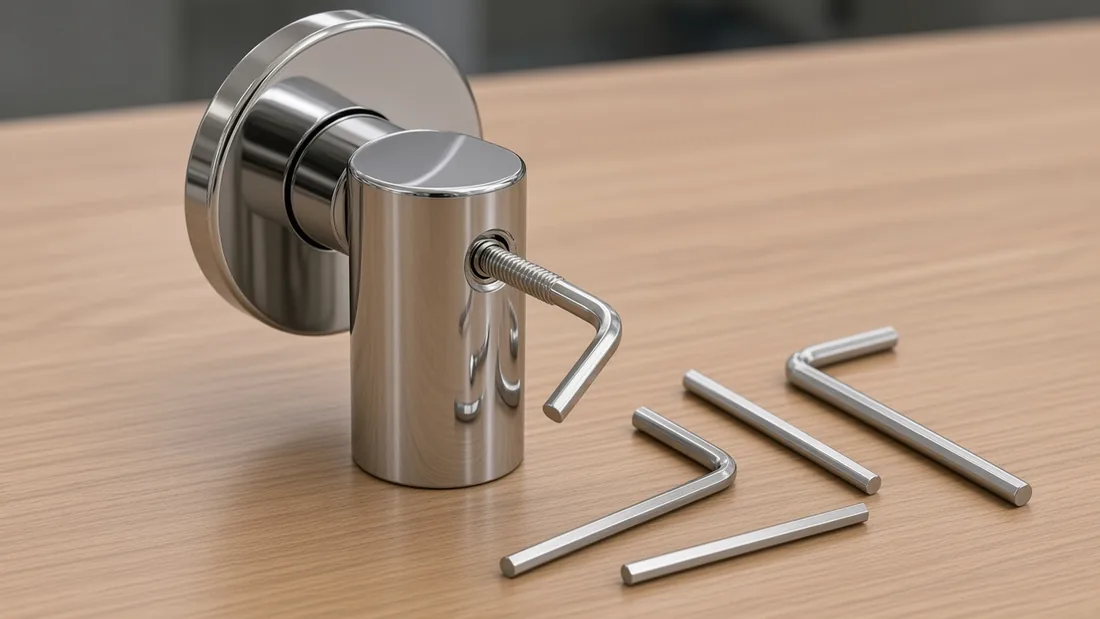
What the factory can pack and check, and what it cannot promise
A factory can pack a stated key, check that it seats in the lot’s screws, and keep the bag list aligned with the instructions. It cannot honestly promise that every end customer will use the packed key, or that a kit will eliminate all install complaints.
Koitor can review a collection kit as a family-owned China OEM manufacturer of bathroom and home-storage metal hardware. Commercial pack substitutions and any promised reduction in returns stay outside this page.
Buyer checklist for a set screw hex key size kit bathroom accessories pack
Use this list when you approve a family, and again when a screw or a bag changes.
- Write the drive type and size on the same line as the set screw.
- Write the key size and the count on the packing list.
- If the family uses more than one drive, pack a kit that covers every size in that carton, or split the SKUs honestly.
- Check that the packed key seats in the screw from the same lot.
- Use the same size words in the instructions and in the listing copy.
- State the rule for multi-packs: one key per unit, or one key per carton, and pack to that rule.
- Do not substitute a leftover key or a leftover screw without updating the file.
- Keep seating and thread engagement in their own standard; do not merge them into this kit file.
- Re-check the kit when a new SKU joins the family.
- Keep unlabeled “black hex key” language out of the specification.
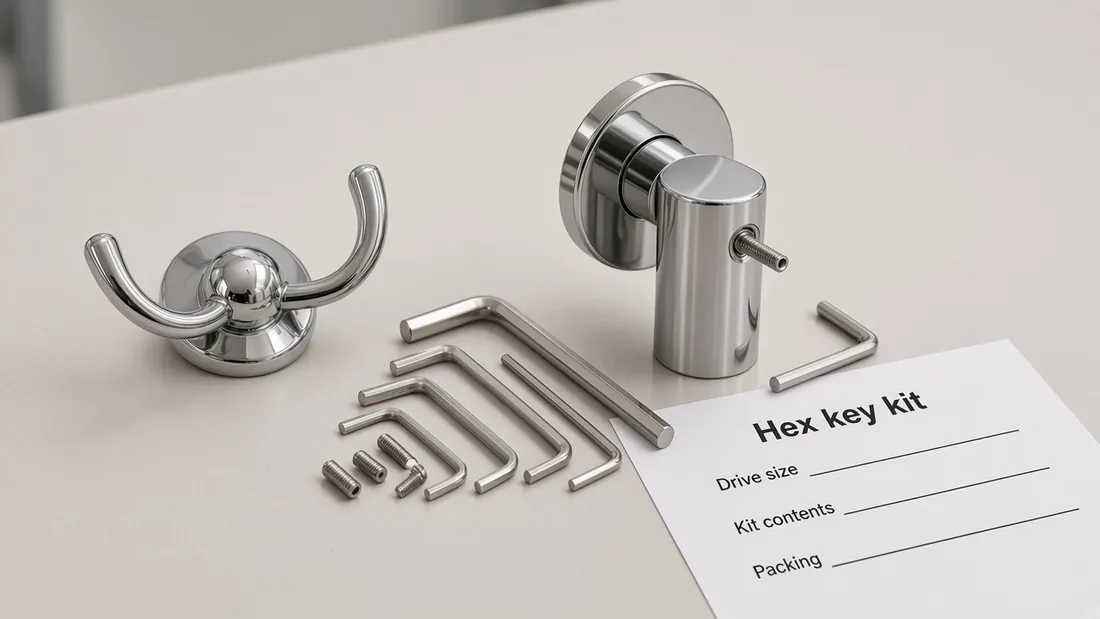
A chrome hook that uses a 3 mm socket and a matte-black bar that later switches to a 2.5 mm socket is a family break, even if the bodies still share a plate. Either keep one drive across the finish family, or pack both keys and say so on the sheet. A finish change is not a license to change the drive quietly.
Some markets prefer inch keys, and some prefer metric. If you sell both, do not assume a “standard small key” will be understood. Write metric or inch, write the size, and keep market kits under the same family map so a US carton and a European carton are not quietly swapped in a warehouse.
Keys with a plastic flag or a colored cap can help a customer find the tool in the bag, but the color is not the size. If you use a color code, print the size on the flag or on the sheet as well. Color-only systems fail when a bag is refilled from a mixed bin.
A folding driver or a mini-driver in a gift set is still a key. It must fit the screw. A branded driver that is slightly too large will look premium in a photo and ruin sockets in the field. Check fit on the lot screws, not only on a catalog image of the driver.
If the set screw is recessed deeply in a post, the packed key needs enough reach. A short stub key that fits the size but cannot enter the bore is a kit failure, even if the hex dimension is correct. Write reach when the bore is deep.
Do not print an invented size on a photograph used in this article or in a listing if the project file uses a different size. This page deliberately avoids stating a Koitor default key size. Your file should state yours.
Warehouse refills are a common drift point. A pack line that runs out of the specified key will grab a nearby size. The kit standard should say that a missing key stops the line or triggers a recorded substitution approval, not an unofficial scoop from a mixed drawer.
Returns marked “missing hardware” should be read beside this kit file and beside the return-reason map. A missing key is a kit-count issue. A present but wrong-size key is a match issue. Those two owners are close, and they are not identical.
If a retailer wants a key packed only in a master carton and not in each unit, write that rule and accept the service cost: later single-unit shipments and replacements will need a key policy. This page does not forbid a master-carton rule; it forbids leaving the rule unstated.
Ball-end keys can help at an angle, and they can also cam out if the socket is shallow. If you pack a ball-end key, check it in the actual post at the install angle you expect. Do not assume a ball end is always kinder.
A family that also uses a slot or a Phillips screw on a wall plate should not bury that second drive in the hex-key sentence. Name both drives and pack both tools, or use one drive family. Mixed informal drives are how a “complete kit” still leaves an installer searching a home toolbox.
First-article should include a bag photo, a key-to-screw fit check, and a read-through of the instruction size words. A first-article that only looks at the hook body will approve a beautiful product with an unusable kit.
If a third-party inspector is used, give them the packing list and a reference key or a written size, and ask them to check seating, not only presence. Presence checks alone will pass a wrong-size key.
Spare screws in the bag should match the same drive as the installed screws. A spare with a different socket is worse than no spare, because it suggests a match that does not exist.
When a collection is photographed for a catalog, show the packed key beside the post at least once in the internal file, even if the public image is product-only. The internal photo helps later pack audits. It is not a substitute for the written size.
Do not use this file to specify steel grade, coating, or corrosion performance of the key as a standing Koitor claim. If a project needs a coated or stainless key, write it as a project choice and approve a sample. The core gate remains size, reach, count, and match.
A private-label team that sources screws from one vendor and keys from another must still run the match check on every new incoming lot of either part. Vendor split is allowed. Unchecked mix is not.
Keep the language boring: size, count, reach, and a seating check. When those four are written, a set screw hex key size kit bathroom accessories pack can travel with the family without depending on a packer’s memory.
If instructions show a drawing of a key, the drawing should not contradict the packed tool. A long L-key drawn on the sheet and a short stub packed in the bag will generate avoidable tickets, even when the hex size is right. Align the picture and the bag.
For replacement orders of keys only, keep the same size words and a way to tie the order to the original collection. A bag labelled only “hex key for bathroom hook” will eventually be picked from the wrong bin.
When several carton counts exist—two-pack, four-pack, and a display six—the key rule should be written per carton type. Copy-pasting “one key included” across all cartons is how a six-pack ships with one tool and five disappointed later installs.
If the screw is changed to a security or tamper-resistant drive, the kit change is mandatory and should be treated as a product change, not as a hardware footnote. The listing, the sheet, and the bag all move together, or the product is no longer installable with the published tool.
Store the current kit list with the family architecture file, because a new colorway should inherit the same drive unless a deliberate market exception is written. Finish families that silently grow a second drive create pack exceptions that no one can audit at season’s end.
A short end-of-line audit—open one carton per lot, seat the key, photograph the bag—takes little time and prevents a whole shipment of near-size keys. Write the audit as a project habit, not as a promised defect rate.
If a buyer already has keys in a service warehouse, still pack the unit kit unless a written program says otherwise. Service stock is not the same as an in-carton kit, and customers will not go to your warehouse for a 3 mm key.
Retail display hooks that are sold as singles after a set is broken down at the store need a key rule of their own. If the set kit lived only in the outer carton, the single that leaves the display may have no key. Either pack a key with each hook, or tell the retailer in writing that display singles need a service key at the counter.
A magnetic tray in a pack cell can collect stray keys from a previous SKU. The match check should use a key from the bag that will actually ship, not a key from the tray. Trays are convenient and they are also a cross-SKU mixer.
If instructions are printed in several languages, every language should carry the same size designation, not a translated nickname. A local word for “small key” is not a size. Keep the millimeter or inch figure identical across languages.
Coated keys that pick up paint in the socket can fail a seating check even when the metal size is right. If you coat keys, check the coated production parts, not only a bare sample. A painted socket is a production kit, not a decorative extra.
Do not mix this kit file with a wall-anchor kit file. Anchors, screws into the wall, and the set-screw key are different bags in many programs. If they share one bag, the list should still name each item, or a missing key will be hidden behind a complete-looking anchor count.
When a factory proposes a cheaper screw with the same stated size, still run the seating check. Tolerance on a low-cost socket can be poor, and a key that fitted the approved screw may wobble in the new one. Price is not a fit test.
Field technicians who carry a multi-tool will still need the packed key when the multi-tool does not include that size. Instructions should not say “use any hex key” if the packed tool is part of the approval. “Use the packed key” is the cleaner line.
A quality hold on screws should also hold the matching packed keys if the screw lot may change size or supplier after the hold. Releasing the body and the old bag while the screw is still on hold is how mismatched cartons escape.
If you laser-mark a size on the key, protect that mark in the specification so a later un-marked purchase does not silently replace it. A mark is helpful and it is not required by this page; if you use it, it becomes part of the kit standard.
Keep a physical reference bag in the quality room, labeled with the family and the date. Staff can then compare production bags to a real object, not only to a line on a spreadsheet. Replace the reference when the kit legitimately changes, and retire the old bag so it cannot be used as a false standard.
For OEM customers who already print their own instructions, send them the size and count in time to print, and require a proof that the size words match the bag. A beautiful retail sheet with the wrong hex size is still a kit failure.
If a second shift starts without a kit briefing, the day-shift standard will drift by morning. A one-page kit sheet at the pack table matters more than a long manual in an office. Put the size, the count, and a photo of a correct bag on that page.
When the drive, the key, the count, the reach, and the lot seating check are written and actually used, the kit stops being a lucky extra in the carton. Until then, the product is only half specified, even if the hook body is perfect.
Foire aux questions
Can one key in a master carton cover a whole family?
Only if that rule is written and you have a plan for single-unit and replacement shipments. Do not assume a master-carton key reaches the end installer.
Is there a default hex size Koitor requires on this page?
No. Write the size you use with the screw, and pack the matching key. This article does not publish a factory default size.
How is this different from a wall-mount set-screw seating page?
Seating is about how the screw holds the bar or the body. This file is about drive size, the packed key, and the match check. You need both, and they should stay in separate documents.
What if two SKUs in one set use different drives?
Pack both keys or redesign to one drive. A single unmatched key is not a complete set kit.
Does a packed key guarantee an easy install?
No. It removes a common mismatch. Seating, wall condition, and instructions still matter, and no install success rate is promised here.
Should the inspector only confirm that a key is present?
No. Presence is not enough. The key should seat in the lot screw and should match the written size and count.
Collaborez avec Koitor Hardware
Need a collection hex-key kit reviewed against the screws in the same family?
Send Koitor the screw specification, the packing list, and a photo of the current bag. Our team can review drive size, key match, and pack checks, and can also discuss the hardware construction and small-batch OEM options.
Fabrication pour compte de tiers / Marque de distributeur
Transformez ce guide d'approvisionnement en cahier des charges
Indiquez-nous le produit souhaité, ses dimensions, sa finition, la quantité commandée et vos exigences en matière d'emballage. Votre équipe recevra une analyse pratique de la faisabilité de la fabrication avant l'établissement du devis.


 English
 Español
 Português
 Français
 Deutsch
 العربية