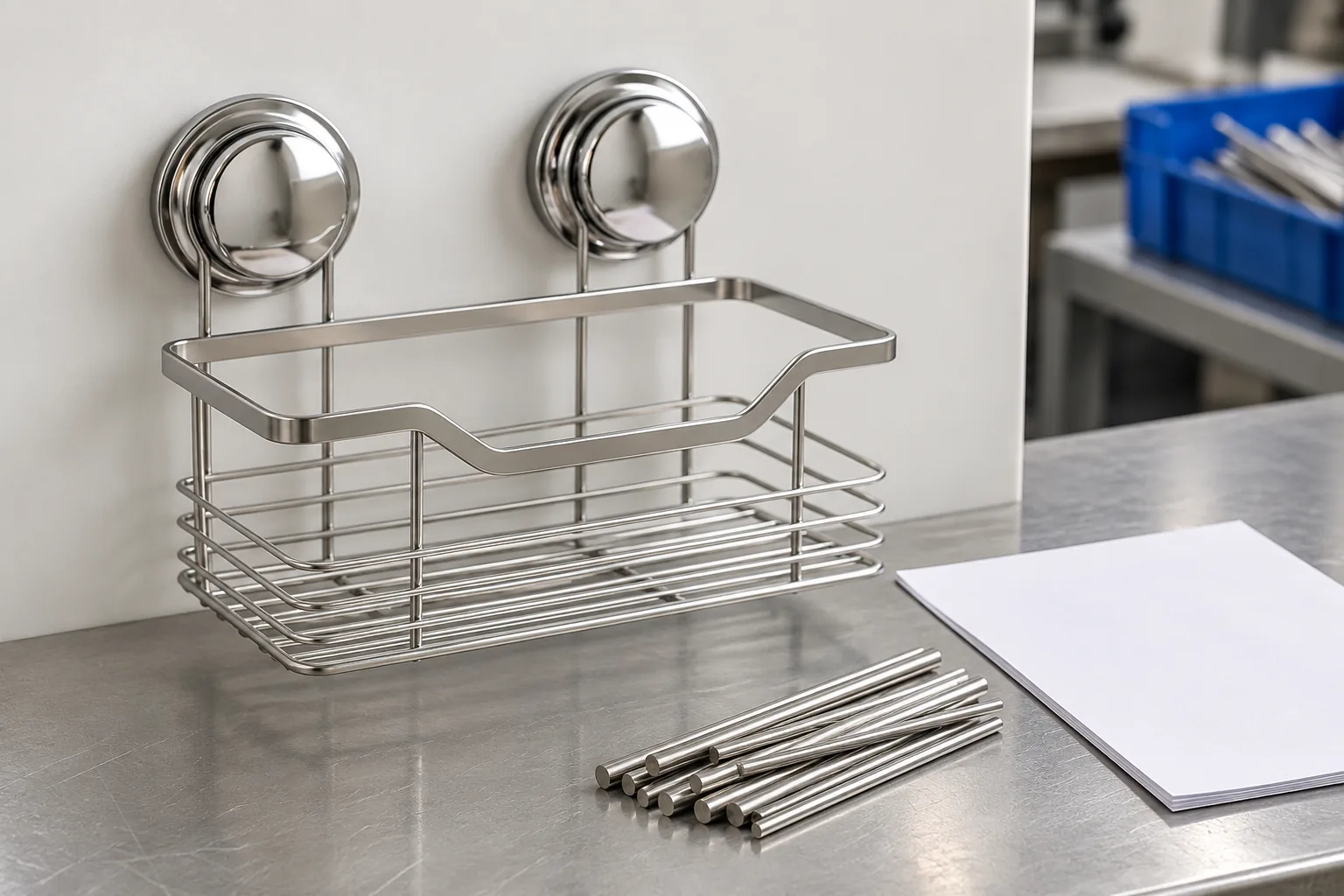
Stainless steel hardware material traceability means being able to connect a buyer’s material requirement to appropriate supplier evidence and, when required, to identifiable production and shipment lots. A material declaration, a mill certificate, a lot tag, and a test report are not interchangeable. Importers should define the required grade and evidence before quotation, then agree what identifiers must remain linked as wire, tube, or sheet is formed, welded, finished, packed, and shipped. This guide explains what common records can establish and where their limits begin.
This short video shows the product or manufacturing context discussed in this guide.
What does material traceability mean for bathroom hardware?
Material traceability is the documented relationship between an ordered material requirement, a supplied material lot, the processing that uses it, and the finished goods delivered under the order. The depth of that relationship can vary. A buyer may need a clear material declaration for an ordinary accessory, or a more specific lot linkage when the contract, application, risk, or customer requirement justifies it.
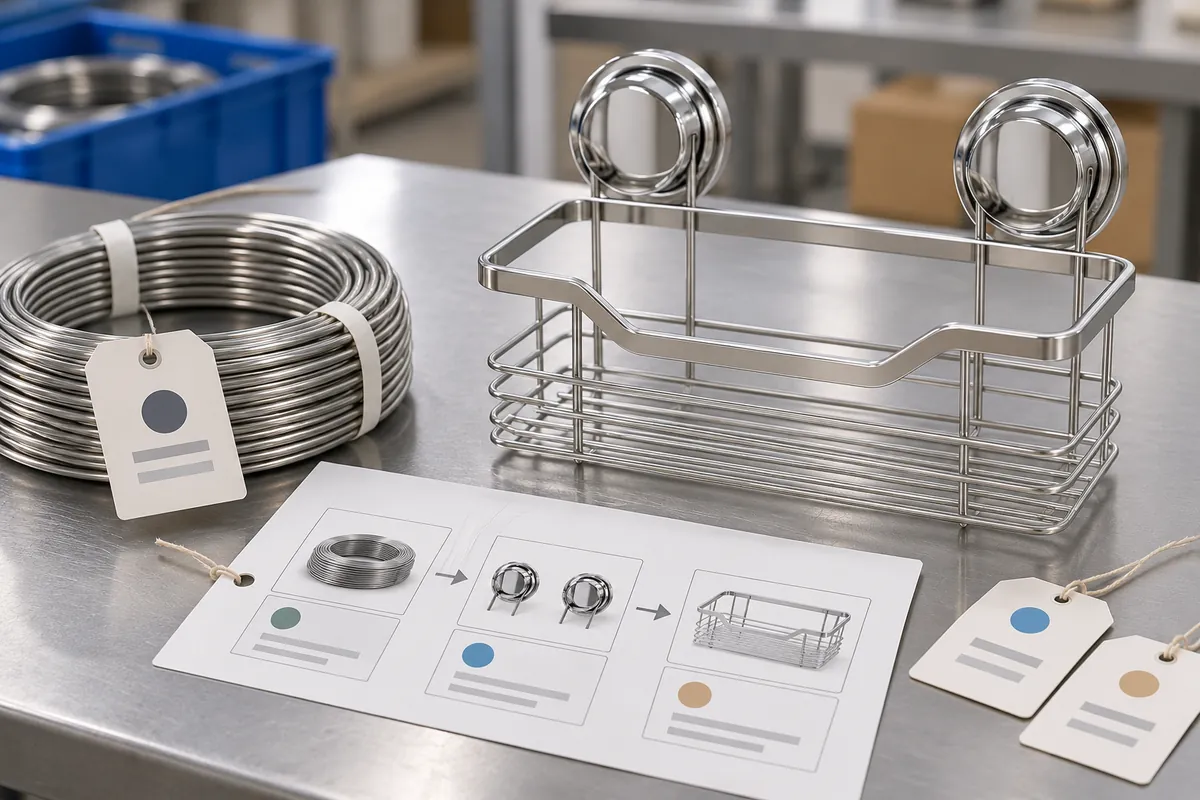
Bathroom hardware often passes through several physical and administrative steps. Stainless wire, tube, or sheet may be cut, bent, welded, ground, polished, assembled, packed, and split among finished batches. During these transformations, the original stock label may no longer remain attached to each component. Buyers and suppliers therefore need to agree what records or lot grouping will preserve the connection relevant to the order.
The term “traceability” should not be used as a vague promise. Ask what can be traced, to which identifier, through which operations, and at what unit of grouping—for example, a received lot, production batch, purchase order, or shipment. A statement such as “material is traceable” is incomplete unless both parties understand the evidence and retention boundary.
What does a material declaration or mill certificate prove?
A material declaration is a supplier statement describing the material supplied, typically against a specified grade or buyer requirement. A mill certificate or material test certificate is a document issued within the material supply chain that reports defined information about a batch or heat, according to the document type and applicable supply arrangement. A test report records results for tests that were actually performed and identified. The names and contents can vary, so buyers should inspect the actual document and issuing context rather than rely on labels alone.
No single document automatically proves every property of the finished bathroom accessory. A certificate may identify source material information but does not, by itself, establish that every finished piece came from the named lot, that fabrication avoided contamination, that coating or polishing was correct, or that the finished product will resist corrosion in every environment. The buyer should connect each evidence item to a precise question.
| Evidence item | May help establish | Does not automatically establish |
|---|---|---|
| Purchase specification or PO | Required grade, form, dimensions and agreed scope | What material was actually delivered or used |
| Supplier material declaration | Supplier-stated identity against the order requirement | Independent verification of composition or each finished unit |
| Mill/material certificate | Source-lot information and reported properties stated on that document | Continuous linkage through every downstream processing step |
| Receiving/lot record | Which identified stock lot was received and assigned | That the stock grade is independently confirmed unless evidence supports it |
| Production batch record | Which inputs or lots were associated with a defined production group | That every part is defect-free or that performance was tested |
| Test report | Results for the named sample/item and stated method | Unreported properties or all units outside the tested sample |
| Shipment/packing record | Which finished lot or order quantity was packed and dispatched | Material composition unless linked to the relevant upstream evidence |
When documentation matters, agree whether the buyer requires the original supplier document, a copy, a supplier declaration, an inspection record, or another defined record. Do not assume every metal-hardware order needs the same document set.
How should a buyer specify material evidence in an RFQ?
Start with a material requirement precise enough to quote. State the grade or approved alternative where known, product form, relevant dimensions, finish expectations, and any customer or market-specific document requirement. If the grade is undecided, ask suppliers to identify proposed options rather than silently substituting a material.
For sourcing teams, stainless steel hardware material traceability is most useful when the evidence request names the product scope, identifier, and handoff that matter—not merely a generic request for paperwork.
Then state the evidence request in operational terms. For example: “Identify the material grade proposed in the quotation; state whether a material certificate is available for the supplied stock lot; describe the lot identifier and how it will be associated with the order’s production batch and shipment.” If lot-level linkage is contractually required, define the required stage and record before the quote is accepted.
Avoid broad phrases such as “full certification required” without naming the document, issuing party, scope, and connection to the goods. Broad requests create ambiguity and can lead to documents that appear impressive but do not answer the buyer’s question. If a downstream customer requires a specific format or retention period, attach that requirement to the RFQ and ask the supplier to confirm feasibility and any cost or lead-time effect.
How can material identity stay linked through fabrication?
Traceability depends on controlled handoffs. The receiving step records what arrived and its available identifiers; production planning assigns stock to an order or batch; processing records preserve the relevant association when materials are divided or transformed; finished-goods packing links the accepted batch to the shipment documentation. The exact record system may be paper-based, digital, or combined. What matters is whether it answers the agreed buyer question consistently.
A practical control map can be simple:
- 1. Define: Identify material requirement and evidence in the approved PO or specification.
- 2. Receive: Record supplier, description, received quantity, available lot/heat identifier, and document reference.
- 3. Assign: Link the received stock to a work order or a controlled production batch.
- 4. Process: Preserve the lot association when stock is split, combined, or moved between operations, according to the agreed requirement.
- 5. Finish and pack: Associate finished lots, cartons, or packing lists with the relevant production record.
- 6. Retain and retrieve: Agree which documents are retained, for how long, and how the buyer can request them.
Each transformation is a possible break in the chain. For instance, cutting may produce multiple sub-lots; a production batch may combine stock from more than one receipt; subcontract finishing may introduce a new handoff; and one shipment may contain several manufacturing batches. The buyer should specify whether mixed lots are acceptable and how they must be identified. Do not demand a heat-by-heat chain if the risk and commercial need do not support it—but do not accept a generic batch reference when a tighter link is contractually necessary.
What limitations should buyers understand?
A document trail answers an identity or association question only to the extent that records are authentic, relevant, and linked to the goods. It is not the same as independent chemical verification. A material certificate does not establish surface cleanliness, welding quality, polishing condition, coating integrity, or corrosion performance. Similarly, a finished-product visual inspection does not identify alloy composition.
If independent verification is needed, define the question and method with a qualified testing provider or the buyer’s technical team. Avoid improvised chemical spot tests or conclusions based on magnet response, appearance, or a supplier document alone. Such checks can be misleading when the product form, grade, finish, or test limitations are not understood. Any test should identify the sample, method, acceptance basis, and limits of interpretation.
Traceability also has a practical boundary: records can be separated from physical goods if labels are removed, identifiers are reused, or mixed batches are not controlled. Therefore, specify how labels, work orders, carton marks, packing lists, and retained records relate to each other. Keep the scope proportionate to the order’s requirements and the consequences of a material mix-up.
How should buyers review a traceability proposal from a supplier?
Review a supplier’s proposal by following one hypothetical order lot from the incoming record to the shipment record. Ask the supplier to describe the identifiers that appear at each handoff and which documents are available to the buyer. If a step uses a batch code instead of a mill heat number, clarify whether that batch contains one source lot or several and how any mixing is recorded. The goal is to understand the chain, not to assume that one format is universally correct.
Ask practical questions during quotation or sample review: What document identifies the material requirement? What identifier is recorded at receipt? How is stock allocated to a work order? If a lot is split or combined, where is the relationship preserved? Can the finished packing list identify which order batch it covers? How long are supporting records retained? Which documents can be supplied with the shipment and which are available only on request? These answers should be proportionate to the agreed traceability level.
Review the terminology in context. “Batch,” “lot,” and “heat” may refer to different points in the supply chain. Ask the supplier to define the term it uses and show how it maps to the ordered product. Avoid treating two identifiers as equivalent because they appear on adjacent pages. If a customer requires heat-level linkage, state that clearly and ask the manufacturer to confirm the specific route and records before production begins.
Where subcontracting occurs, identify the handoff without presuming that the subcontractor must provide the same document set as the material mill. The buyer should know which party owns the record, which manufacturing operation it covers, and how the finished order is associated with it. If the route or source changes after approval, use the agreed change-notification and buyer approval process rather than relying on an outdated traceability description.
For repeat orders, retain the approved material description and compare it with each new order’s supplier documentation. A changed source, grade, product form, or identification method may require review even when the finished design appears unchanged. Conversely, avoid demanding a new extensive evidence package for every order if the agreed system already identifies the applicable lot and no relevant change has occurred. The purchasing specification should say what is required, and the receiving review should confirm that the actual documents match it.
What should buyers include in a material traceability checklist?
Use this checklist when planning an OEM stainless hardware order:
- – [ ] Is the requested grade, product form, and dimension stated in the approved specification?
- – [ ] Has the supplier identified the proposed grade and any substitution explicitly?
- – [ ] Is the requested evidence named precisely (declaration, certificate, test report, or lot record)?
- – [ ] Is the document’s issuer and scope understood?
- – [ ] Does the document identify a material lot, heat, or other relevant supplier identifier?
- – [ ] Is the required link to production batch, finished lot, cartons, and shipment defined?
- – [ ] Are split lots, mixed lots, rework, or subcontract processing addressed where relevant?
- – [ ] Are record format, delivery timing, retention, and retrieval expectations stated?
- – [ ] Are verification tests requested only when their method and acceptance criteria are agreed?
- – [ ] Are limitations recorded so no document is treated as proof of unrelated performance?
The checklist should match the product and buyer’s actual obligation. A clear material statement and lot reference may be adequate for one program, while another customer may require certificate copies and an explicit shipment association. Make the level of evidence a written purchasing decision, not an informal assumption made after production.
For a multi-component accessory, apply the requirement to each material-bearing part that matters rather than writing one blanket line for the entire product. A wire basket, mounting component, tube support, screw, and decorative cover may use different materials or suppliers. Identify which components must be covered by the material evidence and which are controlled by other specifications. This keeps the request focused and reduces the risk that one certificate is incorrectly assumed to cover every component in a finished set.
Before closing the supplier review, verify that the agreed stainless steel hardware material traceability evidence can be retrieved for the defined order grouping. Record any exception and the buyer who accepted it so a later reorder does not quietly inherit a different documentation assumption.
The buyer can record the agreed evidence level directly in the RFQ response or an attached quality appendix. Include the named documents, lot identifier expectation, shipment linkage, exceptions, and contact responsible for resolving missing records. If the supplier cannot meet part of the request, record the gap and its proposed alternative for technical and commercial review. Do not treat silence as acceptance. This approach helps the importer judge feasibility before a purchase order commits the parties to an unclear requirement.
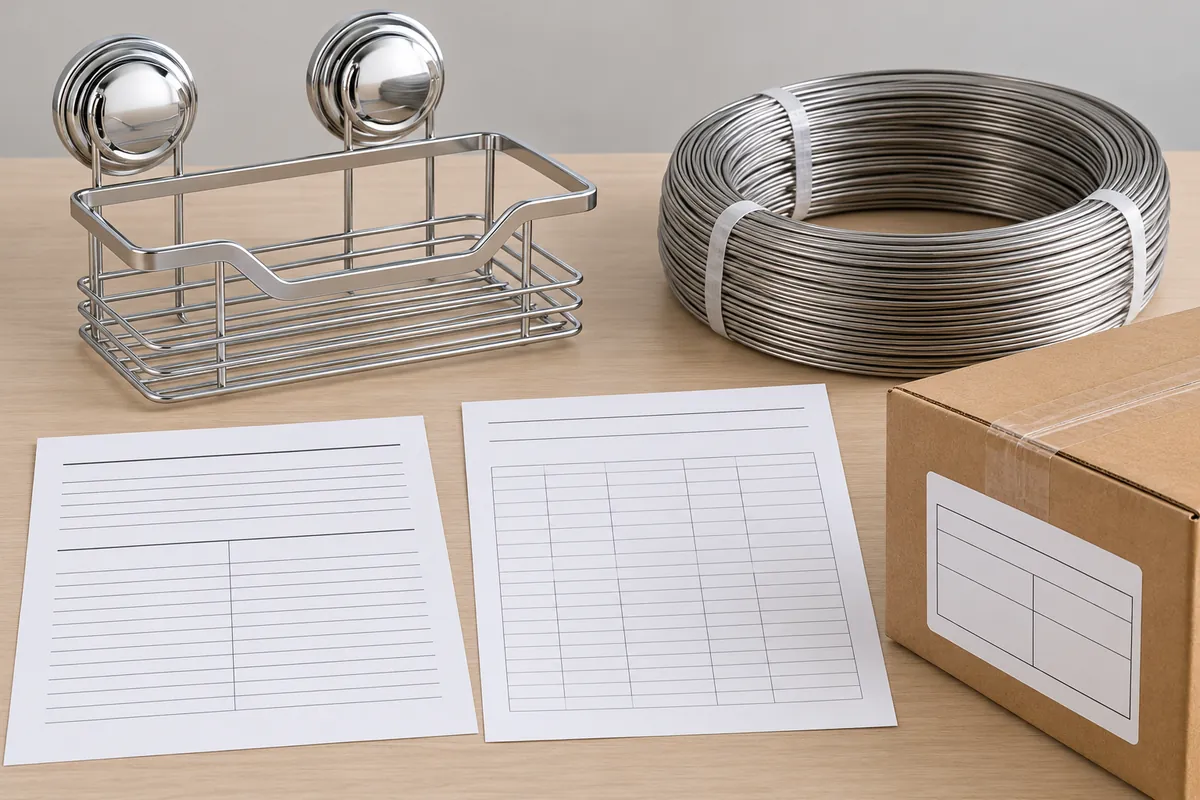
The same discipline applies when a document arrives with the shipment. Check that the purchase order, supplier or mill identity, material description, lot reference, and quantity context are consistent with the agreed scope. If the document covers only a portion of an order or lists an identifier that cannot be connected to production, ask for clarification before closing the receiving review. Record the disposition, but do not alter a source document to make it appear to cover goods it does not identify.
Frequently asked questions about stainless steel material records
Is a mill certificate always required for stainless bathroom hardware?
Not universally. Requirements depend on the buyer specification, contract, product risk, customer obligations, and supplier capability. State the required document and scope in the RFQ rather than assuming the same evidence applies to every order.
Does a material certificate prove that every finished item is stainless steel?
A certificate describes the material and scope identified in that document. It does not automatically prove uninterrupted use of that lot in every finished unit. The buyer should confirm how the identifier is connected to production and the delivered quantity.
Is a material declaration the same as a test report?
No. A declaration is a supplier statement; a test report records specified results for a sample or item tested under a stated method. A certificate can contain different types of information, so review its issuer, scope, and actual contents.
What is the difference between a heat number and a production batch?
A heat number identifies a source-material grouping from the mill or upstream supply chain. A production batch is a downstream manufacturing grouping. One batch may use one or more source lots unless controls prevent mixing, so the relationship must be documented if it matters to the buyer.
Can visual inspection confirm the stainless grade?
No. Visual appearance can support checks for visible condition but cannot establish alloy composition. If grade verification is required, agree a suitable evidence or test method with a qualified technical provider.
Specify Material Evidence Before Your OEM Order
Share the material requirement, product drawing, finish, order grouping and customer documentation needs when discussing bathroom hardware development. Koitor Hardware can review the manufacturing scope and clarify which order details need to be defined before quotation.
Fabrication pour compte de tiers / Marque de distributeur
Transformez ce guide d'approvisionnement en cahier des charges
Indiquez-nous le produit souhaité, ses dimensions, sa finition, la quantité commandée et vos exigences en matière d'emballage. Votre équipe recevra une analyse pratique de la faisabilité de la fabrication avant l'établissement du devis.


 English
  Español
  Português
  Français
  Deutsch
  العربية