
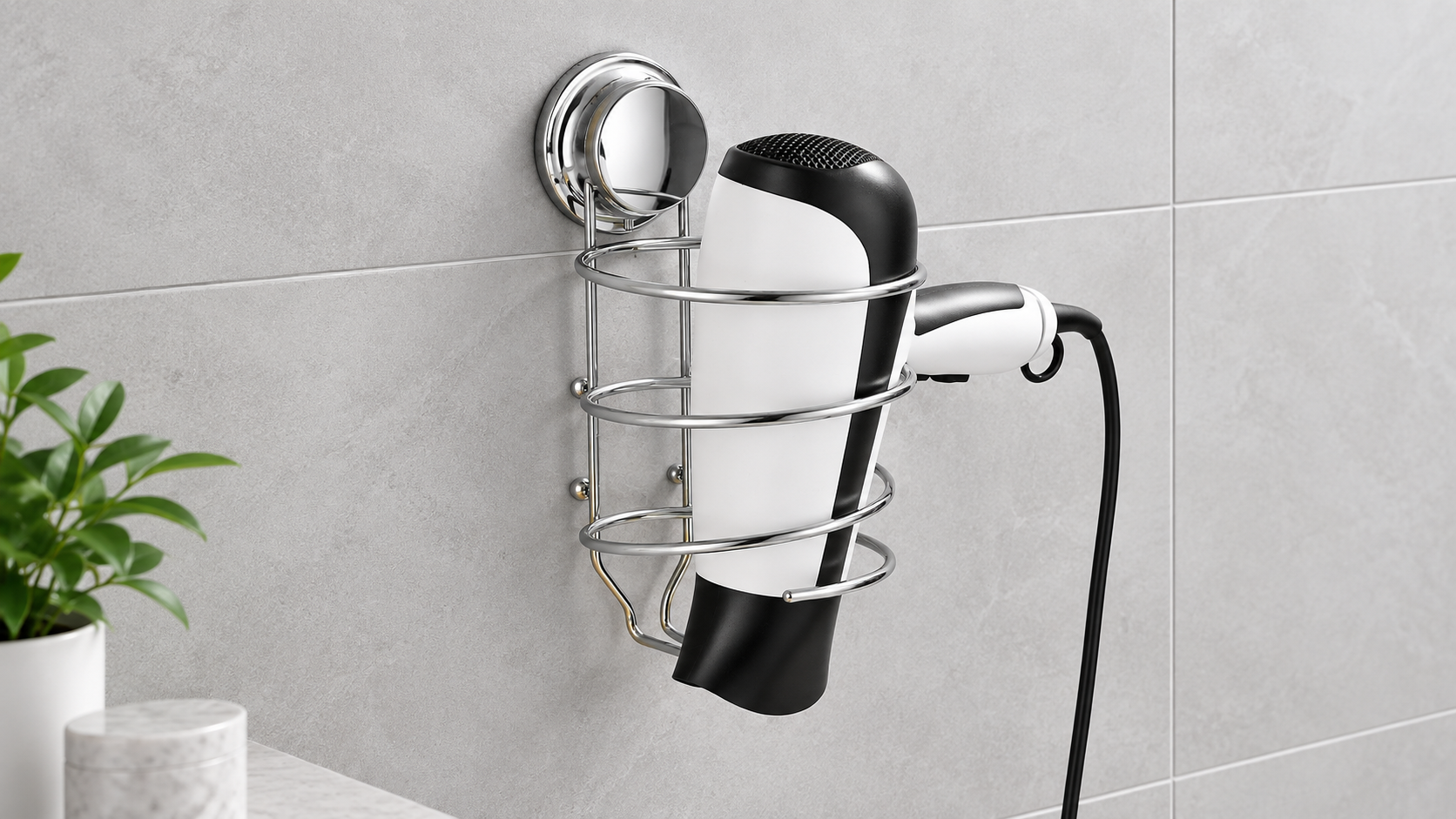
A suction cup hair dryer holder manufacturer should be evaluated on appliance fit, wire-frame geometry, suction-mount integration, surface finish, sample control and packaging. The key sourcing question is not whether a dryer fits in one photograph. It is whether the approved holder can accommodate the buyer’s defined appliance envelope, remain correctly oriented on the intended smooth surface and arrive with every mounting component protected and identifiable.
Hair dryers vary widely in barrel diameter, body taper, handle angle, nozzle length and cord arrangement. An OEM buyer should therefore provide dimensions or physical samples for the intended fit range. The factory can then translate those inputs into a controlled basket diameter, insertion depth, handle opening and mount position instead of guessing from a generic dryer.
What Should Buyers Define Before Requesting a Quote?
Begin with the intended use case and product family. State whether the holder is for a full-size hair dryer, compact travel dryer, straightener, curling tool or a defined combination. A cylindrical wire holder that works for a tapered dryer body may not work for a rectangular straightener, and a deep basket may interfere with controls or the power cord.
Provide the target appliance envelope: maximum and minimum body diameter, insertion length, handle projection, handle angle and any nozzle or concentrator that remains attached during storage. If several appliances must fit, identify which one is the largest, which one creates the most difficult handle clearance and which one has the smallest body that must not drop too deeply.
The holder drawing should specify basket inside diameter, basket height, lower support style, wire diameter, support-wire spacing, distance from wall to basket center, suction-cover diameter and the position of any cord hooks. Define dimensions from stable datums such as the wall plane, suction centerline and top basket ring. Measuring from an irregular decorative curve creates avoidable ambiguity.
State the material and finish direction, but avoid using finish names as a substitute for a specification. A polished or plated appearance should be approved against a physical reference and agreed cosmetic zones. Also define whether the mounting cover, metal holder and purchased suction components must match in color and gloss.
Surface assumptions belong in the inquiry. Suction products are commonly reviewed on clean, smooth, non-porous test surfaces. Textured tile, porous stone, grout joints and uneven walls require separate evaluation. Koitor’s no-drill bathroom accessories manufacturing page provides a useful starting point for discussing the mounting family without mixing suction and adhesive structures.
Which Hair Dryer Holder Structures Should OEM Buyers Compare?
The best structure depends on the appliance range, available wall space, expected retail price and packaging format. Buyers should compare functional geometry rather than choosing only by appearance.
| Structure | Typical sourcing advantage | Critical approval point |
|---|---|---|
| Open spiral wire basket | Accommodates tapered bodies and allows airflow | Inside diameter, insertion depth and open wire end |
| Parallel ring basket | Clear measuring datums and repeatable forming | Ring alignment and spacing |
| Mesh or crossed-wire base | Supports a smaller appliance body | Drainage, weld condition and minimum opening |
| Single suction mount | Compact appearance and simpler installation | Wall offset, rotation control and product leverage |
| Holder with cord hooks | Keeps the cable organized near the appliance | Hook opening, edge condition and cord clearance |
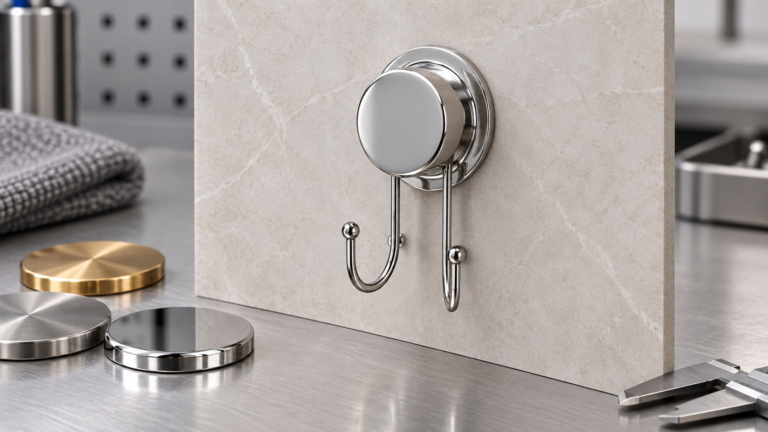
A vacuum suction dryer rack OEM project should document the complete mounting assembly. The bill of materials should identify the rubber cup, center connector, locating base, decorative cover, metal interface and any retained hardware. Similar-looking covers are not automatically interchangeable because center openings, internal ribs and wire-retention features can differ.
Single-mount holders need particular attention to leverage. The dryer basket sits away from the wall, so appliance weight and user handling create a turning moment around the mount. This does not justify an unsupported load claim. It does mean the buyer should control wall offset, frame stiffness, rotation resistance and the agreed validation method.
The lower basket detail affects both fit and cleaning. A fully open bottom may suit a large tapered dryer, while a mesh base can support smaller bodies. The buyer should check that the hot-air outlet or air intake is not being represented as safe for immediate storage without an appliance-specific instruction. Product literature should state storage and cooling assumptions conservatively.
How Should Appliance Fit and Mounting Geometry Be Approved?
Approve fit with physical appliances or accurate gauges, not with diameter alone. A dryer can pass through the top ring but stop at an unintended point because the body widens, the handle contacts the frame or a control switch catches on a wire. Use representative samples for the largest body, smallest body and most restrictive handle geometry.
Record insertion depth from the top basket plane to a consistent point on the appliance. Check that the dryer is stable without forcing it into the frame. Confirm that the handle remains accessible and that the cord exits without a tight bend against a wire end. For a spiral basket, inspect the termination of the open wire and its distance from the appliance surface.
The mount position should be checked against a wall-plane fixture. Measure the suction centerline, wall-to-basket offset, basket verticality and frame rotation. Parallel support wires should enter the approved mounting interface without distortion. Once assembled, the decorative cover should hide the connection while remaining centered and correctly oriented.
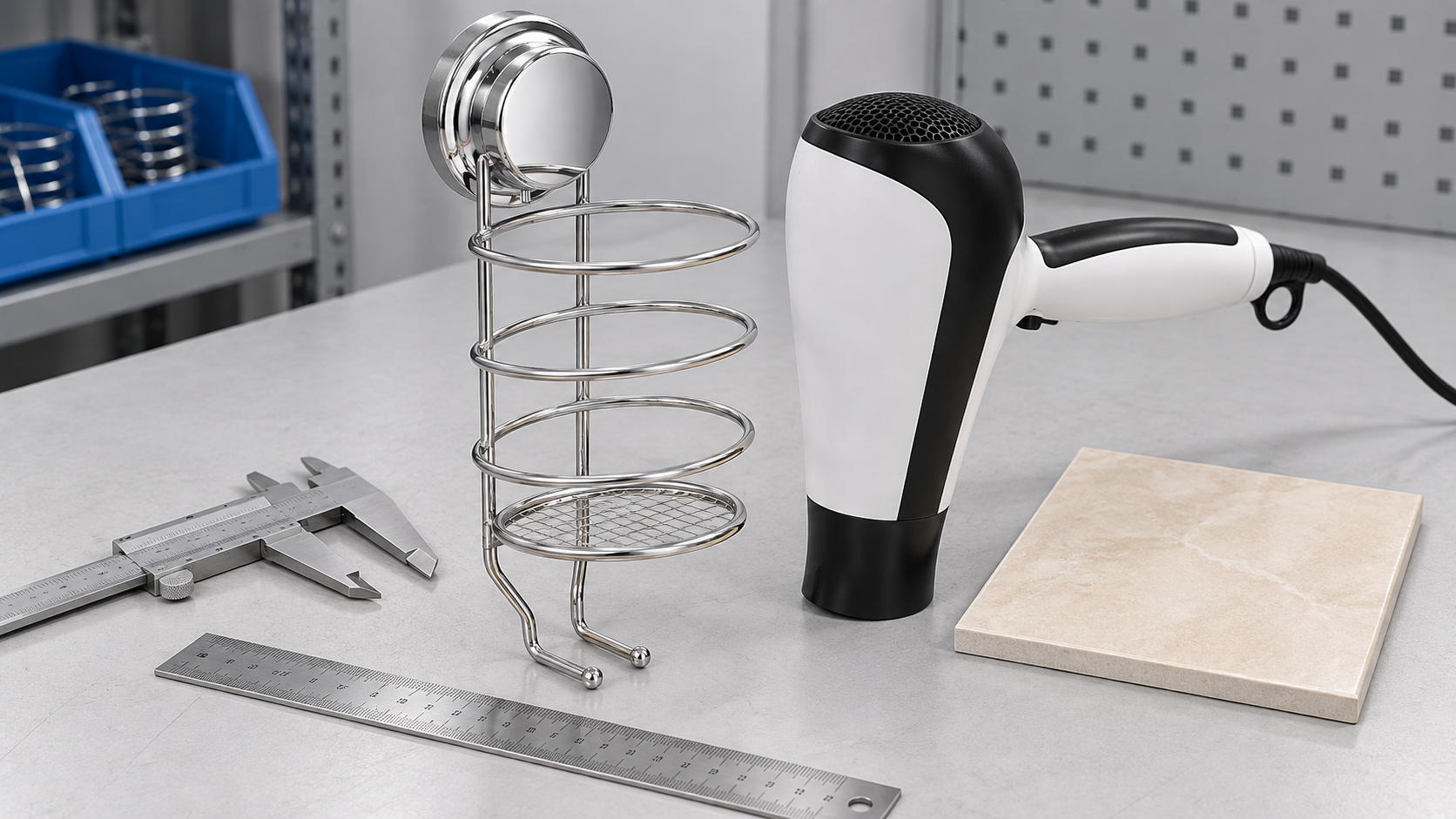
A no drill hair dryer holder supplier should separate dimensional approval from performance validation. Dimensional checks confirm that production matches the drawing. Installation and retention checks confirm behavior under agreed conditions. The validation record should identify surface material, cleaning method, installation steps, appliance sample, observation period and acceptance criteria.
Do not convert one successful sample into a universal claim for every wall or dryer. If the buyer requires a retail claim, the claim should match the tested configuration and documented conditions. This protects both the importer and the factory from expectations that the approved evidence does not support.
What Should the Approval Sample and Factory Review Cover?
The approval sample should use production-intent wire, suction components, cover, finish and accessory set. An early hand sample can confirm the concept, but production release should reference a controlled drawing revision, bill of materials, approved appearance sample and packaging specification.
- Confirm the appliance fit range and the physical samples or gauges used for approval.
- Measure basket diameter, depth, ring spacing and wall offset from defined datums.
- Insert the largest, smallest and most restrictive appliance samples.
- Check handle, control, nozzle and cord clearance without forcing the appliance.
- Inspect wire ends, bends, joints and the lower support feature.
- Assemble the suction unit and confirm the metal frame is retained as designed.
- Install on agreed smooth surfaces and record the validation conditions.
- Review finish appearance, component matching and the complete retail pack.
The manufacturing route may include wire cutting, forming, fixture loading, joining, polishing or surface finishing, mounting assembly and packaging. The buyer does not need to prescribe every factory operation, but should ask how first-piece geometry is confirmed and how open wire ends, joints and visible surfaces are inspected.
Fixture control matters because a round basket can become oval during forming or joining. Check at more than one height if the design uses several rings. Support wires should remain parallel and the basket centerline should match the mount. A holder that leans on the inspection table may rotate or present poorly after installation.
Koitor Hardware is a family-owned custom metal hardware factory specializing in bathroom and home storage hardware. Koitor can review buyer drawings or physical samples, discuss manufacturability and support flexible small-batch OEM development. MOQ can start from 100 pieces for some products, while the practical quantity, sample route and schedule depend on confirmed structure, finish, purchased mounting components and packaging.
For broader metal-product development questions, buyers can review Koitor’s fabrication sur mesure de quincaillerie de salle de bains capabilities and send the actual appliance samples with the inquiry.
Which Quality and Packaging Checks Reduce Sourcing Risk?
Inspection should follow the functional risks. Incoming checks identify the correct suction components and metal material. First-piece review confirms formed geometry. In-process inspection checks alignment and joining. Final inspection confirms assembly, appearance, accessory completeness and packaging condition.
Use this checklist before releasing a private label bathroom appliance holder order:
- ☐ The approved appliance range is identified by model, sample or controlled gauge.
- ☐ Basket inside diameter and insertion depth match the drawing.
- ☐ Handle, switch, nozzle and cord clearances have been reviewed.
- ☐ Round rings are aligned and the basket is not visibly oval or twisted.
- ☐ Support wires remain parallel and match the mounting interface.
- ☐ Wire ends, hooks and joints are smooth and correctly oriented.
- ☐ Suction cup, base, cover and connector match the approved bill of materials.
- ☐ Mount orientation and wall offset match the approved sample.
- ☐ Finish color, gloss and cosmetic zones match the reference.
- ☐ Installation instructions state surface preparation and use assumptions.
- ☐ Packaging prevents metal-to-metal rubbing and protects the suction face.
- ☐ Any appliance-fit or mounting change requires reapproval.
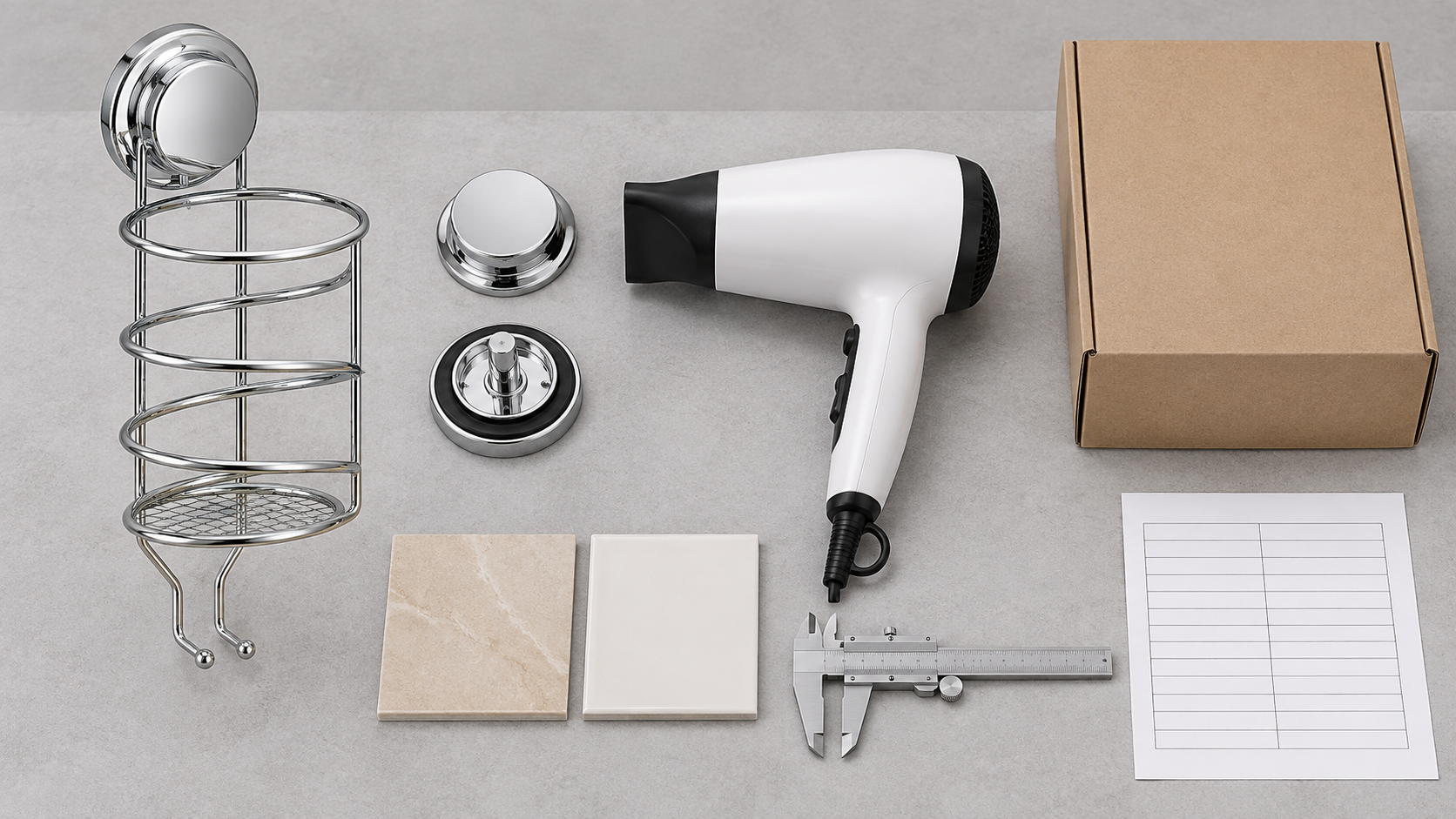
Packaging must protect the circular frame from compression. A deformed ring can change fit even when the finish looks acceptable. The chrome cover should not rub against wires, and the rubber working surface should remain clean and free from pressure marks. If the product is nested, define separators and orientation with a packed reference sample.
Common sourcing mistakes include approving only a catalogue photo, measuring one dryer, ignoring handle interference, leaving the open spiral end uncontrolled, treating the suction cover as a generic component and publishing broad wall or load claims without agreed evidence. Another frequent error is changing the dryer sample after the holder tooling or fixture has been approved.
Compare quotations on the same basis: metal frame, mounting assembly, finish, samples, fixtures or tooling, retail packaging, inspection requirements and delivery terms. A cheaper quotation may exclude the appliance-fit work, mounting parts or protective packaging assumed by another supplier.
For repeat orders, compare the new drawing revision, bill of materials, suction-component source, finish reference and packed sample with the approved production record. A purchased cup or cover can change internally while keeping a similar outside appearance. Any substitution should be identified before assembly and the affected fit, mounting and packaging checks should be repeated. Lot records and retained samples help the buyer distinguish a one-off handling issue from a recurring dimensional or component problem.
Before quotation is finalized, ask the suction cup hair dryer holder manufacturer to return a written assumption list. It should identify the appliance samples reviewed, dimensional tolerances still open, included mounting parts, finish reference, packaging method and delivery basis. Resolve those assumptions in the drawing or purchase specification. A controlled inquiry pack helps purchasing, product development and inspection teams evaluate the same configuration, and it prevents an early concept image from becoming the only reference used during production.
Foire aux questions
What should buyers send to a suction cup hair dryer holder manufacturer?
Send a dimensioned drawing or physical holder sample, representative hair dryers, required finish, target quantity, suction-mount concept, packaging format and approval criteria.
Is one basket diameter enough to define appliance fit?
No. Body taper, insertion depth, handle angle, nozzle, controls and cord exit can all affect fit. Physical appliance samples or accurate gauges provide better approval evidence.
Can the same holder fit a hair dryer and a straightener?
Sometimes, but the shapes are different. The buyer should define both product envelopes and confirm that the selected basket and lower support safely retain each intended appliance.
Which surfaces should be used for suction validation?
Use buyer-approved representative surfaces and document preparation, installation and observation conditions. Smooth non-porous surfaces are different from textured tile, porous stone or grout.
Can Koitor develop a holder from a physical sample?
Koitor can review a drawing or physical sample within its supported manufacturing scope. Missing dimensions, appliance range, mounting, finish and packaging requirements should be documented before production approval.
Collaborez avec Koitor Hardware
Planning a Custom Suction Hair Dryer Holder?
Send Koitor your drawing, holder sample, representative appliances, finish target, mounting concept, packaging idea and expected order quantity. The team can review fit, manufacturability and a practical small-batch OEM route before quotation.
Fabrication pour compte de tiers / Marque de distributeur
Transformez ce guide d'approvisionnement en cahier des charges
Indiquez-nous le produit souhaité, ses dimensions, sa finition, la quantité commandée et vos exigences en matière d'emballage. Votre équipe recevra une analyse pratique de la faisabilité de la fabrication avant l'établissement du devis.
 English
  Español
  Português
  Français
  Deutsch
  العربية