

For buyers searching “UK product safety requirements importer consumer products,” the practical starting point is to define the market, identify the rules that apply to the specific product, and agree who owns each safety and traceability record. For non-powered bathroom and home-storage hardware placed on the Great Britain market, official guidance describes duties for producers, which can include UK-based importers, as well as duties for distributors. Factory records can support that process, but they do not replace the importer’s own product-specific assessment or legal responsibilities. Northern Ireland follows a separate general product-safety regime, so a GB checklist should not be copied there unchanged.
Scope note: This guide reflects UK Government guidance checked on October 23, 2026. It is operational buyer education, not legal advice, a product risk assessment, a conformity assessment or a declaration that any SKU complies. Confirm applicable rules, roles, markings and deadlines with a qualified UK product-safety adviser.
Does the GB product-safety guide apply across the whole UK?
No. The General Product Safety Regulations 2005 guidance discussed here applies to England, Scotland and Wales. UK Government guidance says that the 2005 regime was superseded in Northern Ireland on December 13, 2024 by EU Regulation 2023/988 on general product safety. Product-specific rules can also take precedence or apply alongside relevant general rules, so a buyer needs a market-and-product screen before using a document checklist.
Begin by recording where each product will be placed on the market: Great Britain, Northern Ireland, or both. Then identify the product as sold, including whether it is a towel rail, wall shelf, wire basket, shower caddy or another storage product; whether it is powered; how it is mounted; who uses it; and what instructions and accessories ship with it. Similar-looking bathroom hardware can differ in intended use, installation and foreseeable risks. The answer should follow the actual SKU and market, not a broad category label.
The UK Government’s Great Britain guidance on the General Product Safety Regulations 2005 explains the GB framework. Its separate overview of general product-safety regulations identifies the different Northern Ireland regime. Check the latest official guidance again at launch, especially if a product is to be sold in more than one UK market.
Who owns product-safety decisions when a UK buyer imports hardware?
The factory and importer have different jobs. Under the GB 2005 guidance, a UK-based importer can fall within the definition of a producer when bringing products from outside the UK onto the GB market. The guidance describes producer obligations that include ensuring safety before market placement, supplying relevant risk information, supporting traceability and maintaining measures to learn about risks. Distributors also have their own due-care, traceability and cooperation responsibilities.
This does not mean every importer has identical obligations regardless of the product, transaction or other applicable law. It means a buyer should not assume that a supplier’s declaration, a quality certificate or a successful sample transfers the importer’s market-placement responsibilities to the factory. Decide internally who approves the product, confirms applicable legislation, approves consumer instructions and labels, releases the SKU for sale, monitors complaints and contacts authorities if a serious issue arises.
The factory can contribute product facts it can substantiate: model and revision, materials and components used, assembly configuration, production or lot references where maintained, available drawings, inspection records and changes communicated for the order. The importer or brand should decide which evidence is legally relevant, whether it is sufficient, whether additional assessment is needed and how the records are retained. Keep those roles explicit in the purchase specification or supplier quality agreement.
What product evidence should buyers request from a factory?
Ask for evidence that identifies the product and helps the importer assess its real-world use. A useful request is specific to the SKU and drawing revision rather than a generic request for “all certificates.” Identify whether each record is available, who issued it, which model it covers, when it was prepared and what it actually demonstrates.
| Buyer evidence request | What the factory may be able to confirm | What the importer still decides |
|---|---|---|
| SKU identity | Model, revision, components, finish and order configuration | Whether the product description matches the item placed on the GB market |
| Construction and materials | Documented material or component details and approved changes | Which safety rules, material restrictions or assessments apply |
| Drawings and sample record | Current drawing, agreed sample revision and production change history | Whether design and foreseeable use have been adequately reviewed |
| Available inspection or test records | Actual method, sample, date, result and stated scope of a record that exists | Whether the test is relevant and sufficient; do not extrapolate beyond its scope |
| Instructions and warnings | Factory-provided assembly/use information and agreed language versions | Required user information, translation, label content and market approval |
| Production identity | Available order, batch or manufacturing references | How the identifiers connect to the importer’s sale and complaint records |
For bathroom and home-storage products, a buyer may want to review foreseeable installation, loading, sharp edges, pinch points, corrosion environment, cleaning and assembly where relevant to that SKU. These are prompts for a product-specific risk review, not a statement that every product needs a particular test or that Koitor has performed one. A load check, coating record or sample inspection proves only what its documented method, sample and acceptance criteria support.

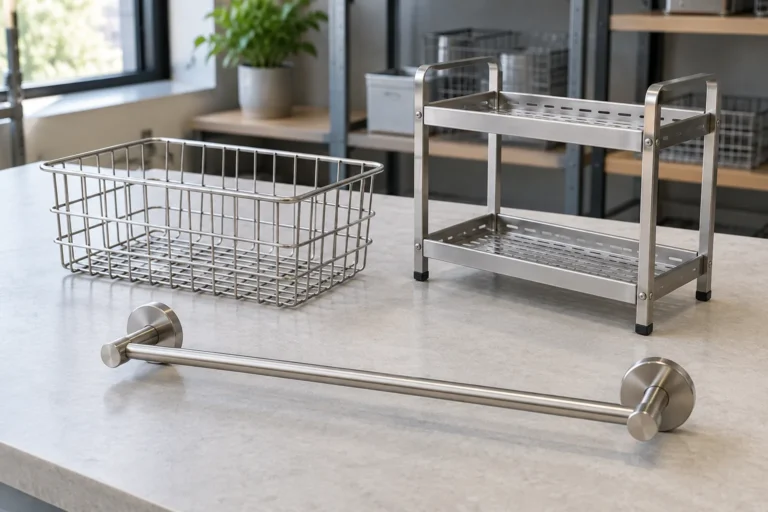
This generic illustration shows a sample-review setting only. It is not a Koitor product, test, conformity assessment or evidence that any product is safe.
Do all bathroom accessories need a UKCA or CE mark or one general safety certificate?
Do not assume so. UK Government guidance says certain product types require UKCA and/or CE marking where applicable, while conformity-assessment steps differ by product. It also says product-specific provisions may take precedence over general product-safety rules. A buyer therefore needs to establish the product category and applicable legislation before requesting a marking, declaration or test report.
For a non-powered metal towel rail, wire basket or shelf, ask the responsible UK compliance owner to determine whether specific rules or marking obligations apply to the actual product and market. Do not add a marking because a retailer template asks for one without checking its legal basis, and do not treat the absence of a marking as proof that a product is non-compliant. Likewise, do not assume a generic “GPSR certificate” exists or proves compliance for every hardware SKU. The evidence file should map each requested document to a requirement and product.
The official manufacturer and importer guidance discusses standards, conformity assessment and marking where needed. It explains that the process varies between products and may involve product design, manufacturing controls, technical documentation or testing. A named standard or report should be checked for the exact issue and model it covers; it is not a blanket performance guarantee.
How should product identity and traceability link to an order?
The buyer needs a practical way to connect a consumer product in the market back to the relevant supplier, model and production information. The GB guidance describes product or batch references and producer identity on the product or its packaging where reasonable. A buyer can make this workable by aligning the model name, drawing revision, purchase-order line, carton information, production reference and complaint log instead of keeping each record under an unrelated description.
Ask the factory to confirm which identifiers it can reliably apply or record and how a change would be communicated. Ask the importer’s packaging owner to verify that the final consumer-facing product and shipper contain the approved information for the relevant market. Keep a controlled label artwork file and approval record; do not infer that a blank label shown in a sample image is a compliant design.
The GB guide describes a limited alternative approach for certain cases where it is not reasonable for the importer’s name and address to appear on the individual product or its packaging while adjusting to new arrangements. The official guidance says these alternatives are time-limited and may not be used after December 31, 2027. This is not a general exemption or a recommendation to omit importer details. Before relying on any alternative, the responsible UK business should confirm that the conditions apply and how traceability remains available to users and regulators.
What should the importer do after the product is on sale?
Set up monitoring before launch rather than trying to invent a process after a complaint. UK guidance describes sampling products, recording safety complaints, keeping distributors informed of investigations or feedback that may present a safety risk, and notifying the relevant enforcement authority when required. The GB guide says producers or distributors who know a product poses an incompatible risk must notify the relevant authority in writing. The importer should use the official procedure and competent advice for the specific incident.
At minimum, decide who receives complaints, what product information is captured, how serious reports are escalated, who can pause sales, how affected batches are identified and how the factory is contacted. Keep the original report, product photos, purchase and shipment records, investigation notes, corrective action and customer/distributor communications together. Provide only information that is accurate and supported; do not promise that a factory can close a regulatory incident or decide the importer’s reporting duty.
The current UK Government product-safety advice for businesses was updated on July 21, 2026. It describes seller/importer responsibilities, product-specific rules, recordkeeping and safety incidents. For an actual risk or consumer incident, follow current official guidance and contact the appropriate Trading Standards or other competent authority; an article checklist is not an incident-response decision.
What should a buyer confirm before approving a hardware SKU for GB sale?
Before launch, check that the commercial, engineering, labeling and post-market owners are working from one approved SKU record. The phrase “UK product safety requirements importer consumer products” is a search expression; the actual work is a specific evidence and responsibility handoff for the item and market.
- [ ] Confirm whether the intended market is Great Britain, Northern Ireland or both.
- [ ] Identify product-specific legislation and any applicable standards or marking requirements.
- [ ] Assign the UK business owner for product safety, label approval and market release.
- [ ] Freeze the SKU, drawing revision, components, finish, installation method and instruction version.
- [ ] Request factory evidence with model, date, scope and revision identified.
- [ ] Review foreseeable consumer use and product-specific risks with the responsible adviser.
- [ ] Agree how product identity, importer details and any product/batch reference will be shown or linked to records.
- [ ] Validate final packaging and instructions in the approved market language before mass production.
- [ ] Establish complaint intake, sample monitoring, escalation and corrective-action contacts.
- [ ] Reopen the review after a material, design, supplier, market, label or instruction change.

The label in this illustrative image is deliberately blank. It is not an official label layout or a statement of the exact information required for an individual SKU.
Is the factory responsible for a UK importer’s product-safety assessment?
The factory can provide accurate product and manufacturing records, but the UK importer should identify its own obligations, determine applicable rules and decide whether available evidence is sufficient before the product is placed on the market. Contract terms can allocate tasks, but the buyer should not assume that a supplier’s document transfers statutory responsibility.
Does the GB General Product Safety Regulations 2005 guide apply in Northern Ireland?
No. The UK Government’s GB guidance applies to England, Scotland and Wales and states that Northern Ireland has a separate general product-safety regime. A product planned for both markets needs a market-specific review.
Must every metal bathroom product carry UKCA or CE marking?
Not as a blanket rule. Official guidance says certain products require marking where applicable and that product-specific rules differ. Identify the legislation for the actual item and intended market before deciding which marks or conformity documents are needed.
Is there one universal product-safety certificate for a bathroom shelf?
Do not assume there is a single certificate that proves every legal and safety question for every shelf. Ask what requirement a document addresses, which model and revision it covers, which method was used and what the result does—and does not—show. The importer’s adviser should confirm whether further evidence is required.
Can an importer leave its address off the individual product or package?
The GB guide describes a limited, time-bound alternative approach under specified conditions when it is not reasonable to mark an individual product or its packaging. It is not a blanket exemption and the guidance says the alternatives cannot be used after December 31, 2027. Confirm current conditions and a viable traceability path before relying on it.
For buyers searching “UK product safety requirements importer consumer products,” the durable takeaway is to match the product to the market and applicable rules, request specific and revision-controlled evidence from the factory, and keep importer-owned traceability and incident processes ready. Koitor can discuss documented construction and manufacturing facts for its own quoted hardware; the UK importer or brand must make its market decisions with qualified advice.
Prepare a SKU-Specific Supplier Evidence Request
Share the product drawing, approved revision and target market for a discussion of documented bathroom and home-storage hardware facts. Confirm compliance and market-placement decisions with your UK product-safety adviser.
Fabrication pour compte de tiers / Marque de distributeur
Transformez ce guide d'approvisionnement en cahier des charges
Indiquez-nous le produit souhaité, ses dimensions, sa finition, la quantité commandée et vos exigences en matière d'emballage. Votre équipe recevra une analyse pratique de la faisabilité de la fabrication avant l'établissement du devis.


 English
 Español
 Português
 Français
 Deutsch
 العربية