
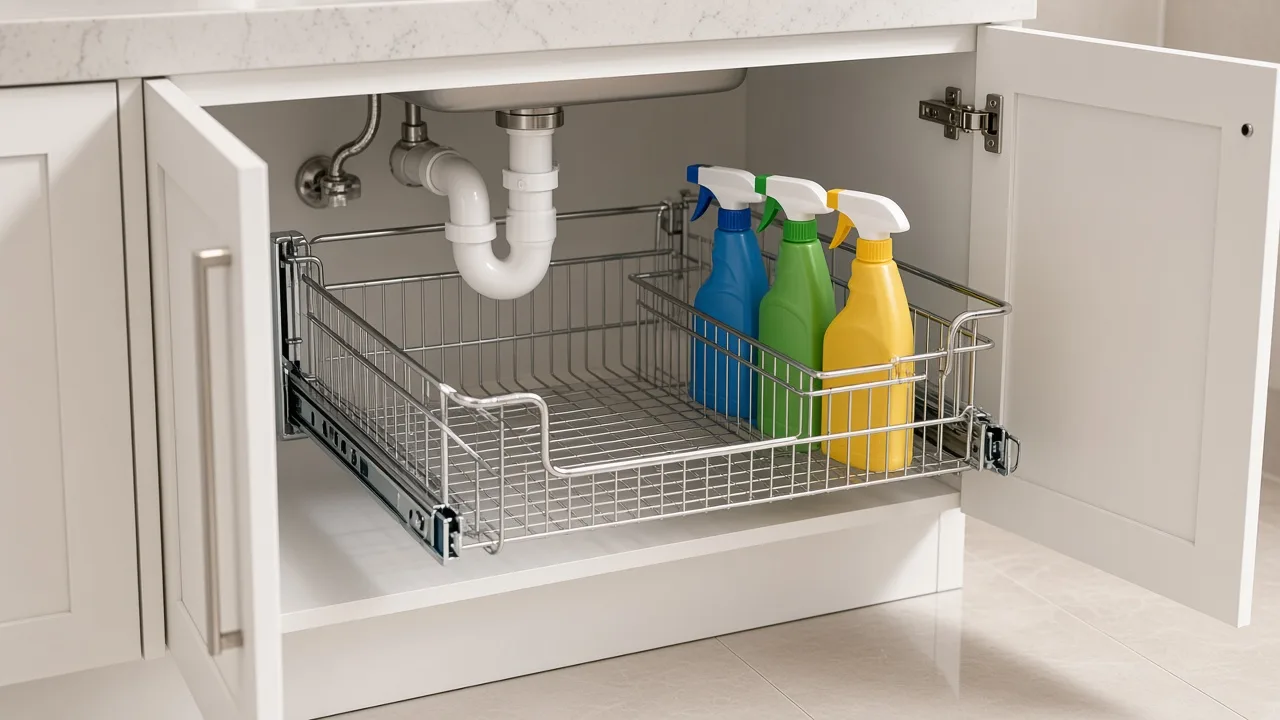
Un under sink wire basket slide fails in the field when the basket kisses the P-trap, the slide rack hits supply stops, or the U-cut is copied from a drawer RFQ that never saw real plumbing. This guide freezes importer language for a chrome or coated under sink wire basket slide without rewriting U-shaped under-sink drawer plumbing clearance essays or static under-sink metal rack pipe clearance specs.
Those neighbor posts remain the place for deep plumbing envelope math and fixed rack standoffs. Here the angle is the sliding wire basket: travel, cutout, soft-close, and IQC around live pipes.
In this guide
- Why Under Sink Wire Basket Slide Specs Differ From U-Shaped Drawers
- How to Freeze Under Sink Wire Basket Slide CTQs
- 9 Plumbing Clearance and Slide Checks
- Accept, Rework, or Reject Under the Sink
- RFQ Checklist Language for P-Trap Clearance and Travel
- FAQ: Under Sink Wire Basket Slide Specs
- Send Your Under Sink Wire Basket Slide Spec for Review
Why Under Sink Wire Basket Slide Specs Differ From U-Shaped Drawers
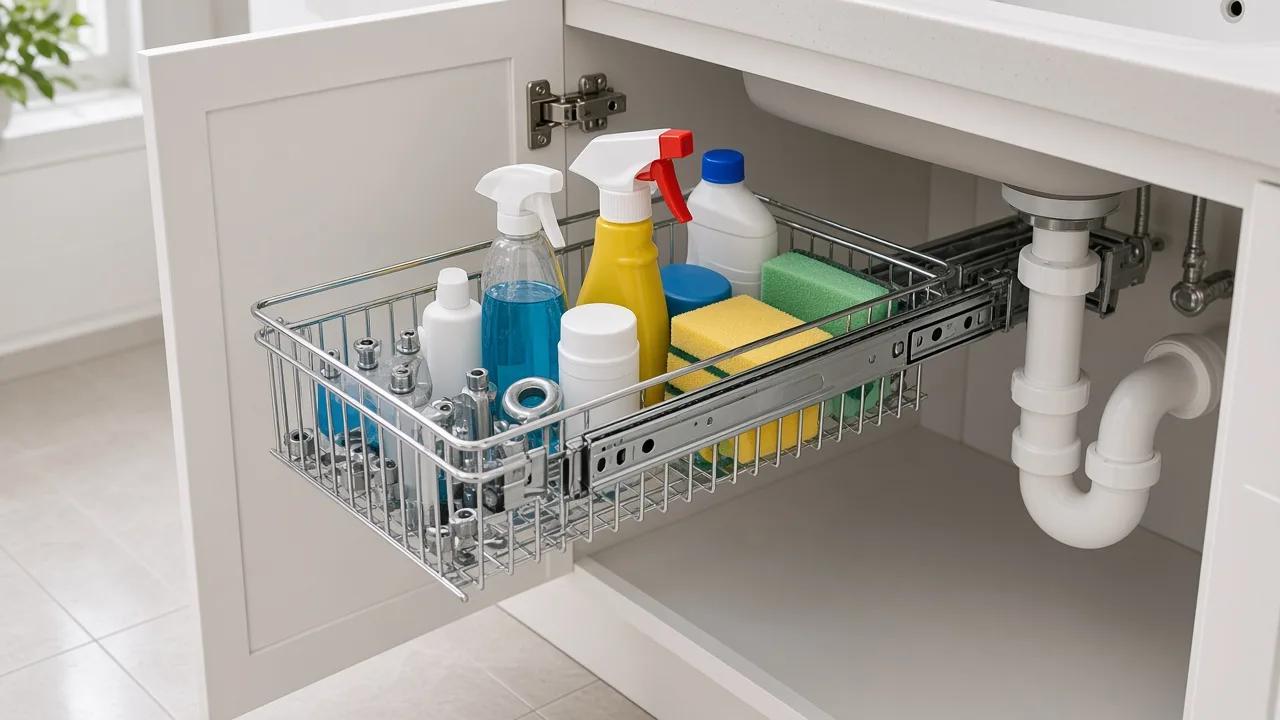
U-shaped drawers emphasize solid floors and skirt heights. Wire baskets emphasize weld stiffness, bottle retention through open grids, and slide mounting that still clears trap swing.
A static under-sink rack never teaches you what happens at full extension. The under sink wire basket slide must clear pipes through the entire stroke, not only when parked.
Read plumbing clearance fundamentals in U shaped under sink drawer plumbing clearance OEM guide et under sink metal rack pipe clearance specification. For basket manufacturing context upstream of the slide assembly, keep wire basket manufacturing CTQ playbook as a neighbor—not a duplicate under-sink slide RFQ.
How to Freeze Under Sink Wire Basket Slide CTQs
Freeze sink base width, trap diameter and drop, supply stop positions, basket U-cut or offset, slide length, soft-close, load map, and finish. Write the under sink wire basket slide CTQ name on the IQC sheet so CAPA searches work.
Plumbing mock before tooling buyoff
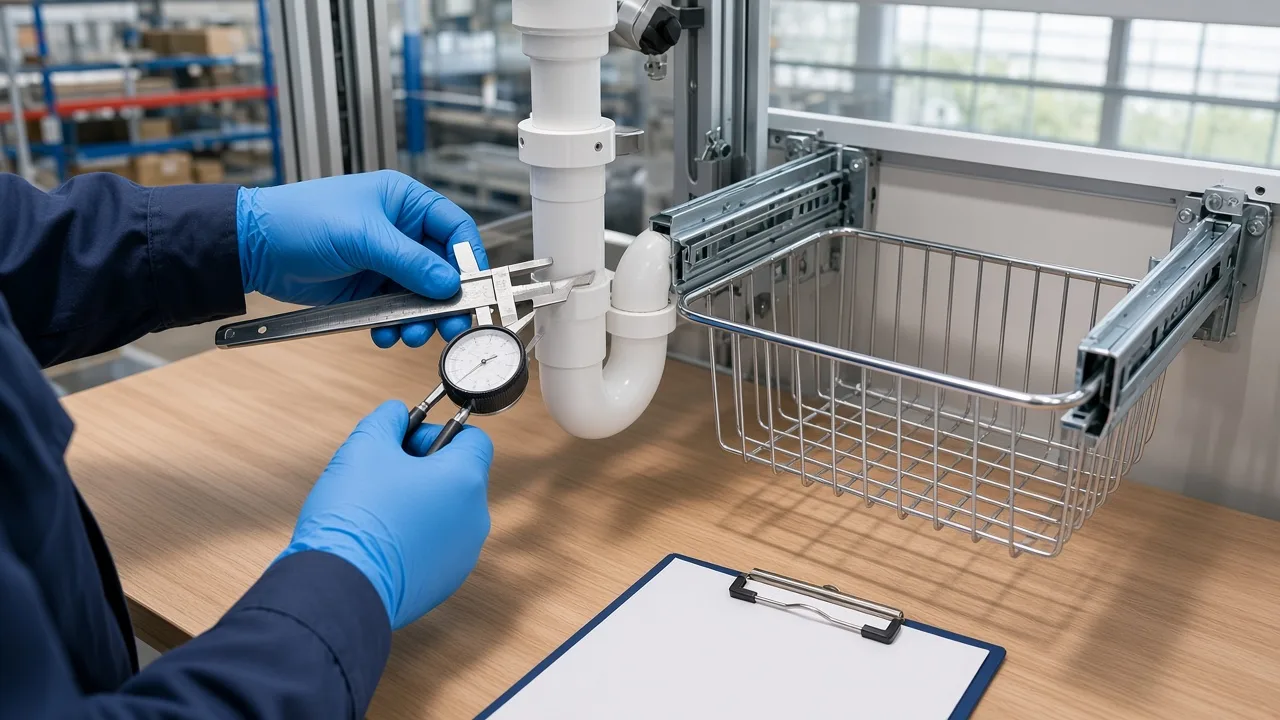
Build a trap-and-stops mock that matches the target retail vanity claim. Photograph clearance at closed, mid, and full extension.
Basket and slide as one assembly
Do not approve the basket weldment without the production slides. Racking often appears only when slides are mounted.
Dimensional inspection culture can reference ISO 2768 style general tolerances when drawings are silent, while NIST supports gauge calibration expectations. Corrosion claims for humid cabinets sometimes cite methods cataloged by ASTM—use them only when the RFQ truly adopts them.
9 Plumbing Clearance and Slide Checks
US-01 — Trap clearance at full stroke
Min gap __ mm at closed/mid/full; photo required. File under under sink wire basket slide.
US-02 — Supply stop clearance
No scrape on stops or braided lines through stroke. File under under sink wire basket slide.
US-03 — U-cut / offset accuracy
Cut matches drawing ± __ mm; no sharp wire ends. File under under sink wire basket slide.
US-04 — Slide travel both sides
Travel within __ mm; no racking beyond play limit. File under under sink wire basket slide.
US-05 — Soft-close window
Closes loaded without slam/stall. File under under sink wire basket slide.
US-06 — Retention under yank
Bottles stay behind lip/rail at agreed yank. File under under sink wire basket slide.
US-07 — Finish at pipe kiss zones
No coating breach if light contact is within Minor rules; prefer zero contact. File under under sink wire basket slide.
US-08 — Mount hole pattern
Matches cabinet jig; screws do not split thin floors. File under under sink wire basket slide.
US-09 — Hardware kit
Stops, screws, and dampers match BOM photo. File under under sink wire basket slide.
FAQ: Under Sink Wire Basket Slide Specs
Is a U-drawer RFQ enough?
No. Add stroke clearance photos and wire retention CTQs.
Wire vs solid base?
Wire drains spills better but needs retention rails; solid bases need different wipe and mold claims.
Left/right sinks?
Offset plumbing may need mirrored baskets—freeze both.
Send Your Under Sink Wire Basket Slide Spec for Review
If you are building an RFQ or PPS checklist around under sink wire basket slide, send the drawing revision, target retail channel, and sample matrix to Koitor Hardware contact or email simon@koitorhardware.com. We will map CTQs, suggest accept language, and note where a complementary pillar post already covers an adjacent angle.
Factory reference: Jiangmen, Guangdong OEM wire and bathroom/kitchen storage hardware. Photos in this draft are generic laboratory and product scenes, not a claim that every SKU ships from one line.
Include dishwasher drain loops in the mock if the retail vanity often has them.
Braided supply lines move; test with lines in worst-case dress.
Powder vs chrome changes cleaner advice under the sink.
Do not let factories ship slides separately without a match drill jig note.
Mark minimum gap on the install sheet so DIYers do not force collisions.
Cycle tests should include wet wipe chemical exposure if claimed.
Export packs must immobilize slides so they do not telescope and bend.
Retail photography should show realistic trap, not an empty cabinet fantasy.
If the basket nests for freight, validate nest abrasion separately from slide CTQs.
Keep spare damper SKUs for aftersales under-sink kits.
Particleboard floors need screw type notes to avoid strip-out.
Measure both slides; one long one short creates racking that looks like a weld issue.
Forbid silent slide brand swaps after PPS.
Capture humidity if the vanity sits against an exterior wall claim.
Train IQC to fail sharp wire ends at the U-cut as Major for cut risk.
Align SKU codes for narrow vs wide vanity widths clearly.
If claiming tool-free clips, yank-test the clips as their own line.
Document max bottle diameter for the front rail opening.
Use feeler gauges at the trap during full extension.
Golden sample should include the production trap mock photo set.
Tie every fail to a fixture ID, tool ID, and revision letter so CAPA is not a blame meeting. Lock carton marks and insert revision with the hardware BOM to protect retail intake identity.
Photograph the scale or caliper display in the same frame as the sample tag whenever metrology decides the lot. Prefer a short process note on the controlling dimension over a marketing capacity claim.
Separate Critical, Major, and Minor before the audit walk so rework cannot be redefined after goods leave the dock. Require the supplier to name the consumer-condition fixture used in the lab.
Ask for bilingual callouts when EU and AU share tooling but not copy decks. Skip-lot cadence should be written, not implied by “we tested the first lot.”
Confirm cure and cool-down after finishing before functional cycles begin. Keep quarantine cages for failed units so they cannot re-enter finished goods without a retest.
Map left-hand and right-hand variants explicitly; silent mirroring errors become field returns. Export edge protection on golden samples prevents false field narratives.
Store golden samples with desiccant when finish rub is part of accept criteria. Train inspectors to reject undocumented tool substitutions during the audit.
Lock carton marks and insert revision with the hardware BOM to protect retail intake identity. When retailers demand in-store demos, label non-rated demo masses clearly.
Prefer a short process note on the controlling dimension over a marketing capacity claim. Humidity loggers near wet-room fixtures prevent dry-lab theater.
Require the supplier to name the consumer-condition fixture used in the lab. Change wire diameter or slide brand only with a protocol re-run, not a verbal OK.
Skip-lot cadence should be written, not implied by “we tested the first lot.” Retail channel differences (hotel yank vs residential bottle mass) belong in the RFQ notes.
Keep quarantine cages for failed units so they cannot re-enter finished goods without a retest. Third-party labs must receive your mount kit and coupons, not “equivalents.”
Export edge protection on golden samples prevents false field narratives. Digital records should keep the English CTQ phrase stable across translations.
Train inspectors to reject undocumented tool substitutions during the audit. Tie every fail to a fixture ID, tool ID, and revision letter so CAPA is not a blame meeting.
When retailers demand in-store demos, label non-rated demo masses clearly. Photograph the scale or caliper display in the same frame as the sample tag whenever metrology decides the lot.
Humidity loggers near wet-room fixtures prevent dry-lab theater. Separate Critical, Major, and Minor before the audit walk so rework cannot be redefined after goods leave the dock.
Change wire diameter or slide brand only with a protocol re-run, not a verbal OK. Ask for bilingual callouts when EU and AU share tooling but not copy decks.
Retail channel differences (hotel yank vs residential bottle mass) belong in the RFQ notes. Confirm cure and cool-down after finishing before functional cycles begin.
Third-party labs must receive your mount kit and coupons, not “equivalents.” Map left-hand and right-hand variants explicitly; silent mirroring errors become field returns.
Digital records should keep the English CTQ phrase stable across translations. Store golden samples with desiccant when finish rub is part of accept criteria.
Tie every fail to a fixture ID, tool ID, and revision letter so CAPA is not a blame meeting. Lock carton marks and insert revision with the hardware BOM to protect retail intake identity.
Fabrication pour compte de tiers / Marque de distributeur
Transformez ce guide d'approvisionnement en cahier des charges
Indiquez-nous le produit souhaité, ses dimensions, sa finition, la quantité commandée et vos exigences en matière d'emballage. Votre équipe recevra une analyse pratique de la faisabilité de la fabrication avant l'établissement du devis.
 English
 Español
 Português
 Français
 Deutsch
 العربية