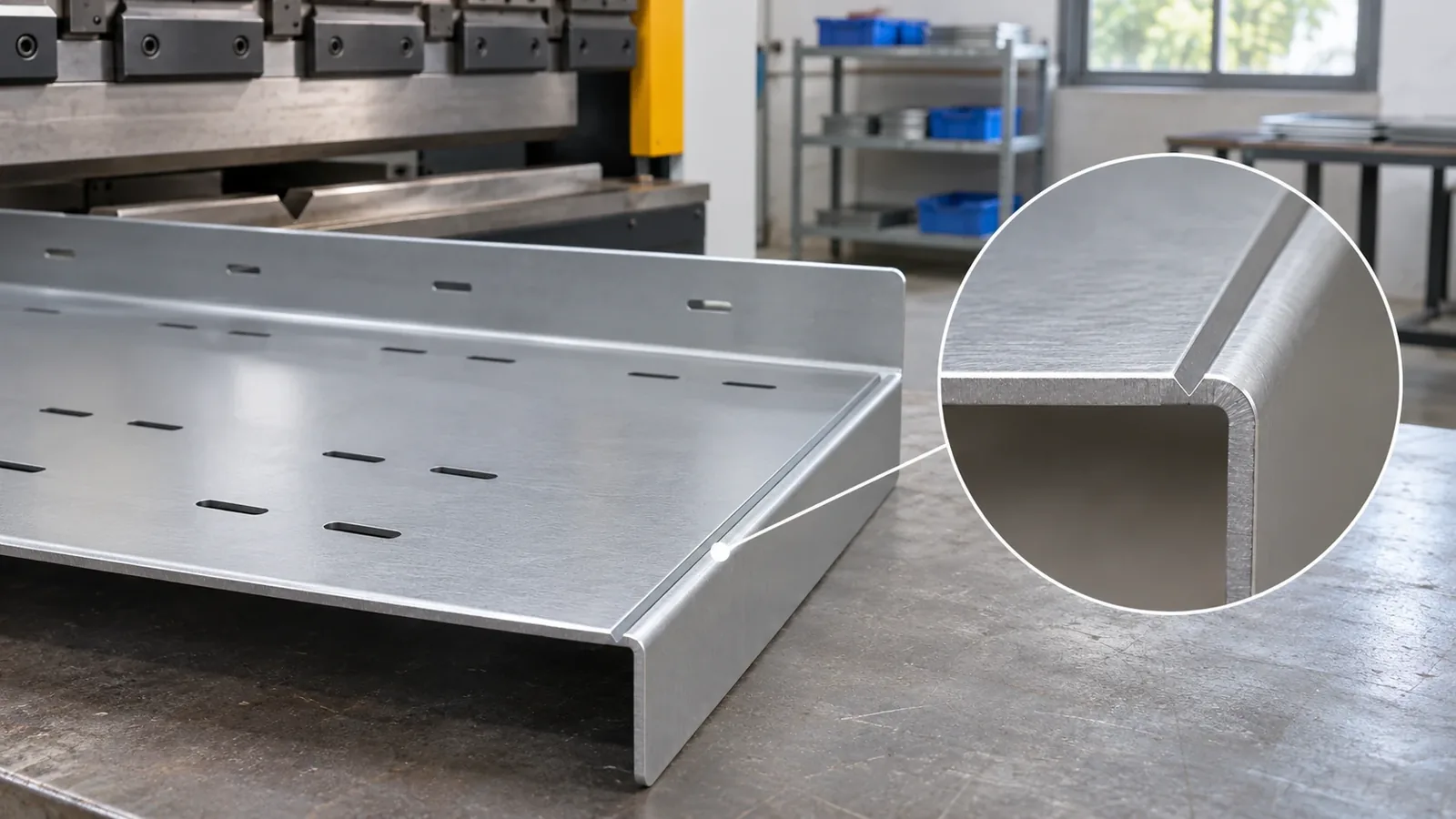
When specifying v grooving sheet metal for a storage shelf or enclosure, buyers should review how much material is intentionally removed, what section remains beneath the groove, and how that section behaves in the planned bend and finished part. The groove may help create a defined corner appearance, but a visually sharp line does not establish the part’s strength, dimensional stability or suitability for a particular load. Do not use a universal groove depth, remaining-wall percentage or bend radius. The responsible designer and processor should confirm the exact material, geometry, process route and acceptance evidence.
What is V grooving in a sheet metal design?
V grooving is a machining or cutting operation that removes material along a planned line before a sheet is formed. The resulting groove can help the sheet bend along a defined path and can change the appearance of the corner. The material that remains under the groove forms a web or residual section. The actual shape and dimensions depend on the tool, material, target bend, machine setup and drawing.
Equipment makers describe partial-depth grooving before forming and identify the remaining web as a feature of the operation. For example, Harsle’s V-grooving equipment description explains the process mechanism. This is process context from an equipment maker, not validation of a storage shelf design, a recommendation for a specific machine, or evidence of a universal accuracy. The buyer should rely on the part supplier’s drawing, process proposal and sample for the actual product.
The key design distinction is between the removed groove and the retained bend section. A drawing that marks only a “sharp corner” leaves important information open. It may not define groove location, profile, depth, width, surface orientation or how the remaining material is inspected. If a supplier proposes V grooving, ask for a section view and an agreed inspection point rather than assuming the process will produce a zero-radius edge or preserve full original thickness.
The process is one possible route, not the only way to form a corner. Depending on geometry, material, finish and production scope, a buyer may discuss a formed bend, assembled panels, an extruded or joined design, or another specialist process. Each route changes different aspects of tooling, joints, access, appearance and cost. This article does not establish which option is best for every shelf or confirm that a specific supplier offers V grooving.
Why does the retained bend section matter?
Grooving removes material from a sheet. The remaining section therefore differs from the original sheet at that line. How that difference affects a product depends on the exact material, groove dimensions, bend geometry, part orientation, adjoining structure and use conditions. A buyer should not infer that a particular shelf will be safe or unsafe from the visual appearance of the groove alone.
The remaining section is especially relevant where a groove coincides with a structural path, an attachment, a cosmetic edge or a surface exposed to the environment. The designer and process supplier should review how the bend is formed, whether the groove remains on an exposed face, what the edge looks like after finishing, and whether the final assembly introduces additional loads or restraints. If the design has a performance requirement, the responsible engineer should define suitable analysis or test evidence.
| Design question | What to define | Pourquoi est-ce important ? |
|---|---|---|
| Matériau | Grade, thickness, condition and finish sequence | Determines the specific process and forming review |
| Groove location | Datum, length, edge distance and relationship to features | Controls where material is removed relative to the part geometry |
| Groove profile | Width, included shape, depth and retained section on the drawing | Makes the supplier’s proposed process reviewable |
| Bend direction | Which face is grooved and which way the sheet is formed | Affects the part’s geometry and visible surface |
| Finished corner | Appearance, edge condition and joining requirements | Defines what the buyer approves on the sample |
| Product function | Attachments, assembly and use conditions | Connects the bend detail to the complete product decision |
The remaining section should be discussed with the supplier rather than chosen from a rule of thumb. A buyer may have seen a percentage or a nominal wall recommendation elsewhere, but such values depend on material, tooling, dimensions and the product. A number copied from another application can produce a different result in a storage shelf. Ask the supplier to mark the proposed residual section on the drawing and explain what it has reviewed for the actual material and geometry.
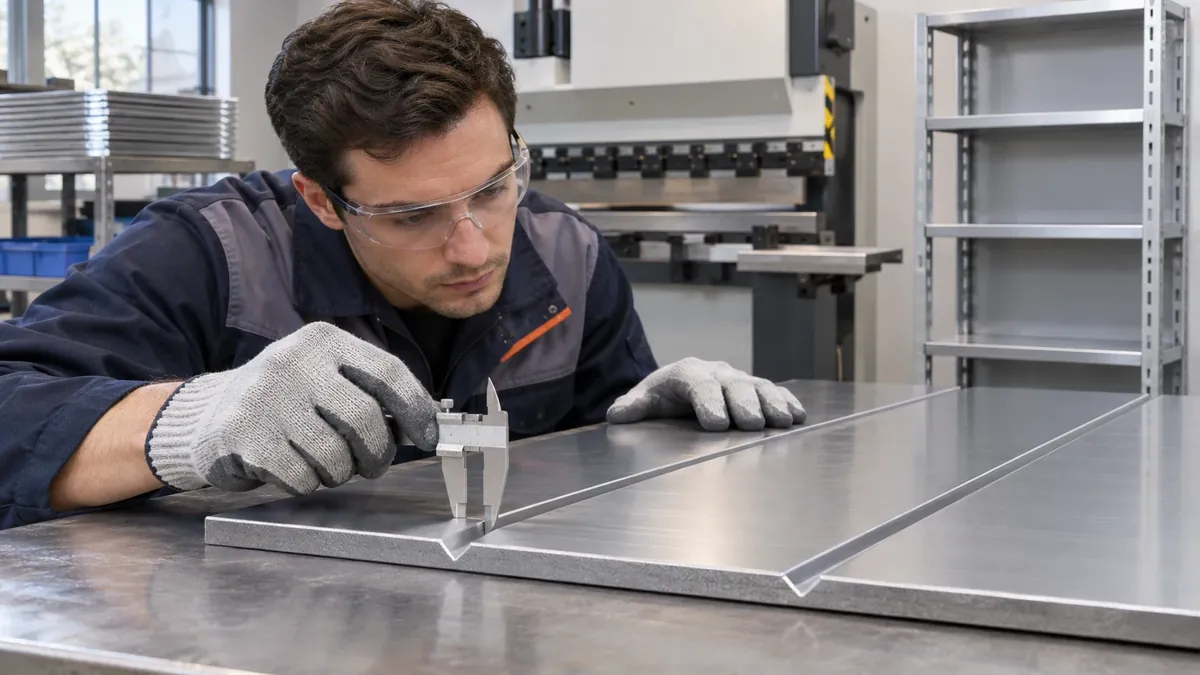
A first-off coupon or short bend sample can help review the local corner and surface appearance. It does not automatically approve a full shelf. The full part may include multiple grooves, openings, flange returns, joints, cutouts or attachment points that interact. Review a representative component or assembly with the same material and finish route intended for production. State the limits of any coupon evaluation.
How should grooving relate to material, finish and assembly?
The material specification should identify grade, nominal thickness, supply condition and any finish that already exists or will be applied later. A finish-before-groove route and a finish-after-forming route can produce different surface conditions, but the correct sequence depends on the supplier’s process. Do not assume the groove edge will receive the same coverage or appearance as an uncut face. Ask the supplier to explain the proposed order of operations and show the production-representative sample.
If the final product receives powder coating, plating, polishing or another finish, identify which faces are visible and which areas contact other components. Grooving can expose a different edge or surface condition that the buyer may wish to inspect. This does not prove that a finish will fail or succeed at the groove. It means the acceptance plan should include the location if appearance or function makes it important.
Assembly design can also constrain the process. A shelf may require tabs, holes, fasteners, welds or brackets near the bend. The grooving path and bend sequence should be reviewed against those features. A tight visual corner may leave less room for a connection or a finishing operation. Do not assume that a clean corner can be obtained without trade-offs in assembly access or secondary processing.
| Interface | Buyer and supplier review |
|---|---|
| Adjacent hole or cutout | Confirm location relative to groove and formed surface |
| Weld or attachment | Define sequence, access and cosmetic face review |
| Return flange | Check clearance and final assembly envelope |
| Finish | State whether applied before or after the grooving/forming route |
| Contact surface | Identify mating components and required fit condition |
| Emballage | Protect the finished bend and exposed edge from rubbing or deformation |
Surface finish and packaging should be reviewed together. A finished corner may be a prominent visible edge, and a nested shelf can contact another component during shipment. The pack should restrain the parts without forcing pressure onto a thin or grooved section. Ask for a packed sample if that edge is visually important. A packaging review is not proof of a transit-test result; it simply lets the buyer examine the proposed protection and arrangement.
How can buyers compare V grooving with other construction routes?
Compare routes against the same functional and appearance brief. A conventional formed bend may retain more of the original material section at the bend but could produce a different corner radius or springback behavior. A grooved bend removes material to define a different corner geometry. A multi-piece construction may create a seam and require joining or finishing. These are general trade-off categories, not guaranteed outcomes for any particular material or supplier.
Ask each supplier to provide a route description and identify what evidence supports its proposal. Compare actual part dimensions, corner appearance, assembly sequence, finish, packaging and required sample. If one supplier offers a groove while another proposes a formed bend, do not compare a rendered image to a finished sample. Request the same drawing, material, finish and acceptance conditions for each option.
| Route to compare | Potential buyer benefit to examine | Questions that remain project-specific |
|---|---|---|
| V-grooved and formed sheet | A defined bend line and corner appearance | Residual section, process control, finish and part-level performance |
| Conventional formed bend | A formed corner without a machined groove | Radius, springback, tooling and visible geometry |
| Joined multi-piece construction | Separate panels or features may be assembled | Joint location, finish access, distortion and component scope |
| Alternative specialist process | May suit a particular geometry or quantity | Capability, interface, quotation and validation by that supplier |
The lowest quote may reflect a different route, material utilization, finish sequence, assembly scope or inspection plan. Ask for each proposal’s exclusions and operation list. If a route requires a specialist, identify which supplier owns it and who is accountable for the finished component. The presence of a V-grooving article on a company blog is not proof that Koitor currently offers the process.
How should a sample and drawing be approved?
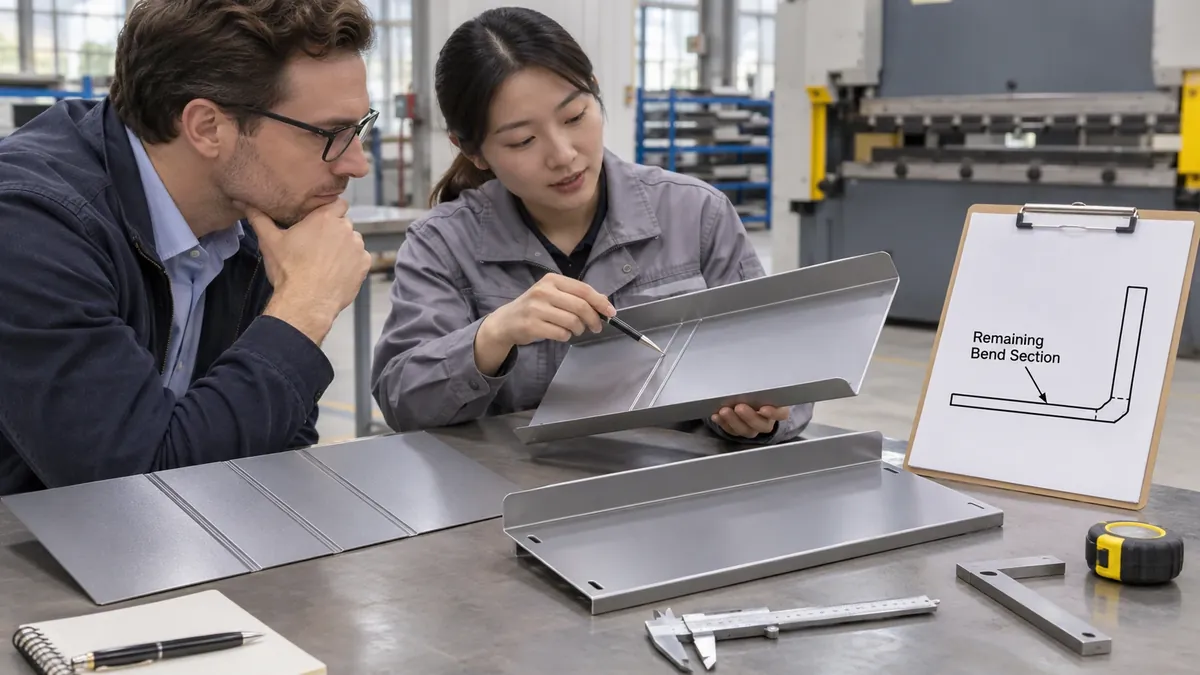
The drawing should describe both the flat blank and formed part as needed. Include the material, thickness, groove section, location, bend direction, finished dimensions, critical interfaces, finish, and relevant appearance zones. Identify the reference surfaces and inspection condition. If the exact groove profile is controlled by a supplier process sheet, reference that document and make sure the buyer can review the applicable revision.
The sample should use the intended material and finish sequence. Review the groove position, bend line, finished corner, part dimensions, nearby features and assembly interfaces. Note whether a visual result is acceptable under the agreed viewing conditions. If the sample is a coupon rather than a full component, record precisely what it demonstrates and what remains unverified.
Use a first-article record for changes that affect geometry or process. If the supplier changes groove depth, tool, material, bend sequence, finish route or assembly, ask whether the approved sample remains representative. A small change near a groove can shift a hole or alter the finished corner. Do not treat an unchanged part number as evidence that the process remains unchanged.
| Sample review point | Record on the approval sheet |
|---|---|
| Identity | Part number, drawing revision, material and sample date |
| Groove | Location, section detail and visible condition |
| Bend | Direction, completed corner and finished dimensions |
| Interfaces | Holes, tabs, brackets, mating parts and assembly fit |
| Finish | Reference, sequence and inspection areas |
| Evidence limit | Coupon, single part, assembly, or another defined scope |
| Deviations | Supplier proposal, buyer disposition and approval owner |
If the product requires a load or service-life assessment, the responsible product engineer should define the method and acceptance basis. This article provides no universal test method or performance number. A cosmetic review cannot replace a design review, and a test of a coupon cannot automatically qualify the complete shelf.
\1
Specifying only a sharp-corner appearance. State the process proposal, groove section, bend direction and finished sample expectation. Appearance alone does not define the retained section.
Copying a groove percentage from another design. Material and geometry vary. Have the supplier and product engineer review the actual drawing instead of using a universal residual-wall rule.
Assuming a zero-radius result. A machine or supplier phrase does not define the exact corner. Inspect the finished sample and state the required geometry.
Treating a coupon as full-part approval. A coupon may not include multiple grooves, holes, attachments, finish or assembly. Document the limits of the sample.
Ignoring the finishing sequence. Exposed edges and surfaces can have different visual conditions depending on operation order. Ask for a representative finished part.
Assuming Koitor owns a specialist grooving process. The approved company facts do not establish a specific V-grooving machine or service. Confirm process ownership and supplier scope for the actual project.
Using general machine marketing as product proof. Equipment literature explains a process concept, not the performance of a specific shelf. Require product-specific evidence.
Failing to control revisions. Changes to material, groove, tooling or finish can affect the result. Link sample approval to a specific drawing and process revision.
\1
Koitor Hardware is a family-owned custom metal hardware factory specializing in bathroom and home storage hardware. Approved company knowledge supports discussion of metal product development, bending, punching, welding, grinding, polishing, finishing, assembly and packaging, along with drawing or sample review. The research does not confirm an in-house V-grooving service or machine capability. A buyer should not assume this specific process is available until the project scope is reviewed and the responsible route is confirmed.
If a storage shelf or bathroom hardware design includes a grooved bend, provide the complete part drawing, intended function, material and finish, visible corner requirements, quantity and assembly interfaces. Identify whether a specialist supplier will perform grooving and how the part transfers between suppliers. Koitor can discuss the defined metal component within its actual production scope, while the process supplier and design owner confirm the grooved section and its evidence.
Small-batch customization can support an early sample or trial order when the process, product and quantity are suitable. MOQ can start from 100 pieces depending on the product. Samples usually take five to seven working days after details are confirmed; bulk production usually takes four to six weeks depending on product, quantity, finish and packaging. These are planning references and do not promise a specific machining process or schedule. Confirm current scope and timing in the quotation.
For a practical DFM review, submit the flat and formed views, material details, key dimensions, finish sequence, mounting or attachment drawing, and the desired visual result. Ask the supplier to separate confirmed capability from a proposed outsourced step. If the supplier cannot confirm a required groove profile or residual section, mark the design as unresolved and obtain the missing engineering review before a purchase order defines the part as production-ready.
Buyer checklist before requesting a quotation
- Flat blank and formed-part drawings with revision identifiers.
- Material grade, thickness, condition and finish sequence.
- Groove location, profile, depth and retained section proposed for the part.
- Bend direction, corner appearance and visible-face requirements.
- Nearby holes, slots, welds, tabs and mounting interfaces.
- Intended function and any product-specific performance criteria.
- Supplier responsible for grooving, forming and final acceptance.
- Sample type and what it can or cannot demonstrate.
- Finish inspection and packaging protection for the grooved corner.
- Exact tolerance and acceptance basis from the responsible design/process owner.
- Target quantity, market and packaging requirement.
- Revision and change-approval process for material, tooling or route changes.
Separate local bend appearance from whole-part requirements
A corner can be visually acceptable while another part feature remains unresolved. The product team should decide whether the critical acceptance is appearance, finished dimensions, assembly fit, surface condition or a performance requirement, then evaluate each with the appropriate evidence. A groove sample can show the line and the bend; it cannot by itself demonstrate the strength or service performance of a whole shelf. A complete part inspection can confirm its dimensions but still does not constitute a design validation unless a relevant method has been agreed.
If multiple grooves cross or approach one another, or if a groove sits near a hole, slot or attachment, mark that relationship on the drawing. V grooving sheet metal should be reviewed against the full part and process sequence, especially where features approach the bend. A process supplier may need to review the sequence and tool access. The buyer should avoid assuming that one isolated bend coupon represents a panel with several interacting features. If the geometry is complex, ask for a prototype or first article that includes the relevant details before releasing production quantities.
The buyer should also state whether a corner appearance is inspected before or after final finish. The same bend can look different under a coating, polish or lighting arrangement. A finish panel can establish color and texture, while the formed sample establishes how that finish appears around the groove and edge. Keep both records if both matter. Do not use a finish panel alone to approve the finished shelf geometry.
Where another supplier performs the grooving, the handoff should identify the blank revision, material lot, groove drawing, and any protection required before forming or coating. A small scratch or handling deformation at the groove can complicate later evaluation. Clarify who owns that risk at each stage, but avoid assigning fault before inspecting the part and process record. A defined sequence makes it possible to diagnose issues without confusing the material supplier, grooving specialist and final fabricator.
A production note should identify the surface on which the groove is located and the direction of the final bend. If the part is mirrored for left and right sides, confirm that the groove orientation is also mirrored correctly. A symmetrical flat blank can produce different visible faces after forming if its finish or hole pattern is not symmetric. A first-article inspection should compare handed parts with their own drawing details rather than treat one sample as proof for both.
V grooving sheet metal should be evaluated against the complete component, not only the desired corner appearance.
Foire aux questions
Does V grooving preserve the original sheet thickness at a bend?
No. The operation removes material along the groove, leaving a reduced section. Its dimensions depend on the design and process. The buyer should ask for a section drawing and project-specific review rather than assume the original thickness remains.
Is there a universal groove depth or remaining-wall percentage?
No universal number is established here. The appropriate geometry depends on the material, thickness, tooling, bend and finished product. The responsible supplier and engineer must review the actual drawing.
Does a V groove guarantee a zero-radius corner?
No. A process description or appearance target does not by itself define the final corner. Confirm the geometry on a representative finished sample and record the accepted condition.
Can a small bend coupon approve an entire storage shelf?
Not automatically. A coupon can show a local groove and bend under the tested conditions. A full shelf adds its own holes, joints, finish, dimensions and assembly, which may need separate review.
Does Koitor offer V grooving for every custom shelf?
That capability is not established by the available company facts. A buyer should send the drawing and request confirmation of the actual manufacturing route and any specialist supplier involvement.
What information helps compare grooved and conventionally formed parts?
Use the same drawing, material, finish, dimensions, assembly and acceptance criteria for both proposals. Ask each supplier to identify its process, exclusions, sample evidence and any unresolved performance question.
Collaborez avec Koitor Hardware
Review a Storage Shelf Drawing
Share the flat and formed drawings, material, finish, visible corner and supplier process scope. Koitor can discuss a defined metal-storage project and confirm which steps require a specialist review.
Fabrication pour compte de tiers / Marque de distributeur
Transformez ce guide d'approvisionnement en cahier des charges
Indiquez-nous le produit souhaité, ses dimensions, sa finition, la quantité commandée et vos exigences en matière d'emballage. Votre équipe recevra une analyse pratique de la faisabilité de la fabrication avant l'établissement du devis.


 English
 Español
 Português
 Français
 Deutsch
 العربية