
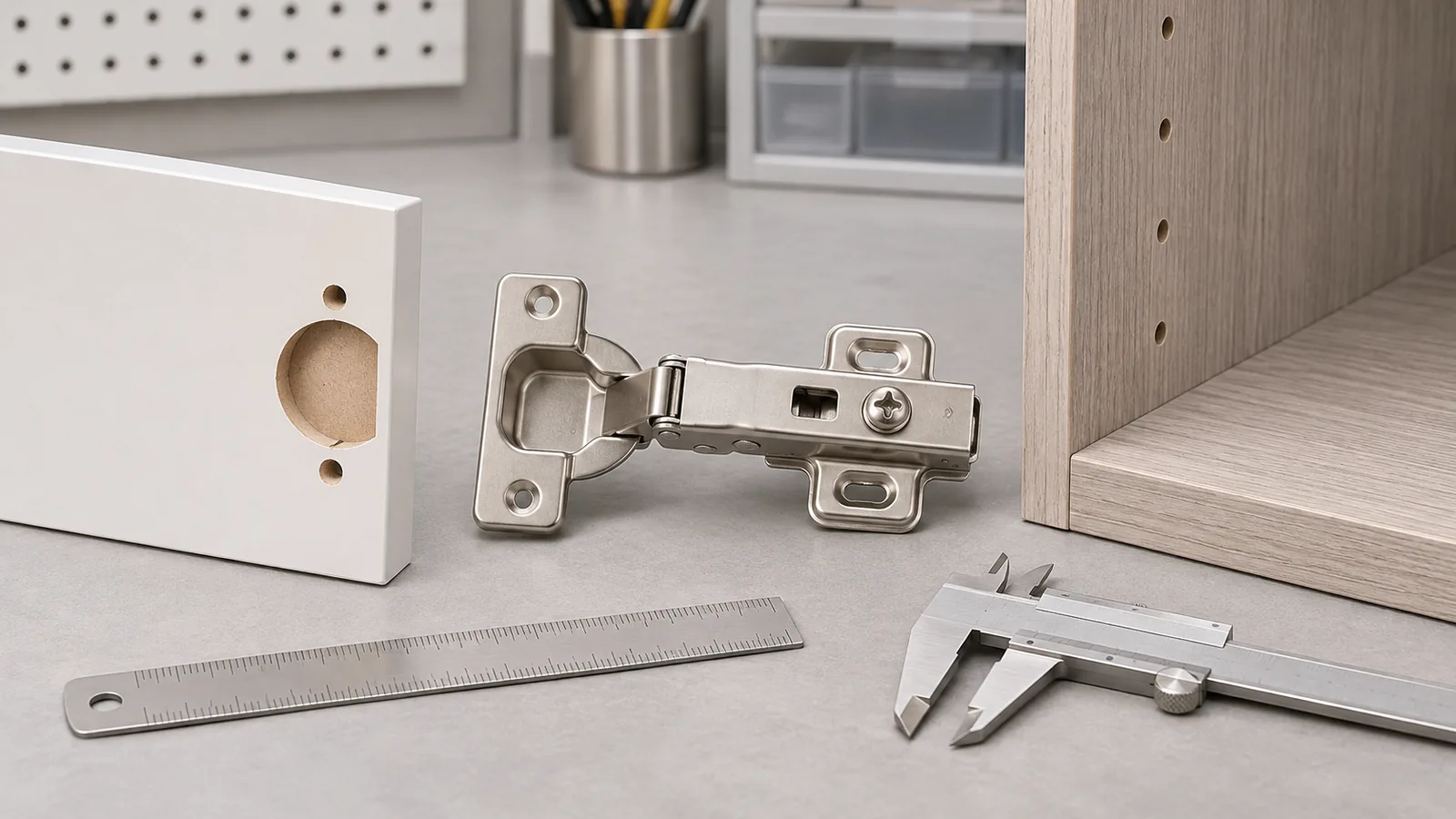
For how to measure cabinet hinges, distinguish the metal hinge, the door preparation and the installed door-to-opening relationship. ## Start by Identifying the Hinge Family
The measurement method depends on the hinge architecture. The concealed cup hinge dominates many kitchen-cabinet search results and uses a round bore in the door. Other hinges use leaves, barrels, pins or another geometry. Do not apply cup-hole measurements to a surface-mounted, butt, pivot or specialty hinge. Identify the maker, model and markings where possible, and consult the maker’s dimensioned drawing for the family in hand.
Photograph the hinge while installed, including the hinge arm, cup area, mounting plate and relationship to the door and cabinet. Record whether the door is overlay or inset and which door the sample came from. If parts must be removed for measurement, follow the product’s actual instructions; not every hinge has the same release mechanism. Keep the original screws and plate associated with that sample.
| What is being measured? | Useful reference | What the measurement does not establish alone |
|---|---|---|
| Metal hinge | Model marking, cup or leaf dimensions, mounting plate identity | Compatibility with a different door or plate |
| Prepared door | Bore diameter/depth, door edge, fixing pattern, door thickness | Installed overlay or cabinet fit |
| Installed relationship | Closed-door overlap against cabinet opening | Hinge cup size or exact drilling pattern |
This three-object map prevents a frequent mistake: a hinge can be the right nominal cup size but still have a different door-edge position, screw pattern, plate or installed overlay. Measure the actual reference that answers the replacement question.
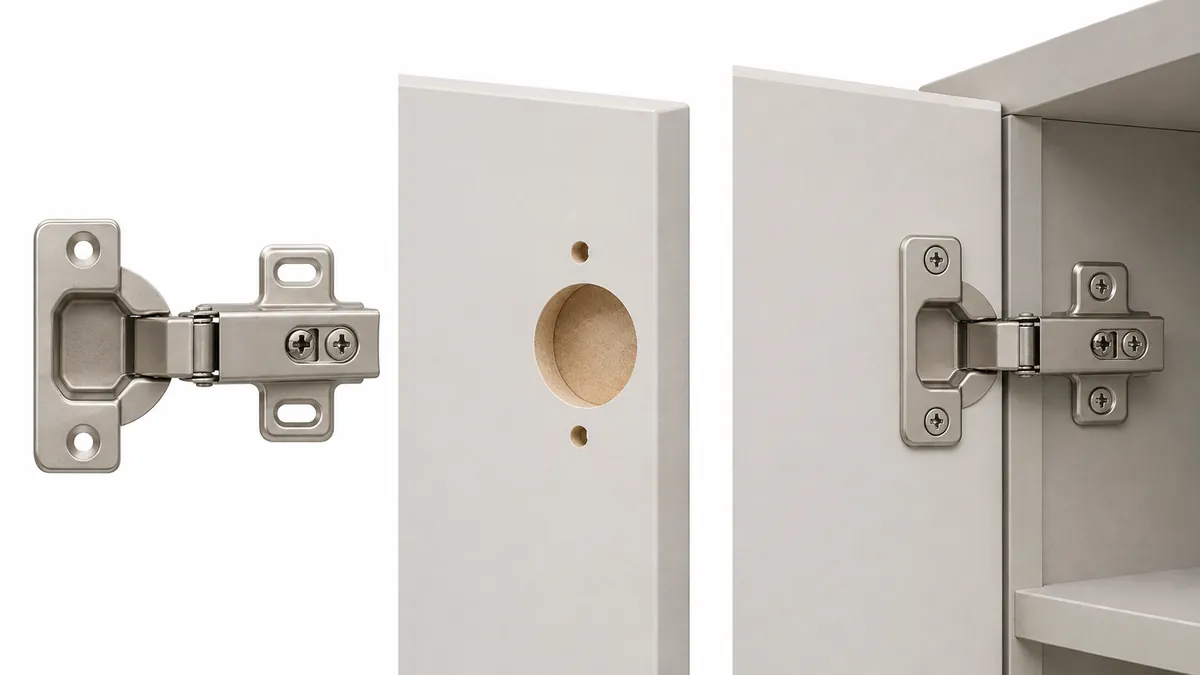
How To Measure Cabinet Hinges: Measure the Door Bore, Not the Hinge’s Outside Flange
For a concealed cup hinge, the round recess is prepared in the door. A supplier measurement guide specifically directs the reader to measure the cup hole in the door rather than the exterior of the hinge. These are different surfaces. The metal flange may overlap the bore, and measuring across the fitting itself can give the wrong reference for the door preparation.
With the door accessible and the measurement tool appropriate for the task, record the bore diameter across the opening. Keep the result in a stated unit and note that it is the door bore. Do not copy a catalog’s example diameter as a universal cabinet standard. The supplier sources list several sizes as catalog examples, but the existing door and the selected hinge model determine the actual fit.
If the hinge is still installed, do not estimate the bore from a visible crescent or exposed edge. Remove or expose it only as instructed for that product. Avoid damaging the door surface or enlarging the hole simply to make a measurement easier. If the bore is obscured or the fitting cannot be removed safely, consult the maker or a qualified cabinet professional.
Record bore depth from the correct surfaces
When depth can be accessed, record the bore bottom relative to the back face of the door, using the datum described by the measurement guide for the particular hinge. A source’s detailed procedure defines depth from the back door surface to the bottom of the bore. Do not change that datum to the decorative front face or to the hinge flange. The same numeral can mean something different when measured from a different surface.
Depth should be recorded separately from diameter. A cup can match in width while the preparation or hinge geometry differs in depth. This article does not provide a universal depth, cutting setting or new-door machining specification. Use the actual maker drawing for a proposed replacement or new production.
Measure the hole’s position relative to the door edge
Cup diameter alone does not locate the hole. Record the distance between the door edge and the near edge of the bore, or another clearly named edge reference required by the chosen maker’s drawing. Also note the hinge’s associated fixing holes or dowel pattern. Do not substitute a center-to-edge reading for a near-edge-to-edge reading without writing down which one was used.
The distance from the door edge may influence how a hinge sits relative to that edge, but it is not by itself a compatibility verdict. Compare it with the exact hinge model’s stated reference and keep the orientation clear. Left/right door, top/bottom position and the drawing’s view can affect how a measurement is interpreted.
Measure the Installed Overlay Separately
Overlay is about how the closed door sits over the cabinet opening. It is not the cup diameter, door thickness or hinge-arm appearance. A supplier’s measuring method uses the closed door edge as a reference, then opens the door and measures from that reference to the edge of the cabinet opening. The purpose is to read the actual overlap rather than infer it from a product label.
One practical method is to place a removable reference at the closed door’s edge, mark that position on the cabinet face, open the door and measure from the mark to the opening edge, following the exact source method and keeping the direction consistent. If using tape or a pencil mark, protect the finish and ensure the door remains in the intended closed position during marking. Record which side and which opening edge were used.
This approach applies to an overlay relationship. An inset door sits within the opening and should not be described as having the same positive overlap. For inset geometry, record the actual gap and position according to the cabinet or hinge maker’s instructions instead of forcing an overlay measurement. Read our guide to concealed hinge overlay versus inset for the distinction; that page owns the geometry explanation, while this article focuses on how to take measurements.
Do not infer the installed overlay solely from a full-overlay label or the hinge arm’s shape. Different cabinet constructions and plates can alter the installed relationship. Measure the door in place and record the actual reference. For example, if a closed door overlaps the opening by a measured amount, that observation belongs to the door/cabinet pair; it does not reveal the cup bore size.
Keep Vertical Hole Location Tied to the Door
When a replacement guide asks for the vertical center of a cup hole, use the edge of the door specified by that guide. One supplier’s door-replacement procedure measures the upper hinge-hole center from the top door edge and the lower hole center from the bottom door edge. These datums are not the same as measuring from the cabinet unit’s top or bottom.
Consider an illustrative drawing: the upper bore center is 80 mm below the door’s top edge. If the cabinet unit top sits 15 mm above that door edge, a measurement from the cabinet-unit top would read 95 mm. The apparent difference is caused by switching datums, not by a changed bore location. These figures are authored arithmetic to demonstrate the reference error; they are not a drilling specification or typical cabinet dimension.
Write each vertical measurement with its starting edge and its target: “upper door edge to upper bore center,” for example. Avoid abbreviated notes such as “80 mm down,” which do not say from where. If there are multiple hinges, identify each door and each position. Do not assume the top and bottom hinge locations are symmetric unless the actual drawing or product instruction says so.
Record the Mounting Plate and Fixing Pattern
The mounting plate connects the cabinet side to the hinge arm. Its identity and relationship to the hinge matter. Record the model or part marking, plate type and the actual screw or dowel pattern as required by the hinge maker. Do not conclude that two hinges are compatible because both attach to a plate that looks similar.
Supplier guides may describe particular clip-on or plate arrangements, but those are catalog-specific. This article does not promise that any replacement hinge snaps onto an existing plate or that plate height can be inferred from a generic thickness rule. Check the maker’s compatibility table or drawing for the exact hinge and plate combination.
Also record door thickness, cabinet construction and any constraints visible at the hinge location. These are contextual inputs rather than substitutes for the measured bore, edge and overlay references. The supplier guide specifically separates door and carcass thickness from hinge identity and installed overlap.
A Complete Measurement Record
An actionable measurement sheet can include:
- Hinge maker, model, markings and a clear installed photograph.
- Hinge family: concealed cup, butt, surface-mounted or another identified type.
- Door identity and which hinge position is being recorded.
- For a cup hinge: door-bore diameter and depth with their datums.
- Near bore edge to door edge, or the exact edge reference requested by the maker.
- Cup screw/dowel pattern and mounting-plate identity.
- Door thickness and relevant cabinet-side information.
- Installed overlay measurement for an overlay door, or the appropriate inset gap references.
- Units, measurement tool and any uncertainty or inaccessible feature.
This list is not a universal order form. Include the dimensions relevant to the actual hinge family and replacement decision. A leaf hinge needs its own leaf/body drawing; cup measurements should not be forced onto it. If a dimension cannot be accessed, mark it unknown instead of estimating it from a photograph.
Make every number traceable to a physical point
Before taking a measurement, write down its start point and endpoint. “Cup depth” is not enough if one person measures from the decorative door face and another measures from the back. “Edge distance” is ambiguous unless the record says whether it is from the near edge of the bore or its center. “Overlay” should identify the closed-door edge and the opening edge used. A small sketch with arrows can be more useful than a column of numbers without reference labels.
Use the same units throughout a record or show the conversion explicitly. Do not round a value silently to match a catalog option. If the surface is chipped, the bore is partially blocked or a plate conceals the relevant point, note the limitation and seek the maker’s procedure. An apparently precise number from an inaccessible datum can be less useful than an honest “not measured.”
For a multi-door cabinet, label the door location and orientation. A left door and a right door may mirror one another, and the maker’s drawing may show the fitting from a particular side. Record the view used and mark top and bottom. This avoids turning a correct measurement into an incorrectly interpreted replacement order.
Use a sample-to-drawing comparison, not a memory test
When a candidate replacement arrives, compare its model drawing with the record. Check the actual cup preparation, nearby fastening pattern, mounting plate and installed relationship as separate items. Do not rely on a salesperson’s phrase such as “same size” when the shared size could mean only cup diameter. Ask what datum and model the statement refers to. If a replacement requires a new door preparation, treat that as a separate design and manufacturing decision, not a measurement correction.
Avoid These Measurement Errors
Measuring the metal fitting instead of the door preparation
The hinge’s outer flange is not the cup-hole edge. Measure the actual bore in the door when the question concerns door preparation.
Mixing edge-to-edge and center-to-edge distances
Both can be legitimate references in a particular drawing, but they are not the same measurement. Label the endpoints in the record.
Measuring from the cabinet when the guide specifies the door
The door and cabinet edges may not align. A datum switch changes the recorded location even when the hardware has not moved.
Treating overlay as a hinge dimension
Overlay is the installed relation between door and opening. Keep it separate from cup diameter, plate identity and door thickness.
Assuming a catalog example is universal
Supplier examples show what that supplier offers; they do not define every hinge family or every door. Verify the current model drawing and the existing door.
Declaring a replacement compatible from measurements alone
Measurements narrow the candidate. They do not establish material, cycle life, load, quality, adjustment range or fit without the matching product specifications.
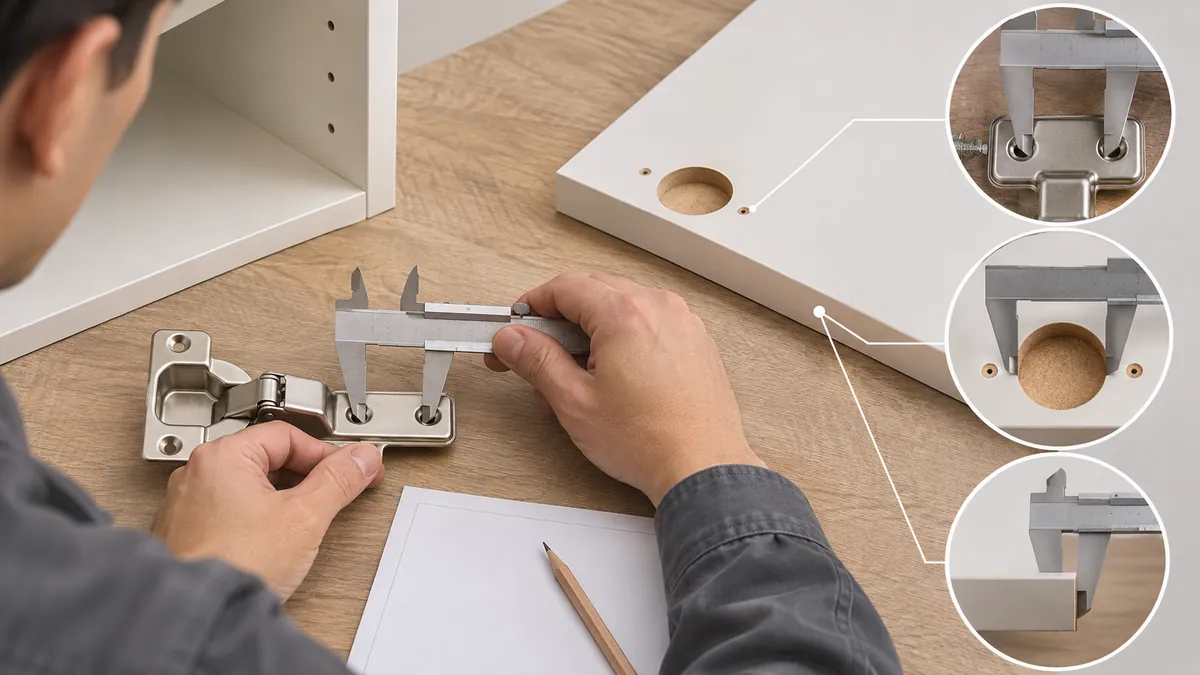
What Measurements Can and Cannot Tell You
Correct reference points improve identification and reduce avoidable back-and-forth. A bore measurement tells you about the prepared door opening. The door-edge distance locates it. A screw or dowel pattern describes another part of the preparation. Overlay records the closed door’s relationship to the cabinet opening. A model marking or plate reference helps connect those values to a specific fitting.
None of those observations by itself establishes that a replacement is interchangeable. The maker may use additional dimensions, plate geometry or model-specific features. Nor does a measurement certify the condition of a used hinge or the quality of the door. Treat the data as an identification record to compare with the supplier’s actual drawing and compatibility instructions.
Measurements also do not explain why a door is sagging, rubbing or misaligned. Those symptoms may relate to installation, adjustment, cabinet condition or a different part of the assembly. Do not respond by changing a bore dimension or ordering a new hinge solely from the symptom. First establish whether the task is identification, installation, adjustment or replacement; each has a different evidence path. The dedicated installation and adjustment pages linked below cover those separate jobs.
If a buyer is sourcing a custom metal organizer that mounts inside a cabinet, the cabinet-door hinge measurements may describe a neighboring interface but do not automatically define the organizer’s fit. Keep the organizer’s own mounting points, clearances and cabinet opening on its drawing. A hinge record should not be repurposed as a shelf or drawer measurement specification just because both components occupy the same cabinet.
For supplier communication, attach the measurement record to photographs and the product model rather than sending numbers alone. A useful note might say: “Door bore diameter measured across the prepared hole; near edge to door edge; overlay read with door closed using the marked opening edge.” This is an example of clear wording, not a standard form or a substitute for the hinge manufacturer’s official dimensions.
If the goal is installation, see how to install cabinet hinges. If an installed hinge needs adjustment, use the hinge adjustment guide; adjustment is separate from measuring and selecting a replacement. For a broader family comparison, see types of hinges.
Related buyer guidance: Hinge Radius: Record Each Replacement Leaf’s Corner Shape Before Ordering.
A replacement decision also needs an explicit uncertainty field. Mark a concealed dimension as unknown when the door or plate prevents access, then ask the supplier what drawing or sample is needed. Do not turn an estimate into a production value simply because the rest of the record is complete. The responsible cabinet or hinge supplier can confirm the correct datum and compatibility details for the identified model.
Frequently Asked Questions
The measurement methods are bounded to the supplier guides from Eurofit Direct, WoodworkerExpress, and Eagle Woodworking. Their examples do not establish universal dimensions; compare them with the exact model drawing.
Before measuring, choose one consistent orientation and keep the drawing view beside the part. This small discipline prevents a top-edge reference from becoming a bottom-edge reference halfway through a record.
Do I measure the hinge cup or the hole in the door?
For concealed cup hinge identification, measure the actual cup bore in the door, not the metal hinge’s outer flange. Record bore depth and location separately using the datums required by the maker.
Is the cup diameter enough to order a replacement?
No. Also confirm the model, door-edge reference, fixing pattern, mounting plate and installed relationship. The exact maker’s compatibility instructions determine what else is required.
How do I measure cabinet-door overlay?
For an overlay door, follow a supplier’s closed-door reference method: preserve the closed door edge position, open the door and measure to the cabinet opening edge as instructed. Record the direction and datum. Inset geometry is different.
Should I measure the hinge hole from the cabinet top?
Use the datum in the model’s guide. A replacement-door procedure may specify the door’s top or bottom edge. Do not substitute the cabinet-unit edge without recording the change.
Can I use measurements from a catalog to drill a new door?
Do not use generic examples as a machining specification. Obtain the exact hinge maker’s current drawing and verify all preparation dimensions for the selected model.
What if I do not know the hinge model?
Record clear photos, markings, plate identity and the actual measurements that can be taken safely. Ask the hinge supplier or a qualified cabinet professional to identify the candidate; do not claim interchangeability based on one dimension.
Can I estimate a hidden measurement from the cabinet door’s outside dimensions?
Do not infer a concealed bore or fixing pattern from the overall door size. Measure the prepared feature directly when accessible, or use the exact maker drawing and model record. An estimate should be labelled as an estimate and must not be treated as a machining instruction.
Do all hinges use cup measurements?
No. Cup dimensions apply to cup-style concealed hinges. For another hinge family, identify the actual body or leaf and use that maker’s drawing and datum instead.
Share the Actual Interface for a Product Review
For a custom metal storage or cabinet-organizer project, share the drawing or sample and the intended hinge or support interface. The Koitor team can discuss the manufacturing scope for bathroom and home-storage hardware based on those actual requirements. Use the custom metal storage rack page or contact page to start a product discussion.
When sending a sample, include the cabinet and door context in the same package of information. A loose hinge without its mounting plate or door preparation may not answer the replacement question. Keep the sample labelled, protect the prepared edge and state whether the measurements describe an existing installation or a proposed new configuration. That distinction helps the supplier compare like with like.
How does how to measure cabinet hinges fit the exact product and buyer decision?
Use the model-specific drawing and evidence described above; this guide does not create a universal specification.
Review the Cabinet Hardware Interface
Share the relevant product drawing or sample, intended use, material or finish requirements, and target quantity. Koitor can review the manufacturing scope for custom bathroom and home-storage hardware based on the information provided.
OEM / PRIVATE LABEL
Turn this sourcing guide into a product brief
Share your target product, size, finish, order quantity and packaging requirements. Your team receives a practical manufacturability review before quotation.
 English
 Español
 Português
 Français
 Deutsch
 العربية