
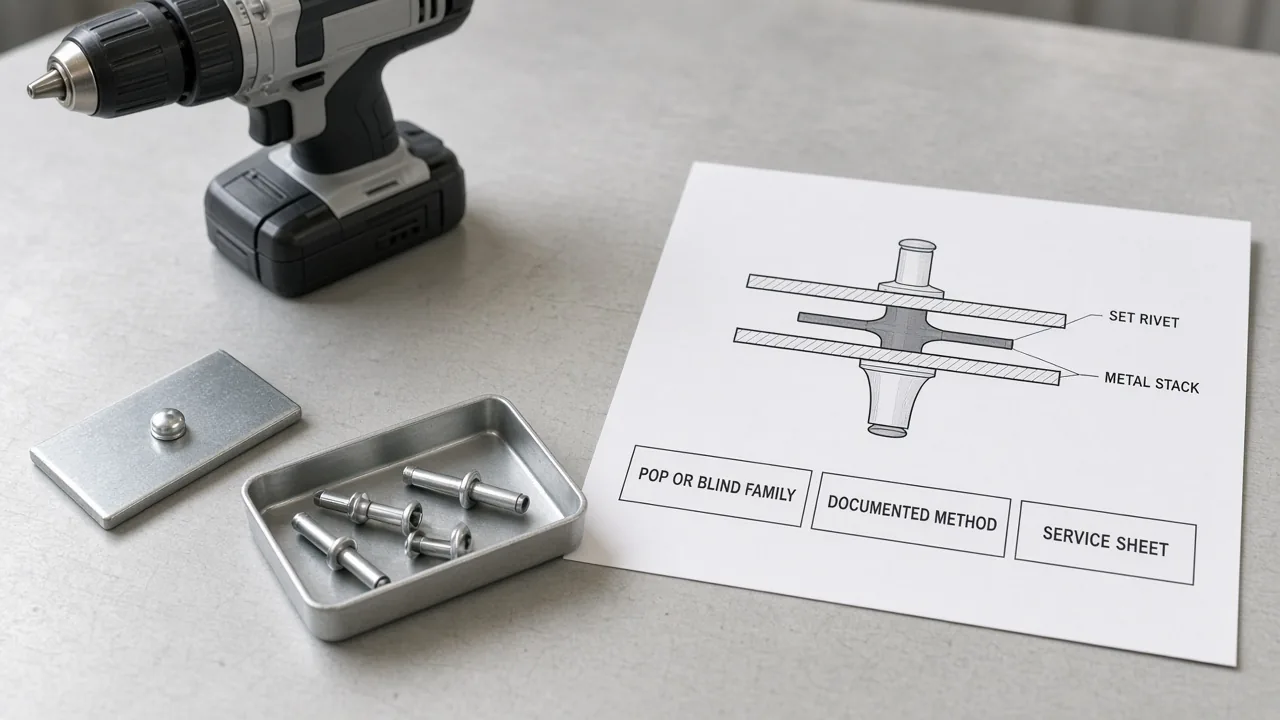
A service sheet can tell a buyer how to remove a pop rivet only after the packed pop or blind joining family and the documented removal method are named from the supplier’s service data. The family is a set pop or blind rivet, not a solid rivet, not a garment rivet, and not a plastic automotive trim clip.
The method is the removal path the supplier actually documents, or an explicit exclusion that points back to that data. This file is a service map for a set joining rivet. It is not a first-set leaflet, and it is not a without-drill trick list.
First set of joining rivets belongs on the companion article in this batch. First set of rivet nuts belongs on the already-written rivet-nut article. Types and grip-range questions belong on those neighboring files, which this official lock-copy list currently names only in prose. None of those decisions is a removal map.
This guide is for importers, distributors, and private-label teams approving service-sheet wording for pop or blind rivets already used on brackets, plates, or storage assemblies in the live OEM library. Koitor Hardware is a family-owned China OEM manufacturer of custom metal bathroom and home storage hardware.
Adjacent typological and grip-range pages already sit in that published library. That fact is not a claim that Koitor currently manufactures a named joining-rivet SKU or a removal tool. Send the rivet data and the remaining-hole requirement. We can review the wording. We will not issue a universal drill chart, a no-damage guarantee, or an undocumented without-drill method.
What does a how to remove a pop rivet file actually freeze?
It freezes the packed pop or blind family and the documented removal method, or an explicit exclusion for either field. It does not freeze a first-set of joining rivets, a rivet-nut first set, a solid-rivet method, or a garment or trim-clip sequence.
Searchers often ask how to remove a blind rivet, or they arrive under a broader how-to-remove-a-rivet umbrella, because a set mandrel is in the way of a repair. That demand is real. For an importer, the usable decision is whether a listing may say the rivet is easy to remove, and which family and documented method that sentence is allowed to assume.
A set pop or blind rivet is not a solid structural rivet, even when both are called rivets in casual speech. It is not a jeans or leather rivet, and it is not a plastic push-in trim clip. If the sheet does not say which family is in the assembly, an easy-to-remove line will be applied to the wrong part.
This file is not a consumer teardown tutorial, and it is not a product listing. Informal names such as blind rivet are coverage of the same pop or blind removal decision when that family is what is set in the joint. They are not a license to official a jeans, leather, or without-drill phrase as this page’s target.
An OEM home storage hardware manufacturer can review whether a removal sentence and a packed pop or blind family stay together. Matching a head style to a collection is not the same as inventing a default drill size, a default remaining hole, or a no-damage promise.
A published easy-to-remove claim is only as complete as the named family and the named documented method. If the photograph shows a pop rivet and the assembly holds a rivet nut, the sheet has already failed. The same is true of a plastic trim clip packed into the wrong service panel, or of a without-drill trick printed as if it were the supplier’s method.
This file can precede a service-data review. It should not be turned into a first-set leaflet, a types essay, or a salvage guarantee. Those jobs already have, or should keep, their own files.
Which packed pop or blind family and documented method must be named first?
Name the packed joining family first, in the supplier’s terms: a pop or blind rivet that is already set, not a solid rivet, not a garment rivet, and not a plastic trim clip. Do not start with a generic how-to-remove-a-rivet sequence, and do not start with a without-drill question that has not been excluded.
Name the documented removal method from the supplier’s current service data, or keep the field named and honestly blank. The sheet may list the method in the supplier’s words. It must not invent a factory-universal drill chart, a grind sequence, or a remaining-hole size presented as a Koitor standard.
If the service data requires a particular tool family, name that family or mark it excluded and point back to the data. A drill or a punch may appear in a review photograph as objects. That photograph is not a license to print an unofficial verb sequence on the service card.
If the remaining hole after removal matters to the repair program, name that requirement from the data, or keep it named and blank. Do not promise that the hole will be reusable, damage-free, or ready for the original rivet, unless the cited data actually says so.
A rivet nut in the same photograph must sit under an exclusion, not under this family line. The already-written rivet-nut first-set file is a different family. Removal of a rivet nut, if it is ever written, would be a different service mode as well.
If the assembly also contains solid rivets or decorative garment rivets, the sheet must say those parts are not this family. A mixed service panel is how the wrong method is applied to the wrong joint.
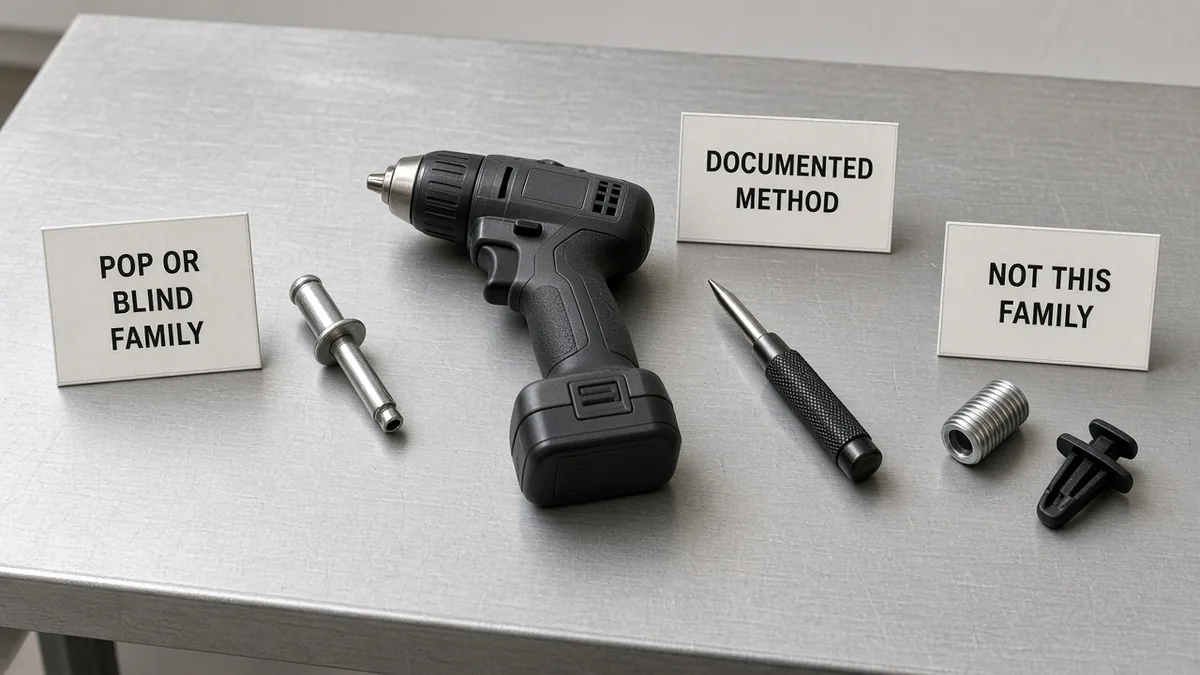
What belongs in the service-sheet map, and what must stay out?
The service-sheet map should name the set family, the documented method, and any remaining-hole note the cited data actually supports. It is not a shop sequence, and it is not a place to merchandise a drill as the thesis of the page.
If a service card ships with the original joining-rivet program, say what that card covers. If removal instructions are sold separately or live only in the supplier’s current data, the sheet should say so on its own line. A hardware kit packing inspection checklist is useful only when a service card is actually packed, not as a substitute for the named method.
Jeans, leather, button, and other garment volumes stay off this map. Those phrases were not validated as this page’s target. A plastic automotive trim clip stays off the map for the same reason.
Without-drill tricks stay off the map, including undocumented grind, chisel, or pry workarounds presented as a Koitor method. Demand for those paths is evidence that the documented method must be named. It is not a license to print a bypass.
| Field or claim | What must be named | What belongs in the service data | What this row is not |
|---|---|---|---|
| Packed pop or blind family | The set joining family the assembly actually uses, in the supplier’s terms | The set rivet and the matching service instructions | A solid rivet, a garment rivet, a plastic trim clip, or a rivet nut |
| Documented removal method | The method taken from cited service data, or a named field left blank | Only the method the cited data actually supplies | A factory-universal drill chart, or an undocumented without-drill trick |
| Remaining-hole note | The remaining-hole requirement taken from that data, or a named field left blank | Only what the data will support | A no-damage guarantee, or a promise that the original hole is reusable |
| Easy to remove | The family and documented method the sentence is allowed to assume | Nothing beyond that named list and cited data | A first-set leaflet, or a jeans or leather sequence |
The table is a decision map for the service leaflet. It is not a drill standard, a salvage guarantee, or a claim that Koitor manufactures removal tools. If a row cannot be filled from the supplier’s current data, leave the field named and blank rather than inventing a number.
A custom metal storage rack manufacturer review can confirm whether a pop-rivet removal sentence belongs on a bracket or plate program already in the live library. That review does not turn this page into a rack catalog, and it does not authorize a no-damage claim.
Why are without-drill threads not a license to print a bypass?
Forum threads often ask how to remove a rivet without a drill, or they treat a jeans-button job as if it were a metal joining joint. That wording is a real demand signal. It is not a method this sheet may teach, and it is not a secondary this page should official or target.
A service leaflet that prints an unofficial path will be copied onto assemblies that never intended it. The buyer then treats a grind or pry trick as if it were the documented method. When the remaining hole is wrong, or when the surrounding sheet is damaged, the listing still said the rivet was easy to remove.
The honest response is to name the documented method, or to exclude unofficial methods and point to the supplier’s current service data. If the program does not pack a removal card, say that the method lives in that data. Do not fill the gap with a without-drill workaround.
Brand videos and specialist blogs may show a particular drill, a particular punch, or a particular shop setup. Those sources can explain why a buyer arrived with a how-to question. They are not a factory standard for this leaflet, and they are not a license to invent a Koitor drill size, a timed removal, or a damage-free promise.
The unofficial umbrella how to remove a rivet is broader than this page and was not validated as this target. Keep this file on the packed pop or blind family. Do not absorb every rivet-removal volume into one service map.
Which neighboring rivet files should stay out of this sentence?
The companion first-set article on how to install rivets, when published, stays a first-set file. It freezes joining family, grip or stack and hole, and the approved setting tool. This removal file may name that neighbor in prose. It should not reprint a setting leaflet.
The already-written rivet-nut first-set article stays a different family. A rivet nut is a threaded insert, not a pop rivet. Name that neighbor in prose if the official lock-copy list does not yet carry its href. Do not interchange the two families.
The types-of-rivets file and the live blind-rivet grip-range RFQ should stay identification and procurement files. They are named in prose only because the official lock-copy of the internal-link list omits those hrefs. This page must not become a second types table or a second grip chart.
Solid-rivet or structural-removal questions belong elsewhere. So do jeans, leather, and button volumes, and so does a failed or thin question about removing a rivet nut. Those jobs were not validated as this service map.
If a later file owns mandrel retention or pull-through as a setting defect, keep that procurement question there. A removal sentence that tries to settle every neighboring RFQ will be wrong for the assembly that is actually in front of the buyer.
What should be checked before a listing tells a buyer how to remove a pop rivet?
Use the list as a service-sheet review, not as a shop sequence and not as a pass-fail audit grade. If a line cannot be answered from the assembly, the carton, or the cited service data, keep the field named and unresolved rather than inventing a value.
- Name the packed pop or blind family in the supplier’s terms before any removal sentence is printed, and treat blind-rivet phrasing as coverage of the same decision when that family is what is set.
- Name the documented removal method from cited service data, or keep the field named and blank; do not invent a factory-universal drill chart.
- Name any remaining-hole requirement from that data, or keep the field named and blank; do not print a no-damage or reusable-hole guarantee the data does not support.
- Exclude undocumented without-drill, grind, or pry workarounds presented as a Koitor method.
- Keep jeans, leather, button, and plastic trim-clip volumes off this leaflet; those were not validated as this target.
- Keep joining-rivet first set and rivet-nut first set on their companion files; do not interchange those families or modes with this removal map.
- Keep types and grip-range questions on their neighboring files, named in prose when the lock copy omits those hrefs.
- Do not merchandize a drill or punch as the thesis, and do not claim that Koitor manufactures removal tools.
- Do not official the broad umbrella how to remove a rivet as this page’s target.

If the listing still wants an easy-to-remove line after this review, the line may only assume the family and the documented method that were just named. A sentence that cannot point to those fields is not ready to print.
A missing documented method is a data defect, not a reason to publish a without-drill workaround. The same is true of a photograph that shows a rivet nut or a plastic clip, or of a service card that was written for a first-set carton.
If a buyer arrives with only a jeans-button video, stop the removal sentence until the packed family is named from the assembly and the data. A shared word such as rivet does not make a garment fastener and a metal joining rivet share a service map.
When the official lock-copy of the internal-link list omits a neighboring rivet href, name that neighbor in prose and stop there. Do not invent a URL, and do not paste a types table or a first-set leaflet into this service map to make up for the missing link.
If the intended part is a solid structural rivet, a rivet nut, or a plastic trim clip, this sheet is the wrong file and should say so. Point the buyer off this leaflet rather than improvising a method. This file will not issue a no-damage conclusion to keep that buyer on the page.
A repair program that later installs a new joining rivet should send that job back to the first-set file. Removal and first set can follow each other in a workshop. They still do not share a leaflet, and they still do not share an approved tool family.
If incoming or warranty inspection is part of the program, inspect against the named family and the named method, not against a remembered forum trick. A set head that looks familiar in a photograph can still be the wrong family for the service card in the bag.
A service program that later changes the joining family must revise the removal card as well. A method written for a set pop rivet will not travel safely onto a solid shank or a rivet nut, even when the surrounding plate looks the same. Stop the easy-to-remove sentence until the new family is named from the revised data.
Mandrel remnants, painted heads, and hidden backside access can all change how a documented method is reached. Those conditions may be named as conditions if the service data actually addresses them. They are not a license to invent a Koitor drill chart, and they are not a license to print an unofficial pry sequence.
If two assemblies share a carton photo, keep the service map tied to the family that is actually set in each joint. A shared finish does not make a pop rivet and a plastic trim clip share a method. The photograph should separate the exclusion, just as a review layout separates not-this-family parts.
Warranty teams sometimes want a single sentence that covers setting and removal together. Resist that merge. The first-set file owns the approved tool for placing the rivet. This file owns the documented method for taking a set pop or blind rivet out. One workshop visit can use both files. One leaflet should not.
When the remaining hole will be reused for a new joining rivet, say only what the cited data will support, then send the new first set back to the companion install file. A reuse wish is not a guarantee, and it is not a reason to skip the named method on this service sheet.
The question how to remove a pop rivet is a service-map question about a packed pop or blind family. It is not a second types file, not a second first-set leaflet, and not a garment tutorial. Keep those neighbors in their own sentences, even when this official lock-copy list cannot yet carry their hrefs.
If incoming inspection of a repaired assembly is part of the program, inspect against the named family and the named method, not against a remembered forum clip. A head that looks familiar can still be the wrong family for the service card in the file.
Do not let a tool catalog rewrite the service map. A drill or a punch can be a documented tool family when the data says so. A catalog photograph is not the method, and merchandising the tool is not the thesis of this page.
Frequently asked questions
Can the listing say the pop rivet is easy to remove?
Only after the packed pop or blind family and the documented method are named or honestly pointed to cited service data, and only if unofficial without-drill paths are excluded. An easy-to-remove line is not a substitute for a missing method, and it is not a no-damage promise.
Is this the same file as how to install rivets?
No. First set and removal are different service modes. The companion first-set article freezes joining family, grip or stack and hole, and the approved setting tool. This file freezes the set pop or blind family and the documented removal method.
What should the sheet say if the buyer asks how to remove a rivet without a drill?
Exclude that path and point the buyer to the documented method or to the supplier’s current service data. Do not print a workaround on this page. Without-drill demand is evidence that the documented method must be named, not evidence that a bypass belongs in the leaflet.
Does this sheet also cover jeans, leather, or rivet-nut removal?
No. Garment and leather volumes were not validated as this target. A rivet nut is a different family, and a rivet-nut removal question remains off this map. If the part in the assembly is one of those items, this is the wrong leaflet.
Can the sheet promise a damage-free remaining hole?
Only if the cited service data actually supports that note, and even then the wording should stay inside that data. This page must not invent a no-damage guarantee or a reusable-hole standard.
Is how to remove a blind rivet a second article?
No. That informal phrase is coverage of the same pop or blind removal decision when that family is what is set. Name the packed family in the supplier’s terms. Do not open a second page for the synonym, and do not invent a Koitor SKU from the name.
Work With Koitor Hardware
Review a pop-rivet removal sheet
Send the rivet data and the remaining-hole requirement. We can review the wording and the named pop or blind family. We will not issue a universal drill chart, a no-damage guarantee, or a without-drill method.
OEM / PRIVATE LABEL
Turn this sourcing guide into a product brief
Share your target product, size, finish, order quantity and packaging requirements. Your team receives a practical manufacturability review before quotation.
 English
 Español
 Português
 Français
 Deutsch
 العربية