

A handsome handle is not an acceptance standard. Kitchen wire basket handle pull off should be frozen as an attachment type, a pull-off or shear check, and a written accept-or-reject rule before a heavy-duty handle line is approved. Appearance of a smooth weld or a tidy wrap does not prove the handle will stay on when a loaded basket is lifted. If those items are not written, keep “heavy duty handle” off the artwork.
This guide is for importers and private-label teams buying home kitchen or bath storage wire baskets with formed or welded handles. It is not a general welding playbook, not a stackable interlock file, and not a tutorial for foodservice or craft baskets. Koitor Hardware, a family-owned China OEM manufacturer of kitchen and bath metal storage hardware, can review a handle-attachment brief with a drawing or a sample; the buyer still has to name the method and the disposition.
Why a tidy handle is not enough to approve the SKU
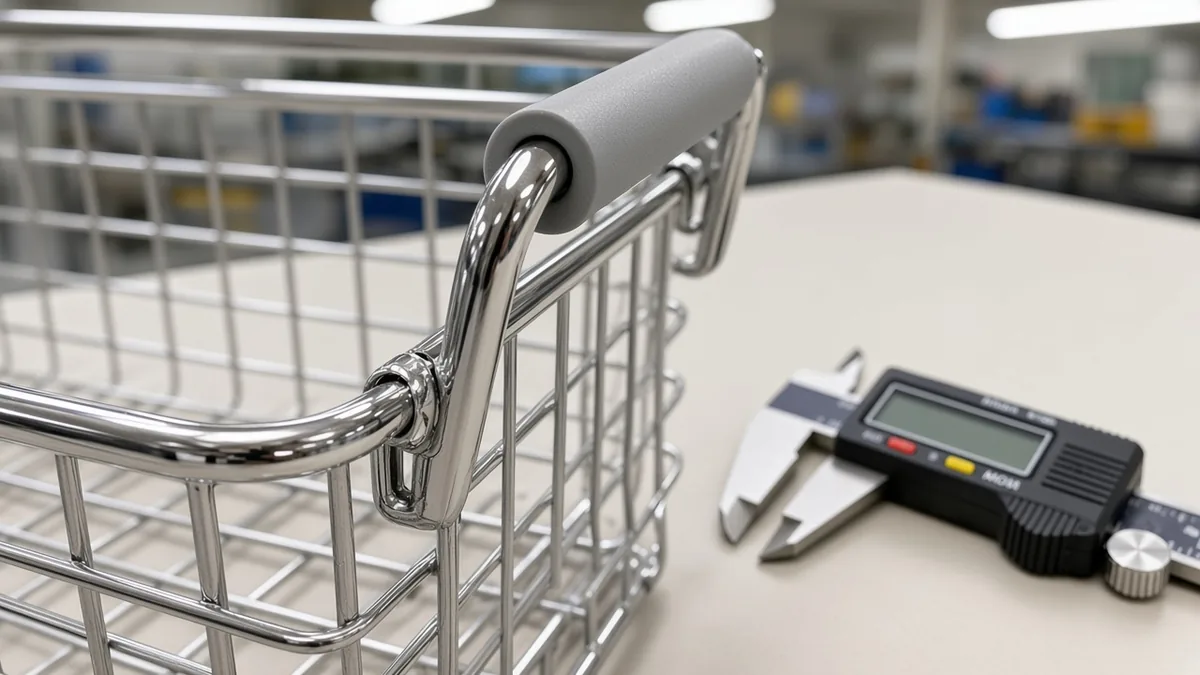
Handles fail first at the attachment, not at mid-span wire. A fillet that looks complete, a wrap that looks tight, or a bolted ear that looks flush can still peel, rotate, or crack once the basket is lifted by one hand. Returns then arrive as “poor quality,” with no frozen method to sort a true attachment failure from a misuse story.
Do not let a manufacturing overview replace this file. How a line bends, welds, and packs baskets is useful context, but it does not name the handle joint you will accept. Do not let a stack-interlock or lid-fit page replace it either. Wire basket lid fit and retention is the right neighbor when a lid must stay on the rim. This page only asks whether the handle stays on the basket.
Head-term shopping for “wire basket handle” often shows foodservice fry baskets or craft-wire tutorials. Those products are out of scope here. A kitchen pantry basket and a restaurant fry basket do not share an attachment standard, and a craft spiral handle is not an OEM acceptance method.
Worked example: a chrome kitchen basket ships with a welded side handle that looks smooth in a first-article photo. In stores, shoppers lift a loaded basket by one handle. The weld peels at the ear after a few weeks. The file had no pull-off direction and no reject rule, so each lot is argued as a one-off.
Worked example: a “heavy duty” line is printed because the handle wire is thicker. The attachment is still a short tack that is later hidden by powder. The thicker wire never gets a chance to work. The claim was about the wrong part of the handle.
Custom metal storage basket manufacturing can quote a handled kitchen or bath basket, but only if the inquiry names the attachment and the check. A request that only says “add handles” is not yet an acceptance file.
Which handle attachment constructions should the RFQ name?
Name the construction in words a factory and an inspector can share. Common in-scope types for home kitchen or bath baskets include a welded ear or tab, a wrapped or hooked wire that is then welded or crimped, a continuous rim that rises into a handle, and a bolted or riveted ear. Each type fails in a different place and needs a different look during the check.
Say whether the handle is a separate wire or a formed continuation of the rim. A continuous rim handle still has a joint somewhere; find it. A separate handle has two attachments, and both belong in the file. If only one ear is checked, the weaker ear will be the one that ships.
If the joint is welded, name the weld family in practical terms: a fillet, a projection or spot-style weld, or a tack that is then dressed. You do not need a novel process essay. You need to know what the inspector is looking at, and whether later grinding will hide a cold joint.
If the joint is mechanical, name the fastener or rivet, the clamp area, and whether the ear can rotate. A bolted handle that loosens is still a pull-off failure in the field, even if the wire never broke.
Coating must be addressed at the joint. Powder or plating can hide a cold weld or a cracked wrap until the first lift. Write whether the check is done on a finished coated sample, on a bare sample plus a finished sample, or both. A bare-weld lab shot is not a substitute for a finished-handle check if the SKU ships coated.
Mixed metals should be named when they exist: a stainless handle on a carbon-steel body, or a chrome handle wire on a different grade ear. Galvanic staining or a weak mixed joint will show up as a “rusted handle” complaint. That is still this attachment file, plus a material note, not a generic rust-wording page.
What pull-off or shear check can be agreed without inventing a load?
Agree the direction and the fixture concept first, then, if a project needs a force value, agree that value in the project file after a sample. Do not invent a Newton or kilogram rating for Koitor, and do not print a number on the carton until it is written that way. Kitchen wire basket handle pull off can still be a serious check when it is described as a method rather than as a badge.
Direction matters. A straight-up lift on both handles is not the same as a one-handed lift, a peel at 90 degrees, or a shear along the rim. Shoppers often lift with one hand at the end of a pantry shelf. If that is the use, the check should include a one-handle lift in the direction the ear will actually see.
A fixture can be simple: a padded clamp, a strap through the handle, a blocked basket so the body does not collapse and fake a pass, and a way to apply a steady pull. The fixture exists to make the check repeatable. It is not a reason to invent a laboratory rating.
If you only want a qualitative method for a first file, write it clearly: load the basket with a named kitchen condition, such as a stated set of jars or folded towels, lift by one handle and by both handles, and watch the joint for peel, rotation, crack, or coating break. Name the contents. Do not convert that condition into a printed capacity.
Keep the method out of any sampling-plan sentence. ISO 2859-1 can be used later as a sampling scheme once accept and reject are defined. It is not a pull-off method. Define what a fail looks like, then, if needed, agree how many baskets in a lot are checked.
After the check, inspect the joint under good light. Look for peel at the weld toe, a wrap that has opened, a cracked coating that later rusts, and an ear that has rotated. A handle that springs back but shows a cracked coat is not a clean pass if rust at the ear will follow.
| File item | What to freeze | What a sample should show | What to keep off artwork until then |
|---|---|---|---|
| Attachment type | Welded ear, wrap, continuous rim, or mechanical ear, including whether the handle is a separate wire | Both attachments, if there are two, match the named type | A lifestyle photo of a handle with no joint callout |
| Check direction | One-hand lift, two-hand lift, peel, or shear, as the use requires | The fixture or lift matches the written direction | A mid-span bend used as if it were an attachment check |
| Finished joint | Whether the check is on the coated SKU, a bare joint, or both | Coating at the ear is inspected after the check | A bare-weld photo used to approve a coated SKU |
| Accept or reject | Peel, rotation, crack, or coating break, and what happens to the lot | A written disposition, not a verbal “looks strong” | “Heavy duty handle” with no method |
| In-scope product | Home kitchen or bath storage baskets only | The sample is the household SKU, not a fry basket or a craft bag | A strength claim borrowed from foodservice or industrial totes |
| Change control | A later handle wire, ear tool, or coating shop is a new file | The new joint is checked again before the claim is reused | A running change hidden as a cost reduction |
How should coating, rust at the ear, and disposition be written?
Write what happens if the handle peels, cracks, or loses coating at the joint. A vague “rework if needed” will turn into arguments. A clearer file says whether a peeled ear is a reject, whether a coating crack at the toe requires strip and redo or a complete reject, and whether a lot is held until the attachment is rechecked.
Rust at the ear after a coating crack is a common later complaint. You do not need a salt-spray hour or a Koitor rust rating to write a rule: if the check opens the coat at the joint, the handle is not ready for a wet kitchen or a bath, and the claim should wait. Keep invented rust-proof wording off this page.
Heat tint or over-grind at a weld should be visible in first-article photos, not cropped out. A dressed weld that leaves a knife edge under the powder will cut the coat on the first lift. Photograph the joint before and after coating when you can.
Disposition should also say what the factory may not do quietly: adding a hidden tack, switching to a longer wrap, or changing the ear stamp without a notice. Those are construction changes. They reopen the check.
Which product families are out of scope for this file?
Industrial parts baskets, shopping baskets, restaurant fry baskets, and craft-wire bag handles are out of scope. They have different users, different loads, and often different retail language. Do not copy a foodservice strength line onto a pantry basket, and do not use this page to rank craft videos.
Stackable baskets are in scope only for their handles, not for the interlock. If a stack load travels through a handle, write that as a special condition, but do not turn this file into a stack-fit page.
Bath baskets with handles are in scope when they are household storage baskets, not when they are suction-mounted soap baskets with a decorative loop. Mounting systems should stay distinct. A suction cup is not a handle attachment.
If a program wants a “heavy duty handle” retail line, treat it as a claim that needs this file, not as a thicker-wire adjective. The U.S. FTC Policy Statement Regarding Advertising Substantiation is a useful reminder that the line needs a reasonable basis. The basis is the attachment and the check, not the adjective.
Buyer checklist for kitchen wire basket handle attachment
Use this list before a handled kitchen or bath storage basket, or a heavy-duty handle line, is approved.
- Confirm the product is a home kitchen or bath storage basket, not a fry basket, shopping basket, or craft bag.
- Name the attachment type at both ends, including whether the handle is a separate wire or a continuous rim.
- Write the pull-off or shear direction and a repeatable fixture or lift concept; do not invent a Newton value in the listing.
- Say whether the check is run on the finished coated SKU, on a bare joint, or both.
- Inspect the joint after the check for peel, rotation, crack, and coating break, and write the disposition.
- Keep heavy-duty handle language off artwork until the method and the accept-or-reject rule exist.
- Do not treat a manufacturing playbook, a lid-fit page, or a stack-interlock page as a substitute for this file.
- Photograph both joints, before and after coating when possible, and do not crop the ear out of the first-article set.
- Treat a later ear tool, handle wire, or coating shop as a change that reopens the check.
- Keep measurement methods and any later sampling plan in separate clauses.

Koitor can review a handle brief as part of custom metal storage basket manufacturing. Send the drawing or the sample, the intended handle claim, the attachment callout, and the check direction.
Small-batch customization is possible depending on the product. MOQ can start from 100 pcs depending on the product, samples usually take 5–7 working days after details are confirmed, and bulk production usually takes 4–6 weeks depending on the project. A new ear tool or a new handle form can change that discussion; those commercial details stay project-specific under careful approved wording.
A family-owned factory can hold an ear fixture and a retained handle sample, but it cannot honestly promise that every later lift in a shopper’s kitchen will match an unwritten claim. The buyer still owns the method and the artwork.
Incoming lots should include a look at both handle joints, not only a count of baskets. A later welder, a later grind, or a later powder vendor can reopen kitchen wire basket handle pull off even when the mesh looks unchanged. Tick both ears on incoming photos.
If a distributor asks for a longer handle on the same basket, treat it as a new attachment file. A longer lever changes the peel at the ear even when the weld size looks the same.
Retail sets that add a lid, a liner, or a heavier typical load should rerun the named lift with those parts. A liner that lets a shopper fill the basket more completely is a new condition.
Instruction cards should show two-hand lifts if that is the intended use, and should not silently invite a one-hand swing if that condition was never checked. Honest use language is part of the claim file.
Warehouse damage can start a peel that is later blamed on the weld. Inspect handles after transit samples, not only after a line test, when cartons are dropped or stacked on the handle.
When the attachment type, the direction, the finished-joint check, and the disposition are written, a heavy-duty handle sentence can be considered. If the file only says “strong handles,” the joint is still open.
A second plant should not inherit the handle claim by a photo of a similar basket. Recheck both ears on the actual construction and finish.
Do not accept a mid-span wire bend as a substitute for an attachment check. A handle that bends in the middle and stays on the ear is a different problem, and it should not be used to “pass” a peel method.
Color or chrome at the ear can hide a hairline crack in a catalog photo. First-article images should include a close, raking-light view of the joint after the check, not only a glamour shot of the lifted basket.
If the handle grip uses a plastic or rubber sleeve, freeze whether the sleeve may hide the joint. A sleeve that covers the weld can also trap water at the ear. Either stop the sleeve short of the joint or add a look under the sleeve in the check.
Spare handles, if offered, must use the same attachment identity. A spare that is “close enough” will not match the ear hole or the weld pad, and it will fail in the field as if the original joint were weak.
Export packing should keep handles from being used as carton feet. A handle that supports the carton in transit is already in a peel condition before the shopper ever lifts the basket. Write a pack orientation and inspect it.
A private-label color extension can hide a joint change. A black basket from a new coater may use a different grind at the ear, even when the chrome first article was sealed. Overlay the joint and rerun the named lift on the new finish before the heavy-duty line is copied onto the black SKU.
If the basket is sold in a nested pair, check the handle while the pair is still nested and after it is separated. A handle that catches the rim of the inner basket will be twisted in the store, not only in the kitchen. Write that condition if nesting is part of the pack.
Sales samples that travel in a suitcase take odd lifts and bumps. Collect travelling samples and look at the ears, or the field will train itself on a bent unofficial standard. A travelling sample is not automatically a sealed first article.
Frequently asked questions
Can I approve the handle because the weld looks complete?
No. Looks are not a method. Name the attachment, the direction, and the reject rule, then run the check on the finished joint.
Do I have to print a load rating?
No. You can agree a named lift condition and a visual reject rule without inventing a Newton value. If a project later needs a force figure, write it in the project file after a sample.
Is a thicker handle wire enough for a heavy-duty line?
Not if the attachment is the weak point. Freeze the joint first. Wire size is an input, not a substitute.
Does a lid-fit page cover handles?
No. Lid retention is a rim-and-lid decision. Handle pull-off is an attachment decision.
Are restaurant fry baskets included?
No. This file is for home kitchen and bath storage baskets. Foodservice and industrial baskets stay out of scope.
What should a first sample include?
The finished basket with both handle joints, the attachment callout, and a short method note. A beauty shot of one handle is not an acceptance sample.
Work With Koitor Hardware
Need a wire-basket handle attachment brief reviewed?
Send Koitor the drawing or sample, the intended handle claim, and the attachment callout. Our team can review the joint, the check direction, and small-batch OEM options before quotation.
OEM / PRIVATE LABEL
Turn this sourcing guide into a product brief
Share your target product, size, finish, order quantity and packaging requirements. Your team receives a practical manufacturability review before quotation.


 English
 Español
 Português
 Français
 Deutsch
 العربية