
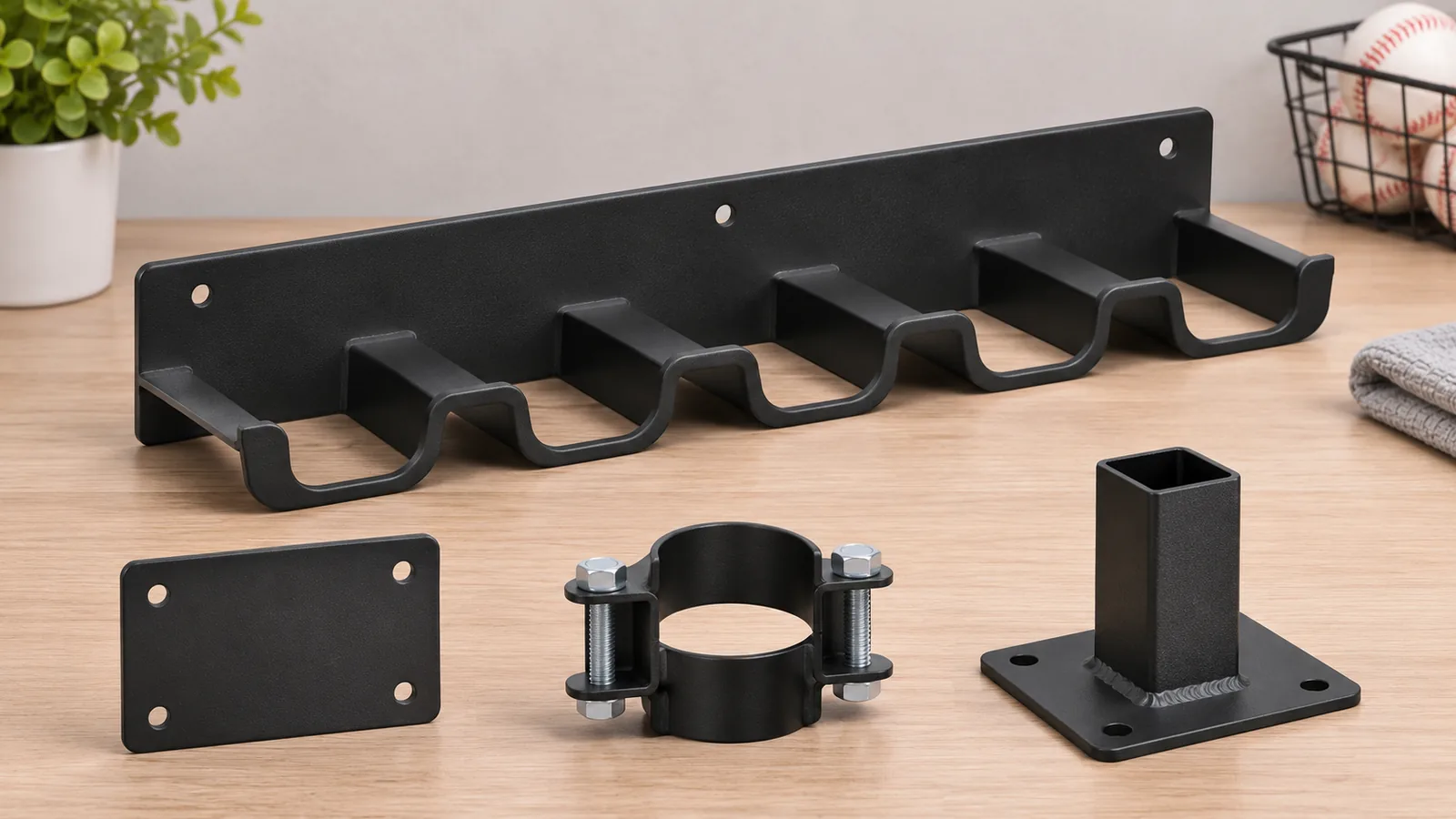
A baseball bat rack mounting specification should identify whether the buyer wants a fence-hung, wall-mounted or floor-anchored format, then match the supplied kit and approval documents to the actual site. “Stand-alone” may describe a rack that is separate from a wall while still requiring floor anchoring; it should not automatically be read as movable or unanchored. Buyers should also confirm how bats are supported, which fasteners are included and who reviews the substrate or fence. Fit, kit completeness and structural installation are separate approvals.

Why Must the Mounting Format Be Named Before Ordering?
Bat racks are sold in different architectures. One product may attach to chain-link fencing, another may fix to a wall, and a third may sit on a base plate and require anchoring to a floor. These formats have different interfaces, installation documents and supplied parts. A quotation that says only “metal bat rack” may leave the buyer unsure whether the price includes a fence bracket, a wall fixing kit, a base plate, anchors or none of those components.
The language in product listings deserves attention. A manufacturer’s “stand-alone” bat rack product page in the reviewed source set explicitly states a floor-anchoring requirement. Its associated drawing shows base plates and a supplied anchoring kit. That is evidence about that particular product, not a universal bat-rack rule or instruction to use the same anchor on another product. A separate fence product uses a different attachment concept. Another supplier drawing describes a kit that can vary by fence or wall application and uses wood-based construction rather than metal, so it should not be treated as metal manufacturing evidence.
The buyer should choose the site and attachment architecture first, then request the exact kit and installation requirements from the rack supplier. A generic photo cannot prove which parts are included. Nor does a rack’s apparent ability to stand on the floor establish that it is approved for use without anchoring. If the application is in a dugout, garage, retail display or public facility, the responsible site professional should confirm the actual mounting conditions.
| Rack description | Buyer’s interpretation to confirm | Information needed before order |
|---|---|---|
| Fence-hung | Which fence profile and attachment interface is intended? | Fence reference, bracket/clip details and included hardware |
| Wall-mounted | Which wall or panel interface is specified? | Product drawing, fixing scope and qualified substrate review |
| Floor-anchored base | Is the base intended to be fixed to a floor? | Base drawing, kit list and site approval responsibility |
| Stand-alone | Does the unit still require anchoring or another restraint? | Current instructions, stability/installation evidence and exclusions |
| Display-only holder | Is it for product presentation or actual storage use? | Demo purpose, support arrangement and any separate display fixing |
For other storage interfaces, see the relevant home-storage product guidance; the mounting selection here is limited to the bat-rack context and does not replace a site assessment.
How Should Buyers Compare Fence, Wall and Floor Formats?
Begin with the actual location and what the buyer knows about it. For a fence installation, identify the fence type and the part of the fence where the rack is expected to engage. Do not assume every chain-link fence has the same wire, spacing, condition or support. A product designed around one geometry may not fit another. The buyer should provide a reference photo and let the product supplier state the intended interface; a site professional should evaluate whether the fence is appropriate for the use.
For a wall-mounted configuration, distinguish the rack’s bracket pattern from the wall’s construction. A drawing may define hole spacing or supplied fasteners, but the actual wall substrate, backing and installation conditions need review by the responsible qualified person. This article does not prescribe anchor type, embedment, fastener size or safe load. Those depend on the actual rack, substrate, intended contents and applicable project review.
For a floor-anchored product, ask whether the base is meant to be fastened and which components are included in the quoted kit. If the base has an open tube or open-ended support, clarify how the bat bears in the installed arrangement. Do not infer a hidden floor or cap from a product photo. Ask for the current drawing and installation instructions for the selected model.
If a buyer wants a movable rack, specify that requirement directly and ask what evidence supports that use. “Freestanding” and “unanchored” are not synonyms in every product description. A portable unit may have casters, a weighted base or another architecture, but those features and their performance must be verified for the actual product. Do not transform an anchored product into a mobile one by omitting the fixing kit.
What Should the Buyer Confirm About Bat Support and Access?
The mounting decision does not establish that the bats fit. Identify the stored orientation and contact or bearing points. Does the rack support bats vertically or horizontally? Are the tubes or cradles open or closed at the bottom? Does the bat rest on a base, a stop or another part? A source drawing may show one specific support arrangement. Ask the supplier to explain the offer for the exact model rather than assuming the feature from an online photograph.
Use representative bats from the intended assortment to check the opening, barrel or handle clearance that matters. Confirm whether different sizes or models create an interference at the selected storage position. Review how a bat is inserted and removed with neighboring bats in place. If the rack also stores helmets or accessories, confirm those parts separately and do not allow a secondary accessory to hide the actual bat support.
Review finish and contact zones as sample observations. A metal edge, coating or protective insert may affect the visible contact, but no visual check establishes no-mark or scratch resistance. Record the buyer’s cosmetic requirement and ask which components are included in the production-intent sample. A buyer-supplied bat sample should be representative and lawfully shared.
Finally check the surrounding site. The rack may project into an aisle or fence-side route. Confirm access to the stored items and any adjacent equipment. The buyer’s facilities or project team should evaluate the location and mounting, including any site-specific operational requirement. This guide does not establish league, school, accessibility, fire-route or child-safety compliance.

What Should an Included Hardware Kit List State?
The purchase document should list each component by part name and quantity, and identify whether it is supplied with the rack or must be sourced separately. Include brackets, plates, clamps, fasteners, spacers, caps, washers, tools and instructions only when they actually apply to the selected product. The supplier should identify the kit’s intended interface. The buyer should not infer that a set of bolts is complete simply because it is shown in a listing photograph.
For alternate mounting options, assign distinct kit identifiers or clear selection fields. A fence kit, wall kit and floor-anchor kit may have different parts. If one model can be ordered with alternatives, the buyer needs to select one before production and packaging. If the installation hardware is purchased from another supplier, name who approves compatibility and who packs it with the rack.
The kit list should align with carton contents and the installation document. If fasteners are not included, say so in the product package and buying information. If the buyer’s installer provides them, identify the requirement and responsible party without making a universal technical recommendation. Keep a record of the approved revision so repeat orders do not ship an old set with a new rack configuration.
| Kit/document field | What to record | Why it matters |
|---|---|---|
| Rack format | Fence, wall, floor-fixed or explicitly movable | Selects the correct interface scope |
| Site reference | Named fence/wall/floor area and reviewer | Makes site assumptions visible |
| Attachment components | Part IDs, quantities and included/excluded status | Prevents kit omissions and assumptions |
| Bat support | Orientation, bearing feature and reference model | Confirms the rack’s intended storage arrangement |
| Instructions | Document ID, revision and product identity | Connects the package to the offered model |
| Approval record | Sample, drawing, kit and reviewer/date | Preserves the configuration for reorders |
| Evidence/exclusions | Supplier evidence and any limits | Keeps product claims within supportable scope |
How Should Buyers Treat “Stand-Alone” and “Freestanding” Claims?
Read the actual installation instructions and product drawing. Marketing words can describe a rack’s relationship to other furniture, not its required site attachment. A unit can be a separate structure and still require a floor fixing. A product may be described as “freestanding” while a specific installation document instructs anchoring. The buyer should ask the supplier to clarify the term for the exact SKU and use.
Do not assume that a base plate, wide footprint or heavy appearance proves stability without anchoring. Those visual characteristics are not a substitute for product-specific performance evidence. Conversely, do not assume every product must be anchored based on a competitor’s instructions. The supplier and qualified project reviewer should establish what applies to the offered design and site.
Keep claims precise in listings and packaging. If a unit requires floor anchoring, do not describe it as “free-standing, no installation required.” If the included anchor is intended for a specific substrate, do not imply it works for every floor. If the buyer plans a different mounting method, pause to obtain the appropriate design and approval rather than improvising a kit change.
What Should Buyers Ask Before Sample Approval?
- Which exact site and mounting format is this sample designed for?
- Does “stand-alone” mean separate from a wall, or unanchored in use?
- What is the current product drawing and installation instruction revision?
- Which bracket, clamp, plate and fastener components are included?
- Are alternate fence, wall or floor kits available and how are they selected?
- Where and how does the bat bear in the intended stored position?
- Which reference bat configurations were used to assess fit?
- What neighboring items or obstructions were considered?
- Who reviews the actual substrate and installation conditions?
- Which claims are supported by product-specific supplier evidence?
Make the sample match the order configuration where possible. If a prototype uses substitute fasteners, missing kit parts or a temporary support, record that difference. Do not approve final packaging or product copy while the mounting scope remains ambiguous. For a private-label product, update the fitment, included-parts list, artwork and instructions together when the kit changes.
Koitor Hardware’s approved capabilities include metal forming, joining, finishing, assembly, packaging and buyer drawing/sample coordination for bathroom and home-storage hardware. That process knowledge can support a discussion of a buyer’s metal product brief. The current manufacture of bat racks, aluminum extrusion, fence-anchor engineering, sports-facility installation and certified load testing are not confirmed. A buyer interested in an adjacent metal storage product should share a lawful drawing, site assumptions and intended scope for feasibility review; no production capability should be assumed from this article.
Buyer Checklist Before Ordering
Record the baseball bat rack mounting specification against the named site and mounting architecture before the purchase order is released.
Keep the baseball bat rack mounting specification tied to the named fence, wall or floor interface and its separate kit.
- Choose a specific fence, wall, floor-anchored or movable format.
- Identify the intended site and who evaluates its substrate or structure.
- Confirm the meaning of “stand-alone” or “freestanding” for the offered model.
- Obtain the current drawing, instructions and product-specific evidence.
- Freeze the included kit, alternate kit and any buyer-supplied parts.
- Confirm how bats are supported and which reference models fit.
- Check insertion, removal, adjacent storage and full rack projection.
- Ensure package contents, product copy and instructions describe the same kit.
- Record sample, drawing, fastener kit and approval revisions together.
- Do not reuse a fit result as structural installation evidence.
Frequently Asked Questions
Does “stand-alone” mean a bat rack needs no anchoring?
Not necessarily. The phrase can describe the rack as a separate unit, while the current instructions may still require floor anchoring. Confirm the exact model.
Are fence and wall mounting kits interchangeable?
Do not assume they are. The interface and components depend on the design and site. Request the selected kit and compatibility information from the responsible supplier.
Can a buyer choose anchors from a product photo?
No. A photo does not establish substrate, installation requirements or anchor suitability. Follow current product instructions and obtain qualified site review.
Does a bat fitting in a tube prove the rack is approved for storage?
It demonstrates only an observed fit condition. Support, access, structural evidence and installation remain separate questions.
Should mounting parts be included in every quotation?
The quotation should clearly state what is included and excluded. Buyers can then compare products and arrange any site-specific components with the responsible party.
Discuss a Metal Storage Hardware Brief
Share your own drawings, kit definition and site assumptions to discuss product feasibility within Koitor’s confirmed manufacturing scope.
OEM / PRIVATE LABEL
Turn this sourcing guide into a product brief
Share your target product, size, finish, order quantity and packaging requirements. Your team receives a practical manufacturability review before quotation.


 English
 Español
 Português
 Français
 Deutsch
 العربية