
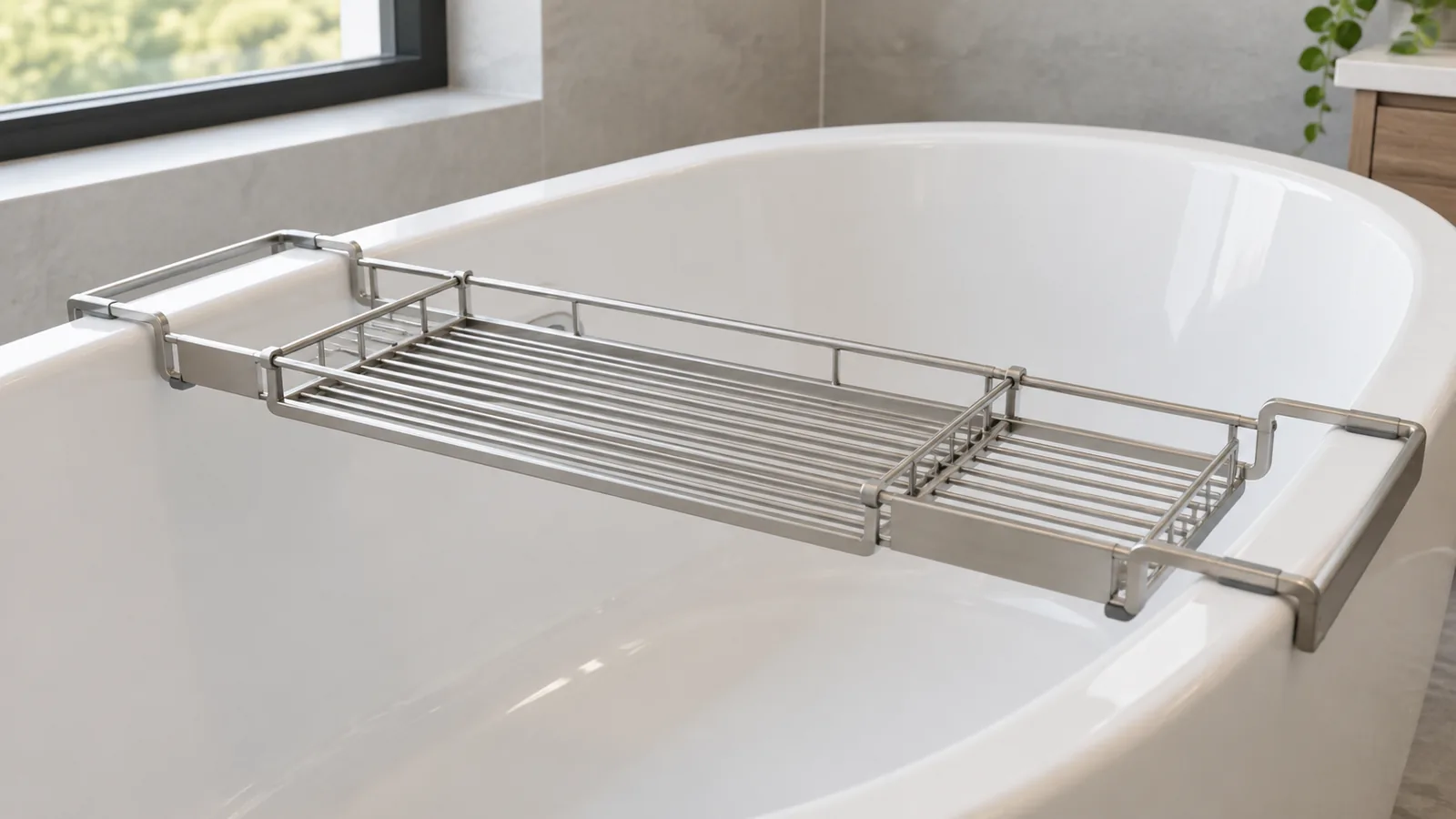
A buyer evaluating a bathtub tray manufacturer should define the tub profiles, support points, usable adjustment range and sample checks before approving a metal caddy. A width number alone cannot show whether a tray contacts a narrow, rolled or sloped rim correctly, stays level at the ends of its adjustment range, or retains enough overlap in its sliding section. The importer should give suppliers a measurable fit brief, test representative samples at the intended settings and record the approved configuration by SKU and revision.
How should an importer specify bathtub caddy fit and support?
A bathtub caddy spans two opposing sides of a tub, so its fit depends on the geometry where its ends rest, not simply on one overall bathtub width. Importers often receive a nominal adjustment range but still need to determine whether the stated measurement describes the tray body, the outer support points, or the tub’s inside opening. Those dimensions answer different questions.
The sourcing decision is practical: which bathtub types should the SKU serve, where will the product touch each rim, and what should the approved sample demonstrate? This B2B guide treats the caddy as a product-development and sample-approval problem. It is not a consumer “best” product list, does not state a universal bathtub size, and does not imply Koitor currently manufactures a bathtub caddy.
Separate four facts in the RFQ: the tub dimension used as the fit reference; the minimum and maximum support span; the support-end geometry and contact material; and the product condition and evidence required at each tested setting. Put those facts in the drawing, quote, sample record and final SKU specification. If a supplier says “fits most tubs,” ask which measured range and contact conditions make that statement true for the quoted model.
Which bathtub measurements should an importer provide?
Start with representative tub profiles from the markets and channels the product is intended to serve. Record the distance between the support locations and the shape of each contact surface. Provide drawings or photographs with a scale reference when possible, and mark measured values separately from estimates. A photo can communicate a rolled edge or sloped deck; it cannot replace a dimensioned fit envelope.
The buyer’s measurement sheet should identify:
- Support-to-support span. Measure between the intended left and right contact zones. Do not assume the inner opening, outside rim-to-rim dimension and support distance are interchangeable.
- Contact surface width. Note how much stable surface exists at each end. A tray may have sufficient total span but place a narrow foot partly on a curve or edge.
- Profile and slope. Record whether the deck is flat, rolled, sloped, rounded, unusually narrow or interrupted by a nearby wall. Capture both sides if they differ.
- Height and clearance. Check nearby faucets, walls, shower screens or trim, plus clearance beneath any raised caddy structure.
- Fit tolerance. State the range of measured tubs the SKU is meant to cover and how a sample near either boundary will be judged.
Use the product drawing to show measurement endpoints with arrows and names. “Width: adjustable” is not a complete specification. “Usable support span measured between the centers of the two resting pads, with the sliding section at its approved minimum and maximum positions” is easier for a supplier, inspector and buyer to interpret. The datum must match the actual design; it is not a universal convention.
How should the adjustment range and overlap be defined?
Specify a minimum and maximum usable support span, then ask how the supplier measures both values. Check the product at each endpoint and at a representative middle setting. If the caddy uses nested tubes, sliding rails or an extension plate, record the remaining overlap at maximum opening and any stops or detents that retain the selected position.
Overlap is a design input, not a universal pass/fail number. A long extension may increase range but also change stiffness, appearance, alignment, finish or exposed gaps. A short extension may look compact yet fail to reach the target profile. Review the actual construction, intended use and proposed validation with the product engineer instead of inventing a generic minimum.
Ask the supplier to explain which part moves, how adjustment is retained during placement and ordinary handling, whether either end can slide or rotate at the widest setting, whether extension joints create pinch points or finish wear, and how the factory will confirm a consistent usable range from sample to production.
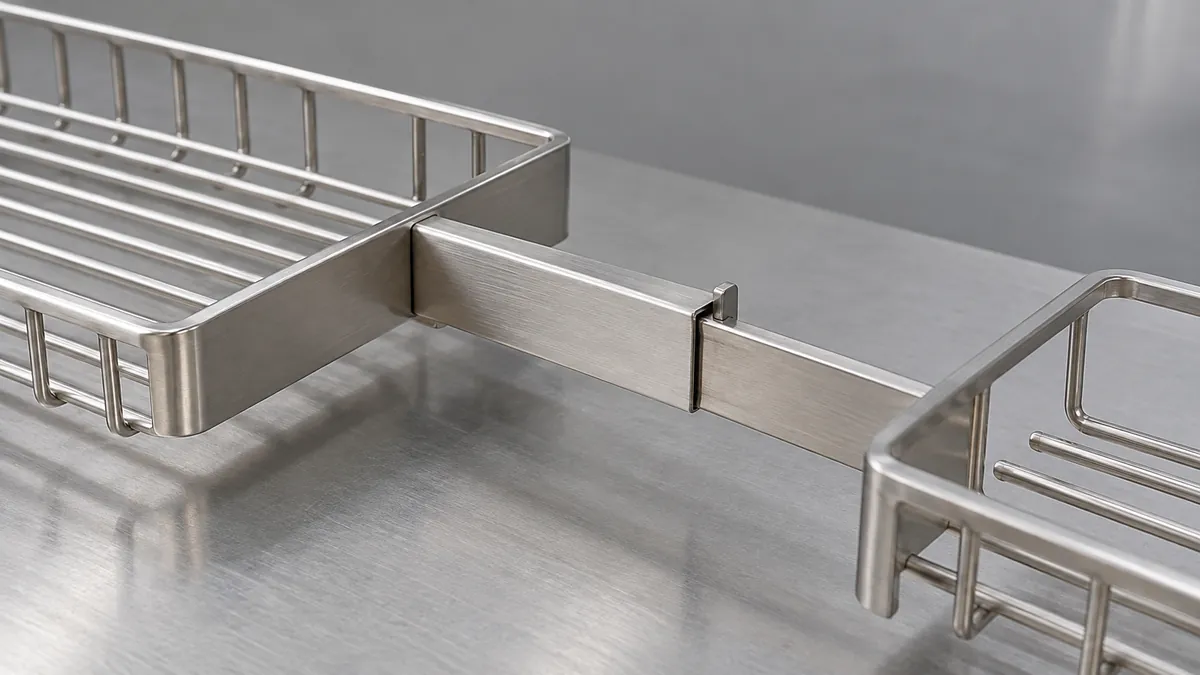
The table below turns broad product language into checkable buyer inputs. Values such as span and load must come from the actual proposed model and its supporting evidence.
| RFQ item | What the buyer should define | What sample review can confirm |
|---|---|---|
| Intended tub coverage | Measured support span and profile examples | Contact on narrow, typical and wide target conditions |
| Adjustment | Usable minimum and maximum span; measurement datum | Level position and retained overlap at both endpoints |
| Support ends | Foot or pad size, material and location | Contact without rocking or unintended edge loading |
| Center structure | Tray depth, compartments, rails and extension construction | Clearance, access, drainage and finish around joints |
| Load statement | Intended use, loading position and supplier evidence | The stated method and configuration, not every misuse case |
| Revision control | Drawing, material, finish and sample revision | Whether the reviewed sample matches the release record |
What should the support ends and contact surfaces do?
The ends form the interface between the metal product and the tub. Ask for the contact footprint, location, edge treatment and any protective sleeve or pad to be shown on a drawing. Review whether the contact area remains supported on each target profile, including at maximum span. Small pads can concentrate contact; larger pads may still be ineffective if they land on a curve or slope.
Specify a surface-protection component by material, thickness if relevant, attachment method and inspection expectation. Do not assume that a soft pad automatically prevents slipping, protects every finish or stays attached in every cleaning environment. Ask the supplier to identify the proposed material and limitations, then evaluate the intended contact conditions.
During sample review, place the product on representative tub-edge forms or buyer-provided fixtures. Observe rocking, sliding, uneven contact, scratches, local deformation and whether the caddy sits level. Repeat after adjustment instead of checking only one span. If a bench fixture differs from the target bathtub, document the difference. This makes the evidence useful without overstating what the setup proves.
Which tray details affect fit and buyer usability?
Span solves only the cross-tub fit question. A private-label buyer sourcing from a bathtub tray manufacturer should also set the usable tray depth, edge height, compartment layout, drainage openings and clear space around accessories. Evaluate these decisions against actual user needs and channel requirements, rather than adding features only to lengthen a list.
A raised rail may reduce the chance of an item sliding off during ordinary placement, but it can also block access or interfere with an accessory. A deeper tray may hold more items but could contact a wall or overlap a narrow deck. Dividers and removable cups can make a layout flexible, yet introduce joints and parts to inspect and pack. Each feature should address a defined buyer or assortment requirement.
Ask for the outside dimensions at minimum and maximum extension, usable flat tray area, height of rails and holders, location of moving joints and stops, rounded or deburred edges on contact surfaces, and part count and assembly steps. Also ask how moving parts are protected in the carton.
Do not infer load capability from material thickness, product weight or visual appearance. If a load statement will appear on retail packaging, agree on the test setup, loading position, duration, acceptance criteria and responsible party before approval. Keep the claim limited to the tested product configuration and method.
How can the buyer compare sample performance fairly?
A useful sample protocol connects every observation to a defined condition. A compact protocol has three stages.
Inspect the sample against the drawing. Confirm the relevant spans, tray depth, support footprints, stop positions, finish, edges and moving-joint details. Write down the revision and measurement method. If a dimension is missing or ambiguous, resolve it before calling a sample compliant.
Evaluate the fit envelope. Place the sample on representative narrow, middle and wide fixtures reflecting the buyer’s target profiles. Confirm support contact, level position and adjustment retention at each setting. Photograph the end interfaces from consistent angles. Record limitations, such as a flat block replacing a rolled tub rim.
Check operation and handling. Extend and retract the product through the intended range, place it on and remove it from the fixture, and review whether parts bind, disengage, scratch, loosen or become visibly misaligned. If the product has separately installed accessories, verify their location, retention and packing arrangement.
This is a sample-review protocol, not a universal durability or safety certification. It does not establish performance on every bathtub, load pattern or long-term use condition. Buyers should decide whether additional validation is needed for the intended market, claims and sales channel.
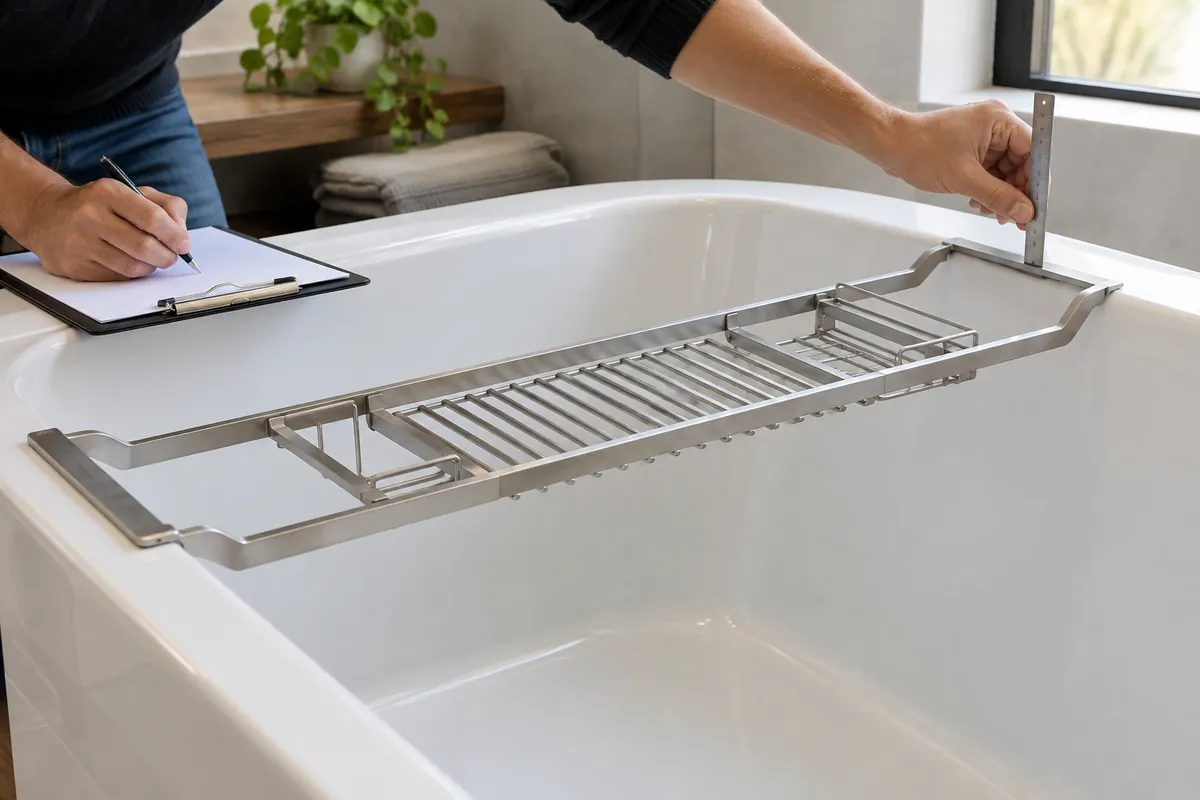
How do material, finish and packaging choices affect a quote?
A metal bathtub caddy can use different materials, sections, joining methods and finishes. A product page or competitor listing describes one configuration, not the whole category. Ask the supplier to quote the selected construction and identify substitutions before they occur.
A thinner or lighter structure may reduce weight and package volume but can change stiffness and feel. More metal may increase mass without solving a poor support interface or unstable extension joint. Surface finishing has its own process and cost implications, particularly around telescoping overlaps, welded joints, edges and areas where components move against one another. The drawing should identify cosmetic faces and locations where finish buildup or contact marks matter.
Discuss package protection around exposed ends, trays and sliding parts. Separate components that can rub, lock or dent one another in transit. Confirm whether the caddy ships assembled, partially assembled or folded, and compare the carton and parts against a real packing sample. The packaging plan should protect approved surfaces without concealing SKU identification or required instructions.
For general bathroom hardware sourcing and drawing review, buyers can explore Koitor’s custom bathroom hardware manufacturing overview. This describes Koitor’s broader product category, not a claim that a bathtub caddy is a current Koitor model.
What should approval records and change control cover?
Record the model, drawing revision, target market, supported profile range and exact measurement datum. Add material and finish selection, support-pad construction, extension mechanism, included parts, packaging configuration and any intended on-pack claims. The approval record should identify which sample was reviewed, who reviewed it, which conditions were tested and what remained outside the review.
A change to the support end, extension overlap, sliding joint, finish or carton can affect fit or appearance. Route changes through revision-controlled approval. Ask the supplier to identify changed components and provide a revised sample or evidence when a change could alter a buyer-visible requirement. An old sample photograph cannot approve an unrecorded design change.
Clear records make quotes more comparable. Ask each bidder to quote the same span, support footprint, finish, package format, accessory set, target quantity and sample scope. If a supplier proposes an alternative, show it as a separate option with its own drawing and cost. When comparing a bathtub tray manufacturer, the buyer can evaluate a lower-cost construction without losing visibility into what changed.
What mistakes cause avoidable fit disputes?
Comparing only maximum width. A quoted maximum can hide the support datum or minimum usable setting. Ask for both endpoints and a drawing that shows where each is measured.
Treating every bathtub rim as flat. Target tubs may have rounded or sloped contact zones. Include representative profiles in the fit brief and inspect the ends at those locations.
Checking only the middle of the range. A sample may work midway but become unstable or misaligned at an endpoint. Test the intended operating envelope.
Approving a sample without its revision record. A sample alone does not prove the final material, finish, parts or carton will match. Link approval to drawing, BOM and packaging revisions.
Using a load number without its method. A number without the configuration, load placement and acceptance criteria cannot be compared reliably. Do not turn an unverified claim into a buyer promise.
Adding features without a channel reason. Extra holders and detachable parts can complicate cleaning, assembly, inspection and packaging. Keep features tied to a defined use case.
How can an OEM partner support product development?
An OEM partner can help translate a buyer drawing or physical sample into a manufacturable specification, identify questions about bends, joints, finish access and packaging, and provide feedback during sample review. That support depends on the supplier’s actual experience and should be confirmed in the project scope. A supplier should not be treated as an independent testing laboratory unless it has that verified role.
Koitor Hardware is a family-owned custom metal hardware manufacturer serving bathroom and home storage categories. Buyers can discuss a drawing, proposed sample or specification with the factory, but should first confirm that the product type is within the factory’s verified current capability. The bathtub caddy described here is a conceptual sourcing example, not an existing Koitor product claim.
When requesting feedback, share intended use, target tub measurements, adjustment range, contact-zone detail, finish and quantity assumptions. Ask the supplier to return questions against a drawing revision instead of replying with an unqualified “fits all.” For adjacent product work, start with the custom bathroom hardware category overview and confirm scope directly.
Buyer checklist before requesting a quotation
- Identify the tub profiles and market the SKU should serve.
- Show measurement endpoints and distinguish the inner opening from support span.
- Specify usable minimum and maximum width and the expected settings between them.
- Show support footprint, pad or sleeve material, location and acceptable contact.
- Provide tray depth, rail height, accessory layout and nearby clearance requirements.
- Identify moving joints, stops, overlap areas and required edge treatment.
- Request the selected material, finish and proposed alternatives separately.
- Define sample fixtures, fit conditions, records and acceptance criteria.
- State what any planned load test must cover; do not infer performance from appearance.
- Approve packaging, part protection, assembly state, SKU label and revision details.
- Link the approved sample to the drawing, BOM, finish sample and carton specification.
- Confirm whether this product type is within the supplier’s current verified capability.
Frequently asked questions
Does an adjustable bathtub caddy fit every tub?
No. The usable range is one fit variable. Support ends must contact the intended rim locations, remain stable across the defined span and avoid nearby interference. Verify the adjustment datum and test representative profiles.
Should an importer specify the tub’s inside width or outside width?
Specify whichever dimension corresponds to the actual support locations and label it clearly. The inside opening, outside edge-to-edge width and support-to-support span may differ. Marked endpoints prevent a supplier from assuming one means another.
What should a buyer test at the widest adjustment?
Check that support ends remain seated, the caddy stays level, the extension retains the approved overlap and moving parts stay aligned. Record the fixture profile and method. The result applies to that configuration, not all tubs.
Can a load rating be copied from a similar model?
No. A load rating belongs to a specific design, configuration and test method. A similar-looking product or competitor listing is not evidence for the model under sourcing.
Does Koitor currently make the caddy described in this guide?
This article does not claim Koitor currently makes this product. It describes buyer-side questions for a conceptual adjacent-category metal caddy. Confirm product scope and current capability before adding it to an RFQ or assortment plan.
Reference examples for model-specific measurements
- Yamazaki Home Europe: Extendable Bathtub Tray — one model page lists its width range, bathtub context and load figure.
- Water Creation: Expandable Bath Caddy technical sheet — a model-specific drawing lists its adjustable span and depth.
- Signature Bath: Bathtub Tray Caddy — another product page lists a different arm range and accessories.
These examples illustrate why buyers should record model-specific endpoints and interfaces. They are not universal specifications or evidence of Koitor performance.
Discuss a metal hardware sourcing requirement
Share a drawing, approved sample, target dimensions and project requirements so the team can confirm whether the product fits Koitor’s current manufacturing scope.
OEM / PRIVATE LABEL
Turn this sourcing guide into a product brief
Share your target product, size, finish, order quantity and packaging requirements. Your team receives a practical manufacturability review before quotation.



 English
 Español
 Português
 Français
 Deutsch
 العربية