
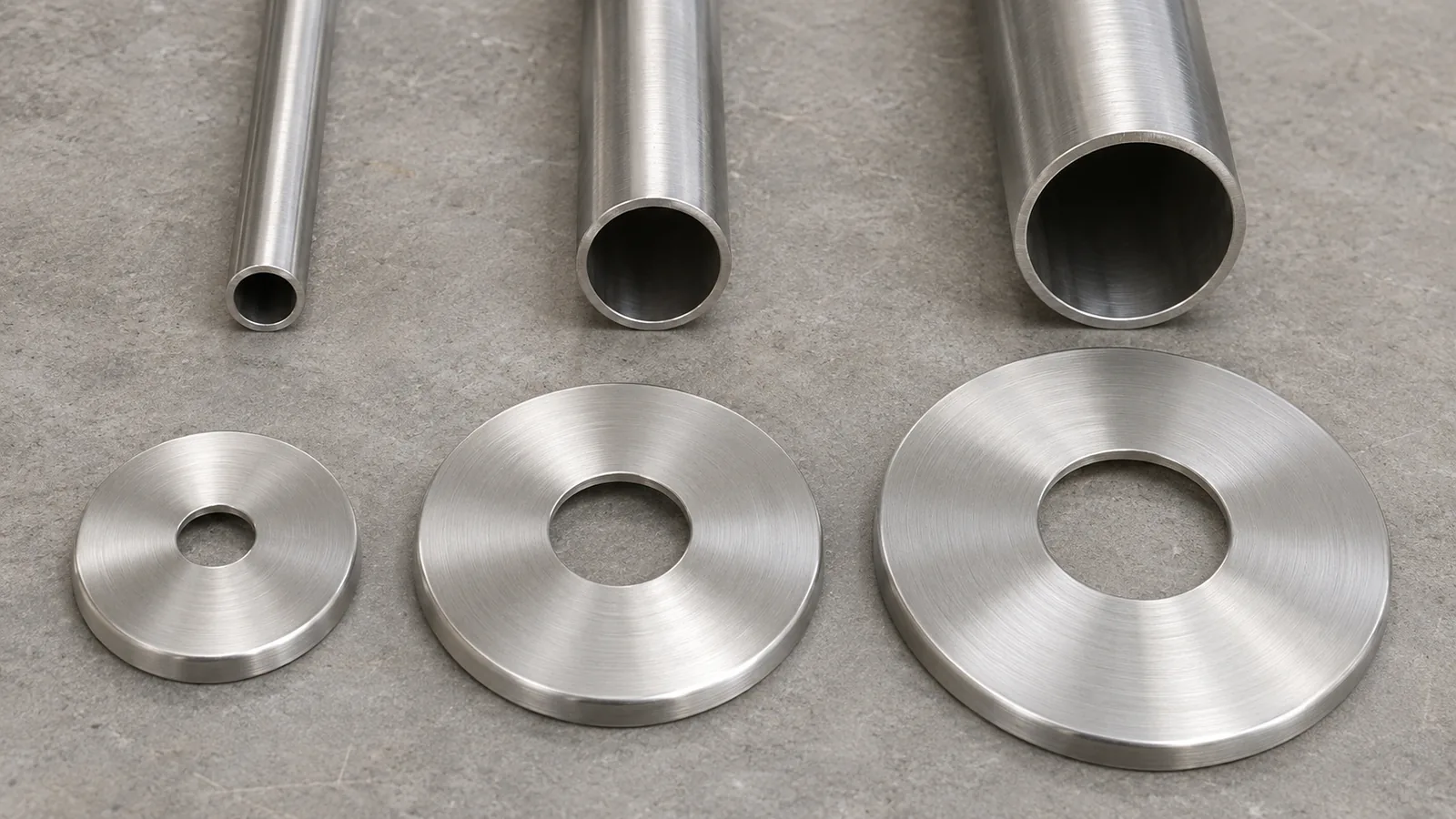
To assess metal escutcheon plate pipe size compatibility, buyers need to distinguish the pipe family, actual pipe envelope, cover’s finished bore, outer coverage and installation access. A nominal size label alone does not say whether the opening clears the real pipe or whether the outer plate conceals the intended wall cutout. Importers should request a current, supplier-approved drawing and compare it with the actual reference part and surrounding opening before releasing an order. This is a guide to decorative cover specification; it is not plumbing installation advice, a universal size chart or a claim that an escutcheon seals a penetration.
Why Does “Pipe Size” Describe More Than One Dimension?
A “pipe size” field can refer to a nominal family name, a measured outside diameter, a mating opening or an application label. These are not interchangeable. A buyer who compares one supplier’s nominal label with another supplier’s finished bore may believe two components match when the dimensions refer to different things.
A decorative plate has its own geometry. It may have an inner opening, a cover face, a depth or profile, and a retention or assembly method. The pipe has a reference identity and an actual envelope. The wall opening has a separate shape and size. The surrounding components may also affect whether the cover can be positioned as intended. Each item deserves its own line in the RFQ.
| Field | What it identifies | What it does not establish by itself |
|---|---|---|
| Nominal pipe family | A supplier’s named size category | Actual outside diameter or a universal fit |
| Pipe envelope | The actual pipe reference or measured outside condition | Cover opening or wall coverage |
| Finished bore | The escutcheon’s relevant inner opening | Outer concealment or assembly access |
| Cover face | Outer diameter, shape or visible outline | A seal or water barrier |
| Cover depth/profile | How the plate sits relative to its support | Clearance for every adjacent assembly |
| Wall opening | Existing cutout or rough opening | Whether the supplier’s chosen part is current |
| Assembly method | Supplier-defined sequence and retention | Authorization to alter plumbing or the wall |
The supplier’s approved drawing should mark where each dimension is taken. A catalog description may show several fields yet use wording that is unclear or inconsistent. If so, the buyer should not average, infer or silently choose one. Record the contradiction and request written resolution for the exact model and revision.
This distinction is supported by actual manufacturer product information. BrassCraft’s pages list different decorative cover families and pipe-related size descriptions, while one product submittal separates cover, opening and depth fields. The source material includes wording discrepancies and an older revision, so this guide does not reproduce its dimensions or grade labels as current guidance. It illustrates why importers should request their own supplier-approved drawing rather than treat any listing as a universal table. See the manufacturer pages for one escutcheon family and another listed family.
How Should a Buyer Identify the Pipe Reference?
Start with a named reference supplied by the project: part drawing, product model, physical sample or documented application. If the buyer receives a pipe-size description without a model or measured interface, ask the source to clarify what the label means. Do not use a market convention from memory to replace the actual supplier’s specification.
Record the pipe identity separately from the escutcheon identity. If a project uses several pipe families or finishes, assign a separate row to each combination. A repair-accessory distributor may receive incomplete field information, but should mark the gap rather than present an assumed fit as confirmed.
Where a sample is available, the buyer may measure its relevant envelope for comparison, using an agreed method and recording the instrument or measurement source. The measurement is evidence about that sample, not a definition of an entire nominal family. If the feature is hard to access or measurements are uncertain, request a supplier drawing or qualified review.
The record should identify:
- The buyer’s model or sample reference.
- The source and date of the pipe dimension.
- The specific feature being measured.
- The product revision or finish, if known.
- The party responsible for confirming the interface.
- Any unresolved terms such as “nominal,” “inside” or “outside.”
Avoid translating a label between two supplier catalogs without confirming their definitions. An importer can ask each supplier to mark the size on a controlled drawing and explain any assumptions. If the two suppliers use different reference conventions, put that difference in the comparison record instead of silently declaring the parts equivalent.
How Do Bore and Coverage Solve Different Problems?
The finished bore is related to the part’s inner clearance around the intended pipe reference. The outer cover geometry relates to visible coverage of a wall opening or surface. A plate can have a bore that clears the pipe while leaving a rough opening visible. Conversely, a wide face may cover the opening in a photograph while its inner bore or depth is unsuitable for the assembly.
A buyer should ask for at least these independent drawing fields:
- Finished bore: the opening and any supplier-defined tolerance or measurement boundary.
- Outer cover envelope: diameter, width, shape or relevant face boundary.
- Depth/profile: the plate’s shape behind the face and how it relates to the supporting surface.
- Pipe reference: actual product family or sample dimensions to which the drawing is compared.
- Wall-opening reference: buyer-provided cutout shape and size when concealment is part of the brief.
- Assembly-access note: whether the cover is intended to be fitted before, during or after another part, as confirmed by the responsible supplier.
Do not convert these into universal acceptance values. The required relationship depends on the actual product, surface and application. The buyer’s objective may be a decorative cover, access to an existing assembly or visual concealment. State which outcome is required and ask the supplier to confirm the proposed geometry against the reference.
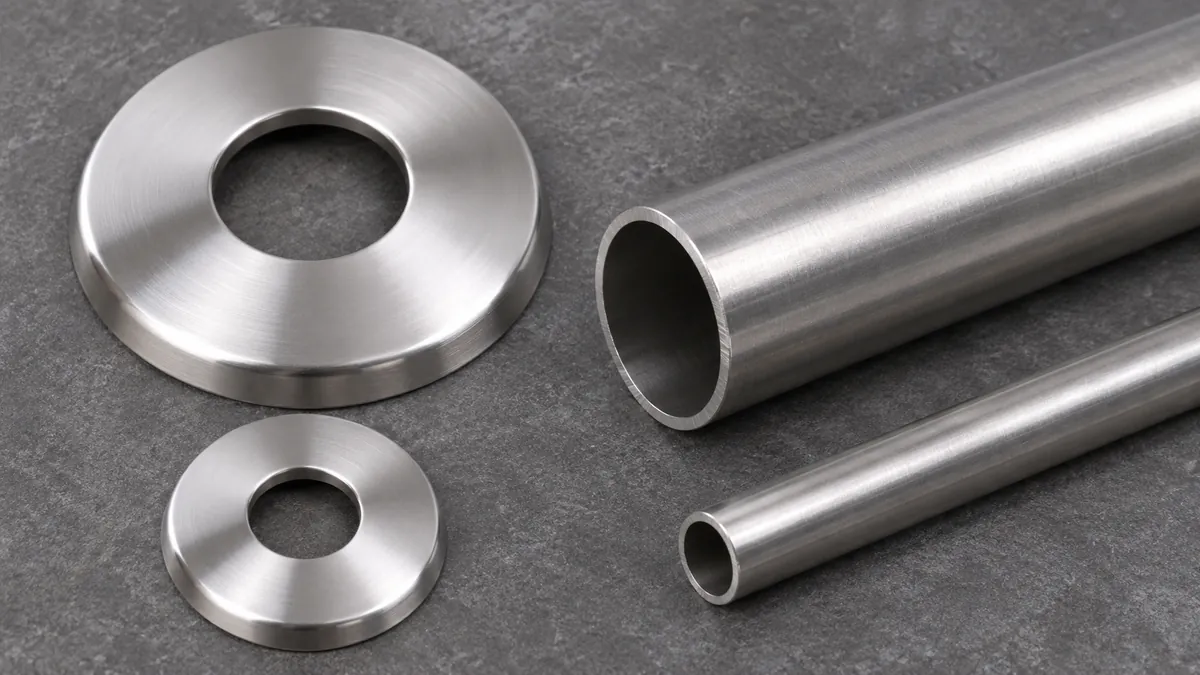
The phrase “wall-hole coverage” also needs a reference. The visible cutout may be circular, irregular or affected by a backing component. Ask the buyer or project party to provide the actual opening, preferably with a drawing or scaled photograph, and identify which part of the plate must cover it. Do not promise that a decorative cover conceals all conditions based on a generic product image.
What Should Be Checked on a Physical Sample?
Compare the sample against the named pipe reference and wall-opening reference without disconnecting or altering a plumbing assembly. The review can be limited to product identity, visible dimensions and the fit relationship that the responsible parties have approved. If an installer or technical authority must evaluate assembly feasibility, defer to that party.
Confirm the sample model, revision and finish match the drawing or quotation. Measure or compare the bore and outer envelope at the marked locations. Place the cover in the intended review position only when the project’s responsible person has confirmed that this does not involve unsafe or unauthorized work. Record whether the visible plate covers the defined opening and whether the pipe interface appears as specified. Do not claim that this visual review proves pressure integrity, waterproofing, firestop performance or code compliance.
If access or sequencing affects the sample, ask the supplier to describe its approved method and ask the qualified installer or project party to confirm applicability. This article intentionally does not describe disconnecting valves, isolating water, removing internal tabs or modifying a pipe or wall. A buyer should never infer permission to change an installation from the fact that a decorative plate can be moved in a photograph.
Record discrepancies by location. “Bore seems tight” is less useful than “sample revision B contacts the buyer reference at the lower edge in the observed position; supplier drawing clarification requested.” The description should state what was actually observed and what remains unknown.
| Sample checkpoint | Record | Escalate when |
|---|---|---|
| Product identity | Supplier, model, revision and finish | The sample cannot be tied to the quotation |
| Bore | Drawing feature and measurement source | Label conflicts with drawing or sample |
| Outer coverage | Reference opening and visible outline | Opening remains exposed or reference is absent |
| Depth/profile | Marked datum and surrounding clearance | Adjacent parts or surface interfere |
| Retention/access | Supplier-described method and authorized reviewer | Instructions or responsibility are unclear |
| Cosmetic condition | Agreed visible face and inspection criteria | Finish or appearance differs from approval |
A sample observation does not automatically change the acceptance drawing. If the buyer accepts a deviation, document the approved revision and scope. If the supplier updates the part, recheck the fields affected by the change.
Can a Catalog Size Label Resolve Conflicting Specifications?
No. If catalog copy, submittal, quotation and sample describe different dimensions or materials, the buyer needs a current written resolution for the exact SKU. An older PDF may be useful as historical context but cannot alone establish a current production specification. A webpage’s date or recent edit also does not necessarily mean every linked document has been revised.
The responsible supplier should identify which document controls the current part. Request a revision date, model code and a drawing that marks the bore, cover face, depth and any relevant assembly condition. If the supplier cannot resolve the discrepancy, hold that SKU from release rather than choosing the most convenient number.
This does not mean every catalog mismatch proves a product is defective. The conflict may be a labeling issue, a distinct model family or an outdated attachment. The buyer’s job is to determine which explanation applies before procurement. Keep the question factual and avoid speculating about why the information differs.
A part number in a distributor spreadsheet should point to the approved drawing and evidence record. Avoid copying one model’s values into another row because the nominal labels look similar. When a family has multiple plate profiles, keep them separate until the supplier confirms which features are shared.
How Should Substitutions Be Evaluated?
A substitute should be evaluated against the same pipe identity, bore, cover envelope, depth, assembly access and appearance requirements. Similar wording or a close face diameter does not show that the substitute has the same interface. Ask the supplier to identify the alternative model and provide its current drawing.
If a supplier changes the source of a component, material, finish, retention feature or forming method, determine which buyer requirements might be affected. This article does not assert that every process change alters fit; it recommends asking for the changed drawing and reviewing relevant dimensions. A substitution should be approved by the person responsible for the part and the project’s acceptance criteria.
Maintain a change log with old and new part codes, document revisions, reasons for the proposed substitution, affected SKUs, sample or drawing review and approver. This is especially useful for distributor ranges that include a standard plate and a variation for a different pipe family. The buyer should not allow one generic “replacement escutcheon” description to blur those differences.
If the intended application has regulatory, plumbing or fire-related requirements, route those questions to qualified parties and current authoritative requirements. A decorative plate’s dimensions do not establish that it provides a firestop, waterproofing, pressure or sealing function. Do not extend the article’s geometry framework into an unsupported compliance statement.
How Do Buyers Compare Supplier Quotes?
Create a common RFQ schedule before requesting prices. Give each supplier the same product reference, required cover geometry, finish, target quantity, packaging and drawing expectations. Ask each bidder to identify their proposed model and revision rather than returning only a generic size name.
A comparable quote should state whether the listed dimensions are nominal or measured, which surface or datum defines them, and which components are included. Clarify whether the quotation is for a single decorative cover, a set or another assembly. If the plate depends on a component from another supplier, identify that boundary.
| Quote field | Buyer’s required clarification |
|---|---|
| Model family | Exact code, revision and finish |
| Pipe reference | What buyer sample or supplier-defined family is supported |
| Finished bore | Dimension location and drawing revision |
| Cover face | Outer dimensions and profile shown on drawing |
| Depth | Datum and how it relates to the assembly |
| Wall opening | Whether buyer must provide a reference for coverage review |
| Assembly scope | Which supplier or installer confirms sequence |
| Packaging | Quantity, protection, identification and labels |
| Sample | Sample code, revision and required approval evidence |
| Change handling | How substitutions and revised drawings are authorized |
This structure allows procurement teams to compare scope as well as price. A lower price may exclude a finish or sample activity, while a higher one may include a different configuration. The buyer should normalize quote assumptions before deciding. Do not create estimated costs or tooling claims without supplier evidence.
What Belongs in the Importer’s Approval Worksheet?
The approval worksheet should be simple enough for product, purchasing and quality colleagues to use consistently. Its job is to carry the part identity and open questions through quotation, sample review and reorder.
Include:
- Buyer SKU and intended product category.
- Supplier name, supplier model and revision.
- Pipe reference, with source of actual dimensions.
- Finished bore and its drawing datum.
- Outer plate dimensions and profile.
- Depth and relevant surrounding clearance.
- Wall-opening reference for a coverage decision.
- Finish and cosmetic-face reference.
- Supplier’s assembly/access instructions or a link to them.
- Any limitation on use or unreviewed condition.
- Sample ID, receipt date and reviewer.
- Observed fit and visual findings.
- Conflicts between catalog, drawing, quote and physical sample.
- Approval owner, unresolved item and disposition.
- Customer-facing wording that the evidence supports.
Keep the record’s statuses distinct: “drawing received,” “sample observed,” “supplier clarified,” “qualified party reviewed,” and “approved for stated application.” Do not use one green check to imply every type of approval. The exact project may require only a decorative dimension confirmation, or it may have broader review needs; the responsible buyer should set the scope.
For images, attach a photograph with the sample ID and a scale reference only if permitted and useful. Do not publish a customer’s confidential drawing or job-site detail. An internal evidence photo is for traceability, while public marketing content requires separate approval and accurate representation.
What Sourcing Mistakes Create Rework?
One common mistake is treating a nominal label as an actual interface dimension. Another is comparing a bore with an outside cover diameter. A third is approving coverage without defining the wall-opening reference. These errors can lead to the correct part family being quoted against an incomplete or inconsistent specification.
A fourth mistake is using an old drawing after the supplier has changed the part. A fifth is resolving discrepancies by choosing one value from a catalog and ignoring conflicting evidence. A sixth is assuming that a visually clean cover seals a wall opening or provides a protective function. A decorative appearance does not substantiate sealing or firestop claims.
Another mistake is allowing a fitter or distributor to infer assembly sequence from a photograph. If the process involves a connected plumbing system, a qualified party and the supplier must define the applicable method. Avoid DIY instructions in product selection material. Keep the buyer guide focused on what to request, record and clarify.
A final mistake is assuming that a custom metal hardware factory already makes the precise escutcheon under review. Koitor’s general manufacturing description does not verify a current SKU, tooling or specialty plating capacity for a specific cover. Ask for a capability confirmation tied to the actual drawing and target quantity.
How Can a Small-Batch OEM Factory Help?
A custom metal hardware manufacturer can review a lawful drawing or sample, discuss material and finish requirements, identify missing dimensions and clarify the production scope. A family-owned factory with flexible small-batch OEM production may be useful to a buyer developing or testing a product range, but the specific part, process and quantity still require confirmation.
Koitor Hardware specializes in bathroom and home storage hardware and can discuss metal-part drawings, sample development, finish expectations, assembly boundaries and packaging within its confirmed capabilities. That background does not confirm that Koitor currently manufactures escutcheon plates, plumbing fittings, plated covers or certified plumbing components. The buyer should provide the actual drawing or sample and request a product-specific feasibility response.
A productive feasibility discussion includes the intended application, pipe reference, finished bore, cover face, depth, required finish, cosmetic faces, annual or trial quantity assumptions if known, sample needs and packaging. Separate any purchased or specialty component from the metal part. Ask the supplier which information is necessary to prepare a quote and which features need approval before production.
For a first order, preserve the drawing revision and approved sample reference. If the product is changed after approval, review the affected dimensions rather than assuming the earlier record still applies. Small-batch flexibility can support product development, but it does not eliminate the need for controlled specifications.
The buyer should record metal escutcheon plate pipe size compatibility against the named sample and revision rather than a generic product label.
Keep the metal escutcheon plate pipe size compatibility decision limited to the references actually reviewed and the approved configuration.
Buyer Checklist Before Requesting a Quotation
- Name the pipe or assembly reference and provide the source of its dimensions.
- Separate nominal family label from measured interface dimensions.
- Request a current drawing that marks bore, outer cover, depth and relevant profile.
- Define the wall-opening reference if visible concealment matters.
- Ask who confirms the intended assembly access or sequence.
- Keep all plumbing modification, sealing, pressure and firestop questions with qualified parties.
- Identify the exact supplier model, revision, finish and included components.
- Compare samples against the named reference and record only actual observations.
- Resolve catalog or quotation conflicts in writing before release.
- Define substitution review and approval responsibility.
- State packaging, quantity, sample and private-label requirements.
- Limit marketing statements to the product identity and evidence actually approved.
Frequently Asked Questions
Is nominal pipe size the same as the escutcheon bore?
Not necessarily. The label and the finished opening may describe different supplier fields. Request a drawing that identifies the actual measurement and its reference.
Does a large cover face prove that the plate fits the pipe?
No. Outer coverage and inner bore address different relationships. The buyer should specify both against the actual reference.
Can a decorative escutcheon be described as sealing a wall opening?
Not from appearance alone. A sealing or protective claim needs separate product-specific evidence and qualified review; this guide makes no such claim.
Is an older submittal sufficient to approve a current order?
Only if the supplier confirms that it controls the current model and revision. Otherwise request a current approved drawing and resolve discrepancies.
Can an importer use this guide to install or modify a plumbing assembly?
No. The guide is for sourcing records and sample approval. Installation, plumbing changes and application compliance belong to qualified project parties.
What should happen when the catalog and sample disagree?
Record the exact conflict, hold the relevant SKU decision and request a written supplier resolution for the model and revision. Do not silently substitute dimensions.
Work With Koitor Hardware
Koitor Hardware can review a drawing or sample for a metal hardware requirement within its confirmed production scope. Share the pipe reference, desired cover geometry, finish and quantity so the team can assess whether the specific request is suitable for discussion.
Discuss a Bathroom Hardware Drawing
Send a reference sample, drawing and finish requirements for a scope-specific review.
OEM / PRIVATE LABEL
Turn this sourcing guide into a product brief
Share your target product, size, finish, order quantity and packaging requirements. Your team receives a practical manufacturability review before quotation.


 English
 Español
 Português
 Français
 Deutsch
 العربية