

A quote for mirror mounting clips should identify more than the glass thickness and a nominal clip size. Some systems use separate lower pieces to support the mirror and upper pieces to retain it; other products are sold as individual edge clips or as a different construction with a cap, socket, liner or fastener. A buyer can therefore identify the right glass range and still order the wrong mix, quantity or mounting arrangement.
Before approving an order, define the actual purchase unit: one replacement clip, a mixed role set, a complete fitting kit with screws and liners, or a project quantity of clips packed as components. Then record the mirror reference, each clip role, the number of each part, the fixing surface and the approved assembly. This is a sourcing and sample-control guide. It does not establish a safe mirror size, universal load rating or an installation method for every wall.
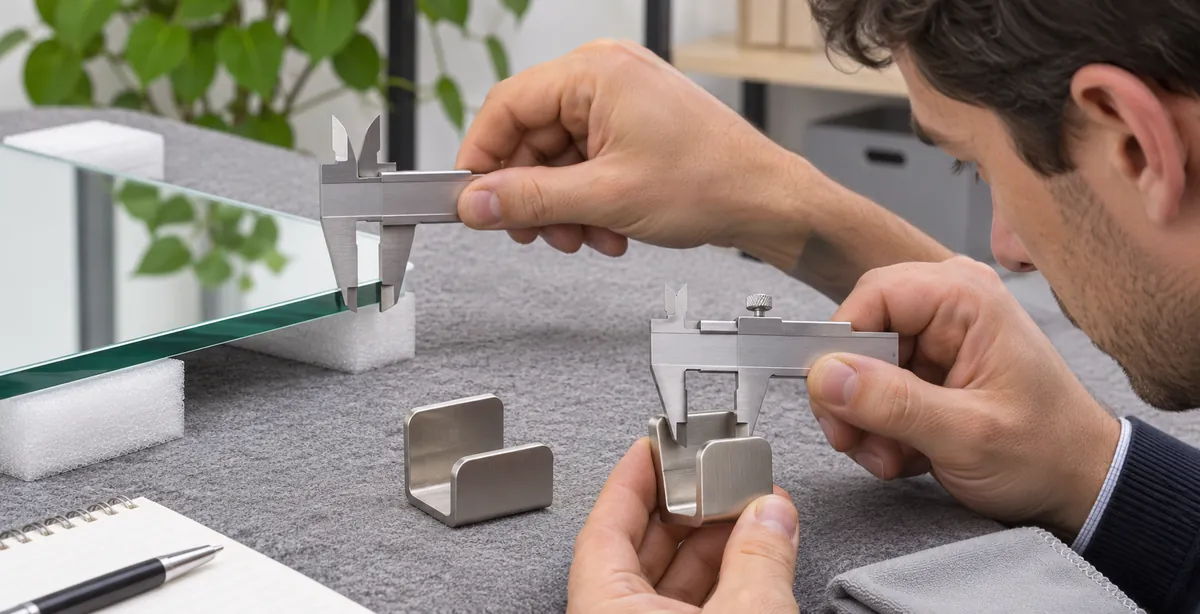
Define the mirror mounting clips purchase unit
The product name in a catalog is not a reliable bill of materials. A catalog may list an individual lower support, a spring-style upper fitting, a mixed set, or a fitting whose metal cover works with a separate plastic socket. The parts can look similar in a small photograph while serving different positions or requiring different installation steps.
Write the purchase unit in plain language. For example: “One mirror fitting set for one defined mirror, comprising two lower supporting clips, two upper retaining clips, their specified liners and four identified fasteners.” That is only an example of how to state scope; the actual count and roles must come from the buyer’s design and the selected manufacturer’s current documentation. Do not assume every mirror uses four clips or that every set includes fasteners.
Separate the following commercial questions in the RFQ:
- Is the supplier quoting one piece, a pair, a four-piece set or a kit for one mirror?
- Are left/right, top/bottom or support/retention parts different SKUs?
- Are liners, caps, sockets, screws, anchors or cover plates included?
- Are components supplied assembled, loose in one bag or packed in separate labeled groups?
- Is the item intended as a complete fitting set or as a replacement for one identified component?
A kit name such as “mirror clip set” does not resolve these points. Ask for a component list with a quantity for every item and have the quote repeat that list. If a model has a product code, associate the code with the exact drawing or manufacturer sheet revision used for approval. A packaging photograph can help explain pack presentation, but it cannot replace a controlled list.
Map each component to its function
For a multi-piece arrangement, identify the role of each clip rather than labeling all pieces “clips.” The role map might distinguish a lower support from an upper retainer. It may also identify a spring element, a rigid body, a cover, a spacer or a protective liner. The specific design varies, and the names must match the chosen manufacturer’s documentation.
An older Häfele catalog illustrates why role mapping matters: it distinguishes an edge clip sold individually from a set described with two rigid supporting clamps, two spring holding clamps and fixings. That is evidence for one cataloged architecture, not a current availability promise or a universal four-clip standard. A separate current regional Häfele listing describes a fitting with a stainless cover cap and plastic socket for a stated glass thickness and pack quantity. It should not be silently treated as the same model or same support/retention architecture as the older catalog entry. Review the historical Häfele catalog and the current Häfele product listing as distinct examples.
Create a role table for the selected model:
| Position or role | Part number | Quantity per mirror | Material or purchased component | Included in quote? |
|---|---|---|---|---|
| Lower support | Confirm from selected drawing | Buyer-defined | Confirm for exact model | Yes/no |
| Upper retention piece | Confirm from selected drawing | Buyer-defined | Confirm for exact model | Yes/no |
| Liner or socket | Confirm from selected drawing | Buyer-defined | Identify material only when documented | Yes/no |
| Cover or cap | Confirm from selected drawing | Buyer-defined | Confirm model-specific finish | Yes/no |
| Fastener and wall interface | Confirm project specification | Buyer-defined | Identify source and scope | Yes/no |
The table is intentionally a template, not a recommendation of quantities or materials. A spring element, where present, is not interchangeable with a rigid support simply because their exterior covers look similar. Likewise, a metal cap does not establish the material or function of the part behind it. If the supplier proposes a different component count, request a marked drawing and written explanation before approving the substitution.
Define the glass reference instead of writing only a nominal thickness
The buyer should identify the exact mirror construction and thickness reference used for selection. State whether the thickness comes from the glass manufacturer’s specification, a measured sample, a named mirror model or a controlled drawing. If the mirror has a backing layer, protective film, edge treatment or other feature that changes the effective envelope at the clip, document that condition for review.
Do not assume that a catalog’s stated glass thickness means every mirror at that nominal thickness will fit every clip. The selected supplier’s product page or drawing governs that specific model. For example, Häfele’s current listing names a particular 5 mm glass application. That value is model-specific and must not be generalized to other clip families. Confirm current product documentation, including whether the selected fitting uses a cover, socket, liner or spring action.
A complete selection record should make clear:
- The mirror model or controlled sample.
- The source and date of the stated thickness.
- Whether thickness is nominal or measured and who measured it.
- Any coating, backing, edge or protective feature at the contact area.
- Which clip model and revision was matched to that reference.
- Any conditions that remain open for supplier or project-engineer confirmation.
If the buyer’s supplier offers a range, copy that range only from the current model-specific technical document and preserve its units. Do not calculate a new tolerance, interpolate across models or take dimensions from a catalog illustration. A catalog drawing can help identify which dimension matters, but it is not a scale drawing unless its issuer explicitly says so.
When there are multiple mirrors in a product assortment, avoid one generic line such as “fits standard mirror.” Record each SKU and its specified fitting set. If the same clip is proposed for several glass constructions, list every pairing and obtain written confirmation from the responsible supplier. Similar thickness alone does not prove equal edge condition, backing, contact geometry or mounting requirements.
Coordinate clip positions with the mirror edge and fixing layout
The fitting’s position relative to the mirror edge should be defined by a drawing or installation plan for the chosen model. Identify the top/bottom orientation, centerlines, distance from the edge and any required spacing pattern only where the supplier’s documentation or the project drawing establishes those details. A product image should not be used to estimate a drilling location.
For a project buyer, the layout also needs to match the wall and the mirror’s dimensions. That is a coordination task involving the mirror supplier, fitting supplier and installer or project engineer. The buyer should not turn a clip catalog into an independent structural design. Ask the responsible party to confirm how the selected components are intended to be arranged for the actual mirror and installation surface, and what information remains outside the clip supplier’s scope.
A useful layout submittal includes:
- A front view showing clip locations and mirror orientation.
- A section or detail that identifies how each clip engages the edge.
- The dimensions that locate mounting points from controlled datums.
- The mirror edge and any relevant backing or surface condition.
- The wall construction and the party responsible for selecting fixing hardware.
- Any access needed to engage or release a clip after the mirror is positioned.
If dimensions are revised, update the drawing revision and repeat the fit review. A change in mirror size, edge treatment or fitting location may affect the arrangement even if the nominal glass thickness remains unchanged. Keep the installation plan linked to the exact fitting set instead of filing it only under a broad product family.
Confirm the wall interface and fastener scope separately
A clip fitting and a wall fixing are related but distinct purchasing decisions. A catalog may include a screw for a named application, omit anchors, or describe a product for a particular substrate. The buyer should identify the intended wall construction and who selects any anchor or other fixing. Do not infer that a fastener included in a consumer pack works for every substrate.
The RFQ should say whether the clip manufacturer is expected to supply only the fitting, the fitting plus screws, or a project-specific hardware kit. If the buyer asks for anchors, specify the responsible design or installation party and the substrate conditions they must evaluate. Tile, drywall, masonry, wood backing and other surfaces can have different installation requirements. This article does not give universal drilling or anchoring instructions.
Where more than one wall type is expected, distinguish product configuration from installation instructions. A single clip SKU might be paired with different fasteners depending on the project, while the fitting itself remains unchanged. Conversely, a different clip architecture or spacer could be needed for a different mirror-to-wall relationship. The supplier should identify the exact configuration proposed and list excluded parts.
For hospitality or multi-site projects, add a field for the site-specific wall condition and the approved fixing kit. Do not place one universal screw set into every carton unless the project owner has confirmed the different surfaces are compatible with that kit. If the buyer is selling through distribution, the label and instruction sheet should state what is included and direct users to qualified installation guidance appropriate to the actual surface and project.
Check installation access and serviceability
A fitting that appears compatible in a static drawing may still be difficult to install if there is insufficient access to position the mirror, engage a retainer or reach a fastener. The buyer should review the sequence with the person who will install the product. This is especially important where some clips are secured before the mirror is placed and others are adjusted afterward.
Ask the supplier for the recommended sequence for the exact fitting model. Confirm whether a spring piece must be moved, whether a cover hides the fastener, and whether any tool needs space near the wall or mirror edge. These are model-specific questions: do not assume all spring clips operate in the same way.
For replacement programs, record whether the part can be identified and replaced without removing the whole mirror, but avoid promising serviceability until the selected product’s design and installation instructions support it. If a cover must be removed for service, the instruction set should identify the correct part and tool. If a replacement is not intended to be installed separately, state that rather than suggesting that individual pieces are interchangeable.
Use a mock-up or controlled sample to review access before a large order. The review should document the mirror reference, wall mock-up, fitting revision, tool access and any open issue. A successful assembly trial confirms only the reviewed configuration and sequence. It does not establish a universal installation method or performance rating.
Control materials, liners and cosmetic surfaces
Material descriptions must stay attached to the exact component and model. A mixed metal-and-plastic assembly should not be summarized as if every part were made from the visible metal. Where a catalog identifies a stainless cover cap and a plastic socket, preserve that distinction. Do not transfer the material statement to another clip family or infer the grade from appearance.
For the RFQ, identify which surfaces are visible and which contact the mirror. If a liner is included, record the exact part or material description only when the supplier documents it. Do not invent a polymer type, softness, thickness or chemical compatibility. Ask the supplier to identify any contact material that needs buyer review and clarify whether the liner is included in every set.
Define the cosmetic target with a controlled sample, approved finish reference or written standard that the supplier can acknowledge. List visible faces, allowable appearance variation and packaging protection needs. A polished-looking cap is not proof of coating adhesion, corrosion behavior or long-term contact performance. A photo or appearance sample can help compare finish, but it does not prove hidden material or mechanical characteristics.
Where multiple colors or finishes are offered, tie each option to a part number and quote. Note whether the finish applies to all metal components or only a cover. If the design includes separate sockets or caps, ask how each component is identified during assembly and inspection. This prevents the buyer from approving one visible sample while receiving an unlisted component substitution.
Specify quantity, packaging and SKU identification
Pack quantity should be tied to the number of mirrors served, not merely to the number of clips in a vendor’s package. If the set includes different roles, show quantities per mirror and per carton. A distributor that sells a pack for one mirror needs a clear consumer-facing contents list; a project buyer ordering loose components needs labels that distinguish support from retention pieces.
Request a pack breakdown such as:
- Sets per inner box and inner boxes per master carton.
- Number of each clip type in a set.
- Included liners, covers, screws or anchors.
- Whether each set is bagged together or components are segregated.
- Part number, revision, finish and lot identification on the label.
- Any installation document or link included with the product.
The supplier should confirm how delicate finished faces are protected from contact damage in the selected pack. Do not assume that an individual bag or divider is included. Ask for a sample packout if the assortment has several similar parts or finishes. Review whether the parts can be matched to the drawing after unpacking.
If one kit is sold across multiple mirror sizes, define the approved models and any exceptions in the SKU matrix. If there are replacement parts, show the parent kit and compatible revision in the service catalog. A broad label such as “fits frameless mirrors” is not a substitute for a model compatibility statement supported by documentation.
Compare quotations on a like-for-like basis
A low unit quote may reflect fewer components, a different pack quantity, an omitted fastener or a different material construction. Build a comparison table with identical scope before evaluating price. Ask each supplier to list assumptions and exceptions instead of silently accepting a short product description.
A useful comparison should include:
| Quote field | What to compare |
|---|---|
| Model and revision | Exact supplier code and controlled document |
| Set definition | Each part, role and quantity per finished kit |
| Glass reference | Named construction, thickness source and open questions |
| Material/finish | Component-level statements, not one family-wide assumption |
| Fastener scope | Included items and excluded wall-specific hardware |
| Pack basis | Pieces per kit, inner pack and carton configuration |
| Sample scope | Production-intent configuration and included parts |
| Documentation | Drawing, installation sequence and label contents |
| Exceptions | Deviations, substitutions and buyer decisions still needed |
Do not treat a different quote as comparable until the supplier confirms the same set contents and revision. If a supplier proposes a substitute, evaluate the changed part’s role and interface, then update the BOM and sample record. Price comparison is meaningful only after quantity basis and scope are aligned.
Approve a controlled sample, not just a photograph
A sample review should use the same mirror construction, fitting set, fasteners and mounting mock-up intended for the order. Record the sample’s part numbers, date, revision, finish and packaging. If the sample uses a different mirror or excludes a liner, mark the review as partial and keep the missing condition open.
A sample acceptance sheet can include:
- Mirror model and thickness source.
- Clip set code and drawing revision.
- Role and count of each component.
- Contact and visible surfaces.
- Wall mock-up and included fasteners.
- Assembly sequence and tool access reviewed.
- Pack contents and label match.
- Deviations and responsible approver.
- The specific observations the sample review supports.
- Any separate assessment still required by the project.
The approval should say what was actually checked. For instance, “parts and counts match drawing revision B; sample assembled on the stated mock-up and fastener kit” is clearer than “approved for all mirrors.” Do not turn a sample fit check into an unsupported load, safety or compatibility claim.
If the supplier changes a liner, spring component, cap, material, finish or fastener after approval, assess whether the change affects the agreed interface. Require a revised drawing and new sample when the buyer’s quality plan or technical owner says the changed feature needs verification. Keep approved and rejected samples clearly distinguished.
Keep load and safety claims within the evidence
Mirror retention is a safety-sensitive application. Neither an attractive product photo nor the nominal thickness range alone proves that a selected arrangement is adequate for a particular mirror and wall. The responsible project engineer or qualified design party must determine the applicable design basis and review the complete installation.
Some catalogs state a rating for a specified set. That rating belongs to the exact product, arrangement and conditions documented by its manufacturer. Do not divide a set rating by the number of clips to create a per-clip rating, transfer it to another model, or apply it to a different mirror, substrate or fixing. No such calculation or transfer is established by this guide.
Before a buyer uses a performance statement in a product listing or project document, request the underlying model-specific evidence and conditions. Confirm who selected the mirror and wall fixing, what configuration was assessed, and whether the evidence relates to the finished assembly. If the supplier provides no supported figure, do not invent one or imply that ordinary visual inspection proves retention performance.
This scope boundary also applies to labels and marketing copy. A phrase such as “universal,” “heavy duty” or “secure for any mirror” requires substantiation appropriate to the exact claim. A buyer can describe the product’s components and documented compatibility without making a broader promise.
Build a specification that survives reorder and substitution
Reorders often fail when the buyer and supplier refer to a sample by a nickname while the controlled drawing, part code or pack list has changed. Keep the approved configuration in a revision-controlled record and repeat the same identifiers on each purchase order.
At minimum, retain:
- Supplier and product code.
- Drawing or catalog document revision and date.
- Approved mirror reference and source of thickness data.
- Component-role table and quantities.
- Material and finish statements by component.
- Wall fixing scope and exclusions.
- Packaging, label and instruction revision.
- Approved sample photos and physical-sample location.
- Any limitations or unresolved project decisions.
- Change-approval owner and effective order.
When comparing a proposed alternative supplier, match functions and interfaces rather than appearance alone. A cap-and-socket arrangement may not substitute directly for a separate rigid and spring clip set. A similar outside shape does not confirm identical fit, material or assembly method. Require a marked comparison and a new sample review for the changed configuration.
If the mirror or installation context changes, reopen the affected requirements. A new nominal thickness, backing condition, clip position, substrate or pack scope can alter the original match. A short change log that records what changed and what was rechecked is more useful than reusing an old approval without context.
RFQ checklist

Before sending the request, confirm that it includes:
- Exact mirror model, construction and thickness reference.
- Drawing, sample or controlled source for the reference.
- A role map for support, retention, liners, caps and other parts.
- Quantity of every part per mirror and per commercial pack.
- Exact fitting model and document revision where known.
- Visible finish and contact-surface requirements.
- Wall substrate and fixing responsibility.
- Required installation access and sequence information.
- Packaging, labels and instruction scope.
- Sample quantity and conditions to be reviewed.
- Evidence owner for any project performance statement.
- Deviations, assumptions and open supplier questions.
If information is not known, state it as an open item and ask the supplier to identify the decision owner. A request for a recommendation is not the same as approval of a changed design.
Frequently asked questions
Do all mirror mounting clips come as a four-piece set?
No. Suppliers may offer individual clips, mixed sets or kits with different contents. The quote must state each part and quantity; a four-piece arrangement in one catalog is not a universal standard.
Is the glass thickness enough to select a clip?
It is a key input, but the buyer should identify the exact mirror reference and check the selected model’s current manufacturer documentation. Edge, backing, clip architecture and mounting layout may also matter.
Are upper retaining clips interchangeable with lower support clips?
Do not assume so. Their roles and construction can differ. Match the exact component part numbers and positions shown in the selected product’s drawing.
Do fitting kits always include anchors?
No. Confirm what the supplier includes and who selects wall-specific fixings. A packaged screw or anchor should not be assumed suitable for every substrate.
Can a catalog load rating be applied to another clip set?
No. A stated rating is model- and condition-specific. Do not transfer or divide it to create a rating for another arrangement.
What should a distributor show on the product package?
State the exact kit contents, number of sets, compatible model information supported by the supplier, and any excluded installation items. Keep instructions matched to the exact fitting revision.
What if the supplier changes one component after sample approval?
Ask for the revised drawing and compare the part’s function, interface, finish and packaging. Re-sample or re-review as required by the buyer’s documented change-control plan.
Koitor capability boundary
This guide explains how a buyer can define mirror clip set scope. It does not claim Koitor currently manufactures mirror fittings or provide a rating for a mirror installation. Koitor Hardware is a family-owned custom metal hardware factory focused on bathroom and home-storage hardware. A new adjacent-product inquiry needs a feasibility and scope review before any production capability is promised. Buyers can share a drawing, reference sample, target components and order quantity through the contact page or review the OEM home-storage hardware scope.
Sources
- Häfele, historical mirror clip catalog: catalog PDF. Used as evidence of one documented component-role architecture; its date and scope do not establish current SKU status or a universal set.
- Häfele Thailand, model-specific mirror fitting listing. Used only for its stated construction, glass reference and pack information.
- CRL, E-Z Mount mirror clip set listing. Direct page access was unavailable in the research pass; the catalog-search result is treated as corroborating product-intent context only, not as an installation manual or technical test.
Discuss a Custom Metal Hardware Project
Share your drawing, reference sample, finish target, component scope and order quantity. Koitor can review whether an adjacent metal concept fits its confirmed production scope before quotation.
OEM / PRIVATE LABEL
Turn this sourcing guide into a product brief
Share your target product, size, finish, order quantity and packaging requirements. Your team receives a practical manufacturability review before quotation.

 English
 Español
 Português
 Français
 Deutsch
 العربية