From Sketch to Shelf: The Complete Shower Caddy Wire Basket Manufacturing Guide
Bathrooms are harsh: humidity, cleaning chemicals, and daily handling. For shower caddies, corrosion resistance, coating adhesion, and weld integrity determine your return rate and reviews. Use this guide + free templates to cut risk and speed up launches.
1) Brief it right: share the key parameters once
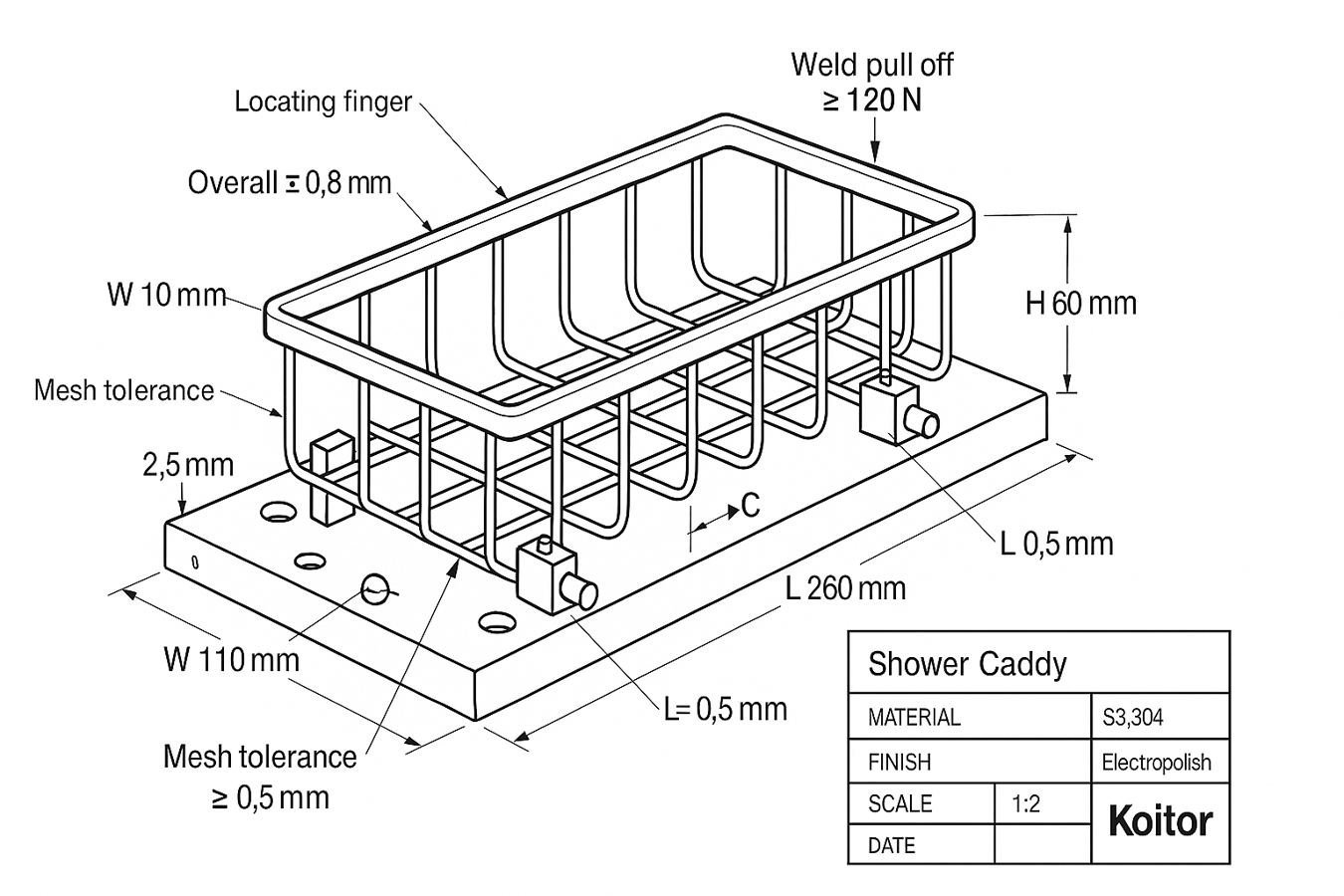
Define use & load (≥8 kg static/24h; dynamic 2 kg × 5,000 cycles), structure & dimensions (L×W×H, main wire dia, mesh, critical toleranceslike ±0.8 mm), material (304/316 or powder-coated mild steel), finish (electropolish, powder 60–90 μm, chrome), weld/edge treatment (deburr R ≥ 0.3 mm), packaging (inner bag, desiccant, carton ECT ≥ 44, ISTA 1A drop), and compliance (REACH/RoHS, target NSS hours).
Get the OEM Brief Request Finish Swatches Free Cost-Down Audit
2) Material pick: 304 vs 316 vs mild steel
- 304 stainless: versatile, good corrosion resistance, electropolishable.
- 316 stainless: better chloride resistance; choose for seaside/pool areas.
- Mild steel + powder coat: budget-friendly and color/texture flexible; needs strong pretreatment and thickness control.
Typical refs: main wire Ø4.0 mm; mesh wire Ø2.5–3.0 mm; mesh 25×25 mm; example size 260×110×60 mm; NSS ≥96h (electropolished 304) / ≥72h (powder-coated mild steel).
3) Welding & aesthetics: resistance vs laser vs TIG
| Process | Best for | Strengths | Notes |
|---|---|---|---|
| Resistance | Mesh/support joints | Fast; cost-efficient | Grind for smooth finish before coating |
| Laser | Visible seams; thin gauge | Clean seam; low distortion | Needs precise fixturing; higher per-joint cost |
| TIG | Small batches; complex joins | High control & strength | Slower; depends on welder skill |
4) Finishes that sell: electropolish, powder coat, chrome
| Use case | Material | Finish | Notes |
|---|---|---|---|
| High humidity / easy cleaning | 304/316 | Electropolish | Excellent corrosion resistance |
| Color/texture lines | Mild steel | Powder coat | Flexible colors & better edge coverage |
| Classic mirror look | Mild steel | Chrome | Requires strict pretreatment & thickness control |
5) Jigs & tolerances: the backbone of reproducibility
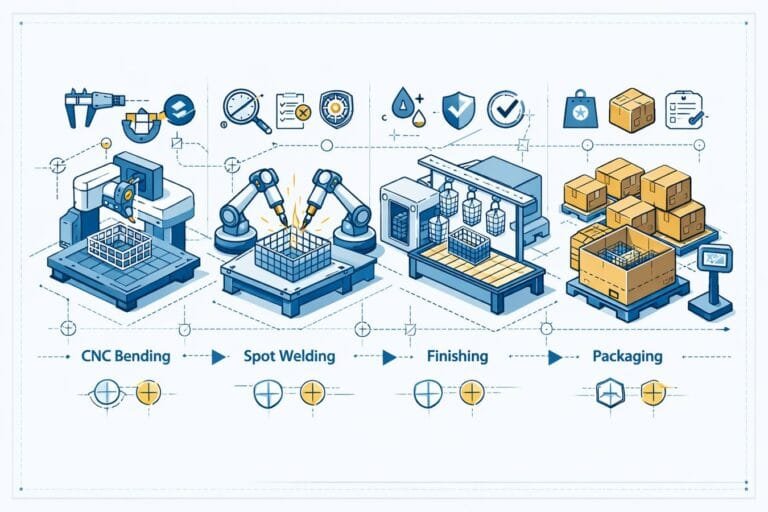
- Custom jigs lock the frame geometry for consistent welding and faster changeovers.
- Typical tolerances: overall size ±0.8 mm; mesh spacing ±0.5 mm.
- Weld pull-off strength ref.: ≥120 N for mesh joints.
- Polish & radius visible edges for safety and finish uniformity.
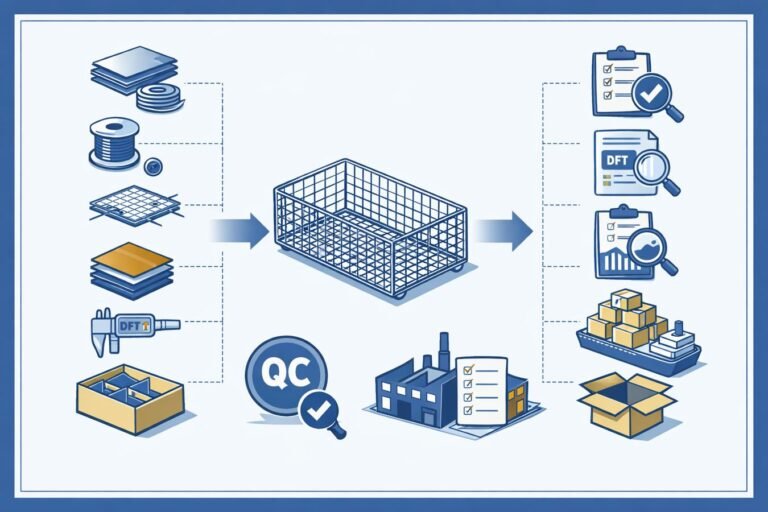
6) QC you can trust: IQC → IPQC → FQC → OQC
Apply checkpoints at incoming materials, in-process, final inspection, and outgoing stages. Use AQL sampling and verify functional load, finish thickness and adhesion as your brand standard requires.
- IQC: grade & wire diameter; surface defects
- IPQC: dimensions, mesh spacing, weld pull-off, burrs
- FQC: appearance at 50 cm, coating thickness, adhesion (ISO 2409 GT0–GT1), salt spray
- OQC: packaging integrity & ISTA 1A drop
7) Packaging & freight: minimize damage rates
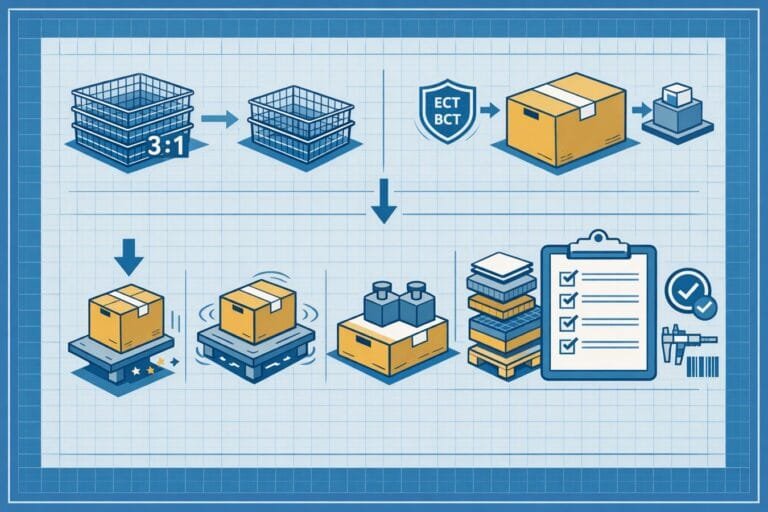
- Inner pack: anti-scratch bag + 5 g desiccant; optional PE face film.
- Outer carton: ECT ≥ 44; 5-ply for e-com; 4–8 sets/carton.
- Drop test: ISTA 1A (10 drops). Pass = no functional damage.
- Palletization: EU 1200×800; no overhang; ≤1.2 m; corner boards + straps.
8) From sample to mass production: a reusable timeline
- D0–D2:complete brief → 48-hour feasibility review & quote
- D3–D7:jig build & trial prep
- D8–D12:first article (structure/welding/deburr)
- D13–D16:finishing (powder/chrome/electropolish)
- D17–D20:testing & visual approval → ship samples
- Small-batch mass production:typically 25–35 days for 500–2,000 sets
9) Cost & lead-time drivers
Material (316>304>mild steel) • Finish (electropolish/powder/chrome) • Weld aesthetics & polishing • Jig complexity • Retail packaging labor & materials • Lab tests • Freight & Incoterms.
FAQ
Q:What is the typical MOQ for a shower caddy: A:300–500 sets per SKU in most cases. Small pilot runs can be discussed.
Q:How long does sampling take: A:10–20 days for standard samples; complex jigs or special finishes may extend lead time.
Q:304 or 316 stainless: A:304 fits most bathrooms; 316 for high-chloride seaside/pool environments.
Q:How many NSS hours should I require: A:≥96h for electropolished 304; ≥72h for powder-coated mild steel (align to brand standard).
Q:Private label & retail packaging: A:Yes—colorways, hang cards, color boxes, barcodes.
Q:Compliance docs: A:REACH/RoHS declarations, coating MSDS, and test reports for salt spray, adhesion, and load (upon request).
Downloads: OEM Starter Kit (Shower Caddy)
OEM Brief TemplateExcelQC ChecklistExcelPackaging SpecExcel
Conversion Block
Upload your drawing and filled brief for a 48-hour feasibility review. Request finish swatches or a free cost-down auditon one SKU.
Get the Starter Kit Start Your Project
Stuur Koitor je tekening, voorbeeldfoto, referentie van de afwerking, gewenste hoeveelheid en doelmarkt.
OEM / EIGEN MERK
Maak van deze inkoopgids een productbeschrijving
Geef aan welk product u op het oog hebt, de afmetingen, de afwerking, de bestelhoeveelheid en de verpakkingsvereisten. Uw team ontvangt een praktische beoordeling van de produceerbaarheid voordat er een offerte wordt opgesteld.
 English
  Español
  العربية
  Nederlands
  Français
  Deutsch
  Português