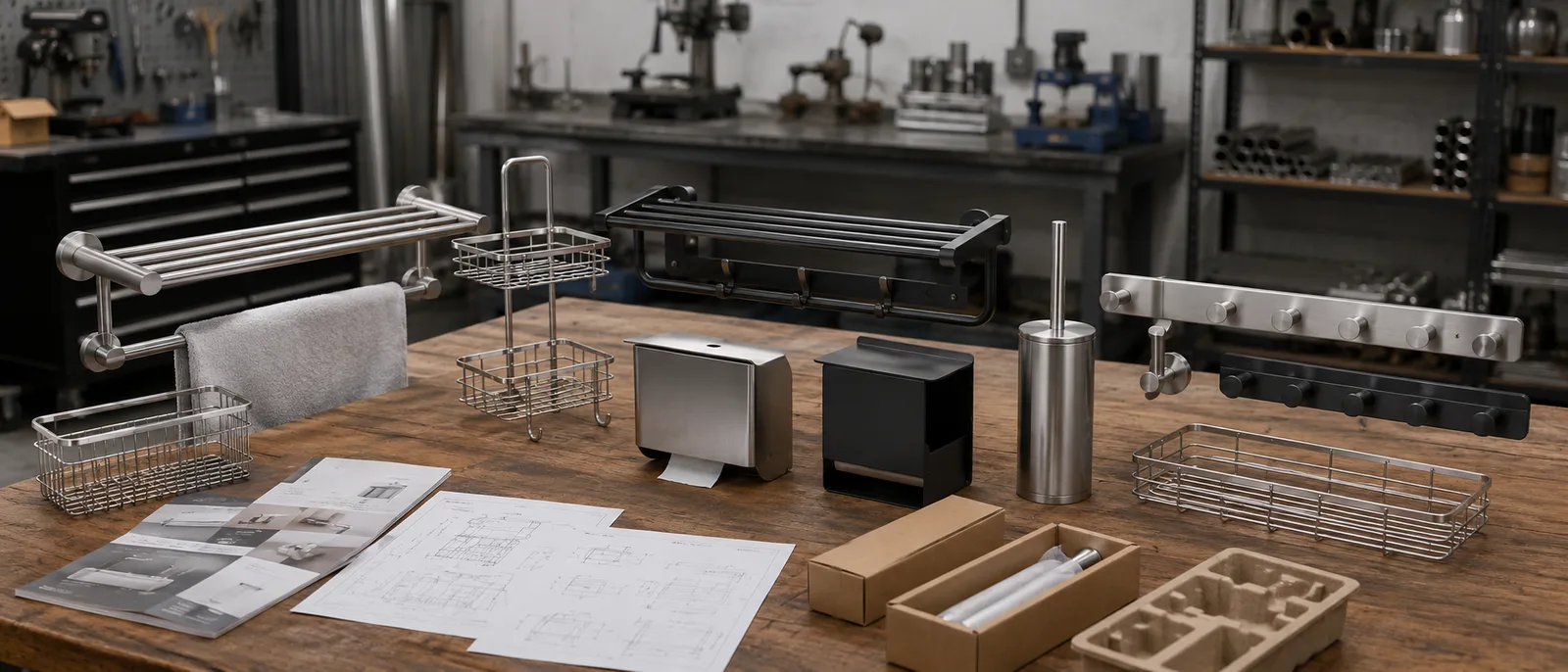
OEM bathroom accessories are custom or semi-custom bathroom hardware products made for an importer’s brand, size requirement, finish preference, packaging style or product line plan. For overseas buyers, the key is to send clear product information, confirm the sample process, check material and finish options, and choose a supplier that can discuss manufacturability before bulk production. A practical OEM partner should help buyers review towel racks, shower caddies, tissue holders, hooks, metal baskets and related bathroom storage hardware as real products, not just catalog photos.
For importers and private-label buyers, OEM sourcing usually starts with a simple question: can this supplier turn my drawing, reference sample or market idea into a product that is stable, packable and suitable for my sales channel? The answer depends on more than price. It depends on structure, welding points, surface finish, packaging protection, order quantity, sample timing and communication quality.
Koitor Hardware is a family-owned custom metal hardware factory focused on bathroom and home storage hardware. Its role is not to act like a giant corporate supplier, but to help overseas buyers discuss practical customization, small-batch trial orders and sample-based development for metal storage products.
What Does OEM Mean for Bathroom Accessories?
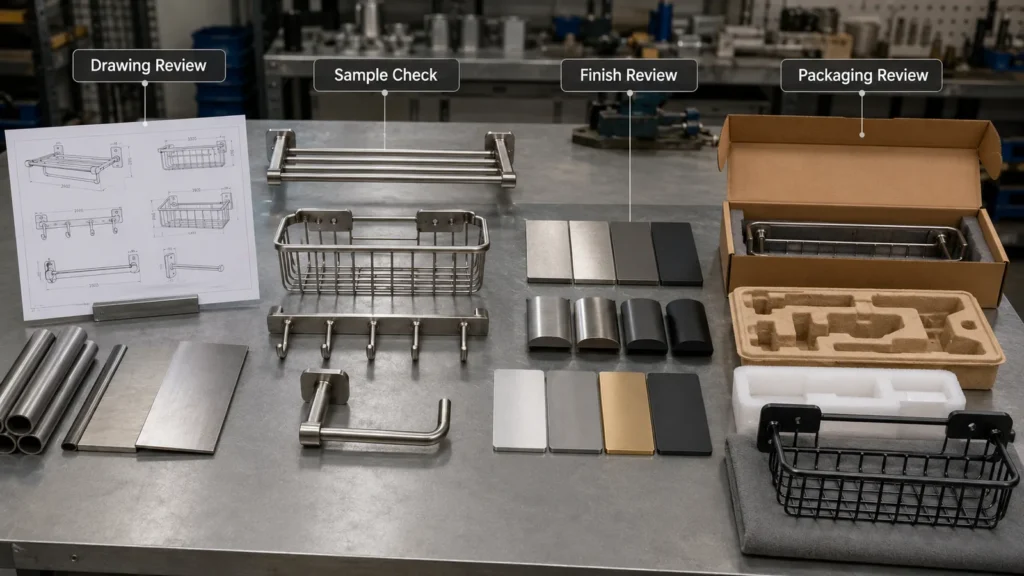
OEM means original equipment manufacturing. In bathroom accessories sourcing, it usually means a factory makes products according to the buyer’s required design, dimensions, finish, packaging or brand plan. The product may be based on an existing item with adjustments, a buyer’s drawing, a physical sample, or a reference product that needs practical improvement.
For bathroom hardware, OEM work often includes towel racks, towel bars, towel rings, shower caddies, corner baskets, hook bars, tissue holders, hair dryer holders, wire baskets and wall-mounted shelves. These products may look simple, but each one has details that affect sourcing results. A hook bar needs stable mounting. A shower caddy needs drainage and suitable spacing. A towel rack needs practical welding or assembly points. A metal basket needs reasonable wire diameter, finish coverage and packing protection.
The difference between buying ready-made products and developing custom bathroom accessories is control. Ready-made products may be faster, but they usually limit the buyer’s choices. OEM development gives the buyer more control over size, structure, color, surface finish, logo packaging and product line consistency. That control is useful for private-label brands, retailers, distributors and e-commerce sellers that need products to match their own market positioning.
OEM does not mean every detail can be changed without cost. A small structure change may affect tooling, welding, polishing, carton size or assembly time. A new finish may affect sample review and production planning. A different package may change the carton quantity and shipping protection. Good OEM communication should explain these tradeoffs before the buyer confirms a sample.
What Should Importers Prepare Before Asking for a Quote?
A strong RFQ helps the factory give a useful quotation instead of guessing. Before asking for price, importers should prepare the product type, target dimensions, reference photos, drawings if available, material preference, finish requirement, estimated order quantity and packaging idea.
If the buyer has a physical sample, it can be especially helpful. A sample shows the real weight, proportion, finish appearance, weld position, assembly style and packaging issues more clearly than a photo. If the buyer wants to improve the sample, the request should be specific. For example, the buyer may want a stronger mounting plate, smoother edges, a different powder-coated color, more protective inner packing or a smaller retail box.
For private label bathroom accessories, buyers should also prepare brand and sales channel information. A product sold through retail shelves may need color box or hang card packaging. An e-commerce product may need stronger mail-order protection. A distributor may prefer carton packing that is easier to handle in warehouse storage. These details affect cost and should be discussed early.
Good RFQ information also reduces unnecessary revisions. If a buyer says only “send price for shower shelf,” suppliers may quote different sizes, materials and packaging assumptions. If the buyer sends size, finish, target quantity and package requirement, the comparison becomes more meaningful.
For buyers building a branded product line, Koitor’s private label bathroom accessories page is the most relevant starting point because private-label work often combines product customization with packaging and sample review.
How Do Product Type, Material and Finish Affect OEM Decisions?
Bathroom accessories are exposed to humidity, water splash, daily handling and retail inspection. Product type, material and finish should match the market position and use environment. A towel rack, shower caddy and tissue holder may all belong to the same bathroom line, but they do not have the same structure or risk points.
A towel rack needs stable wall mounting, clean visible surfaces and suitable tube or wire structure. A shower caddy needs water drainage, basket stability, hook or mounting strength, and a finish that is appropriate for bathroom use. A tissue holder needs smooth operation, stable fixing and safe edges. A wire basket needs good weld appearance, suitable spacing and packaging that avoids deformation.
Material selection should be discussed with the target price and market expectation in mind. Stainless steel may be suitable for some designs. Powder-coated steel can be practical for many metal storage products when the finish and structure fit the project. Wire diameter, tube size and sheet thickness should be reviewed according to the product, not copied blindly from another category.
Finish is also a product decision. Surface finishing affects appearance, rust risk management, retail perception and packaging marks. Powder coating, polishing and other finishing steps require attention to edges, weld areas and contact points. Buyers should ask how the supplier reviews visible surfaces and whether the finish choice fits the product structure.
Koitor can discuss structure, welding points, surface finish and packaging method before sample production. For buyers developing shower shelves or hanging baskets, the custom shower caddy manufacturing page gives a focused category reference.
How Should Buyers Compare OEM Supplier Options?
Importers often compare a direct workshop, a high-volume producer, a trading company and a catalog reseller. The right option depends on project stage. A new product test, a private-label bathroom line and a repeat bulk order may need different supplier strengths.
| Supplier Option | Useful Strength | Possible Limitation | Best Fit |
|---|---|---|---|
| Small OEM workshop | Flexible discussion of drawings, samples, finish, MOQ and packaging | Needs clear buyer input and practical project scope | Trial orders, custom bathroom accessories and private-label development |
| High-volume producer | Good fit for stable repeat orders with mature specifications | May be less flexible for small early-stage changes | Large repeated programs with fixed designs |
| Trading company | Can combine many product categories from different sources | Technical communication may pass through extra layers | Buyers sourcing many unrelated products |
| Catalog reseller | Fast selection from existing items | Limited customization and less control over changes | Simple buying with minimal product changes |
For early OEM bathroom accessories development, flexibility can matter as much as scale. Buyers may need to adjust wire spacing, improve packaging, change a surface finish or test a smaller first order before deciding on a larger program. A supplier that can discuss these details directly may help reduce misunderstanding.
That does not mean every buyer needs the same supplier type. If a product is already mature and the order quantity is large, a different production setup may be suitable. But for importers testing a new towel rack, shower caddy, wall basket or tissue holder, a flexible workshop can make the development process easier to manage.
Koitor’s value is direct manufacturing communication for bathroom and home storage hardware. Buyers can also review the broader custom bathroom hardware manufacturer page when comparing product categories and sourcing routes.
What Happens During Sample Development?
Sample development is the stage where the buyer and factory turn a requirement into a physical product for review. It should not be treated as a formality. The sample is where size, structure, surface finish, assembly, packaging fit and buyer expectations become visible.
A typical sample discussion starts with input files or a physical sample. The factory reviews dimensions, material, tube or wire size, welding points, bending requirements, finishing method and packaging concept. If something looks difficult or risky, the factory should discuss it before making the sample. This is where practical manufacturability review matters.
After the sample is made, the buyer should check the product systematically. Does the towel rack sit straight? Are the mounting points practical? Are welds visible in the wrong place? Is the powder-coated surface acceptable? Does the shower basket drain properly? Does the tissue holder work smoothly? Does the package protect the product corners and finish?
Small revisions are normal during OEM development. The important point is to record the final approved details before bulk production. Buyers should avoid approving a sample with vague comments such as “quality should be better.” Instead, note specific changes: adjust hole position, improve edge grinding, change wire spacing, review coating coverage or strengthen inner packing.
Koitor can support sample-based development from drawings, reference photos or physical samples. Samples usually depend on confirmed design and materials, and project timing should be discussed after the details are clear.
What Are Common OEM Sourcing Mistakes?
One common mistake is starting with price before specification. If three suppliers quote the same product name but use different materials, finishes and packaging, the prices are not truly comparable. Buyers should define the specification before comparing offers.
Another mistake is ignoring packaging until the end. Bathroom accessories often have hooks, corners, tubes, baskets and visible finishes. Weak inner packing can cause scratches, deformation or carton damage. Private-label packaging should be reviewed for both appearance and product protection.
A third mistake is asking for too many changes at once without understanding cost impact. Custom size, new finish, special package and low quantity may all affect pricing and lead time. It is better to identify which changes are essential for market fit and which can wait for later versions.
A fourth mistake is approving samples without a checklist. Buyers should inspect dimensions, finish, welding, stability, assembly, packaging and labeling needs. If the buyer has past quality issues, those concerns should be checked directly on the sample.
The fifth mistake is using unclear communication. Phrases like “high quality” or “good finish” are not enough. Practical checkpoints such as smooth edges, consistent visible coating, stable mounting, correct carton quantity and protected product corners are easier for both sides to confirm.
Buyer Checklist Before Starting an OEM Project
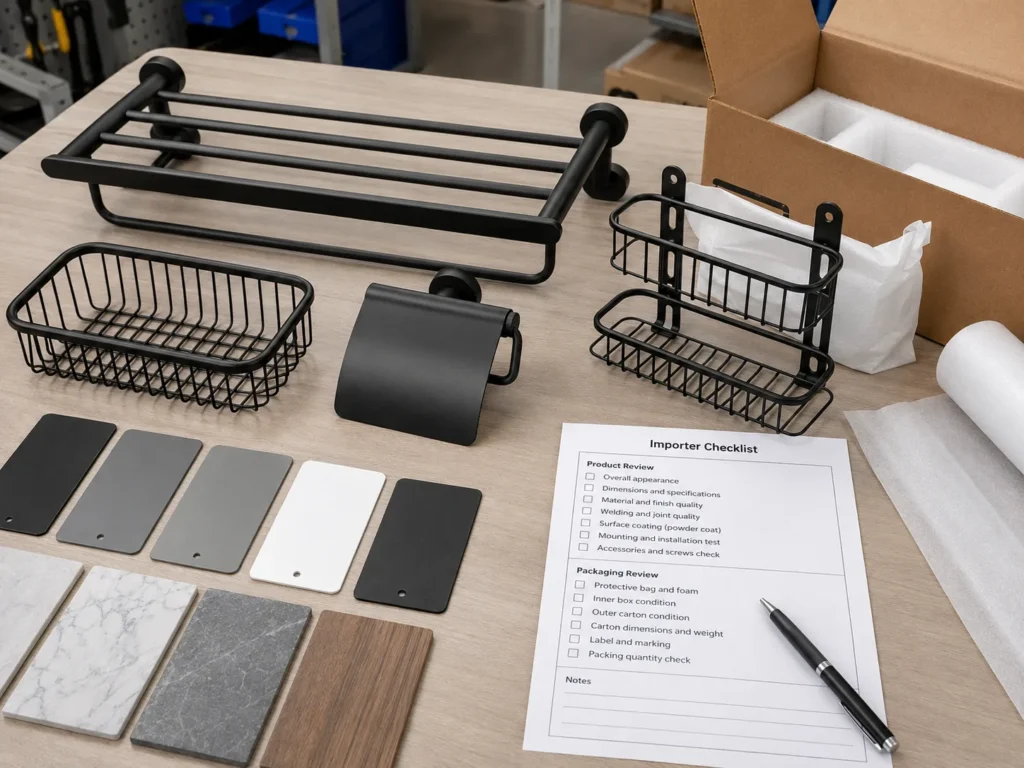
Before sending an inquiry for bathroom accessories OEM work, prepare the following information:
- Product category: towel rack, shower caddy, metal basket, hook bar, tissue holder or other item.
- Product purpose: retail shelf, distributor catalog, e-commerce listing, project supply or private-label line.
- Reference material: drawing, photo, sample, sketch or competitor-style reference without copying protected designs.
- Target dimensions: length, width, height, mounting distance and usable storage space.
- Material preference: steel wire, tube, stainless steel or other practical option to review.
- Finish requirement: powder coating, polishing or another surface finish to discuss.
- Structure requirement: wall-mounted, hanging, freestanding, screw-fixed, adhesive or assembled.
- Quantity plan: sample quantity, trial order quantity and expected future order range.
- Packaging plan: bulk pack, color box, hang card, mail-order pack or private-label package.
- Logo needs: packaging logo, label, insert card or no logo.
- Quality concerns: wobbling, rust risk, rough welds, scratches, coating marks, carton damage or assembly problems.
- Target timeline: sample review timing and expected bulk order schedule.
This checklist helps the factory understand the real project. It also helps the buyer compare suppliers fairly because each factory is quoting against the same information.
Frequently Asked Questions
What are OEM bathroom accessories?
OEM bathroom accessories are bathroom hardware products made according to a buyer’s design, size, finish, packaging or brand requirement. They can include towel racks, shower caddies, tissue holders, hook bars, metal baskets and other bathroom storage items.
Can importers start with a small trial order?
Small trial orders can be possible depending on product structure, material, finish and packaging. For Koitor projects, MOQ can start from 100 pieces depending on the specific item and requirements, but this should be confirmed project by project.
Do I need a technical drawing before contacting a supplier?
A technical drawing is helpful, but it is not always required at the first discussion. Clear photos, target dimensions, a physical sample or a simple sketch can help start the conversation. A drawing or sample usually makes quotation and sample development faster.
What should I check in an OEM bathroom accessory sample?
Check size, structure, finish, welding points, mounting method, assembly, packaging fit and visible surface quality. For shower caddies and baskets, also check drainage, wire spacing and product stability.
Can Koitor help with private-label packaging?
Koitor can discuss packaging options such as logo packaging, retail packaging and protective packing according to the project. Packaging should be reviewed together with product structure because it affects both presentation and transport protection.
Work With Koitor Hardware
If you are sourcing OEM bathroom accessories for an importer, distributor, e-commerce brand or private-label product line, prepare your drawing, sample, target size, finish requirement, packaging idea and expected order quantity. The clearer your input, the easier it is to review manufacturability, sample timing and practical cost drivers.
Koitor Hardware can support small-batch OEM production, drawing-based or sample-based development, and practical discussion of towel racks, shower caddies, metal baskets, tissue holders and related bathroom storage hardware. To start a project, send your drawing or sample to Koitor and ask for a review of structure, finish, packaging and trial order options before bulk production.
OEM / PRIVATE LABEL
Turn this sourcing guide into a product brief
Share your target product, size, finish, order quantity and packaging requirements. Your team receives a practical manufacturability review before quotation.
 English
  Español
  Português
  Français
  Deutsch
  العربية