
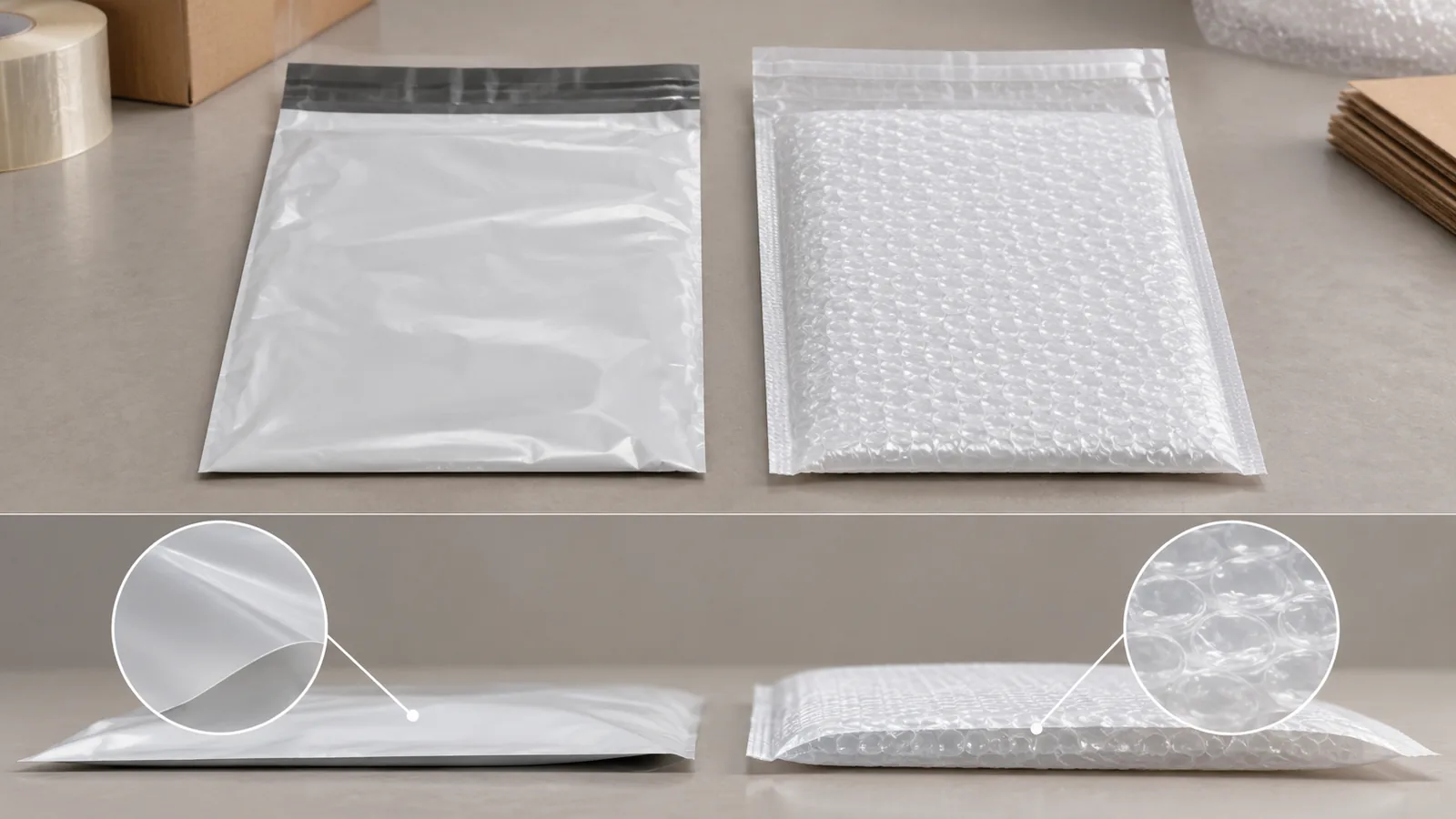
In the usual poly mailer vs bubble mailer comparison, a poly mailer is often a flat, unpadded plastic shipping bag, while a bubble mailer adds a cushioning layer made with air cells. The names describe common constructions, not mutually exclusive exterior materials: a bubble mailer may have a plastic film outside, or it may use a paper outside with plastic bubbles inside. For an importer shipping a small hardware accessory, compare the exterior, cushioning, usable interior space and product geometry separately, then confirm the package with a representative trial. When evaluating poly mailer vs bubble mailer, buyers should record the specific decision and the evidence needed to approve it.
Related buyer references: bathroom hardware packaging insert design and foam cushioning and packaging. The practical answer to poly mailer vs bubble mailer depends on the specified part, method and acceptance evidence.
What do “poly mailer” and “bubble mailer” actually describe?
“Poly mailer” commonly refers to a flexible plastic bag used as an outer shipping envelope. In many commercial comparisons, it is unpadded: the film forms the exterior and there is no built-in cushioning layer. “Bubble mailer” commonly refers to an envelope with an air-bubble cushioning layer attached to an outer layer. The bubble construction may be plastic-on-plastic or paper-on-plastic. A buyer must therefore ask whether “poly” describes only the outside film or the entire package construction.
The terms are useful starting labels, but they are not a complete technical specification. Two products sold under the same label may differ in closure, film thickness, seam construction, padding, dimensions and usable interior space. A package quote should identify the actual sample or product specification. If the supplier says “poly mailer,” confirm whether the proposed mailer is unpadded. If the supplier says “bubble mailer,” confirm the outside layer and cushioning structure rather than assuming one universal construction.
| Comparison field | Common flat poly mailer | Common bubble mailer | What a buyer must still confirm |
|---|---|---|---|
| Exterior | Often flexible plastic film | Plastic film or paper are both possible | Material, closure and supplier-specific construction |
| Cushioning layer | Usually none in the flat-mailer comparison | Air-bubble layer is present | Actual bubble layout, coverage and package condition |
| Usable interior | Flexible envelope volume | Reduced by the attached cushioning layer | Finished inside width, height and depth for the item |
| Product contact | Item may contact the film directly | Cushioning may separate portions of the item from the exterior | Abrasion, sharp edges and movement within the mailer |
| Protection question | Is the item already protected elsewhere? | Does the chosen cushioning suit the item and handling path? | Representative pack trial and agreed acceptance criteria |
EcoEnclose’s mailer guide describes flat mailers and cushioned constructions, including different exterior and cushioning combinations. Its examples help explain the terminology; they do not establish a universal damage rate, recyclability outcome, carbon ranking or lowest-cost choice for every shipment. See the EcoEnclose protective mailer guide and verify the exact product specification with the supplier you plan to use.
What does the outer layer do, and what does cushioning do?
Separate the package’s outer envelope from its cushioning layer. The outer layer contains the shipment, accepts a shipping label and forms the outside surface exposed to normal handling. The cushioning layer can create separation between the product and portions of the package exterior. Neither layer by itself establishes that the complete package will prevent puncture, compression, impact, moisture exposure, cosmetic rubbing or damage during a particular carrier’s handling cycle.
This separation matters because buyers may receive a quotation that treats “bubble mailer” as an all-in-one performance description. It is not. A bubble layer provides a particular construction feature, but the size and shape of the item, how it sits in the envelope, the seam and closure, the package’s fit and the shipment route all affect the result. A hard corner can press against or puncture a flexible outer film. A polished item can rub against another component inside. A heavy part can move differently from a light, flexible product. Those are package-design questions that require the actual product and pack configuration.
Consider two hypothetical shipments. The first contains a soft replacement instruction card and a small fabric component. The second contains a polished metal bracket with a projecting mounting tab and loose screws. Both might fit inside a mailer by external dimensions, but the second shipment raises different questions: could the tab press through the outer layer, could the metal scratch another part, will the hardware move within the envelope, and does the package keep screws from contacting a visible finish? A bubble layer is one possible element, not proof that each risk has been solved.
An outer poly film may be useful when a package needs a flexible water-resistant envelope, but no general statement about a mailer should be treated as a substitute for the actual supplier’s product data. Confirm the closure, seams, film and dimensional tolerance for the chosen item. When the product needs more structure or separation, a carton, inner box, molded insert, foam, paper cushioning or another packaging level may be more appropriate. The right package is the one that satisfies the buyer’s requirements under the intended pack-out and shipment conditions, not the one with the more reassuring name.
How should a buyer compare cushioning with the product shape?
Start with the product, not the mailer category. Record the item’s finished dimensions, weight if known, sharp or projecting features, exposed cosmetic faces, loose accessories and any protective wrap already used. A mailer that has no room for the item to sit without stressing the closure or seam may not be a suitable package even when its external dimensions appear large enough. The cushioning itself occupies part of the inside space.
For a metal bathroom or home-storage accessory, consider the geometry at each potential contact point. A hook, tab, screw end, cut edge or projecting bracket can press against a flexible envelope. A highly finished face may need a separate protective layer to prevent abrasion. Two metal components in one bag may collide unless a divider or individual wrap is specified. If a kit includes screws or anchors, keep small parts from moving freely against the visible product finish. These are practical design checks, not claims that every metal item requires a carton.
The buyer can describe the package as a cross-section rather than a single name:
- Product surface: identify what must not be scratched, marked or contaminated.
- Primary wrap: state whether a bag, sleeve, tissue, film or another material contacts the product.
- Cushion or divider: identify where separation or cushioning is expected.
- Outer enclosure: specify the mailer, carton or other shipping package.
- Closure and label area: show where the mailer closes and where the carrier label is applied.
- Pack-out: include the actual accessories, instruction sheet, labels and any other shipment contents.
The construction record helps clarify what the quoted “bubble mailer” actually includes. It also makes it easier to compare a bubble mailer with a flat poly mailer plus a separate inner wrap. The latter may provide a different arrangement of contact protection, cushioning and usable space. Do not assume the two options are interchangeable solely because they use a plastic exterior.
For a broader map of package levels and material forms, see types of packaging levels, materials and forms. That guide covers packaging structure across levels. This comparison narrows the decision to the construction of a mailer and its cushioning relationship to the item.
How much usable interior space should buyers measure?
Measure the inside dimensions of the package, not only the outside dimensions shown in a catalog. A bubble layer, seam, closure flap and folded edges can reduce the volume available to the product. The item itself may also need room to enter without catching a projection or compressing the cushion. If the mailer is intended to hold multiple pieces, include the complete kit and any individual wraps or separators in the fit check.
Use a simple packaging worksheet:
| Field | Record for the actual pack-out |
|---|---|
| Product or kit revision | Identify the exact SKU, finish and included components |
| Finished item envelope | Record maximum length, width and depth of the protected item |
| Internal mailer dimensions | Confirm the usable space from the actual sample or supplier data |
| Cushioning footprint | Record where the bubble or other layer reduces the available space |
| Closure clearance | Confirm the flap can close without pressing on the product or contents |
| Part separation | State whether metal parts, screws or delicate faces need a divider or wrap |
| Label position | Confirm the shipping label does not cover a required marking or seam |
| Sample status | Identify whether the tested package is a production-intent sample or a concept |
There is no single mailer size that fits every product with the same nominal exterior dimensions. Different suppliers may measure or name their bags differently. Ask for the finished internal dimensions, and compare them with the product in its intended wrap. A small envelope that technically accepts an item may not leave enough room for closure or prevent a projecting feature from stressing the seam.
Packaging should also reflect whether the product is sold individually, as a kit or inside a retail carton. A mailer may be a transport layer around a retail box rather than the package directly touching the product. In that case, compare the mailer’s role with the box’s role. The outer mailer may need to contain and identify the retail unit, while the retail box and its inserts manage internal organization and presentation. Avoid asking one layer to prove a protection result that belongs to the complete package system.
Does a bubble layer guarantee protection for metal hardware?
No. A bubble layer alone does not prove that a mailer will resist every puncture, compression, impact, abrasion or handling condition. The mailer’s construction and dimensions matter, as do the product’s weight, geometry, finish, internal movement and complete shipment configuration. A buyer should assess a representative packed product and define what the trial is expected to evaluate.
Think through the likely failure path rather than asking whether bubbles are “enough.” If a sharp tab can contact the exterior through the padding, a separate cover or sturdier package may be needed. If two metal pieces can move against one another, individual wrapping or a separator may be more directly relevant than adding more air cells around the outside. If the item is heavy, the closure and seam should be reviewed with that actual mass and orientation. If the surface is cosmetic, the innermost contact material may matter as much as the outer cushioning.
The buyer can conduct a pack review with the exact product, wrap, mailer, accessories and closure. Record how the package is assembled and the observed condition at the end of an agreed evaluation. A trial is only useful if the buyer and supplier agree what it demonstrates. A visual fit review can reveal interference or poor closure, but it does not substitute for a transport test if the project requires one. A test result for another product, mailer size or shipment route should not be carried over without an appropriate technical basis.
Do not make universal claims that a bubble mailer is always puncture-proof, compression-resistant, abrasion-safe or suitable for a metal part. Likewise, do not say a flat poly mailer provides no protection in every setting. A specific construction may provide useful containment or environmental separation, but the buyer must match the package to the item and handling requirement. If the required protection is uncertain, ask the responsible packaging supplier or product engineer to review the actual configuration.
For a comparison of cushioning materials inside a package, bubble wrap vs packing paper addresses a different material-level question. The types of foam for packaging guide covers another distinct family. Those internal resources should be used to expand the packaging decision, not to treat a mailer label as a complete protection specification.
How should buyers compare mailers with other package options?
Compare a mailer with the actual alternatives available for the product: a flat envelope, a cushioned envelope, a product sleeve inside a mailer, a carton, a box with an insert or another defined pack-out. The relevant factors include containment, product contact, protection, interior fit, ease of packing, label placement and whether a separate retail package is already present. There is no reliable universal ranking that makes one package form lowest cost, lowest impact or best for every product.
An importer shipping a light, low-profile accessory may find a mailer practical where the product’s own wrap prevents direct abrasion and the shipping requirement is modest. A bulky or projecting metal part may require a different package or an added protective layer. A multipiece kit may need dividers or individual bags to keep the components from colliding. If the mailer is used around a retail carton, assess whether the retail carton already provides the needed structure and what the outer mailer must do.
The comparison can use a decision table:
| Buyer question | Flat mailer candidate | Cushioned mailer candidate | Box or separate pack-out candidate |
|---|---|---|---|
| Does the product need built-in cushioning? | No built-in cushion in common flat designs | Air-cell cushion is part of the mailer | Protection comes from the selected box, insert and wrap |
| Is the product shape compatible? | Confirm projections do not stress film or seam | Confirm the cushion does not reduce usable room too much | Confirm box and insert match the item and packing method |
| Could surfaces rub or collide? | Specify separate wrap or divider if needed | Do not assume the bubble layer protects internal parts | Use defined separation where required |
| Is a retail package already present? | Consider whether the mailer is an outer transport layer | Same question; compare total pack-out | May be the retail package, transport package or both |
| What evidence is needed? | Fit and agreed shipment evaluation | Fit and agreed shipment evaluation | Actual pack-out sample and agreed evaluation |
For a useful comparison, collect supplier specifications for each proposed construction and test the complete pack-out under a method appropriate to the project. If the shipment moves through multiple channels, confirm that the sample represents the actual packaging configuration at each relevant stage. Do not use a sample with a different product mass, wrap or closure and call it equivalent evidence without justification.
What sourcing mistakes should importers avoid?
The first mistake is comparing only the outer material. A plastic exterior does not tell a buyer whether the mailer is flat or cushioned, what occupies the inside or how the product is separated from the outer film. Ask for a cross-section or actual sample. The second mistake is assuming “bubble” means a guaranteed damage-prevention result. The bubble layer is a package feature; it does not establish complete protection for every shape and shipment route.
Another mistake is reviewing an empty mailer rather than the loaded pack-out. An empty envelope may appear large enough, but the bubble lining, closure flap, product wrap and hardware kit all use space. Load the actual product and accessories into the sample, close it using the intended method and inspect pressure points. If the mailer is too tight, the closure may be difficult or a projecting tab may concentrate pressure. If it is too loose, contents may move unless another component controls them.
A fourth mistake is failing to control the pack-out revision. The same product can be shipped with a different screw kit, instruction insert, coating film or retail box. A change to any of those items can affect fit and contact. Identify the product and packaging revisions together, and state who must approve a substitute material or mailer. If production changes after the sample review, determine whether the package needs another fit check.
Avoid using unsupported environmental or cost claims to select a mailer. Material composition alone does not establish local recyclability, a life-cycle comparison, or the lowest landed cost. Claims depend on the actual materials and local collection systems, among other factors. Ask for current, product-specific information and jurisdiction-specific guidance where those claims matter. Do not transform one supplier’s product description into a blanket claim about every mailer.
Finally, do not conflate an agreed visual inspection with a transport qualification. If a buyer requires a formal evaluation, define the method, product condition, packaging revision, route or handling assumptions, sample quantity and acceptance criteria with the responsible parties. The evaluation should answer the actual question, not merely show that a package was closed once.
How can a small-batch OEM review clarify packaging scope?
Koitor Hardware is a family-owned custom metal hardware factory. Depending on the approved project scope, the team can discuss a buyer’s drawing or sample, product structure, surface finish, assembly and packaging preparation. The company should not be presented as a mailer manufacturer or a packaging laboratory. A buyer who is developing a bathroom or home-storage hardware item can share the actual metal product, accessories, retail presentation and unresolved packaging interface so the responsible suppliers can be identified.
For a trial order, packaging review can begin with the exact product revision and a proposed pack-out. Show whether the mailer contacts the hardware directly, whether a separate wrap protects finished faces, how loose screws are contained, and which layer supplies the cushioning. If a film or bubble mailer is proposed, request its finished internal dimensions and material construction. If a separate box or insert is involved, include that layer in the sample. The aim is a clearly documented sample, not a universal recommendation for every shipment.
Small-batch customization can make an early package check useful before a buyer commits to the final retail presentation. A small change to the mounting tab, accessory count, protective film or instruction card can affect how the product fits. Share the updated drawing or physical sample and identify the dimension or finish change. The team can help determine which product details belong in the manufacturing quotation and which package details must be confirmed with a packaging supplier.
If a project requires a test report, certification or quantified shipment performance, that requirement must be supported by project-specific evidence from the responsible qualified provider. Do not infer it from an ordinary sample review or a mailer catalog. Likewise, do not claim that the factory has run a particular transport test unless the project record proves it. A precise scope protects both the buyer’s decision and the supplier’s responsibilities.
Buyer checklist before approving a mailer
- Identify whether the candidate is a flat mailer, a cushioned mailer or a retail package placed inside another mailer.
- Record the actual outside material and cushioning construction from the supplier’s specification.
- Measure or confirm usable interior dimensions, including the closure flap and bubble layer.
- Identify the exact product and revision, accessory count, finish and protective wrap.
- Check sharp edges, tabs, corners and other features that may contact or stress flexible film.
- Decide which finished surfaces need separate protection from abrasion or part-to-part contact.
- Confirm how loose screws, anchors, instructions and labels are contained.
- Assemble and close a representative pack-out sample using the intended packing method.
- Record the package revision, supplier and approval status.
- If a transport or performance evaluation is required, define the method and acceptance criteria before testing.
- Keep cost, environmental and recyclability claims tied to current evidence and the relevant market.
- Identify who approves a change to the mailer, wrap, box, insert or product configuration.
Frequently asked questions
Is a poly mailer always unpadded?
No. The common comparison often uses “poly mailer” for a flat, unpadded plastic envelope, but commercial labels can vary. Confirm whether the quoted product includes a cushion and ask for a sample or construction specification.
Is a bubble mailer made only from plastic?
No. A bubble mailer may use a plastic exterior with a plastic bubble layer, or it may pair a paper exterior with plastic bubbles. Verify the selected product’s actual materials instead of inferring them from its name.
Is a bubble mailer suitable for a metal accessory?
It depends on the part’s weight, geometry, finish, accessories, pack-out and shipment requirement. Check projections and contact points, use the actual product in a sample and determine whether an additional wrap, divider or box is needed.
Does bubble cushioning prevent punctures or shipping damage?
Not by itself. The cushion is one construction feature. Package fit, seams, closure, the product’s shape, internal movement and shipment handling all matter. Any required performance claim needs appropriate evidence for the actual package configuration.
How do I compare a mailer with a carton?
Compare the complete package system, including internal wrap, separators, retail box, usable space, product contact and handling requirement. Decide what each layer is responsible for and evaluate the representative packed product.
What should be sent with a packaging inquiry?
Send the product drawing or sample, finished dimensions, weight if known, finish, included accessories, current packaging and the unresolved protection question. Also identify the market and the supplier responsible for the proposed mailer.
Source note
This article uses the construction explanations in the EcoEnclose guide to protective mailers and its poly-mailer product information. These sources are not used to claim a universal cost, environmental result or damage rate. Related Koitor resources address packaging levels and forms, bubble wrap vs packing paper, foam for packaging and altitude-related pressure considerations.
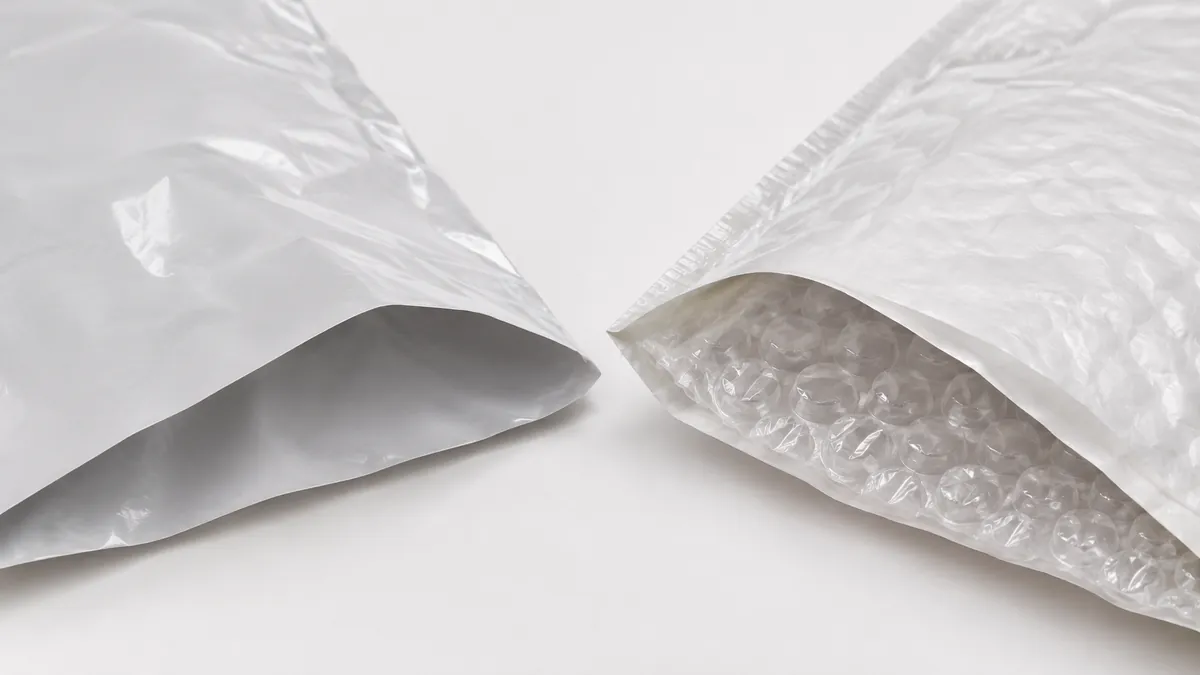

Discuss a poly mailer vs bubble mailer project with Koitor Hardware
Share the relevant drawing, sample, specification and buyer decision. Koitor can review the metal hardware project scope while you confirm any component or measurement detail with its responsible supplier.
OEM / PRIVATE LABEL
Turn this sourcing guide into a product brief
Share your target product, size, finish, order quantity and packaging requirements. Your team receives a practical manufacturability review before quotation.
 English
 Español
 Português
 Français
 Deutsch
 العربية