
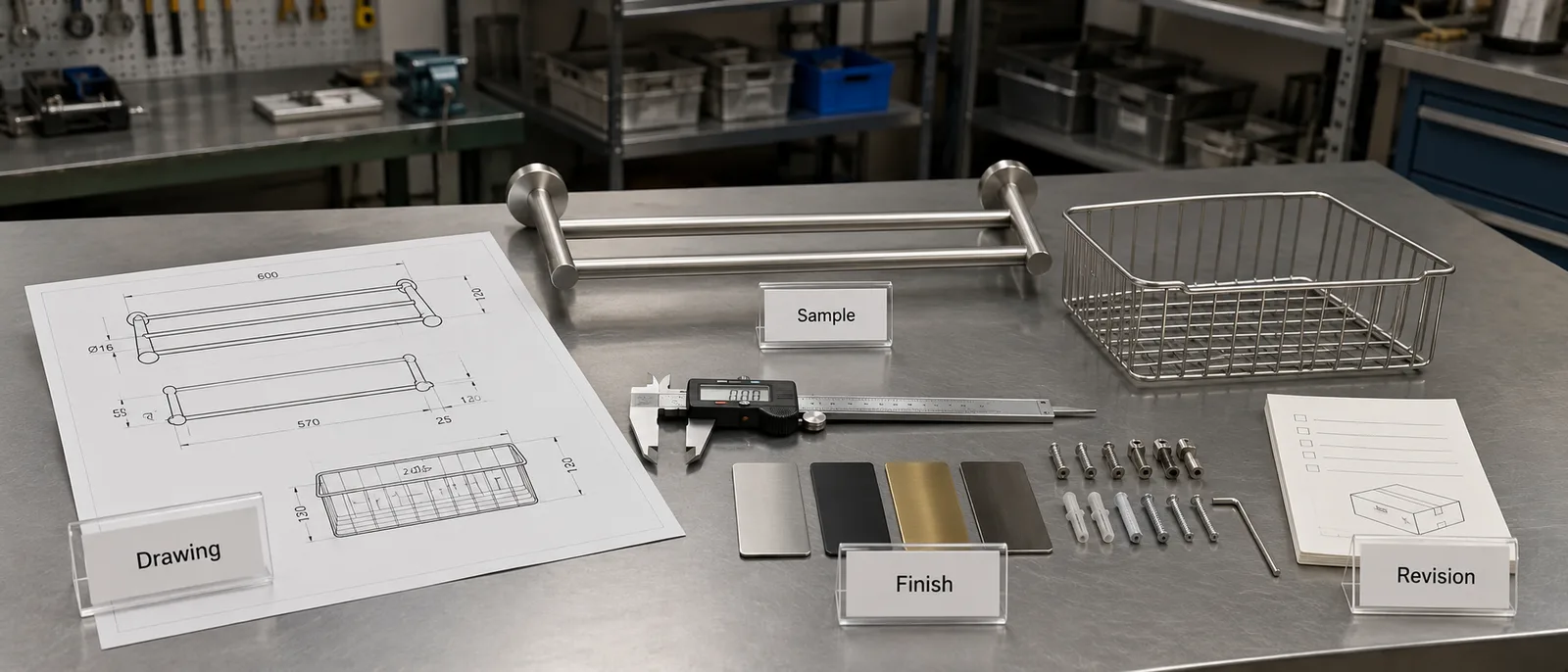
To prepare drawings for a custom hardware factory, buyers should provide the product’s intended use, overall and critical dimensions, material, wire or tube sizes, finish, mounting details, accessories, packaging concept, target quantity and revision status. If a physical sample is available, state which features must remain unchanged and which should be improved. The factory can then identify missing assumptions, review manufacturability and prepare a more reliable quotation.
A beautiful rendering or a reference photo can start a conversation, but it is not a production specification. Accurate quotation and sampling depend on measurable information. The objective is not to create a perfect engineering package before contacting a supplier; it is to separate confirmed requirements from open questions clearly enough for both sides to make the same product.
What Minimum Information Does a Factory Need?
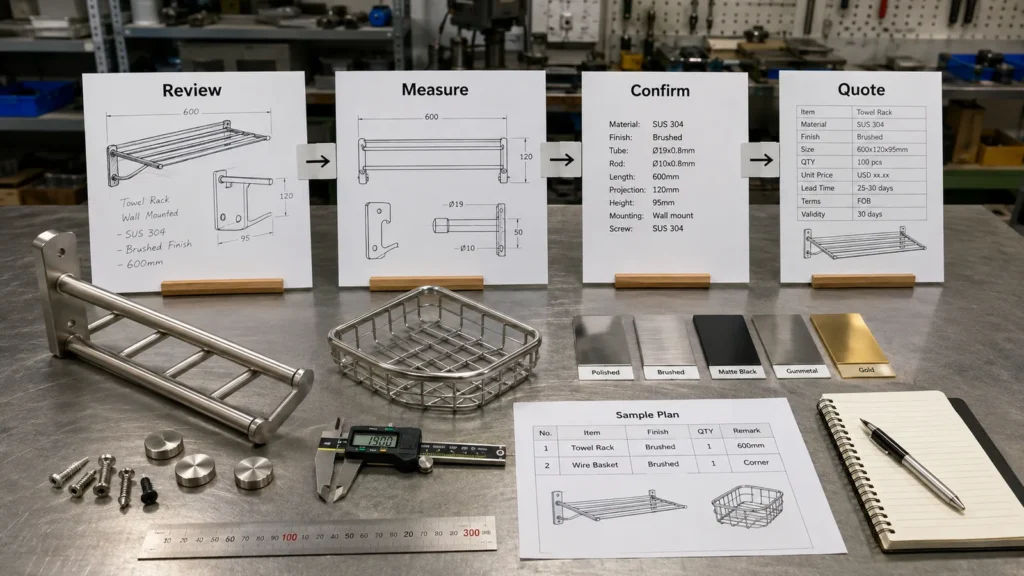
A custom hardware factory needs enough information to understand the product, estimate material and processing, identify purchased components and plan packaging. At minimum, the buyer should define use, size, structure, finish, quantity and the basis for approval.
Begin with one short product brief. Explain whether the item is a bathroom towel rack, shower caddy, tissue holder, wire basket, kitchen rack or another home storage product. State where it will be installed, what it will hold and how the user interacts with it. These facts help the factory interpret the drawing and detect structural questions.
List the complete selling configuration. Include mounting plates, screws, anchors, covers, feet, caps, handles, adhesive pads, instructions and labels where relevant. A quotation for the metal body alone cannot be compared fairly with a quotation that includes all retail components.
State which requirements are fixed and which may be optimized. For example, overall width and mounting-hole spacing may be fixed, while tube size or bracket construction may be open to manufacturing suggestions. This gives the factory room to improve practicality without silently changing buyer-critical features.
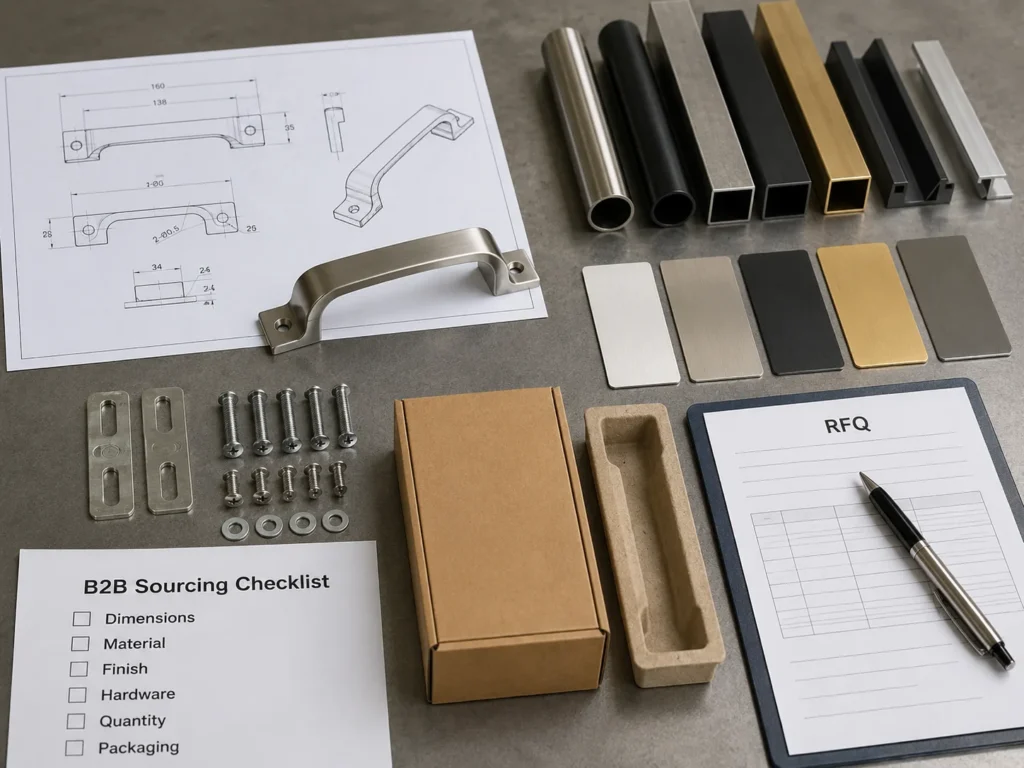
Minimum RFQ Information Checklist
- Product name, intended use and target sales channel.
- Drawing number, revision and date.
- Overall dimensions and critical interfaces.
- Material, wire, tube or sheet direction.
- Surface finish and physical reference where available.
- Mounting method and complete accessory list.
- Target quantity and expected repeat-order pattern.
- Retail packaging and master-carton concept.
- Sample approval and project-specific test requirements.
- Required quotation date and target launch timing.
Should Buyers Send a Drawing, Sample or Both?
Buyers should send both a drawing and physical sample when possible because each solves a different problem. A drawing controls measurable requirements, while a sample communicates proportion, assembly, finish feel and details that may be difficult to describe.
| Reference type | Best use | Main limitation | Buyer action |
|---|---|---|---|
| Dimensioned drawing | Size, interfaces, parts and revision control | May not communicate finish or physical feel | Mark critical dimensions and open questions |
| 3D model | Geometry and component relationships | May omit tolerances, finish and purchasing data | Add a controlled 2D specification |
| Physical sample | Proportion, construction and finish reference | Wear or measurement cannot define design intent | List required changes and ownership instructions |
| Photos or sketch | Early feasibility and budget discussion | Hidden joints and exact size remain unknown | Treat quotation as preliminary |
When sending a third-party sample, the buyer should confirm it has the right to develop the product and should remove or identify any branding that must not be reproduced. Record the sample’s condition before shipping and agree whether it should be returned, stored or used as a retained reference.
For a hardware sample quotation, label every requested change. Do not write only “same as sample.” State whether the factory should copy dimensions, preserve function, match finish direction or redesign certain parts. A dated change list prevents the sample from becoming an ambiguous instruction.
How Should Dimensions and Tolerances Be Shown?
Dimensions should be shown from clear reference points, with critical interfaces distinguished from general geometry. Tolerances should reflect function and manufacturing reality rather than using the same tight value everywhere.
Include overall width, depth and height, but also show usable internal space, mounting-hole centers, wall clearance, wire spacing, tube or wire diameter, bracket position and mating-part dimensions. On a tapered basket, opening and base dimensions may differ. On a towel rack, bar spacing and bracket center distance may matter more than an outside cover dimension.
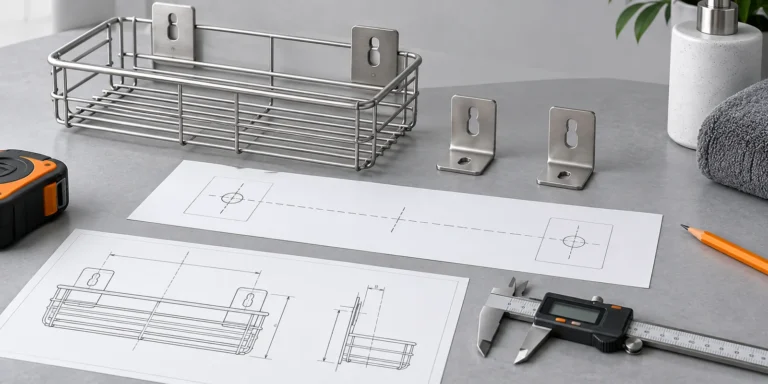
Use section views or detail views where joints overlap. A single front view cannot explain whether a wire sits inside, below or against a rim. Mark hidden features and show how parts are assembled. Simple numbered callouts can connect the drawing to a bill of materials.
Critical dimensions are those that affect installation, fit, safety, customer use or compatibility. Identify them clearly and explain why they matter. Noncritical dimensions can often use practical manufacturing control. Overly tight tolerances may increase inspection and rework without creating buyer value.
Buyers who prepare drawings for custom hardware factory review should also include a dimension-priority note. Mark mounting centers, product clearances and mating features as critical; mark appearance-related dimensions separately; and leave purely reference dimensions clearly identified. This prevents the factory from treating every number as equally sensitive. If the drawing was measured from a physical sample, state which values are direct measurements and which represent the buyer’s intended design. A worn, bent or hand-assembled sample may not represent the dimension that should control new production.
Before sending the RFQ, print the drawing at a readable scale and trace the assembly from part to part. Check whether every component can be identified, whether each mounting interface has a dimension and whether the finish note applies to the correct surfaces. This simple review often reveals missing brackets, unexplained holes or conflicting dimensions before they delay quotation.
Any load, stability or installation requirement should have a project-specific method and acceptance criteria. Do not rely on a drawing note such as “strong enough.” Describe the use case, fixture, orientation and result that will be evaluated, then confirm it on the sample.
How Should Material, Finish and Components Be Specified?
Material, finish and components should be specified with enough detail to support purchasing and visual approval. Generic terms such as metal, silver or black are not sufficient for a final custom metal product quotation.
State the preferred material and relevant form: wire, tube, sheet, bracket or purchased component. Include diameter, wall thickness or sheet thickness where already confirmed. If the buyer is open to alternatives, label the requirement as a performance or appearance target and request a documented proposal.
For powder coating, provide a color reference and describe gloss or texture direction. For stainless steel, state the intended grade and surface appearance when known. For polished or plated appearances, use a physical reference where practical. No material or finish should be described as universally rust-proof; performance depends on design, preparation, coverage, exposure and maintenance.
Purchased components need identification too. Screw type, anchor, cap, adhesive pad, rubber foot and decorative cover can change installation and cost. If a specific component must match the buyer’s existing range, provide a drawing or approved sample.
Buyers working on OEM bathroom hardware manufacturing should also identify visible surfaces. This helps the factory focus finish and cosmetic inspection on the areas customers see while maintaining suitable coverage and safe edges elsewhere.
What Commercial Details Improve Quotation Accuracy?
Quotation accuracy improves when the buyer provides target quantity, packaging format, destination or delivery basis, sample needs and decision timing together with the technical specification. The same product can have a different cost basis at trial and repeat-order quantities.
State the quantity by SKU and finish rather than only a total range quantity. Multiple colors can create separate finish batches. Custom boxes, printed labels and instructions may have purchasing constraints different from the metal product. Clarify whether packaging is plain, private-label retail or e-commerce focused.
MOQ can start from 100 pieces depending on structure, material, finish and packaging. Samples usually take 5-7 working days after details and materials are confirmed. Bulk production usually takes 4-6 weeks depending on quantity, complexity, material availability, finish and packaging. These are planning references, not guarantees.
Ask the factory to list assumptions and exclusions. A useful quotation identifies material, finish, included accessories, packaging, quantity basis and whether tooling or sample charges are separate. This makes supplier comparisons more meaningful than comparing one total number.
For products such as baskets and organizers, the buyer can review Koitor’s custom metal storage basket production capabilities when preparing category-specific RFQ details.
How Should Samples and Drawing Revisions Be Approved?
Samples and drawings should be approved through one controlled revision, with measurements, finish, components, installation and packaging reviewed together. Verbal approval or scattered message comments are not a reliable production reference.
Koitor Hardware’s practical workflow is to review the drawing or physical sample, identify manufacturing questions, confirm a drawing, develop the sample and discuss packaging before small-batch production. As a family-owned custom metal hardware factory, Koitor can review resistance welding, laser welding, TIG welding, bending, grinding, polishing, powder coating, assembly and packaging preparation according to the product.
To prepare drawings for custom hardware factory approval, keep one master file and issue changes through numbered revisions. A new email attachment should not silently replace the controlled drawing. The quotation, sample report, packaging plan and purchase order should all refer to the same revision so the buyer and factory can identify the exact configuration being discussed.
- Assign a product code, drawing revision and date.
- Record all assumptions that remain open before sampling.
- Measure the sample against critical drawing dimensions.
- Inspect alignment, joints, visible surfaces and safe edges.
- Install or assemble the product with intended hardware.
- Review the finish against the agreed physical reference.
- Confirm component count, instructions and packaging arrangement.
- List revisions with photographs and updated dimensions.
- Approve, reject or request another sample in writing.
- Retain the approved drawing and sample where practical.
To prepare drawings for custom hardware factory production, update the drawing after every accepted sample change. Do not leave the final requirement only on the physical sample, because future purchasing, inspection and repeat orders need a readable record.
Additional sourcing and development guidance is available through Koitor resources.
Frequently Asked Questions
Can a factory quote from a hand sketch?
A hand sketch can support an early estimate if it includes basic dimensions and use. The factory will still need confirmed material, structure, finish, accessories and packaging before a reliable final quotation and sample.
Which drawing file format should a buyer send?
Send a readable PDF for controlled review and include editable 2D or 3D files when available. The important point is that dimensions, revision and notes remain consistent across formats.
What if the buyer does not know the correct wire or tube size?
State the intended use, target items, dimensions and critical performance requirement, then ask the factory to propose a practical size. The proposal should be documented and confirmed through a drawing and sample.
Should packaging be included in the first quotation?
Yes, at least as a defined assumption. Packaging affects cost, product protection and packed volume. If final artwork is not ready, describe the box type, protection, label and master-carton expectation.
How can buyers avoid quotation changes later?
Freeze the controlled specification, list all included components, confirm quantity and packaging, and require assumptions in the quotation. Changes may still occur when the design changes, but the reason will be visible.
Work With Koitor Hardware
Ready to Review a Drawing or Physical Sample?
Send Koitor your drawing, sketch or physical sample together with critical dimensions, intended use, finish, packaging idea and expected quantity. Our team can identify missing assumptions and discuss a practical sampling and quotation path.
OEM / PRIVATE LABEL
Turn this sourcing guide into a product brief
Share your target product, size, finish, order quantity and packaging requirements. Your team receives a practical manufacturability review before quotation.
 English
  Español
  Português
  Français
  Deutsch
  العربية