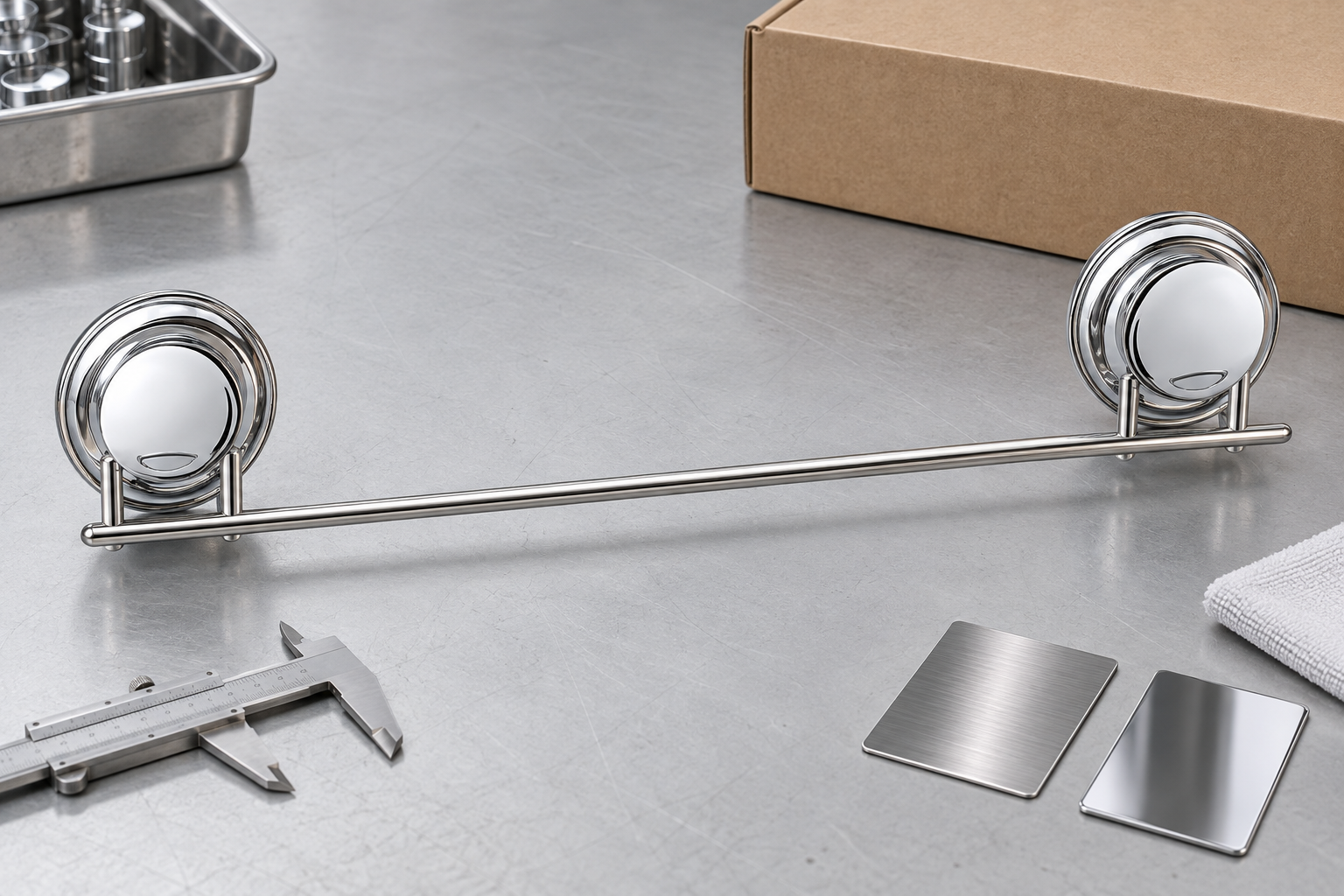
A suction cup towel rack manufacturer should be evaluated as a supplier of a complete mounting system, not only a metal bar. B2B buyers need to confirm the suction mechanism, compatible wall-surface assumptions, mounting-center spacing, towel-bar structure, finish, installation instructions and packaging before approving an OEM order. The most useful supplier comparison is therefore based on controlled samples and written specifications rather than a universal load claim or a low unit price.
This approach is especially important for importers, distributors and private-label brands because suction-mounted bathroom hardware combines metal fabrication with purchased or custom mounting components. A visually similar product can behave differently when the rubber cup, base geometry, cover engagement, wall surface or packing pressure changes. Defining those variables early gives the buyer a clearer quotation and gives the factory a repeatable production target.
What Should Buyers Define Before Contacting a Suction Cup Towel Rack Manufacturer?
Buyers should first define the intended product system: where the rack will be installed, what wall surfaces are expected, how the suction units engage, and what dimensions must remain consistent. A supplier cannot responsibly confirm suitability from a product photograph alone. The RFQ should distinguish required features from preferences and identify which points will be checked on the approval sample.
Start with the intended bathroom application. State whether the product is a single towel bar, double bar, ring-style holder or combined bar-and-hook unit. Define the usable bar length, overall projection, bar diameter or tube section, mounting-center distance and target appearance. If the rack will be sold as a retail kit, also state what installation instructions, protective materials and replacement components are expected.
Wall-surface assumptions deserve their own line in the specification. Smooth glazed tile, glass and polished stone do not represent every bathroom wall. Grout joints, texture, dust, moisture, curvature and installation technique may affect a suction system. The buyer should identify representative surfaces for sample review and avoid describing the product as universally compatible unless project-specific evidence supports that statement.
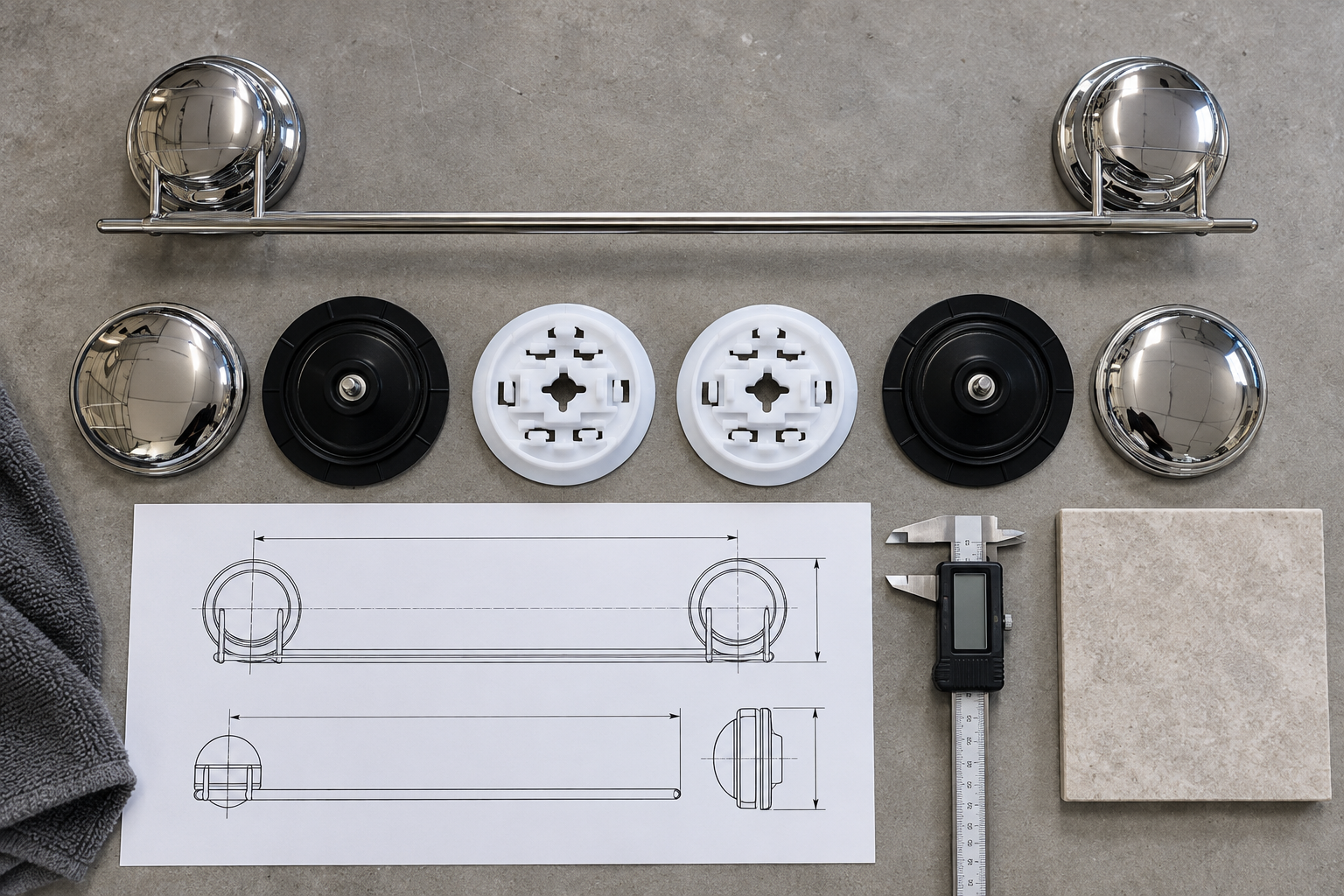
The mounting method also needs a simple definition. A vacuum-style assembly may use a rubber cup, an intermediate base, a metal interface and a decorative cover that locks the components together. Those parts should be reviewed as one assembly. Changing only the decorative cover or base recess can alter the relationship between the towel bar and the wall even when the bar itself is unchanged.
Send the supplier a dimensioned drawing when possible. A physical reference sample can help explain finish, proportion and user interaction, while the drawing identifies measurable requirements. If only a sample is available, agree which dimensions the factory will measure and record before making a development sample. Buyers can review broader options through Koitor’s fabrico de toalheiros personalizados para casa de banho page.
Which Suction Mount, Bar Material and Finish Options Should Buyers Compare?
Buyers should compare mounting components, metal structure and finish together because each decision affects appearance, assembly, inspection and packaging. There is no single best option for every market. The suitable combination depends on the intended surface, product dimensions, price position, retail presentation and the buyer’s own validation method.
| Decision | Common option | Vantagem para o comprador | Approval question |
|---|---|---|---|
| Suction engagement | Cover-activated rubber cup and locating base | Compact appearance with internal components hidden after assembly | Does the complete mechanism engage consistently on the agreed surfaces? |
| Towel bar | Stainless tube or solid/wire-form metal section | Allows different weight, profile and manufacturing routes | Which material, section and wall thickness are included in the quotation? |
| Visible finish | Polished, brushed or buyer-approved plated appearance | Supports different private-label product positions | Which approved sample controls color, gloss and cosmetic acceptance? |
| Mount spacing | Fixed dual-mount center distance | Creates a clear dimensional control point | How will the factory fixture and inspect center-to-center spacing? |
| Retail protection | Backing card, tray, sleeve or fitted carton insert | Helps separate polished covers from the bar and loose components | Can the packed sample protect suction faces and visible metal surfaces? |
Para um vacuum suction towel bar OEM project, the buyer should ask for a component list even when the assembly appears simple. The list can identify the rubber cup, base, cover, bar, connectors, protective films and packing parts. This makes supplier quotations easier to compare and reduces the risk of one quotation omitting a component that another supplier includes.
Material descriptions should be specific but practical. “Stainless” alone does not describe the bar section, surface direction or mating components. Likewise, a bright chrome appearance does not prove a particular base material or corrosion result. Buyers should state the required material and finish, request a representative sample, and confirm any market-specific performance requirement through an agreed project test instead of relying on appearance.
Finish samples should be reviewed under consistent lighting and against clearly marked cosmetic zones. The front covers and towel bar are highly visible, while internal bases may have different appearance requirements. Defining critical faces prevents unnecessary rejection of hidden areas and focuses inspection on the surfaces that customers will actually see.
What Must the Drawing and Sample Specification Include?
A useful specification tells the supplier what to make, where to measure and what evidence will support approval. It should cover the complete rack and its mounting interfaces without forcing every dimension into an unnecessarily tight tolerance. Functional dimensions, cosmetic references and packaging requirements should be separated so each team knows how to control them.
- Overall rack width, usable towel-bar length and projection from the wall.
- Center-to-center distance between the two suction assemblies.
- Bar diameter, tube section or wire size, plus the intended base material.
- Connector geometry and the way the metal bar locates in each mounting base.
- Outer cover diameter, side profile and orientation of the lower release detail.
- Rubber suction-cup and base references, including any controlled mating features.
- Finish direction, gloss reference and important cosmetic surfaces.
- Representative wall surfaces and the buyer-approved installation sequence.
- Retail pack, accessory list, instruction sheet and master-carton assumptions.
- Drawing revision, approval-sample identity and change-approval responsibility.
Use datums that make inspection repeatable. For example, define mount spacing from the centers of the base interfaces rather than from two decorative cover edges that may be harder to locate consistently. State whether the overall width includes the outer covers and whether projection is measured from the wall surface, rubber cup or front cover.
Tolerance should follow function. Mount-center spacing, bar straightness and connector position may affect assembly and visual alignment. Other reference dimensions may allow wider variation. Ask the factory which dimensions are naturally controlled by tooling or fixtures and which depend on manual positioning. This discussion often reveals where a simple checking gauge or first-piece record would add value.
When development starts from a physical sample, record what the sample controls. It may define shape and user interaction but not material grade, internal structure or retail packaging. The supplier should not be expected to infer hidden requirements. Add missing information to the drawing or specification and label the approved sample so later orders do not depend on memory.
How Should OEM Buyers Approve Samples and Factory Capability?
Sample approval should reproduce the intended components, finish, assembly method and packaging closely enough to expose real production risks. A geometry prototype can answer early dimensional questions, but it should not automatically become the final approval standard if the rubber cup, base material, finish or packing method will change.
- Confirm the drawing revision, component list and representative wall surfaces.
- Review the unassembled components and the way the bar locates in each base.
- Measure usable bar length, projection, mount centers and visible alignment.
- Install the complete rack using the intended preparation and engagement sequence.
- Record observations without turning one sample result into a universal performance claim.
- Inspect finish, edges, bar straightness and the orientation of both covers.
- Pack the approved sample and check whether pressure or movement affects suction faces or polished surfaces.
- Label the approved sample and connect it to the final drawing and packaging revision.
Factory capability should be judged against the product’s actual processes. A suction cup towel rack manufacturer may need tube or wire forming, welding, grinding, polishing or another approved surface finish, component assembly and packaging preparation. Ask who controls the mounting components, how bar-to-base alignment is maintained, and where cosmetic inspection occurs. The answers should describe a practical route rather than a broad claim about factory scale.
Koitor Hardware is a family-owned custom metal hardware factory focused on bathroom and home storage hardware. For towel racks, Koitor can review the metal structure, connection points, finish direction, mounting interface and packaging method before sample production. Development can begin from buyer drawings or physical samples, with practical discussion of manufacturability and small-batch production.
MOQ can start from 100 pieces for some products, depending on the structure, mounting components, material, finish and packaging. Samples usually take about 5–7 working days after the design and materials are confirmed, while bulk production commonly depends on order quantity, complexity and component availability. These planning references should be reconfirmed for the specific project rather than treated as fixed promises.
A buyer comparing a no drill towel rack supplier should also examine communication quality. Useful suppliers identify open questions before quotation, separate assumptions from confirmed requirements and explain when a requested change needs another sample. Direct factory communication can be particularly helpful for trial orders, because technical and packaging decisions often happen close together.
Which Production, Inspection and Packaging Controls Matter Most?
Production control should focus on variables that influence mounting alignment, appearance, assembly and pack condition. The factory does not need to measure every feature at every stage, but each critical result needs a defined checkpoint and an identifiable reference.
Incoming checks can confirm the correct suction cups, bases and covers before assembly. First-piece inspection can verify bar length, mount-center spacing, connector position and cover orientation before the batch continues. In-process review can look for bar distortion, visible welding or finishing issues, sharp edges and mixed components. Final inspection can confirm assembly, cosmetic condition, accessory completeness and packaging presentation.
A simple fixture may help maintain the relationship between the two mounts while connectors are positioned or joined. The fixture should reference stable product features and be checked when the drawing changes. Buyers do not need to prescribe the fixture design, but they can ask how the factory prevents one mount from rotating or shifting relative to the other.
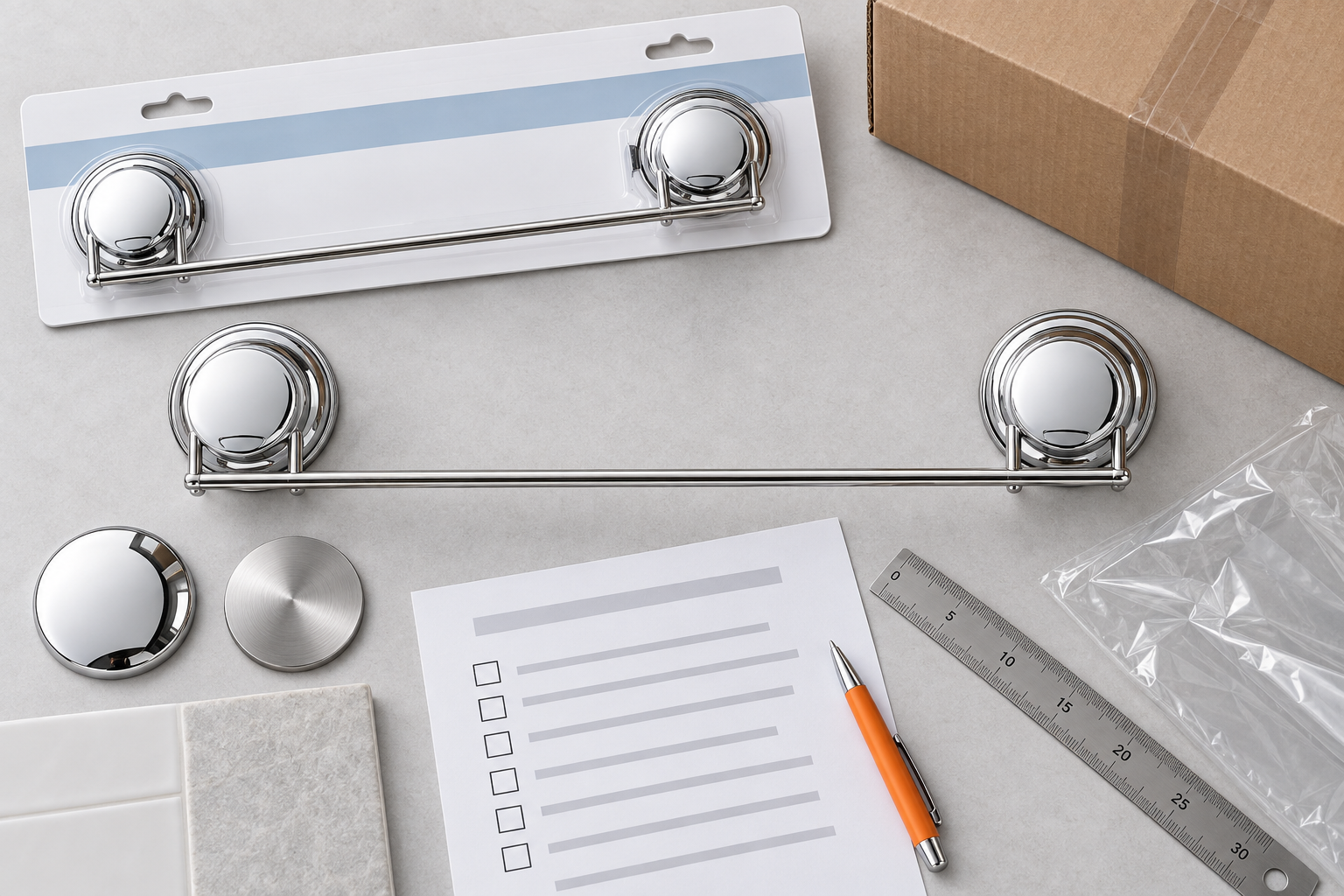
Packaging is part of product control, not an afterthought. Polished covers can rub against the bar, metal accessories or carton surfaces. Suction faces can collect dust or be distorted by concentrated pressure. A fitted tray, protective sleeve, plain backing card or insert may help, depending on the retail format. The packed sample should be reviewed with all instructions and accessories in their intended positions.
Use this buyer checklist before releasing a private label suction towel holder:
- ☐ The latest drawing and approved sample carry the same revision.
- ☐ Wall-surface assumptions and installation steps are written clearly.
- ☐ Bar material, section, finish and usable length are confirmed.
- ☐ Both suction assemblies use the approved component set.
- ☐ Mount-center spacing and bar alignment have measurable references.
- ☐ Cosmetic zones and acceptable finish references are identified.
- ☐ The retail pack protects polished parts and suction faces.
- ☐ Instructions avoid unsupported universal surface or load statements.
- ☐ The quotation states component, packaging, sample and order assumptions.
- ☐ Any change after approval requires documented review.
For related mounting and private-label development options, buyers can review Koitor’s no-drill bathroom accessories manufacturing capabilities. The most productive first inquiry includes a drawing or sample, estimated order quantity, target finish, packaging concept and the buyer’s intended approval method.
What Common Sourcing Mistakes Should Buyers Avoid?
The most common mistakes come from treating the metal bar and suction mounts as unrelated items. A bar may look correct while mount spacing, connector position or cover engagement prevents consistent assembly. Review the complete system and make one party responsible for presenting the assembled approval sample.
Avoid asking for one load number without defining the test arrangement. Surface type, cleaning method, installation sequence, observation period, rack geometry and load position can all affect a result. If a performance statement is commercially necessary, define a project-specific method and confirm how the claim will be supported before it appears on packaging or sales materials.
Do not approve finish from isolated close-up photographs. Lighting and reflections can hide direction, color or cosmetic differences. Review a physical finish sample or a complete product under agreed lighting, and mark the visible zones that matter most. Keep that reference protected and identified for repeat production.
Do not leave packaging until after production. The selected backing card, tray or insert can affect mount orientation, carton size and surface protection. Packaging artwork may also contain installation language that needs product-team review. Approving the packed sample before bulk production reduces rushed changes and helps the buyer compare landed rather than unit-only cost.
Finally, do not allow revisions to remain in separate email threads. Maintain one current drawing, component list, packaging specification and open-issue record. A clear handoff is especially useful for flexible small-batch OEM programs because design, purchasing and packing decisions can change quickly during sampling.
Perguntas frequentes
Can one suction towel rack work on every bathroom wall?
No universal compatibility should be assumed. Buyers should define representative smooth surfaces, installation preparation and an agreed sample-review method. Textured, uneven or interrupted surfaces may need a different mounting solution.
What should be included in a quotation request?
Include the drawing or reference sample, product dimensions, mounting concept, material and finish direction, target quantity, packaging format, intended market and required sample checks. Ask the supplier to list assumptions and excluded items.
How should mount spacing be controlled?
Define a center-to-center dimension from stable mounting references. The factory can then use an assembly fixture, first-piece measurement or checking gauge appropriate to the product and order size.
Should buyers request a universal load claim?
Buyers should avoid unsupported universal claims. Any load-related statement should use a defined product configuration, surface, installation method and project-specific validation procedure.
Can Koitor develop a towel rack from a physical sample?
Koitor can review a buyer-provided drawing or physical sample within its supported bathroom hardware scope. Missing material, tolerance, mounting and packaging requirements should be documented before final sample approval.
Is a small trial order possible?
Small-batch production can be discussed, and MOQ can start from 100 pieces for some products depending on structure, components, finish and packaging. The final quantity should be confirmed after the project review.
Trabalhe com a Koitor Hardware
Planning a Custom Suction Cup Towel Rack?
Send Koitor your drawing, physical sample, wall-surface assumptions, finish requirement, packaging idea and expected order quantity. The factory team can review the metal structure, suction interface, sample plan and practical small-batch OEM route before quotation.
OEM / MARCA PRÓPRIA
Transforme este guia de fornecimento num resumo do produto
Indique o produto pretendido, as dimensões, o acabamento, a quantidade a encomendar e os requisitos de embalagem. A sua equipa receberá uma análise prática da viabilidade de fabrico antes da apresentação do orçamento.
 English
  Español
  Português
  Français
  Deutsch
  العربية