
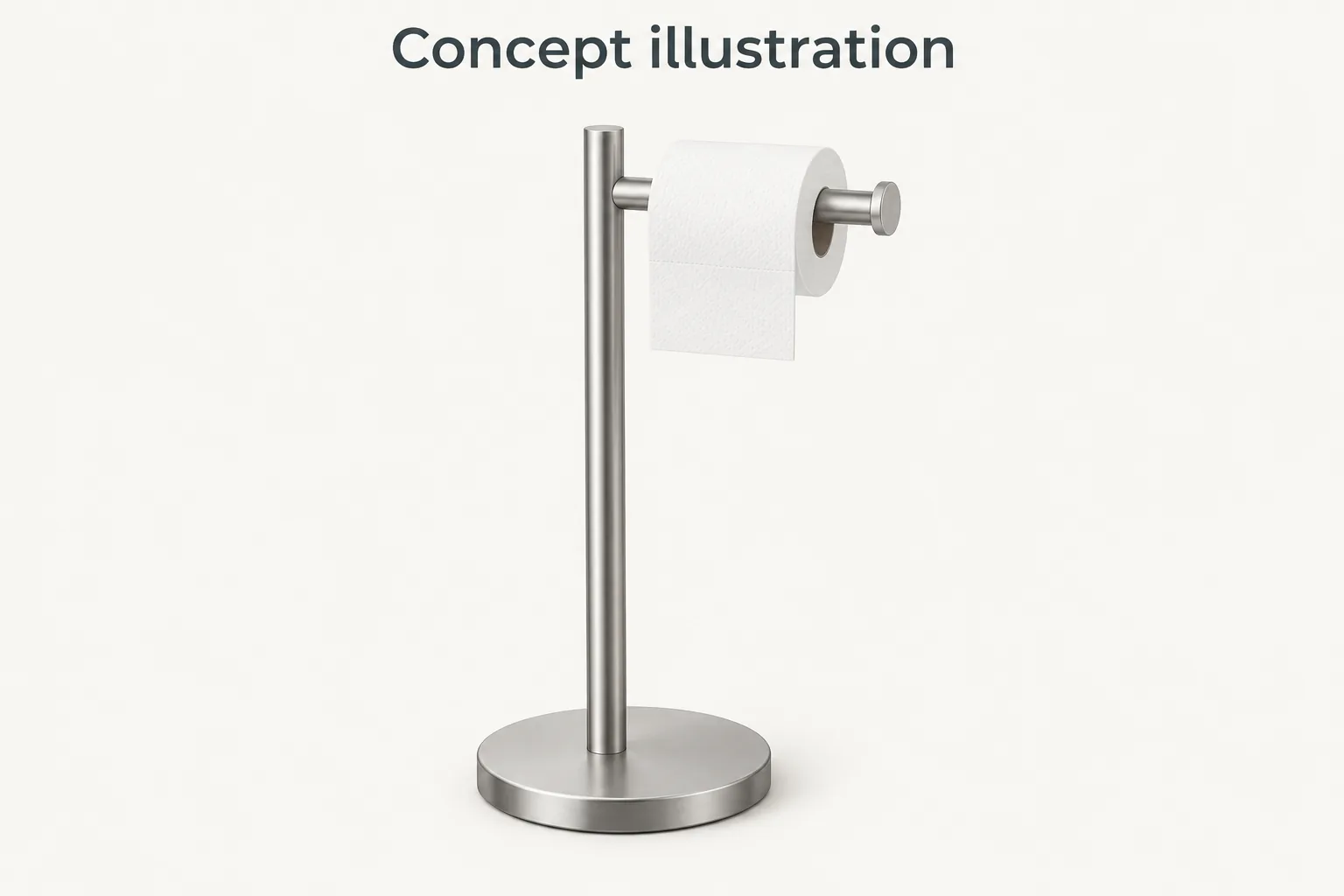
Freestanding toilet paper holder stability design should be approved around the expected dispensing action, roll states and supporting surface, rather than total product weight alone. Buyers need a defined base footprint, floor-contact arrangement, upright and arm geometry, plus a representative sample review. A weighted base can be one design feature, but it does not establish a universal no-tip or no-slide claim. Keep any performance statement tied to the actual configuration and agreed evaluation.
Why can a paper stand tip or slide during dispensing?
A freestanding paper stand can move when the dispensing action interacts with its geometry and floor contact. Tipping, sliding and joint movement are different observations and should be recorded separately.
Tipping involves the stand beginning to rotate about its support boundary. Sliding involves movement across the supporting surface. A loose connection can produce movement even while the base remains in contact. An importer needs to know which behavior was observed before asking for a manufacturing change.
A pull applied at the roll arm can act at a different height and direction from a force applied near the base. The product's overall mass is therefore only one part of the design question. Arm position, roll location, base geometry and contact condition also deserve review by the responsible designer.
Manufacturer examples show that base design is a real product specification issue. Allied Brass describes a weighted base on its tissue stand. That description establishes a feature of the named product; it does not supply a minimum weight, performance threshold or specification for a Koitor design.
Begin the RFQ with the intended user action. Does the product support dispensing from one roll, hold additional spare rolls or include another function? Does the user pull forward, sideways or along a specified path? State assumptions instead of treating every paper stand as the same product.
Do not assume that a broad or heavy-looking base proves adequate stability. Appearance can conceal differences in contact, internal construction or assembly. Request a drawing and representative sample so the buyer can evaluate the actual configuration.
The diagrams in this guide are generic concept illustrations. They explain the review task and do not depict a confirmed Koitor freestanding SKU or a tested performance result.
Which roll states and dispensing directions should buyers represent?
Represent the roll sizes and states that define the intended product claim. A full roll, a partly used roll and a nearly empty roll can present different handling conditions, so the sample plan should not rely on one styled photograph.
Identify maximum roll outside diameter, width and core requirements for the proposed holder. Obtain actual reference rolls or controlled packaging information from the buyer's target assortment. Nominal sheet count or a generic description such as large roll does not establish the envelope.
Check how the roll sits on the arm. Note whether it rotates freely under the intended conditions, contacts the upright or base, or requires an installation action that is difficult to perform. These observations relate to dispensing usability and should be reviewed separately from stability.
Define the pull directions relevant to the design. A straight pull, a lateral pull and an angled dispensing action may raise different questions. Do not invent a universal force or pull speed. The buyer and competent reviewer should agree the evaluation conditions appropriate to the intended use.
Spare-roll storage needs its own configuration record. If the stand is designed to carry spare rolls, specify the permitted arrangement and review relevant loading states. Do not assume that spare rolls always improve stability or that users will always store them in the same position.
| Use variable | Buyer record | Question for sample review |
|---|---|---|
| Full roll | Identified maximum intended envelope | Does the roll contact or obstruct the holder? |
| Partly used roll | Representative approved sample | Does dispensing behavior differ? |
| Nearly empty roll | Defined reference condition | Does the intended pull remain usable? |
| Spare rolls | Approved number and placement | Does the configuration alter the review scope? |
| Pull direction | Defined user action | Does the base tip, slide or remain in the agreed condition? |
| Supporting surface | Identified representative condition | Does contact behave as assumed? |
| Assembly revision | Product and component identities | Does the sample represent the proposed order? |
A retail compatibility statement should reflect the approved roll envelope. Saying that the stand fits every oversized roll is not justified by checking a single local product.
For freestanding toilet paper holder stability design, keep the use matrix manageable but meaningful. Select the controlling conditions for the actual assortment rather than collecting arbitrary combinations that cannot be connected to a purchasing requirement.
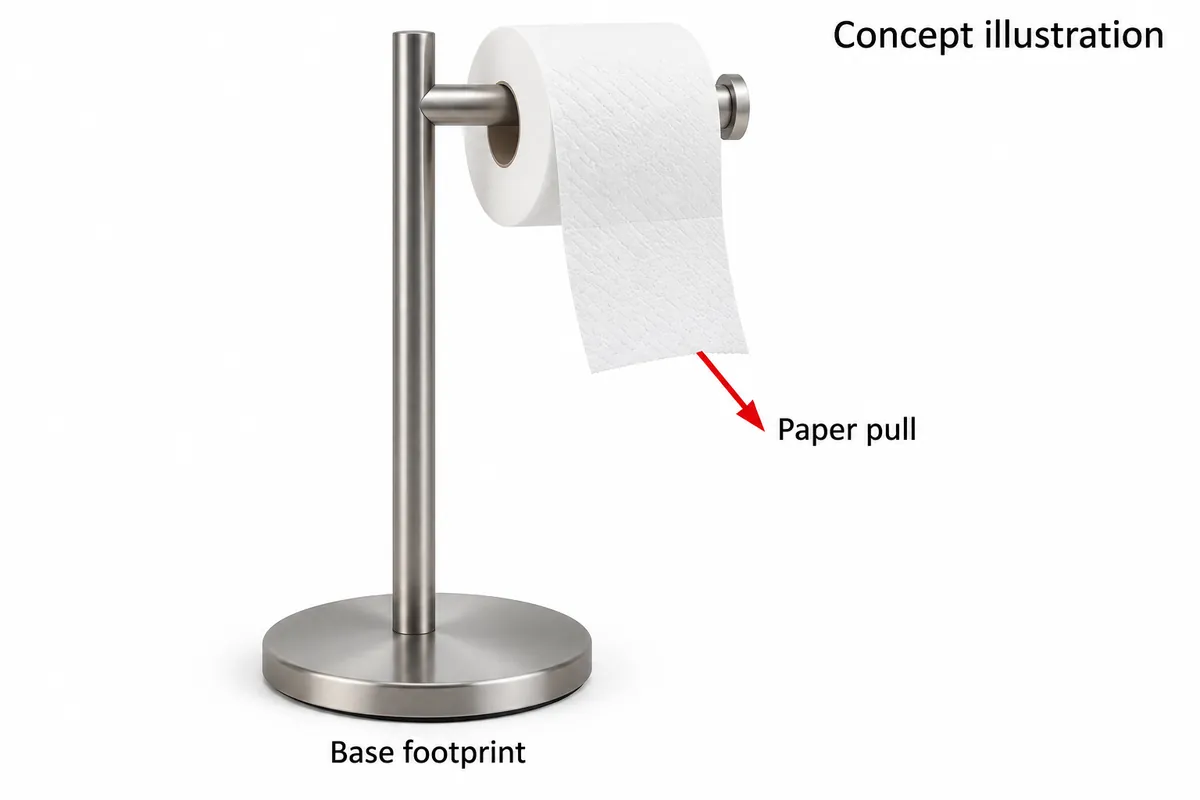
How do base footprint, mass and surface contact differ?
Base footprint, mass and contact are separate design variables. Review them together because improving one can change packaging, appearance or another product behavior.
The footprint is the area and support boundary established by the base's contact arrangement. A decorative outer shape may not match the actual contact locations. Identify the underside features on the drawing and examine the supplied sample.
Mass distribution matters as well as total mass. Ask the designer to explain where weight is located and why the proposed arrangement suits the product. Do not copy a competitor's shipping weight as a design requirement; that number can include packaging and a different construction.
Contact features can influence sliding, surface marking and perceived movement. Identify pads, rings or other components and obtain their relevant supplier information. A soft-looking pad is not evidence of wet-surface grip, long-term adhesion or compatibility with every floor finish.
Specify the intended support environment. A clean level sample surface is different from an unspecified bathroom floor. If moisture, cleaning residues or surface variation are relevant to the product requirement, they need a defined review scope and competent assessment rather than an improvised test.
Changing the base can alter carton size and freight economics. A wider footprint may need more packaging space. Added mass can affect handling and shipment cost. A separable base can improve packing efficiency but introduce an assembly connection that needs review.
Compare options through the actual project requirements. The lowest unit price may omit an intended pad, internal weight or packaging protection. Ask suppliers to quote the same approved configuration so the comparison is meaningful.
Do not publish an absolute non-slip or no-tip statement merely because a base is weighted. Use the evidence and limitations applicable to the final design, with qualified review for any safety or market-specific requirement.
Which upright, arm and joint details need approval?
Approve the upright, dispensing arm and base connection as a complete structure. Their geometry and assembly condition can affect the user's action and the observations recorded during stability review.
Record the dispensing height and the arm's position relative to the base. Identify the roll's location and any features intended to retain it. These are drawing requirements to confirm with the responsible designer, not dimensions to prescribe from a generic illustration.
Check roll installation and replacement. A retention feature should be evaluated for its actual use task. A large roll may fit on the arm but contact another component during rotation or removal. Include those interactions in the sample record rather than treating roll fit as a separate marketing assumption.
Identify welded, threaded or other connections in the proposed structure. A factory-assembled joint and a consumer-assembled joint create different purchasing requirements. Clarify who assembles the product, what tools or instructions are provided and how the final configuration is checked.
Observe whether movement originates at the base or a connection. If a pole rocks while the base stays still, adding base mass may not address the observed joint issue. Preserve the sample and describe the location of movement so the supplier can investigate the relevant structure.
Finishing and packaging need attention at the same time. A revised connection can create exposed contact surfaces or change how parts are packed. Any protective material should be approved for the actual finish. Avoid a late packing change that damages the appearance accepted during sample approval.
Koitor's confirmed capabilities include metal forming, welding, finishing, assembly and packaging preparation for bathroom and home storage hardware. Those capabilities support discussion of manufacturing practicality. They do not confirm that the generic stand shown here is currently manufactured by Koitor.
The custom tissue holder manufacturing page provides the relevant commercial context. Buyers interested in a freestanding concept should ask about project feasibility and current capability before assuming the design is part of an existing production range.
How should the stability review be documented?
Document a product-specific review plan that defines the sample, use matrix, supporting surface and acceptance decision. Keep measurements and performance claims separate from illustrative diagrams.
Start with the drawing revision and complete bill of materials. Record the assembled condition, base arrangement, contact parts and relevant roll samples. Take photographs before evaluation so any initial movement, damage or misassembly can be identified.
Agree the use actions and observation method with the responsible technical reviewer. Where numerical requirements apply, identify who establishes them and how they are measured. This guide deliberately does not invent a dispensing force, base weight or universal pass threshold.
Separate tipping, sliding, rocking and joint movement in the record. Note whether the behavior affects the intended operation and which configuration produced it. A single word such as unstable can obscure several different problems requiring different changes.
A revised prototype should be checked in the affected conditions. If the arm becomes shorter, review roll fit and replacement as well as the original stability concern. If a base pad changes, review its contact and product compatibility as agreed. If packing becomes knock-down, evaluate the assembled sample under the supplied instruction.
Freestanding toilet paper holder stability design is also a change-control task. The approved result should identify the final configuration and what claims it supports. A supplier should not substitute a different contact pad or base construction and silently reuse the earlier approval.
Keep sample evidence honest. A development observation is not a production-wide guarantee. A manufacturer's catalog description is not a test result for your project. A concept sketch explains geometry but cannot establish finished-product performance.
If the applicable market or customer requires a formal standard or safety assessment, obtain qualified guidance on scope and method. Do not replace that work with an invented certificate, borrowed threshold or unverified online claim.
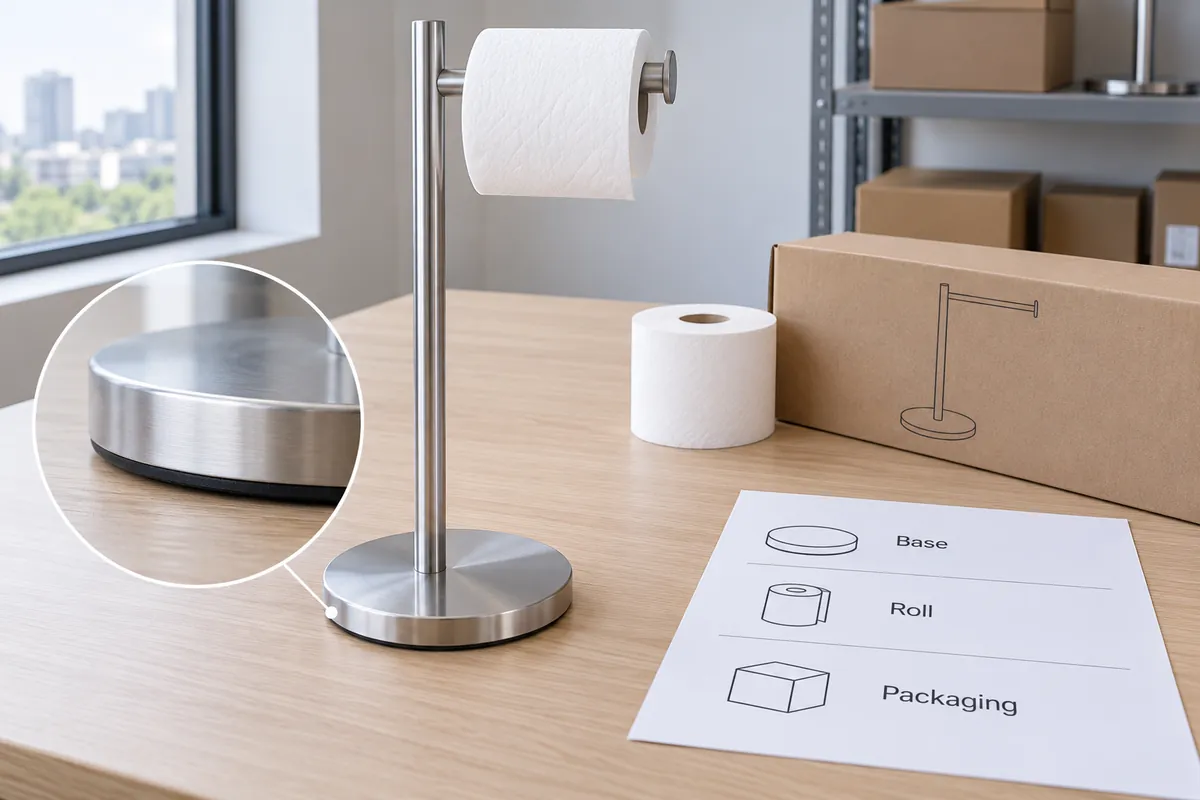
Which checklist balances stability, manufacturing and freight?
Use a checklist that connects the product-use requirement with construction, commercial scope and approved claims. A stable-looking sample is not a complete purchasing specification.
- – Identify the target buyer, market and intended use.
- – Define dispensing and spare-roll functions separately.
- – Record the approved roll envelope and representative roll states.
- – Specify the base's actual contact arrangement and structure.
- – Identify mass-related requirements only when technically established.
- – Record upright and arm geometry and relevant joint details.
- – Define assembly responsibility, tools and instructions.
- – Agree supporting-surface and dispensing review conditions.
- – Record tipping, sliding, rocking and connection observations separately.
- – Save the final drawing, components and approved sample revision.
- – Review finish protection, packing arrangement and carton dimensions.
- – Approve claim wording and change-review triggers.
For quotation comparison, state whether the base is supplied assembled or separately packed. Include contact components, internal construction, required accessories and packaging. Otherwise two quotations may describe different products despite similar renderings.
Review the commercial effect of each proposed revision. A broader base, heavier construction or additional assembly operation may affect cost and freight. A packaging change can improve shipment efficiency while increasing the user's assembly task. The buyer should approve that trade-off explicitly.
Koitor supports drawing-based or sample-based development and flexible small-batch OEM production. Project feasibility, MOQ, samples and lead time depend on structure, materials, finish, quantity and packaging. Confirm those factors for the specific concept rather than transferring general factory planning information into a product guarantee.
Before repeat orders, ask whether the base, pad, arm, joint or packing configuration changed. Review applicability of the original approval and request further confirmation where the change affects the use question.
Retail teams should receive the same approved limitations as purchasing. Avoid adding unsupported claims such as impossible to tip or suitable for any floor. A precise product description can be commercially useful while remaining faithful to the reviewed configuration.
What do buyers ask about paper-stand stability?
Is total product weight enough to approve stability?
No. The buyer also needs the base contact arrangement, mass distribution, arm geometry, roll configuration and relevant use conditions. A total weight does not independently establish the intended performance.
Should a full roll be the only sample condition?
No. Review the roll states and arrangements relevant to the intended claim. A partly used or nearly empty roll may produce a different user interaction, so the plan should identify the representative conditions.
Can a competitor's weighted base become the specification?
No. It shows a design feature used on that product. Your own stand needs a project-specific design and approval record. Competitor shipping weight or marketing wording is not a universal technical requirement.
Does this guide confirm a current Koitor freestanding model?
No. It provides adjacent buyer education based on relevant metal-hardware manufacturing knowledge. Ask Koitor about the proposed design and current project feasibility before making a production-capability claim.
What changes should reopen the approval?
Changes to base construction, contact parts, arm geometry, joints, roll assumptions or assembly can affect the reviewed behavior. Record the change and agree appropriate confirmation before reusing the old performance statement.
Discuss Your Hardware Specification With Koitor
Send Koitor your drawing, physical sample, material and finish requirements, intended use and packaging plan. Our family-owned custom metal hardware factory can review manufacturing practicality and small-batch OEM project requirements before quotation. Specific performance and any adjacent product feasibility require project confirmation.
OEM / MARCA PRÓPRIA
Transforme este guia de fornecimento num resumo do produto
Indique o produto pretendido, as dimensões, o acabamento, a quantidade a encomendar e os requisitos de embalagem. A sua equipa receberá uma análise prática da viabilidade de fabrico antes da apresentação do orçamento.
 English
  Español
  Português
  Français
  Deutsch
  العربية