
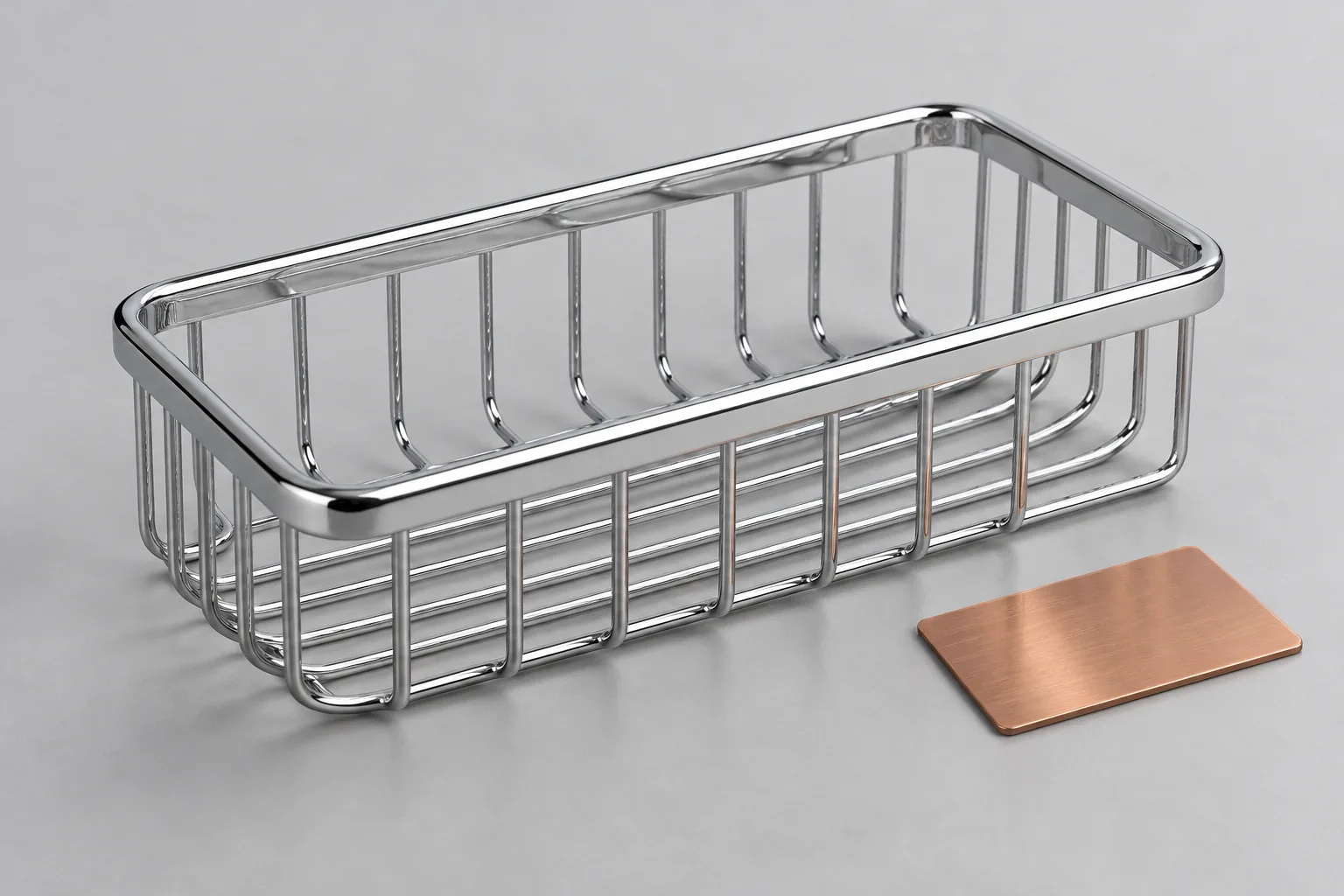
For a decorative bathroom-hardware part, a copper undercoat in nickel chrome plating is a conditional layer choice, not a universal recipe. It may support leveling, buffing, or a substrate-specific plating sequence, but the reason depends on the actual base material, surface condition, geometry, and finishing route. Buyers should ask the finisher to explain the copper layer’s function for the specified component, identify the approved layer sequence, and provide representative evidence; they should not infer the need for copper from a bright chrome appearance alone.
This is a buyer guide to evaluating a proposed finish on a purchased or subcontracted component. Koitor Hardware is a family-owned custom metal hardware manufacturer with experience in forming, welding, grinding, polishing, powder coating, assembly, and sample development. This article does not claim that Koitor operates an electroplating line. A specialist finishing supplier should confirm whether copper is suitable for the buyer’s exact substrate and process.
Why might a buyer ask about copper beneath nickel and chrome?
The question matters because “chrome finish” can describe a visible appearance while concealing different layer sequences and substrate preparation routes. A finisher may propose copper for a specific technical purpose, or a drawing may carry a legacy note that no longer fits the current material or part design. If the buyer approves only the color sample, the underlying process assumptions can remain unclear until a later change in substrate, geometry, or supplier exposes the difference.
Technical finishing references describe more than one possible role for copper. Depending on the system, copper can provide a surface that is suitable for leveling or buffing, contribute a ductile underlayer, or serve as part of a substrate-specific sequence. A finisher may use a copper layer before nickel and chromium on some base materials, while another approved route may use nickel and chromium without a copper undercoat. The layer’s function is tied to the substrate and process, not to the word “chrome” by itself.
For example, Tech Plate’s decorative copper-nickel-chromium guidance discusses copper as an undercoat in certain systems, including leveling and buffability, and distinguishes that decision from nickel thickness. Atotech’s kitchen and bathroom finishing solutions list copper, nickel, and chromium process options for the category. Such supplier references show that multiple routes exist; they do not specify the right recipe for a particular wire basket, mounting tab, hook, or bracket. The buyer still needs a part-specific proposal from the appointed finisher.
That distinction is useful for bathroom and home-storage hardware buyers because a product may combine wire, tube, stamped tabs, welds, folds, and purchased components. A single decorative finish name may not reveal whether every component uses the same base material or route. The RFQ should identify which parts are included, what surfaces are visible or functional, and whether the finishing supplier is responsible for selecting and documenting the layer sequence.
What determines whether copper is appropriate for the specified part?
When a supplier proposes a copper undercoat in nickel chrome plating, start with the base material and the condition of the surface that will enter finishing. Copper’s role on one substrate cannot be assumed to transfer to another. A route proposed for zinc die casting, for instance, should not automatically be copied to stainless steel wire or a fabricated steel tab. The finishing supplier should identify each relevant substrate and explain how the proposed preparation and deposit sequence addresses it.
Next, separate surface leveling from substrate protection. If the incoming part has scratches, weld marks, pits, or polishing variation, adding a layer does not remove the need to agree on acceptable preparation and significant surfaces. A leveling deposit may be part of a route that helps achieve a specified appearance, but it should not be treated as a substitute for reviewing the substrate, joint design, or polishing access. Geometry can affect finishing access, racking, drainage, and coating distribution. The finisher needs the actual drawing or production-intent sample to evaluate these factors.
Then identify the requirement that the finish must satisfy. Is the priority appearance on visible surfaces, assembly fit at a hole or mating face, durability in a defined environment, or a combination? A copper undercoat may be proposed for one objective while the buyer’s acceptance criteria concern another. A bright surface alone does not prove layer identity, adhesion, corrosion performance, or repeatability. Those claims require separately defined evidence and an agreed method.
Finally, establish who controls the process. If a subcontracted finisher selects the route, request a written rationale and change-notification commitment. If the buyer’s specification mandates a stack, name the applicable part revision and the evidence needed to verify it. In either case, record whether copper is required, optional subject to supplier justification, or explicitly excluded. Avoid vague notes such as “copper if needed,” which leave cost and process changes unresolved.
How should buyers compare a copper undercoat with other finish routes?
Compare finished-part requirements and evidence rather than ranking layer stacks in the abstract. The right comparison depends on the base material, surface condition, product geometry, service environment, and supplier capability. A buyer should not treat a copper-containing stack as automatically better, more corrosion-resistant, or more durable than a nickel-chrome route without copper. Nor should a supplier omit a layer that is necessary for its validated route merely to match a target price.
| Buyer decision | Copper-containing route to evaluate | Alternative route to compare | Evidence and limitation |
|---|---|---|---|
| Surface leveling or buffing | Ask what copper contributes on the actual substrate and whether the route includes intermediate preparation | Ask whether nickel leveling or additional substrate preparation can meet the same appearance target | Compare representative production-intent samples and significant surfaces; do not infer a result from finish names |
| Substrate compatibility | Ask why copper is proposed for this base material and what sequence precedes nickel | Ask whether the supplier has an approved substrate-specific route without copper | Supplier explanation must identify the material and route; a different base metal changes the question |
| Ajuste funcional | Check how the complete finish affects threads, holes, mating faces, and assembly | Compare a design or masking change only if the function permits it | Approve fit on the finished component; do not use visual appearance as a dimensional check |
| Corrosion or service requirement | Ask which complete system and agreed test or field requirement applies | Compare the complete alternative system under the same requirement | A copper layer alone does not establish service life; avoid transferring results from other parts |
| Commercial impact | Request the quoted layer sequence, preparation, sample, and inspection assumptions | Request the same scope and assumptions for the alternate route | Compare equivalent scope; do not assume fewer named layers always means lower total cost |
The table is a decision framework, not a process specification. For an existing specification, retain the buyer-approved finish requirement until a controlled review authorizes a change. For a new product, ask at least one qualified finishing supplier to propose a route and explain its limitations. If multiple suppliers quote different systems, map each proposal to the same substrate, drawing revision, significant surfaces, acceptance criteria, and sample plan before comparing price.
This topic is distinct from specifying nickel-chrome coating thickness or selecting a full corrosion-system architecture. If those are also open questions, treat them as separate approval items. For example, a buyer evaluating layer thickness should ask about the applicable measurement method and locations; a buyer asking about copper’s purpose should ask why the layer is present and what it is expected to do on the named substrate. Do not use one question as evidence that the other has been answered.
What should the RFQ and drawing say about the copper layer?
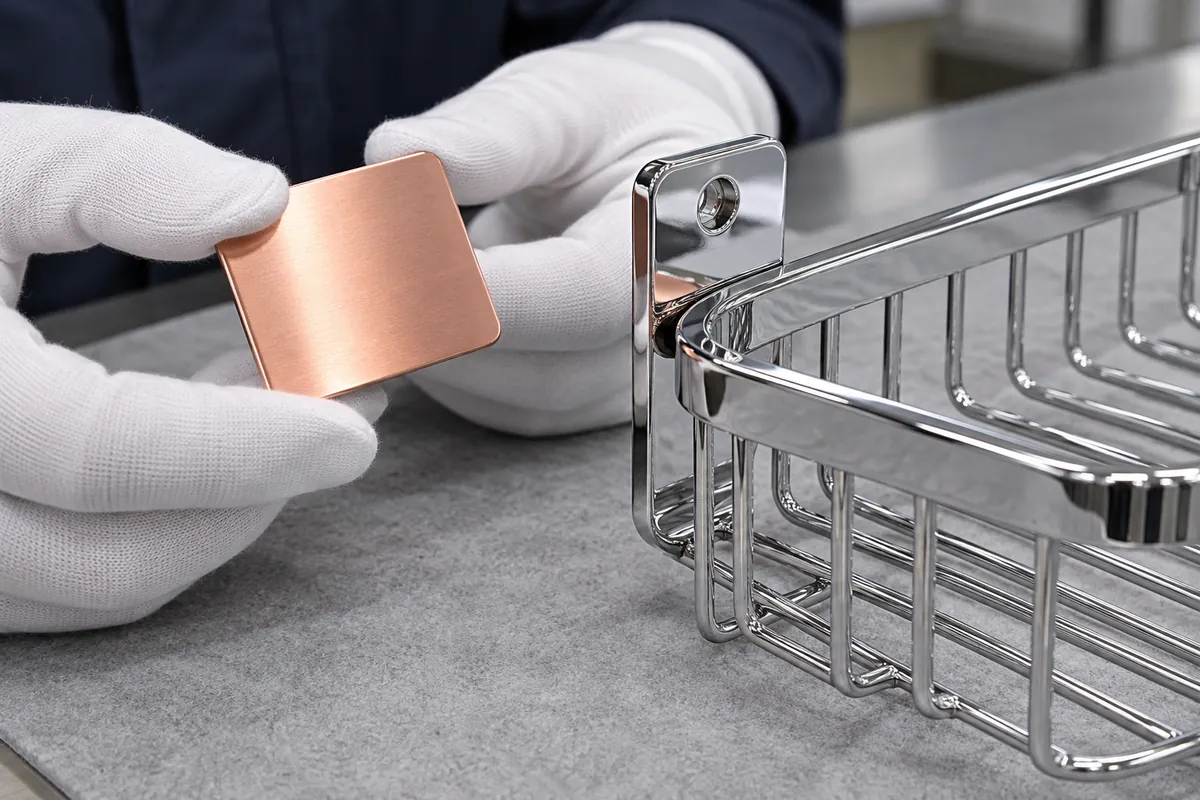
The RFQ should turn a proposed copper undercoat in nickel chrome plating into a reviewable, controlled requirement. It does not need to prescribe chemistry or operating settings that the buyer cannot validate. It should, however, identify the part, material, finish outcome, and decision authority clearly enough that suppliers quote comparable work and later changes can be assessed.
Include the following information where it is available:
- Part number, drawing revision, material grade or supplier-declared substrate, and component source.
- The intended decorative finish and the product’s use environment, stated without unsupported service-life promises.
- Significant surfaces: the visible or functional areas whose appearance or serviceability matters after assembly.
- Whether copper is required, prohibited, or proposed by the finisher for approval, and the function the supplier assigns to it.
- The proposed sequence of substrate preparation, copper (if applicable), nickel, and chromium, described at the level the supplier can document.
- Interfaces that must remain functional after finishing, including threads, locating holes, mating faces, and assembly fits.
- Sample identity, approval owner, inspection evidence, and the change that would require renewed review.
- Any agreed appearance reference and the viewing conditions used to assess it.
If material identity is uncertain, do not let the finish name conceal that uncertainty. Ask the supplier to list the assumed base material and identify any material substitution that would invalidate the route. If the product includes welded assemblies, also show the joints and surfaces that require polishing or visibility review. A drawing can identify significant surfaces and interfaces without telling the finisher how to operate a plating bath.
The buyer should also ask for a clear distinction between “process description” and “acceptance evidence.” A supplier’s route explanation tells the buyer what is proposed. A sample, inspection record, or agreed test report addresses whether a defined requirement was met. One does not replace the other. For a first order, the buyer may decide that a representative sample and visual/fit review are appropriate; for a higher-risk application, technical review may call for additional evidence. Let the product requirement and qualified supplier determine the suitable method rather than adding tests without a decision purpose.
When price is compared, confirm whether the quote includes the same preparation, underlayers, sample approval, inspection, packaging, and change control. If one quotation includes polishing or an additional copper step and another does not, a lower number may represent a different scope rather than a genuine cost advantage. A short assumptions table attached to the RFQ is often enough to expose the difference before purchase approval.
How should buyers approve samples and supplier evidence?
Use a sample that represents the production-intent substrate, geometry, joints, and finish route as closely as practical. Record the part and drawing revisions, the supplier or finishing source, sample identifiers, date, and any route deviation. If the sample uses a different base material or process sequence from production, mark that difference and decide whether the sample can answer the intended approval question.
Review the product from normal viewing angles and inspect agreed significant surfaces. Compare color, brightness, roughness, and visible transitions with an approved reference, while recognizing that appearance judgment should use a shared sample or clearly described criteria. Check the finished component’s functional interfaces and assembly condition as well. If a basket bracket must mate with a separate part, review that interface after finishing instead of assuming that a visually good coupon predicts fit.
Ask the supplier to connect evidence to the part and the claim it supports. A process sheet may establish the declared route; a sample may help assess appearance and assembly; a suitable measurement may address a layer-related requirement; an agreed test may address a defined performance criterion. Evidence is useful only when the method is applicable to the substrate and system, the location is representative, and the acceptance rule is understood. Do not request a thickness number without specifying which layer, which method, and which surface location it refers to.
Copper should not be represented as interchangeable with nickel thickness. If the purchase specification includes a nickel requirement, a supplier must not count a copper value toward it. Likewise, a single reading on an easy-to-reach coupon may not prove the condition of a complex basket or recessed feature. Where the product geometry prevents a meaningful measurement on the finished part, agree in advance on representative samples, witness pieces, or another supplier-supported method—and document its limits.
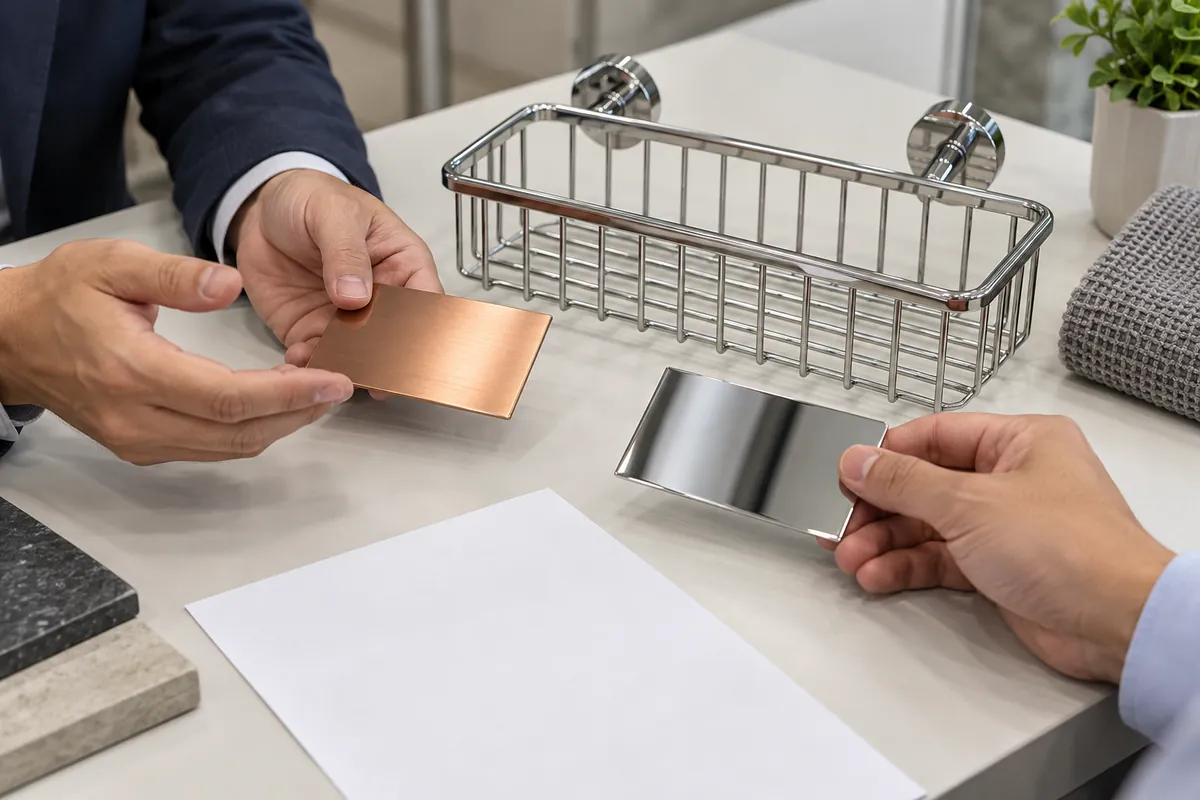
After approval, define which changes require notice or renewed approval. Examples include a substrate substitution, a change in the finishing source, a revised layer sequence, altered preparation, a tooling or geometry change affecting access, or an appearance reference update. The list should reflect the project’s actual risks. Change control prevents a previously approved sample from being treated as a blanket approval for a materially different process.
What mistakes make the finish decision unreliable?
One common mistake is to equate a bright chrome appearance with a known layer stack. The visible surface cannot by itself tell the buyer whether copper is present, what function it serves, or whether the supplier followed a particular specification. Ask for the declared process and evidence appropriate to the purchase requirement.
Another mistake is to require copper on every component because it was used on a past product. A previous route may have been selected for another substrate, shape, supplier, or appearance target. Reuse the prior specification only after confirming that those inputs still match. The reverse mistake—removing copper from a proven system solely to lower the quote—can be just as risky if no qualified review supports the change.
Buyers can also confuse the role of copper with the role of nickel. They are different layers with different specified functions. If the concern is nickel thickness, corrosion-system architecture, coverage in a recess, or a substrate blister, ask that question directly and use the separate technical evidence it requires. A copper undercoat discussion should not be stretched into claims about total corrosion performance or a guaranteed product lifetime.
Finally, do not approve from a generic sample that lacks traceability to the production drawing, material, or supplier. A loose coupon can help explain appearance or a process proposal, but it does not prove that a welded basket, hole, edge, or assembled interface will receive the same result. Tie the coupon to the actual process where possible, then approve the finished part and the evidence plan that will govern repeat orders.
For broader project planning, buyers can review Koitor’s OEM bathroom and home-storage hardware manufacturing information. The page describes Koitor’s relevant custom metal fabrication and project communication; specialist electroplating remains a separate supplier qualification and scope decision.
Frequently asked questions about copper undercoats
Does every nickel-chrome bathroom part need a copper layer?
No. The required sequence depends on the substrate, surface condition, geometry, desired finish, and qualified supplier process. Ask the finisher to justify copper for the identified part or explain why an alternative route is appropriate.
Does a copper undercoat replace part of the nickel requirement?
No. Treat each named layer as its own requirement. A copper value should not be counted toward a specified nickel value. The buyer should state the layer, method, location, and acceptance evidence for any thickness requirement.
Can a buyer approve the finish from a color sample alone?
A color sample can help establish appearance, but it does not prove substrate identity, process sequence, adhesion, layer thickness, or service performance. Approve a traceable production-intent sample and agree what additional evidence is needed for the project.
What should change if the supplier proposes a different layer stack?
Pause the change for review. Compare the new proposal against the approved substrate, drawing revision, significant surfaces, assembly functions, appearance reference, and performance requirements. Record the decision and request a new sample or evidence when the change affects an approved requirement.
Trabalhe com a Koitor Hardware
Review a Bathroom Hardware Finish Requirement
Share your drawing, substrate information, sample, finish expectation, and supplier proposal. Koitor can discuss the metal component, fabrication interfaces, sample review, and packaging scope; the appointed finishing specialist should confirm the electroplating route and its technical evidence.
OEM / MARCA PRÓPRIA
Transforme este guia de fornecimento num resumo do produto
Indique o produto pretendido, as dimensões, o acabamento, a quantidade a encomendar e os requisitos de embalagem. A sua equipa receberá uma análise prática da viabilidade de fabrico antes da apresentação do orçamento.


 English
  Español
  Português
  Français
  Deutsch
  العربية