
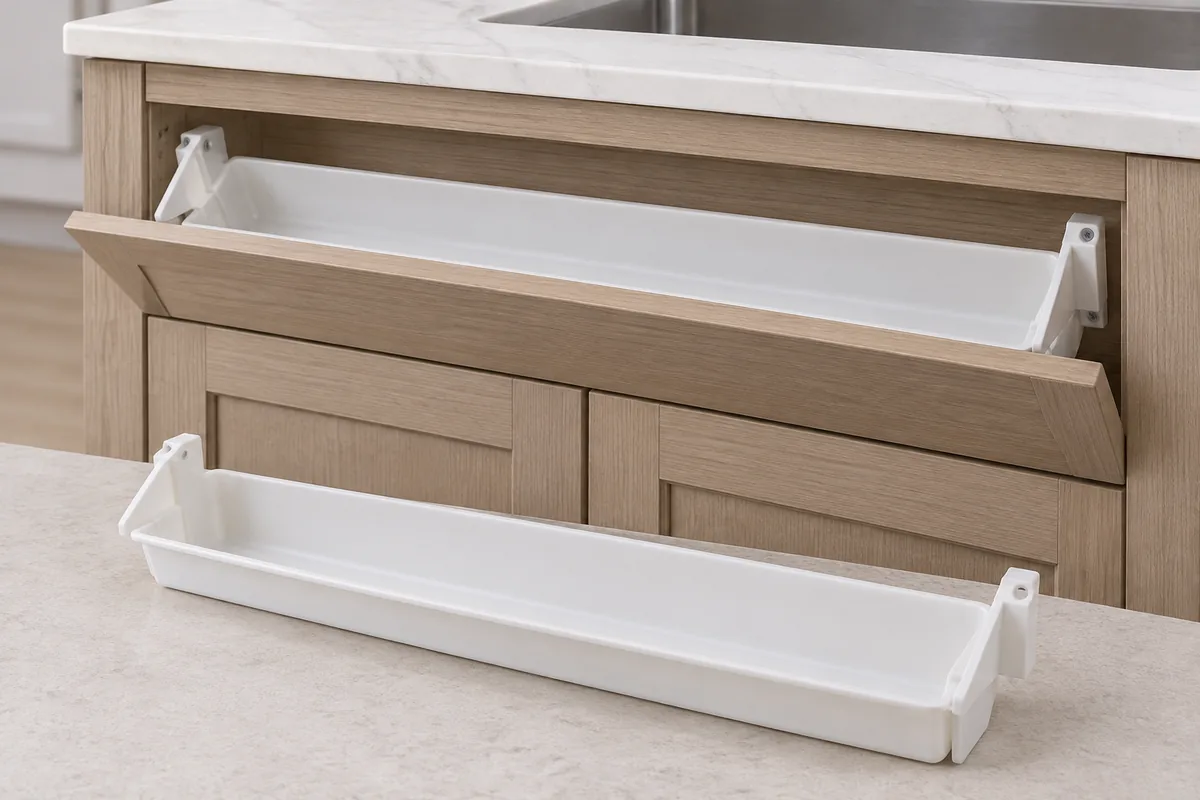
A sink-front tip-out tray should be approved as an interface, not just as a plastic pan. For a buyer researching “sink front tip out tray removable cleaning,” the core checks are deliberate release, retention during normal use, access with the cabinet assembled, and repeatable reinstallation. Public manufacturer listings show that some tray families use removable end-cap interfaces for cleaning, while other products are supplied as tray-only replacements or as complete kits; those details are model-specific, not universal. Rev-A-Shelf’s 6551 series is one example of a removable design to evaluate against the buyer’s own cabinet and supplier proposal.
What decision should buyers make about removable tip-out trays?
Buyers should decide whether the tray must be removable by the end user, service staff, or neither, then specify the release and retention behavior that the approved product must provide. “Removable” alone does not define who can release it, what movement is intended, or whether the surrounding false front, hinges, and sink bowl leave enough access.
A sink-front tip-out tray usually sits behind a false drawer front and pivots with that panel. The tray-to-front attachment and the cabinet’s pivot hardware are separate interfaces. A tray that can be lifted from its supports may still be difficult to reach after installation; a tray fixed to the front may clean adequately in place but require a different service method. Buyers should keep these questions distinct:
- Can the tray be removed intentionally without damaging the tray, end caps, brackets, or cabinet finish?
- Does the tray remain captured during the product’s normal opening, closing, and handling?
- Can the user reach the release points when the tray is mounted in the actual cabinet?
- Can the tray be reinstalled in the correct orientation without ambiguity?
- Are replacement trays, end caps, or brackets identified as separate parts?
These are specification questions, not performance claims about a particular product. Ask the component supplier to show the actual engagement interface and intended service sequence for the model being quoted.
What product and mating details belong in the RFQ?
The RFQ should identify the tray, false-front, hinge and bracket configuration together. A supplier cannot confirm fit from tray width alone when a change to the end cap, support position, or false-front thickness may alter the release path or installed access.
Provide or request the following controlled inputs:
| RFQ input | What to record | Why the buyer needs it |
|---|---|---|
| Tray identity | Supplier, model, revision, material description and whether the tray is sold alone or as a kit | Prevents a tray-only replacement from being compared with a full hardware package |
| Cabinet interface | False-front dimensions and construction, opening width, hinge or pivot hardware, and available space behind the front | Establishes the actual mating arrangement without assuming a universal cabinet fit |
| Attachment | End-cap, clip, pin, slot, bracket or other engagement drawing supplied by the vendor | Shows how the tray is held and how it is intended to release |
| Service path | Release direction, hand access, tool requirement if any, and reinstall orientation | Makes “removable for cleaning” testable on an assembled sample |
| Finish and edge condition | Visible surfaces, molded or cut edges, contact points, and any buyer-defined appearance limits | Keeps cosmetic acceptance separate from fit and retention |
| Package scope | Tray, end caps, hinges, mounting hardware, instructions and spare parts included | Avoids component-scope differences between quotations |
| Revision control | Drawing number, revision, sample identification and approved change procedure | Helps ensure the inspected sample and repeat order refer to the same configuration |
For a sink front tip out tray removable cleaning request, use one drawing or marked-up interface sheet to connect these inputs. Include the target market, order range, sample need, label and packaging requirements, plus whether the buyer is replacing only a tray or sourcing a full kit. The drawing title and revision should match the sample label, quotation and approval record.
Which removable and fixed configurations should suppliers compare?
Compare only the configurations the supplier actually offers, and document what each one includes. Public catalogs describe multiple arrangements: a replacement tray may be sold without its hinge hardware, while a complete set may include trays and pivot hardware; some designs describe removable end caps as the cleaning interface. That is evidence about the listed models, not a claim that every tip-out tray follows the same design. The Rev-A-Shelf tip-out tray category illustrates why buyers should confirm set contents and model-specific functions before comparing price.
| Configuration to evaluate | What the supplier should show | Buyer trade-off to assess |
|---|---|---|
| Tray intended to lift out of end supports | Engagement geometry, release direction, retention features and approved reinstallation orientation | Cleaning and service access versus accidental release risk |
| Tray fixed to the moving front | How the tray is cleaned in place or serviced with the front assembly | Fewer removable interfaces versus more limited access for cleaning or replacement |
| Tray-only replacement component | Compatible end caps, bracket and hinge model, if sold separately | Replacement flexibility versus compatibility and missing-hardware risk |
| Complete tray-and-hardware kit | All included parts, installation drawing and model/revision | A more complete package versus potential mismatch with the buyer’s existing cabinet configuration |
Do not treat a “removable” label as proof of easy or safe use. Ask the supplier to demonstrate the exact release motion and retention method for the SKU quoted. If the supplier offers no removable design, record that as a product choice rather than assuming the feature can be added without changing the attachment or fit.
How should the assembled sample demonstrate cleaning access and retention?
Approve a representative assembled cabinet sample, not only a loose tray. The sample should use the quoted tray model, end supports, false front, pivot hardware and relevant cabinet geometry so the review captures the installed release path and motion.
A practical review sequence is:
- Confirm the tray and hardware part numbers against the drawing and quotation.
- Open the false front through its intended travel and note any contact with the sink bowl, cabinet sides, plumbing, or adjacent hardware.
- Reach the tray’s intended release points in the installed configuration. Record whether the specified user can access them and whether a tool or extra clearance is required.
- Remove the tray using the supplier’s stated method. Observe whether the operation needs unintended bending, prying, or force; stop if the method is unclear or appears likely to damage a part.
- Inspect the tray, end caps, supports, and front panel for visible looseness, cracks, burrs, deformation, finish damage, or displaced parts. Record observations; do not invent a pass/fail force or cycle-life threshold.
- Reinstall the same tray in the shown orientation. Confirm the supplier’s intended engagement is restored and the assembly opens and closes as expected.
- Repeat only the handling or cleaning demonstrations required in the buyer’s written acceptance plan. Record the number of operations if the buyer sets one; no universal cycle count is implied here.
The buyer should separate “the tray came out once” from “the approved interface is repeatable.” If the business needs a numerical removal-force, retention, cycle-life, sanitation, or chemical-resistance criterion, define the method and acceptance limit with the qualified component supplier before testing. A casual hand check cannot establish those values.
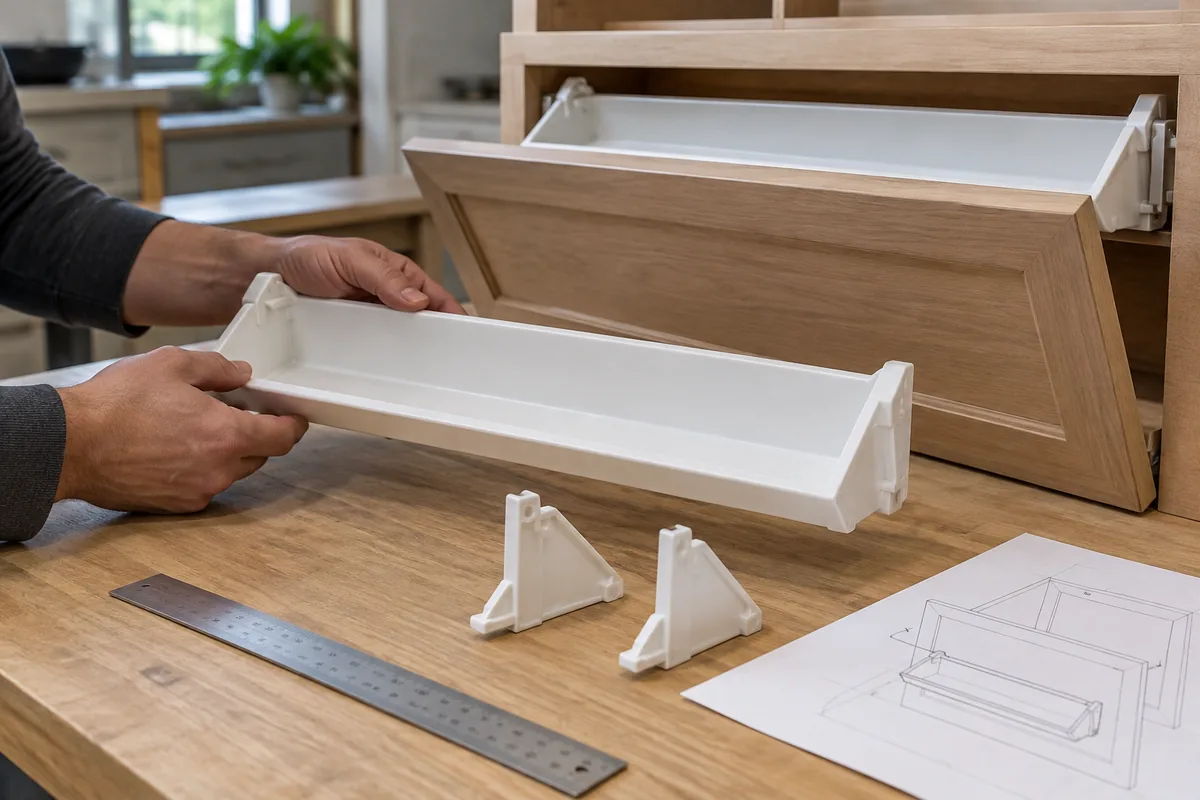
How should buyers verify product evidence and changes?
A manufacturer listing can establish the features and scope it publishes for a named model; it cannot prove that another supplier’s tray has the same interface or that the product fits a buyer’s cabinet. For example, Rev-A-Shelf describes a cut-to-size series with end caps featuring key-shaped holes for removal and cleaning. Hardware Resources’ listing for an individual replacement tray says the tray is sold separately from the hinges and hardware. These examples help frame questions about interface and package scope; they do not establish universal fit, material performance, hygiene suitability, or durability.
For a buyer comparing quotations, keep evidence in three categories:
- Published supplier fact: named model, drawing, stated package contents, or described release feature.
- Sample observation: what the identified sample actually did in the reviewed cabinet.
- Unverified assumption: any dimension, compatibility, force, life, cleaning-agent suitability, or replacement availability that is not documented for the quoted revision.
Ask the supplier to resolve assumptions in writing. Do not transfer a catalog dimension or feature from one manufacturer’s model to an unverified substitute.
A substitution should trigger a renewed interface review whenever it can change the mating geometry, release path, retention, material, or package scope. Even if the visible tray appears similar, a different end cap or support may affect whether it can be removed and reinstalled in the approved false-front assembly.
Record at least these items in the sample approval or change log:
- Approved supplier, model and component revision.
- Drawing or instruction revision used for evaluation.
- Tray and mating-hardware identification, including which parts are included in the order.
- Intended release and reinstallation sequence.
- Cabinet sample or interface dimensions used for the review.
- Observed clearance, access, interference and visible condition.
- Any deviation, its disposition, and the buyer or engineer who approved it.
- Which checks must be repeated after a supplier or component change.
This is a practical change-control framework, not a claim that a specific standard requires these fields. The buyer’s own quality plan and supplier agreement determine formal approval requirements.
Koitor Hardware’s verified expertise is custom metal bathroom and home-storage hardware, drawing and sample review, assembly discussion and flexible OEM production. Sink-front tip-out trays and their polymer end caps are adjacent sourcing subject matter; Koitor’s current manufacture of these specialist components is not confirmed. For this topic, the buyer can use Koitor’s home storage hardware manufacturing page to understand its relevant metal-hardware context, then share the specific component and assembly requirements through the contact page. A qualified component supplier should confirm any tray-specific polymer, hinge, retention or testing question.
Buyer checklist for removable tray sample approval
Before signing off the sink front tip out tray removable cleaning interface, confirm that the record answers each applicable point:
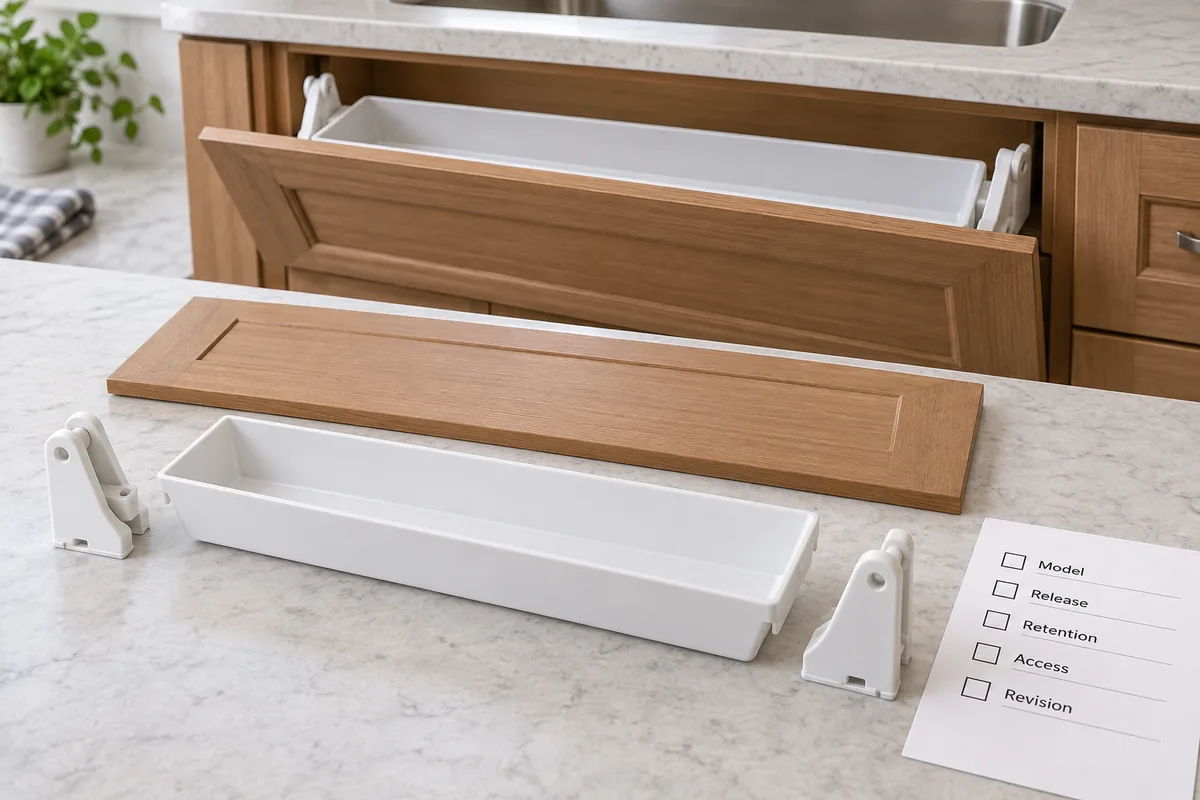
- Is the quoted item a tray alone, a replacement tray, or a complete kit?
- Are supplier, model, revision and included components visible on the approval record?
- Does the drawing show the actual tray-to-support engagement and release direction?
- Can the intended user reach and operate the release with the false front installed?
- Does the assembled sample retain the tray during the buyer’s defined normal-use demonstration?
- Can the tray be removed and reinstalled without undocumented prying or part modification?
- Does the tray return to the same intended position and orientation?
- Are the sink bowl, cabinet sides, plumbing and adjacent parts checked for interference?
- Are any force, cycle, cleaning-agent or material requirements documented and agreed with the supplier?
- Are deviations and substitutions linked to an approval owner and the correct drawing revision?
If a buyer cannot answer a point from a drawing, instruction, quotation or sample review, mark it open and assign an owner rather than filling the gap with an assumption.
Perguntas frequentes
Are all sink-front tip-out trays removable for cleaning?
No. Removability is model-specific. Review the exact supplier listing and instructions, then confirm the release method on the quoted sample. Do not infer that a cleaning feature on one product family applies to another.
Should the buyer order just the tray or a complete kit?
That depends on what the existing or planned assembly includes. A tray-only replacement may exclude hinges, end caps or mounting hardware; a complete kit may include several components. Compare like-for-like package scope and confirm compatibility before approval.
How can a buyer verify that a removable tray will stay in place?
Ask the supplier to identify the retention interface and intended use conditions, then demonstrate the quoted configuration on a representative assembled sample. Define a measurable test only when the buyer and qualified supplier agree on the method and acceptance limit; this guide does not set a universal force or life value.
Can an OEM factory confirm polymer-tray compatibility from a photograph?
A photograph can help identify visible parts, but it does not establish hidden engagement geometry, dimensions or supplier revision. Provide a drawing or physical sample and request the component supplier’s instructions for the exact model.
Trabalhe com a Koitor Hardware
Review a Home-Storage Hardware Interface With Koitor
Share your assembly drawing, sample, component scope, finish and packaging requirements. Koitor can review the related metal-hardware interfaces and customization questions while specialist tray suppliers confirm their own component details.
OEM / MARCA PRÓPRIA
Transforme este guia de fornecimento num resumo do produto
Indique o produto pretendido, as dimensões, o acabamento, a quantidade a encomendar e os requisitos de embalagem. A sua equipa receberá uma análise prática da viabilidade de fabrico antes da apresentação do orçamento.
 English
  Español
  Português
  Français
  Deutsch
  العربية