
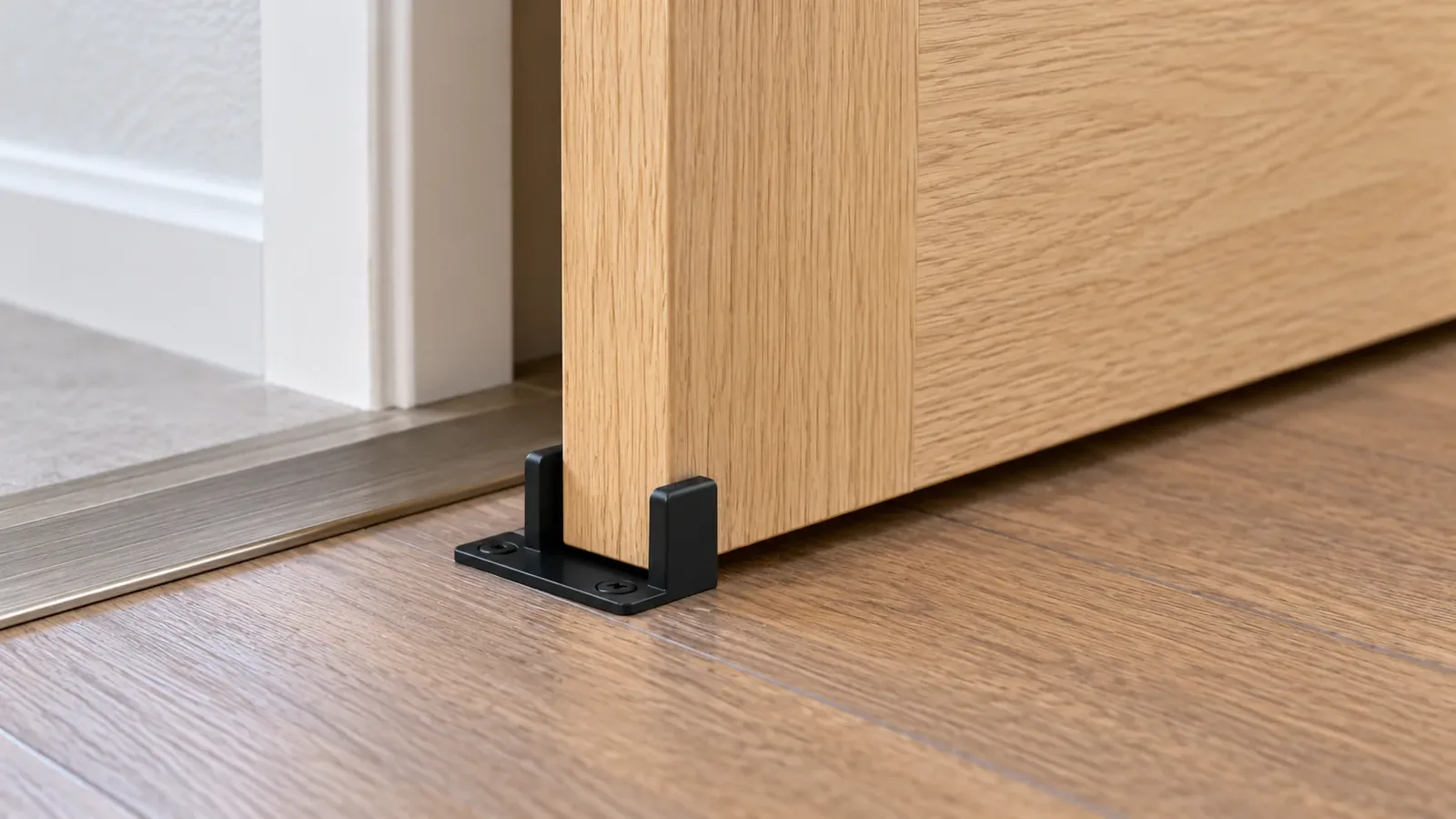
Buyer guide | Sliding storage-door hardware
Sliding closet door bottom guide clearance depends on more than nominal door width. Buyers should identify the guide family, door thickness, any routed groove, the finished floor or threshold condition, and the guide’s installed position as one model-specific configuration. Approve the actual door, guide and floor interface together before production or replenishment.
For importers, distributors and private-label product teams, “bottom guide” can describe different arrangements: a floor-mounted channel that captures the panel, a small guide entering a groove in the door, or a guide integrated with a particular track kit. These designs are not interchangeable by appearance alone. A guide that is too wide may project beyond a threshold; one that is too narrow or misplaced may not control the door as intended. The correct specification is the one matched to the selected door system and its installation instructions.
Why should a bottom guide be specified as an interface?
A bottom guide locates the lower edge of a sliding panel within a particular door-and-track arrangement. Its position and geometry must work with the door edge, the upper track, the floor finish and the opening. Treating it as a generic spare part can leave a mismatch even when the guide seems similar to the original.
Manufacturer documentation illustrates why model-level information matters. Johnson Hardware lists guide options by compatible door thickness and also identifies a cover plate for a routed door groove. Those catalog details are specific to the listed product family; they are not a universal dimension standard. Häfele’s Slido installation document likewise shows a model-specific floor-guide location and groove arrangement. Its instructions apply to that named system, not every closet or cabinet door.
For an OEM or private-label kit, keep the guide tied to the full product identity: door or panel model, track kit, guide part number, drawing revision and installation method. If the intended buyer sells several door thicknesses or frame variants, record which guide is approved for each one. Do not use a single “fits sliding doors” label unless the compatible configurations have been established.
Which door measurements should buyers provide?
Provide the dimensions that define the actual mating surfaces, not just the overall door width. A complete sliding closet door bottom guide clearance specification identifies the door thickness at the guide interface, lower-edge construction, any machined groove, finished-floor condition and required opening or travel envelope.
A useful drawing or RFQ can include:
- Door thickness at the guide, including any wrap, edge band or applied finish that changes the finished dimension.
- Door material and lower-edge construction, such as a solid edge, a frame member or a routed channel.
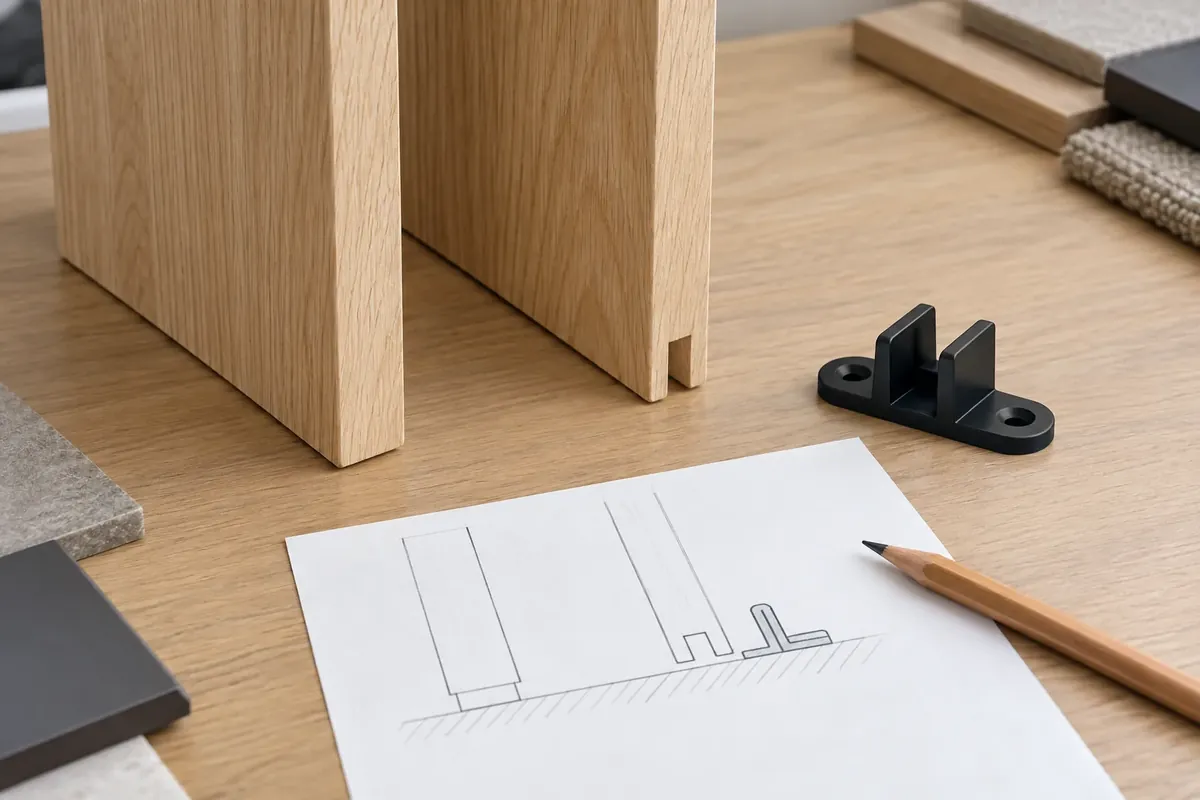
- Groove width, depth and location when the design uses a groove; reference the measurement from a defined door edge.
- The finished floor, threshold or carpet transition across the guide’s path.
- Guide type and part number, plus the selected upper track or kit identity.
- Required door travel and the position at which the lower guide must remain engaged.
- Installation method and any clearance envelope needed for fitting or adjustment.
These inputs help a supplier identify missing assumptions before sampling. The buyer’s drawing should state whether dimensions refer to the unfinished panel or the final coated, wrapped or edged panel. A small change in the finished door thickness can matter when a guide is designed around a narrow capture channel. Likewise, a groove measured from the wrong reference edge may put the guide off-center even when its width and depth match a nominal value.
Do not copy a dimension from a different manufacturer’s guide. Use it as a question to ask, then confirm the applicable value from the selected system’s drawing or instruction sheet.
How do groove-mounted and floor-mounted guides differ?
A groove-mounted guide follows a channel or slot in the door; a surface or floor-mounted guide locates the panel from below without relying on the same routed feature. The two approaches affect the door preparation, assembly sequence and replacement requirements differently, so the chosen design should be fixed before sampling.
For a groove-based arrangement, specify the groove’s width, depth, centerline and distance from the relevant edge. Confirm whether the guide enters the groove directly or whether a cover plate or insert forms part of the interface. The Häfele Slido document is a useful example of a product-specific installation sequence involving a floor guide and a prepared groove. Do not generalize its geometry to another kit.
For a floor-mounted arrangement, show the guide footprint and its position relative to the closed door, finished opening and threshold. Confirm whether the guide is intended to sit on top of the floor, attach to it, or use another specified mounting method. A surface guide may simplify panel preparation, but the floor finish and fastener or adhesive requirements still need to be defined by the system supplier.
A sourcing comparison should look at the complete installation, not just the unit price of the guide. Ask whether a selected design requires routing, a cover piece, extra assembly steps, additional hardware or a different replacement part. These factors affect the buyer’s product bill of materials, packaging and service parts.
How can buyers prevent a guide from projecting beyond a threshold?
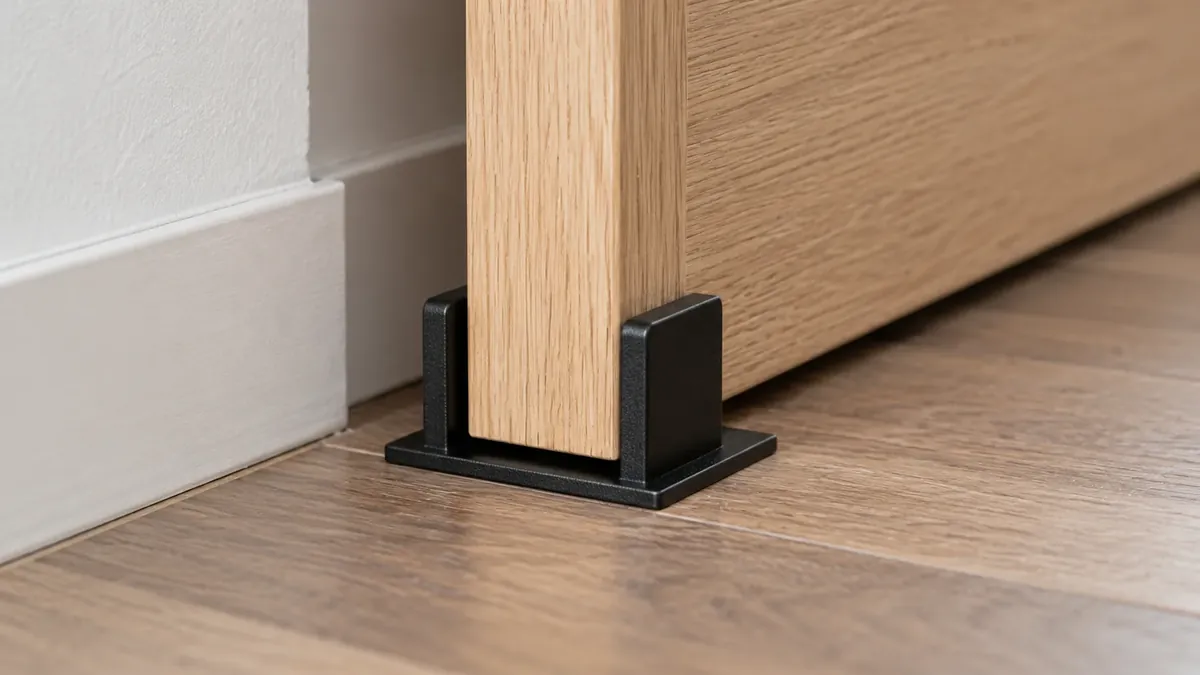
Check the installed guide against the finished floor and threshold in the actual opening. A nominal door-width check cannot show whether a guide footprint extends beyond a floor transition or sits where the moving door can engage it throughout its travel.
A user fit discussion can reveal the practical question: an added guide may protrude beyond a threshold even when it appears suitable for the door. That report identifies a possible interface problem, not a universal failure rate or a diagnosis for every installation. For sliding closet door bottom guide clearance, buyers can prevent ambiguity by supplying a section view of the finished floor, threshold and closed door, then reviewing the guide at both the closed and open positions.
Record the guide’s fore-aft position from a fixed datum, such as the opening edge or a named track reference. State the expected finished-floor height and whether the door is plumb under the installation conditions. If a project includes several flooring transitions, check the applicable installation case rather than assuming one position fits all.
What should the production-intent sample prove?
A production-intent sample should confirm the guide, door edge, track kit and floor interface together. It should show that the selected components can be assembled according to the supplier’s instructions and that the guide remains in the intended relationship to the moving panel.
Use a checklist that records the product model and revision, guide part number, door thickness, groove or mounting arrangement, floor or threshold condition and installation position. Then review:
- The guide identity and quantity match the bill of materials and carton list.
- The prepared door edge, groove or mounting face matches the approved drawing.
- The guide is installed at the specified datum and does not conflict with the threshold.
- The panel travels through the intended range while remaining engaged as designed.
- No part must be forced, bent or modified outside the approved installation steps.
- The sample photos capture the interface before and after installation.
A sample confirms only the configuration and revision examined. If the door thickness, groove, guide material, floor condition or mounting position changes, assess whether the interface needs renewed approval. A sample does not establish compatibility with every door system or prove long-term performance under untested conditions.
How should the replacement guide and kit be controlled?
Treat a small guide as a traceable kit component. Give it a distinct part number, define the quantity per door or opening, and make the replacement listing point to the supported door and track configuration.
Manufacturer catalogs can offer model-specific guide options, and installation documents can identify the guide as part of a defined system. Buyers should capture the same discipline in their own private-label documentation: use consistent names on the drawing, bill of materials, bag label, carton list and service-parts sheet. Avoid generic descriptions such as “small floor piece” when the kit includes multiple guide types.
For mixed-SKU orders, mark which guide belongs with each door thickness or groove configuration. If a replacement part is sold separately, identify the compatible model or revision and state what information a distributor should check before ordering. Do not promise indefinite spare availability unless the supply arrangement confirms it.
What belongs in the buyer’s acceptance matrix?
A concise acceptance matrix connects the door, guide, floor and installation evidence in one record. It gives purchasing, product development, quality and customer service the same reference when approving samples or repeating an order.
| Item | Buyer should record | Acceptance evidence |
|---|---|---|
| Door or panel | Model, revision, finished thickness and lower-edge build | Approved drawing and measured production-intent sample |
| Guide | Part number, type, material or finish where specified, quantity | Part identification and kit count |
| Groove or mount | Groove dimensions and datum, or floor-mount footprint and position | Drawing detail and installation photo |
| Floor interface | Finished-floor height, threshold transition and intended opening | Section view or representative installation setup |
| Track system | Compatible kit/model and installation instructions | Supplier document for the named system |
| Controlo de alterações | Which changes require review | Revision record and approved sample reference |
The matrix should distinguish a measured product requirement from a supplier’s recommendation. It should also state which party owns each drawing or installation instruction and how a revised component is approved. Record the measurement method and datum beside each critical dimension so the buyer, supplier and inspector compare the same feature. For example, note whether thickness is measured across an edge wrap, whether groove position is referenced from the finished lower edge, and whether guide position is checked from the opening or track datum. Keep sample photos attached to that revision record. This makes a later change easier to review and reduces the chance that a visually similar replacement guide is accepted without checking the interface again.
How does the topic connect to Koitor’s manufacturing knowledge?
Koitor’s verified experience is in bathroom and home storage hardware manufacturing, including practical metalworking, assembly and packaging discussions. The company’s current production of sliding-door guide assemblies is not confirmed. This guide therefore focuses on buyer-side interface definition and sample control, not a claim that Koitor manufactures this specific mechanism.
The same disciplined approach is relevant when sourcing metal storage products: define mating features, identify the correct revision and approve the assembled configuration. Buyers evaluating related metal storage projects can review Koitor’s fabrico de estantes metálicas de armazenamento à medida e OEM home storage hardware capabilities pages. For a project discussion, use the Koitor contact page.
Frequently asked buyer questions
Is a bottom guide universal across sliding closet doors?
No. Guide geometry and placement depend on the named door and track system, door thickness, lower-edge preparation and installation method. Confirm compatibility from the selected supplier’s documentation and an assembled sample.
Should the guide be specified by door width?
Door width alone is not enough. Include finished door thickness, lower-edge or groove details, track identity, floor and threshold conditions, and the guide’s installed position.
Can a guide that fits one door be used on another brand?
Do not assume so. Similar-looking parts may differ in capture width, groove engagement, mounting footprint or position. Use a model-specific compatibility record unless cross-compatibility has been confirmed.
What if the door has no groove?
Ask the system supplier which guide family is approved for that door construction. A surface-mounted design may be an option in some systems, but it must be checked against the track, floor and installation instructions.
When should the buyer approve a new sample?
Review again when a change could affect the interface, such as door thickness, groove geometry, guide part, track kit, floor condition or mounting position. Follow the named system’s change-control requirements.
Planning a Home Storage Hardware Project?
Send Koitor your drawing, sample, size target, finish requirement, packaging idea or order quantity. The factory team can review the manufacturability and discuss practical small-batch OEM options for metal storage hardware.
OEM / MARCA PRÓPRIA
Transforme este guia de fornecimento num resumo do produto
Indique o produto pretendido, as dimensões, o acabamento, a quantidade a encomendar e os requisitos de embalagem. A sua equipa receberá uma análise prática da viabilidade de fabrico antes da apresentação do orçamento.

 English
 Español
 Português
 Français
 Deutsch
 العربية