
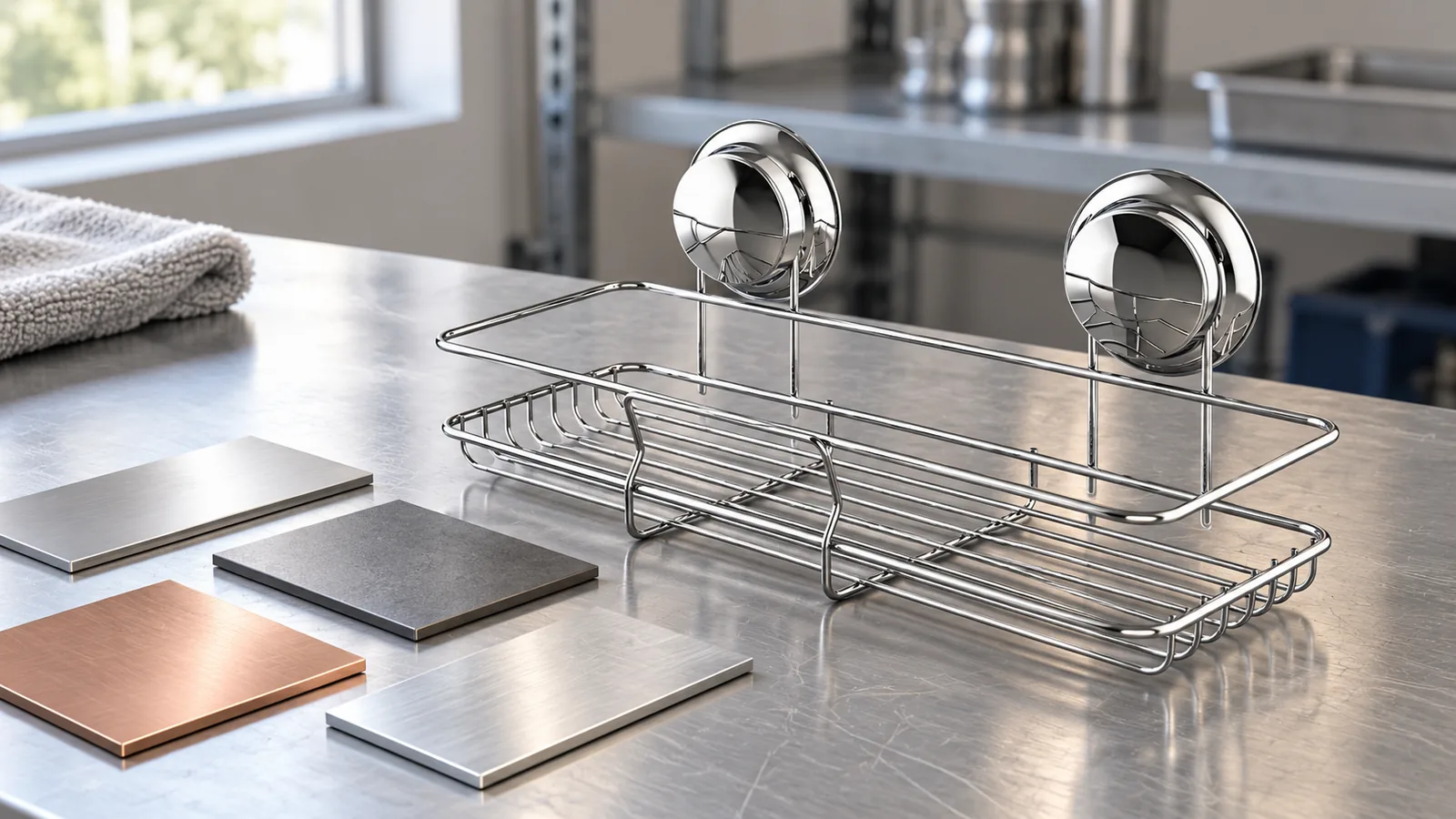
Material selection guide | Welded bathroom and storage hardware
Short answer: 304 vs 304L stainless steel is primarily a lower-carbon grade comparison, while dual-certified 304/304L stock is documented as meeting the requirements of both designations under a stated product specification. For a buyer, the right approval depends on the exact stock form, governing standard, fabrication route, service conditions and evidence supplied—not on the letter “L” alone. State those requirements in the RFQ and approve any proposed substitution against the same controlled criteria.
For a welded wire basket, shelf or towel-rack component, a quotation that says only “304 stainless” may leave important questions open. Does it refer to sheet, wire, tube or another product form? Which standard and edition governs? Is the supplier offering 304, 304L or a dual-certified product? What record connects the delivered lot to the claimed designation? These are specification questions that can be resolved before material is ordered.
The distinction matters, but it should not be overstated. 304L is not automatically stronger, easier to weld in every setup, or immune to corrosion. A dual-certified certificate is not a blanket approval for every temperature or application. The buyer should compare the offer with the part drawing and the project’s actual acceptance requirements. In a 304 vs 304L stainless steel review, compare these project inputs rather than treating one suffix as a universal upgrade.
What is the difference between 304 and 304L?
The key grade difference is the permitted carbon content. In common ASTM/AISI designation language, 304 allows a higher maximum carbon level than 304L; the British Stainless Steel Association describes maximum values of 0.08% for 304 and 0.030% for 304L, while some product standards state a 0.07% cap for 304. The exact limit must therefore be checked in the governing standard, not generalized from one chart.
The letter L means low carbon. Lower carbon is associated with reduced risk of sensitization during certain welding or heating exposures, especially when a welded area will later encounter a corrosive environment. That relationship is conditional: component thickness, time-temperature history, joint design, post-weld treatment, surface cleaning and service exposure all matter. It does not turn every thin welded bathroom component into a mandatory 304L application.
When comparing values, keep the material specification in view. “304” is a familiar shorthand, but an international order may also reference UNS numbers, EN grades, product-form standards or national equivalents. Approximate cross-reference tables are useful for discussion, not a substitute for contractual equivalence. Atlas Steels cautions that its listed grade comparisons are approximate and directs buyers to the original specifications when exact equivalence is needed.
| Pergunta do comprador | What to check | What not to assume |
|---|---|---|
| Which grade is offered? | Full designation and governing specification | That “304” identifies every requirement |
| Is the offer dual-certified? | The certificate states both designations and applicable criteria | That a supplier’s verbal “304L equivalent” is enough |
| What stock is being purchased? | Wire, sheet, strip, tube, bar or other form | That sheet data automatically apply to wire or tube |
| Is the material acceptable for the weld design? | Joint, section, exposure and qualified fabrication route | That the grade suffix alone qualifies the weld |
| Can a substitute be used? | Written acceptance against drawing and project criteria | That a chemically similar grade is contractually identical |
When should a buyer consider 304L for welded hardware?
Consider 304L when the design and service conditions make lower-carbon material a relevant control for the welded region. That can be especially important for heavier sections or components subject to sustained thermal exposure during fabrication and corrosive service afterward. The decision belongs to the design/material owner, using the applicable standard and specialist guidance for the actual construction.
Do not copy a thickness rule from a different application without checking context. The International Molybdenum Association gives an example for welded sections around 6 mm and above exposed to corrosive service; it is guidance for a defined condition, not a universal cutoff for a shower basket made from fine wire. Likewise, a data sheet describing heavy-gauge industrial components does not establish the requirement for every light-gauge consumer product.
For thin wire or formed sheet parts, a buyer should still define the grade, product form, surface condition and approved evidence. The fact that a section is thin does not eliminate the need for traceability or make the wrong substitution acceptable. It simply means the material decision should be proportionate to the product’s actual thermal and service exposure rather than driven by a generic “304L is always safer” rule.
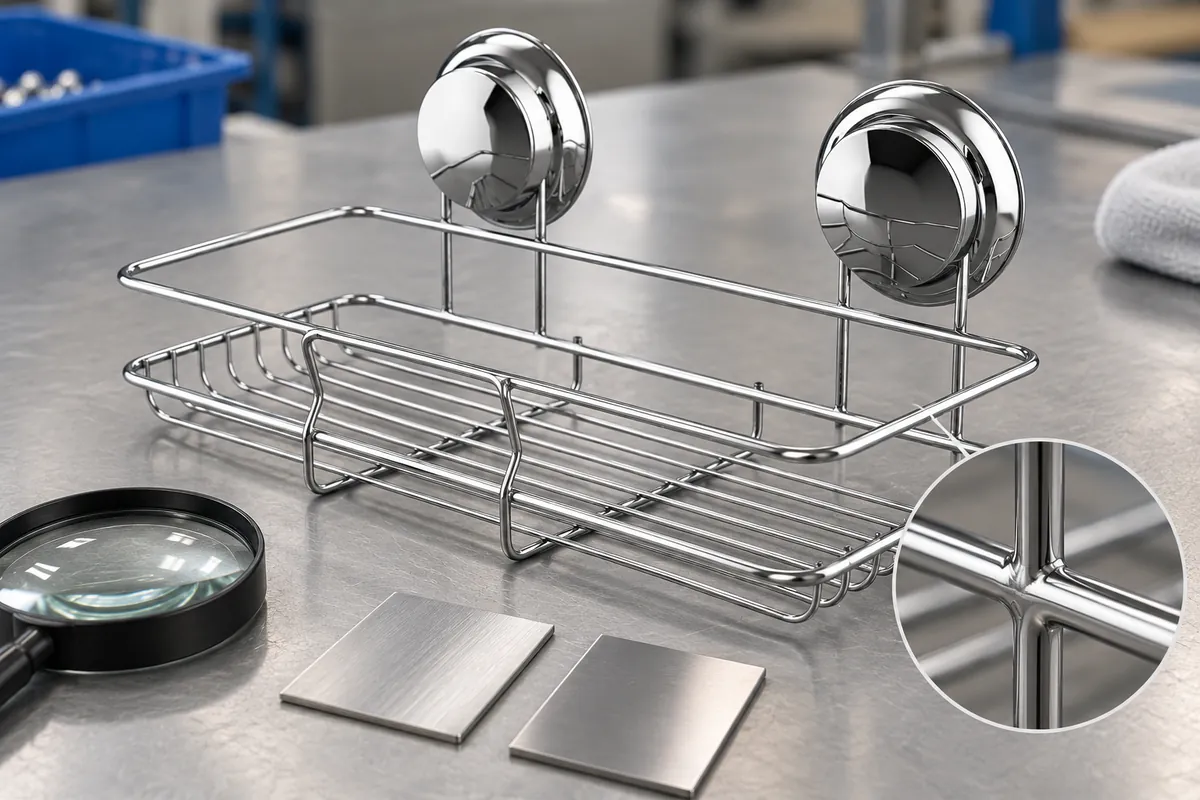
Fabrication variables remain relevant after grade selection. Fit-up, heat input, distortion control, finishing and removal of heat tint can influence the final joint and surface. The material designation addresses chemistry and specified mechanical properties; it does not by itself verify workmanship, surface cleanliness or finished-product performance. If corrosion near a weld is the concern, include the relevant joint and finish acceptance criteria in the product validation plan.
What does dual-certified 304/304L mean?
Dual-certified stock is one supplied product documented as complying with the specified requirements for both grades—not two materials mixed together. It may be convenient when a buyer’s material callout permits either 304 or 304L and the actual heat or lot meets the chemical and mechanical criteria for both within the stated product standard.
The wording must be supported by the supplier’s documentation. Ask the supplier to identify the material designation, product form, governing standard and revision, and to provide a material test certificate or other agreed lot record. Confirm that the record is traceable to the shipped stock and that any relevant project requirements appear on it. If a supplier says “dual certified” but cannot identify the two standards or the traceability basis, the phrase alone is not enough for acceptance.
Dual certification does not make all requirements interchangeable. Atlas Steels notes that dual-certified product can be unsuitable in some high-temperature applications. Its published mechanical and chemical tables are scoped to specified product forms and standards; the data for flat-rolled material should not be carried over uncritically to wire, pipe, bar or tube. Always review the document that applies to the stock you are actually buying.
| Offer received | Buyer interpretation | Suggested disposition |
|---|---|---|
| “304” with a named product standard | Single designation is stated; check all project requirements | Accept only if standard, form and records meet the RFQ |
| “304L” with a named product standard | Low-carbon designation is stated; confirm applicable properties | Compare with design needs and the contract |
| “304/304L dual certified” | Supplier claims compliance to both designations | Verify both criteria and lot traceability on documentation |
| “304 equivalent” without standard | The contractual basis is unclear | Hold for clarification; do not infer equivalence |
| Alternative grade or product form | Potentially a controlled substitution | Require buyer approval before material release |
Why do product form and standard matter?
Material requirements are not a single universal table. A chemistry limit may be shared across designations, while mechanical property requirements and available product conditions can vary with the stock form and the referenced specification. Wire for a welded basket, thin sheet for a bracket, and tube for a rail are not interchangeable simply because a sales description uses the same grade number.
The buyer should write the material callout so a supplier can quote the intended item. Include the grade and standard, stock form, dimensions or tolerances already defined by the drawing, relevant finish or surface condition, and the acceptable documentation. If a product has several components, identify which components have material requirements rather than putting one grade note over an entire assembly without a clear scope. That is the practical buyer question behind 304 vs 304L stainless steel: which documented specification applies to each component?
If an existing drawing uses only a generic “stainless steel” note, request clarification before tooling or sampling. The objective is not to prescribe a supplier’s process settings. It is to make the finished-product requirements and the accepted material basis testable and traceable. A clear callout reduces later debate when the quote, sample and production material arrive under different descriptions.
This is also where buyers can separate specification from verification. A test certificate can document reported chemistry and mechanical properties for a lot under a particular standard. It does not prove that a finished basket was made from that lot unless the supplier’s lot-control records connect them. A visual inspection can assess a sample’s shape and finish, but appearance cannot distinguish 304 from 304L. If independent material verification is required, define the method, sampling plan and responsible party with a qualified service provider rather than improvising a test from a photograph or magnet response.
How should a buyer review the material offer and certificate?
Review the offer against a short, repeatable checklist before approval. First compare the supplier’s exact designation and product specification with the controlled drawing. Next verify whether the material is single-grade or dual-certified. Then check that the documentation identifies the form and lot and that the purchase order requires approval before substitutions.
For a private-label program, record the accepted revision and keep the supplier response with the sample approval. If the material or supplier changes later, assess whether the change affects forming, weld fit-up, visible surface quality, assembly or corrosion requirements. Do not assume a replacement is acceptable solely because it carries a familiar grade name. The approved product and its records should remain linked through the next order.
Practical questions for the RFQ or quotation review include:
- Which exact stainless designation and product standard are you quoting for each specified component?
- Is the proposed stock 304, 304L or dual-certified 304/304L, and which two requirements does the certificate claim to meet?
- Is the document applicable to the actual stock form—wire, sheet, tube, strip or bar—and the delivered lot?
- How is the supplied material lot connected to the components used in the approved sample and production order?
- What process or design conditions make a low-carbon grade necessary for this specific welded region, if any?
- What change-control approval is required before substituting grade, stock form, source or condition?
These questions help importers and product teams compare offers without asking suppliers to guess. If the specification has a specialized service environment, unusual thermal exposure or critical weld, have the responsible materials or welding engineer define the acceptance basis.
Does 304L automatically mean better corrosion resistance or weldability?
No. 304L’s lower carbon can reduce the risk of sensitization in relevant thermal and corrosive conditions, but it does not guarantee that a finished product will resist every corrosion mechanism. Corrosion performance also depends on environment, surface condition, contamination, geometry, crevices, cleaning and fabrication history. Even the British Stainless Steel Association explains the lower-carbon grades in the context of specific temperature exposure and corrosive service.
Similarly, do not tell a buyer that 304L is always easier to weld. The BSSA notes that the common claim is not universally supported by a clear reason; forming and fit-up behavior can also influence how a part is held and joined. Weld quality depends on the joint design, process control, material thickness, fit-up and appropriate finishing. A grade choice cannot substitute for manufacturing validation.
Nor does “304L” promise permanent corrosion-free service. It remains a grade designation with defined composition limits. For a bathroom accessory, buyers should align material choice with realistic exposure and surface requirements, then verify the produced sample and agreed records. Do not select the L grade as a shortcut for an unresolved finish, contamination or design problem.
What should appear in a 304/304L RFQ callout?
A useful callout gives the supplier enough information to quote the same requirement the buyer intends to approve. A concise template can be adapted as follows: “Material: [grade/designation] to [standard and edition]; product form: [wire/sheet/tube/etc.]; component: [drawing item]; required document: [agreed lot record]; substitutions: prior written buyer approval.” Add any project-specific condition or verification requirement only when it is relevant and supported by the engineering owner.
If dual certification is acceptable, write that explicitly and state that the supplied lot must document compliance with both named criteria for the actual product form. If only one grade is permitted, state it. If the project does not require 304L, do not add it as a vague “premium” label that could complicate sourcing or inspection without improving the defined product requirement.
For multi-part hardware, the material note can distinguish wire baskets, mounting plates, tubes, brackets and fasteners. This prevents a single assembly-level shorthand from obscuring different stock forms or supplier subcomponents. It also makes quotation comparisons clearer: each supplier can respond to the same material scope rather than interpreting “304 stainless” differently.
Koitor’s approved company profile supports custom metal bathroom and home-storage hardware development from buyer drawings or physical samples. That makes the drawing, stock form, joining area and required material records useful inputs for an early feasibility discussion. It does not mean Koitor maintains every grade, issues mill certificates for every project or performs independent laboratory verification; availability and documentation must be confirmed for the specific order.
When requesting a quotation, share the controlled drawing or sample, intended application, component-level material callouts, surface finish, required records and any planned substitution rules. A sample review can then focus on fit, form, joints and visible finish, while material identity is handled through the agreed supplier documentation or a separate qualified verification route.
For broader context, review fabrico de acessórios personalizados para casas de banho. To discuss a specific drawing and material scope, contacte a Koitor with the relevant project details.
Perguntas frequentes
Is 304L always better than 304 for a welded basket?
No. 304L is relevant where lower carbon helps address a defined sensitization concern. The right choice depends on section, thermal exposure, corrosion conditions, product standard and design. Thin wire products should not inherit a heavy-section rule without review.
Does dual-certified 304/304L mean the supplier mixed two grades?
No. It refers to a single supplied product documented to satisfy requirements for both designations under the stated standard or standards. Verify the actual certificate and material lot.
Can sheet-metal data be used for stainless wire?
Not automatically. Product-form specifications can define different requirements and conditions. Use the standard and certificate applicable to the wire, tube, sheet or other stock in the order.
Can a buyer confirm 304L from appearance?
No. A finished surface or photograph does not establish carbon content or lot identity. Use appropriate supplier records and, if needed, a qualified verification method agreed in advance.
Should an RFQ allow a supplier to substitute 304 for 304L?
Only if the buyer’s design authority has decided that substitution is acceptable and documented the criteria. Require prior written approval and evidence matching the applicable product standard.
Technical references
- British Stainless Steel Association: comparison of 304/304L compositions and effects
- International Molybdenum Association: stainless steel grade FAQ
- Atlas Steels: 304, 304L and 304H grade data sheet
Discuss Your Material Specification
Share the controlled drawing, stock form, intended use and required supplier records so the project scope can be reviewed clearly.
OEM / MARCA PRÓPRIA
Transforme este guia de fornecimento num resumo do produto
Indique o produto pretendido, as dimensões, o acabamento, a quantidade a encomendar e os requisitos de embalagem. A sua equipa receberá uma análise prática da viabilidade de fabrico antes da apresentação do orçamento.
 English
 Español
 Português
 Français
 Deutsch
 العربية