
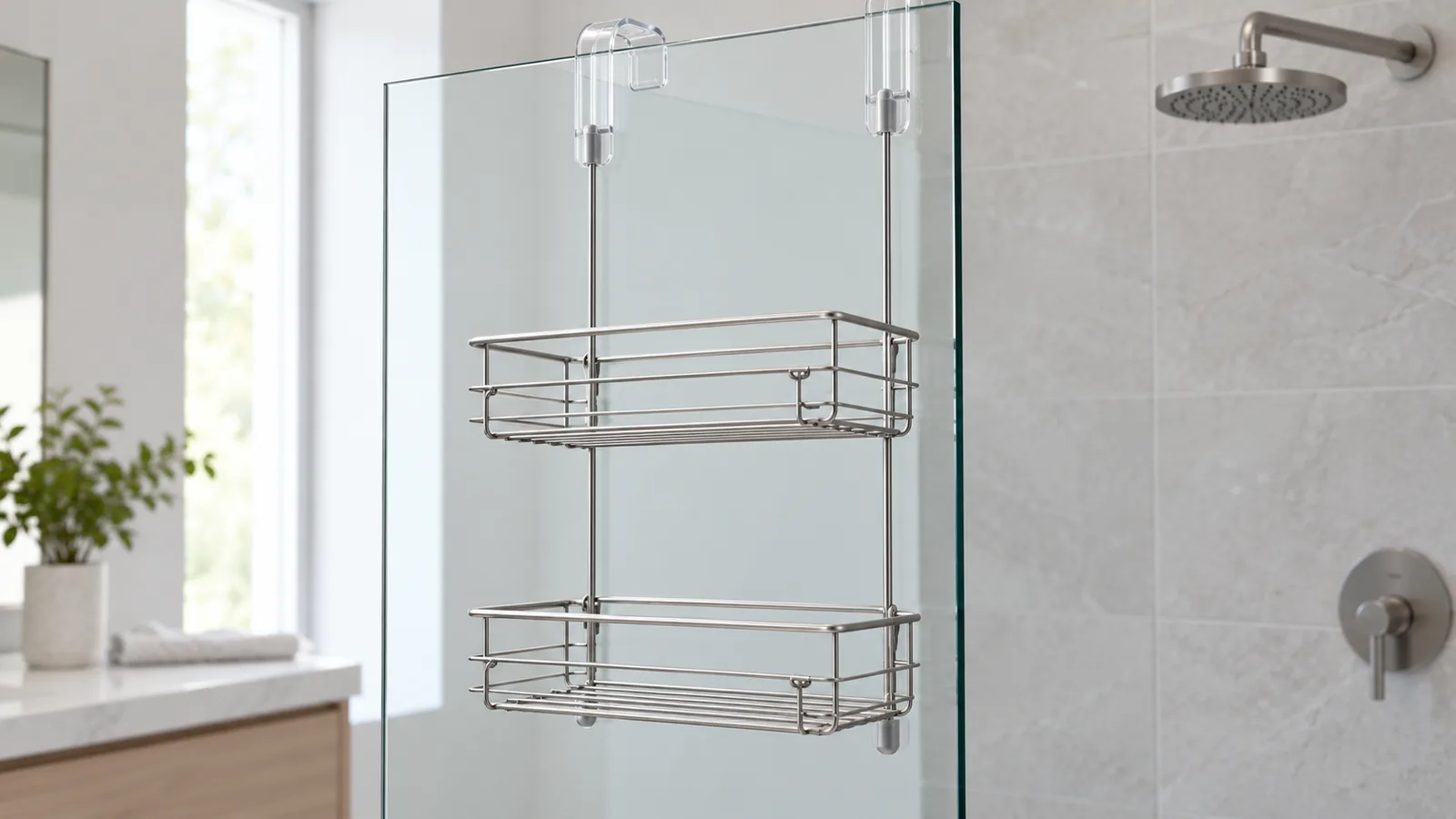
A shower caddy over door should be specified for a defined shower enclosure, not described as a universal fit based on the product name. Before approval, an importer should identify the panel or framed door, measure the relevant top edge and contact surfaces, map the door’s movement path, and check the complete caddy on a representative sample setup. Product pages show that hanger designs, adjustments and included contact parts vary by model; only a model-specific fit check can support a compatibility statement.
What does “over-door” mean for the buyer’s product?
An over-door caddy hangs from a shower enclosure panel or door through a hook, bracket or adjustable hanger. That description does not tell the buyer whether the product is intended for a framed or frameless panel, a hinged or sliding door, or a specific top-edge profile. These distinctions affect both the physical fit and whether the enclosure can still be operated normally.
Keep product architecture separate from generic hook geometry. The buyer question here is not simply “what hook radius should we use?” It is whether this caddy and its contact parts fit the defined shower-door interface without blocking the door, catching a seal, interfering with a hinge or creating unwanted contact with the panel. General hook design may need separate engineering review, but this guide focuses on the enclosure.
For a shower caddy over door program, define the tested door and panel configuration before choosing the product-page wording. A supplier proposal for one opening or panel style should not silently become a promise for a different enclosure family.
Current manufacturer listings illustrate why buyers should avoid transferring one model’s fit statement to another. Simplehuman describes an over-door hanger that adjusts and tightens over the door, while Better Living says its VENUS model works with both framed and frameless glass doors and includes silicone padding and suction cups. Those are descriptions of particular products and their own claimed configurations, not a shared industry standard or evidence that a new caddy fits every enclosure. See the Simplehuman product page e Better Living VENUS listing.
For a buyer brief, identify the intended configuration in plain language: “frameless hinged glass panel with a top edge and a specified seal profile,” for example, or “framed sliding shower door with a measured top frame.” If several enclosure types are intended, list each as a separate compatibility case. Avoid collapsing a broad target market into “fits most doors” unless that claim is supported by a documented range and actual checks for each included configuration.
Which enclosure details should an importer measure?
Build a compatibility matrix around the complete contact and movement interface. A single glass-thickness number is not enough where the caddy also contacts a top rail, frame, seal or protective pad. Measure the interface using a consistent reference and record the source of each measurement.
| Interface or use condition | What to record | Why it affects fit |
|---|---|---|
| Door or panel type | Framed or frameless; hinged, pivoting or sliding; fixed screen if applicable | Establishes the architecture the caddy must fit |
| Panel thickness | Measured thickness at the intended hanging zone | Helps define the opening available at the glass or panel |
| Top rail or frame | Overall profile, depth and local thickness where the hook rests | A frame can be thicker or shaped differently from the glass |
| Seal and sweep | Position, projection and material at the top or side contact zones | A hook or bracket may press on or catch a seal |
| Hinge and handle | Location and clearance envelope along the caddy and door path | Prevents collision during opening, closing or sliding |
| Overlap and adjacent panel | Panel overlap, fixed return, wall or second door location | Reveals interference that is not visible from one panel measurement |
| Caddy envelope | Hook opening, return depth, shelf depth and loaded projection | Connects the product shape to the enclosure and user space |
| Contact components | Pad, sleeve, spacer, fastener or suction part; location and replacement | Changes the interface and may affect movement or fit |
| Declared exclusions | Door types, profiles or configurations that are outside the approved range | Keeps product claims aligned with the sample evidence |
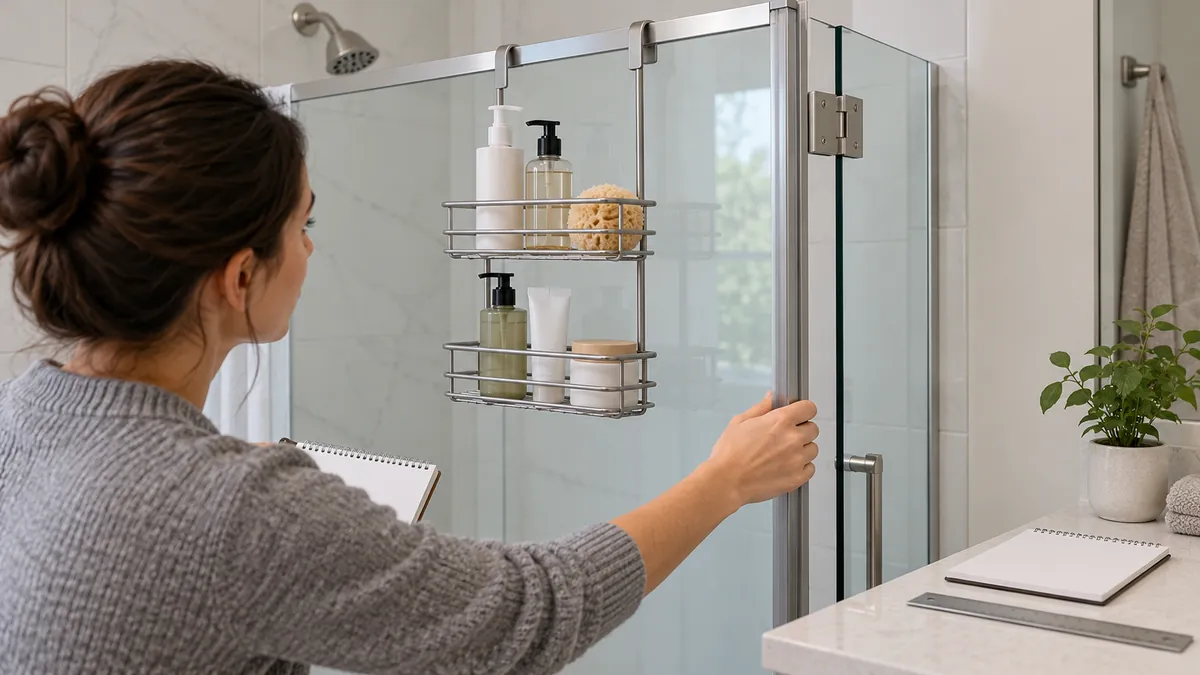
The measurement drawing should show where each dimension starts and ends. “Door thickness” can mean the glass alone, a metal frame, a seal-covered edge or a local combined stack. Ask the supplier and buyer to mark the same reference points on a sketch or sample photo before comparing quotes. If the installation includes a gasket or edge protection, state whether the measurement includes it and whether it remains in place during use.
Do not rely on a caddy’s nominal width or hanger opening alone. A hook might fit over the top edge but still collide with a wall return, hinge, handle or rail when the door moves. Conversely, a product may physically hang over the edge but be unstable or awkward once bottles are loaded. Fit involves both static geometry and the movement envelope.

How should the RFQ describe compatible configurations?
Ask suppliers to quote against a defined interface and a named sample setup. This makes offers comparable and helps prevent a generic “universal” phrase from becoming an unsupported listing claim later.
A useful RFQ should contain:
- Target enclosure types: identify framed and/or frameless panels, and whether hinged, pivoting, sliding or fixed-screen configurations are in scope.
- Measurement reference: show where panel, frame or seal dimensions were taken; attach an annotated drawing or photographs with a scale.
- Top-edge profile: describe corners, rail shape, protective trim and any local projections where the hanger will sit.
- Movement path: show the direction and extent of opening or sliding, plus nearby hinges, handles and overlapping panels.
- Caddy installation method: state how it is placed, adjusted, tightened, secured or removed, using the proposed instruction sequence.
- Contact components: list pads, sleeves, spacers, screws, suction parts or other items, and specify whether they are included or optional.
- Loaded configuration: describe the intended shelf arrangement and representative contents to use during the fit review. Do not state a load limit unless the supplier and buyer have defined the test method and acceptance basis.
- Surface and finish direction: identify the buyer’s required appearance, visible surfaces and any finish sample that needs approval.
- Compatibility language: tell the supplier which configurations must be tested and which exclusions should appear in instructions or product information.
- Packaging and identification: connect the approved caddy, contact components, instructions and drawing revision to the sample and order documentation.
Ask for alternatives as alternatives. A supplier might suggest a different hanger, pad thickness or stabilizing component. Each can change the fit envelope, installation steps, cost or appearance. Document what changed and retest the affected configuration instead of assuming that a visually similar part remains interchangeable.
A short compatibility matrix can use rows for each enclosure case and columns for panel/frame type, measured thickness, seal profile, door movement, installed clearance, loaded operation, included contact parts, exclusions and approval status. The status should refer to the sample and revision that were actually reviewed. Do not use one passing configuration to mark an entire product family as compatible.
How do contact parts and caddy position change the review?
Treat contact protection as a defined component and location, not as a vague promise that glass is protected. Pads and sleeves can influence spacing, friction, installation and replacement. Their presence does not by itself establish that a caddy is safe for every glass panel or every consumer installation.
During drawing review, mark where the hook, bracket, pad or stabilizing feature touches the enclosure. Check whether a pad stays in place when the caddy is installed or removed, whether edges can shift against the panel, and whether the contact point overlaps with a seal or rail. If suction cups or secondary stabilizers are included, list them in the bill of materials and instructions and confirm their intended surface and position; do not assume they work on all surface types.
The caddy’s depth and loaded center of mass also matter to the interface review. A caddy may sit close to the panel when empty but project farther once shelves are filled. The actual loaded configuration can change clearance to a wall, door handle, adjacent glass or the user’s path. The buyer should define representative loading for the sample check and avoid inferring a safe load from product weight, shelf count or marketing photographs.
Check that the proposed position does not obstruct normal access to the shower controls or create an unexpected collision as the door moves. This is a product fit and usability check for the intended enclosure, not a substitute for installation instructions or a structural assessment of the shower panel.
How should the importer test a pre-production sample?
Test the caddy on a representative enclosure or a dimensionally controlled fixture that reproduces the buyer’s specified profile. A table-top demonstration or a photo of the caddy hanging on an unrelated panel cannot verify the target configuration.
Use a documented sequence:
- Identify the sample and setup. Record the product revision, drawing revision, included parts, enclosure type, measured interface and date. Photograph the same setup before testing.
- Measure the interface. Confirm the panel or frame thickness at the hanging location, top profile, seal projection and nearby hardware. Record the tool and measurement reference.
- Install as instructed. Follow the proposed consumer instructions and note any extra force, tool or adjustment that is not described.
- Inspect contact points. Check where the hanger, pads and stabilizers touch. Look for trapped seals, displaced pads, unintended edge contact or a part that does not seat as drawn.
- Operate the enclosure. Open, close or slide the door through its normal path, including the final positions. Watch for caddy collision with a hinge, handle, wall, rail, sweep or adjacent panel.
- Repeat with the representative loaded caddy. Use the buyer-defined contents and shelf setup. Recheck movement and clearance, because product projection and position can change under use.
- Check movement and settling. Note visible shifting, rocking, rotation or contact changes during the agreed operation. Do not convert observations into an unqualified load or safety rating.
- Desinstale e reinstale. If the instructions expect removal for cleaning, test that sequence and confirm whether contact parts remain in place or need replacement.
- Review finish and components. Check the agreed visible surfaces, joints, pads and supplied hardware against the sample specification.
- Record a disposition. Approve the stated configuration, request a defined correction, or exclude the configuration. Attach the result to the sample and drawing revision.
A useful result is specific: “Reviewed on the stated framed hinged-panel profile with the named pad and loaded shelf arrangement; door completed its specified movement without observed interference.” That statement is bounded to the sample setup. It does not establish suitability for a different panel thickness, another seal profile or an untested door type.
What should the importer say about fit claims and production changes?
Make compatibility language traceable to the approved configurations. If only one panel type and one measured profile were checked, state only that scope. If framed and frameless versions are both being considered, record their separate sample setups and results. Product pages should not inherit broad compatibility claims from another supplier’s listing.
Keep the approved sample, drawing, component list, instructions and matrix connected. A revision to hook shape, opening, pad, shelf depth, finish build or included hardware may affect the fit. Decide which changes trigger a repeat check. A new carton insert can also change how pads or removable parts arrive, so confirm that the shipped kit matches the reviewed sample.
Keep evidence boundaries clear. A supplier catalog statement can help define a candidate configuration, but it is not the importer’s approval record. An individual review can reveal a question to test, but it does not establish how often a problem occurs. An empty-caddy fit check does not verify loaded clearance. One enclosure sample does not prove universal compatibility.
Koitor’s live custom shower caddy manufacturer page provides a product-category contact point for a buyer discussing a shower-caddy project. This article does not confirm that Koitor currently makes this exact over-door glass attachment, has a specific protective part or has tested the glass-fit configurations described here. Product-specific capabilities and evidence should be confirmed directly for each inquiry.
Quick RFQ and sample-approval checklist
- Name the enclosure architecture and movement type.
- Measure the panel, frame, seal and contact profile at the intended hanger location.
- Draw hinge, handle, wall, sweep, rail and adjacent-panel clearance.
- List the hanger and all supplied pads, sleeves, spacers or stabilizers.
- Define a representative loaded setup and installation sequence.
- Check the caddy on the target profile while operating the door through its normal movement.
- Record fit observations, exclusions, sample ID and drawing revision.
- Approve compatibility wording only for configurations actually reviewed.
- Recheck fit after any change to the hook, contact part, shelf depth or included component.
Frequently asked importer questions
Does a shower caddy over door fit every shower door?
No. Door top profiles, frames, seals, glass or panel thickness, hinges, handles and movement paths vary. Verify each claimed configuration against the product drawing and a representative sample.
Can an over-door caddy be used on both framed and frameless glass?
Some product makers claim that for a specific model, while others define different adjustments or limits. Treat framed and frameless as separate cases in the RFQ unless the supplier documents and demonstrates both for the exact design.
Is glass thickness the only measurement that matters?
No. The caddy may also contact a frame, top rail, seal or pad, and it can interfere with a hinge, handle, wall or adjacent panel. Measure the complete interface and operating path.
Do silicone pads prove the caddy is safe for glass?
No. A pad is a component in a particular design. Its material, placement, retention and instructions need review, and its presence does not establish universal glass safety or compatibility.
What should change after a design revision?
Recheck any configuration affected by changes to the hanger opening, return depth, contact parts, caddy projection, finish or installation hardware. Keep the new result tied to the updated revision.
Trabalhe com a Koitor Hardware
Review a Shower Caddy Project Brief
Share the caddy drawing or sample, target enclosure profile, finish direction, included components and packaging needs. Koitor can discuss general metal-product development questions; confirm capability for this specific over-door configuration directly.
OEM / MARCA PRÓPRIA
Transforme este guia de fornecimento num resumo do produto
Indique o produto pretendido, as dimensões, o acabamento, a quantidade a encomendar e os requisitos de embalagem. A sua equipa receberá uma análise prática da viabilidade de fabrico antes da apresentação do orçamento.
 English
 Español
 Português
 Français
 Deutsch
 العربية