
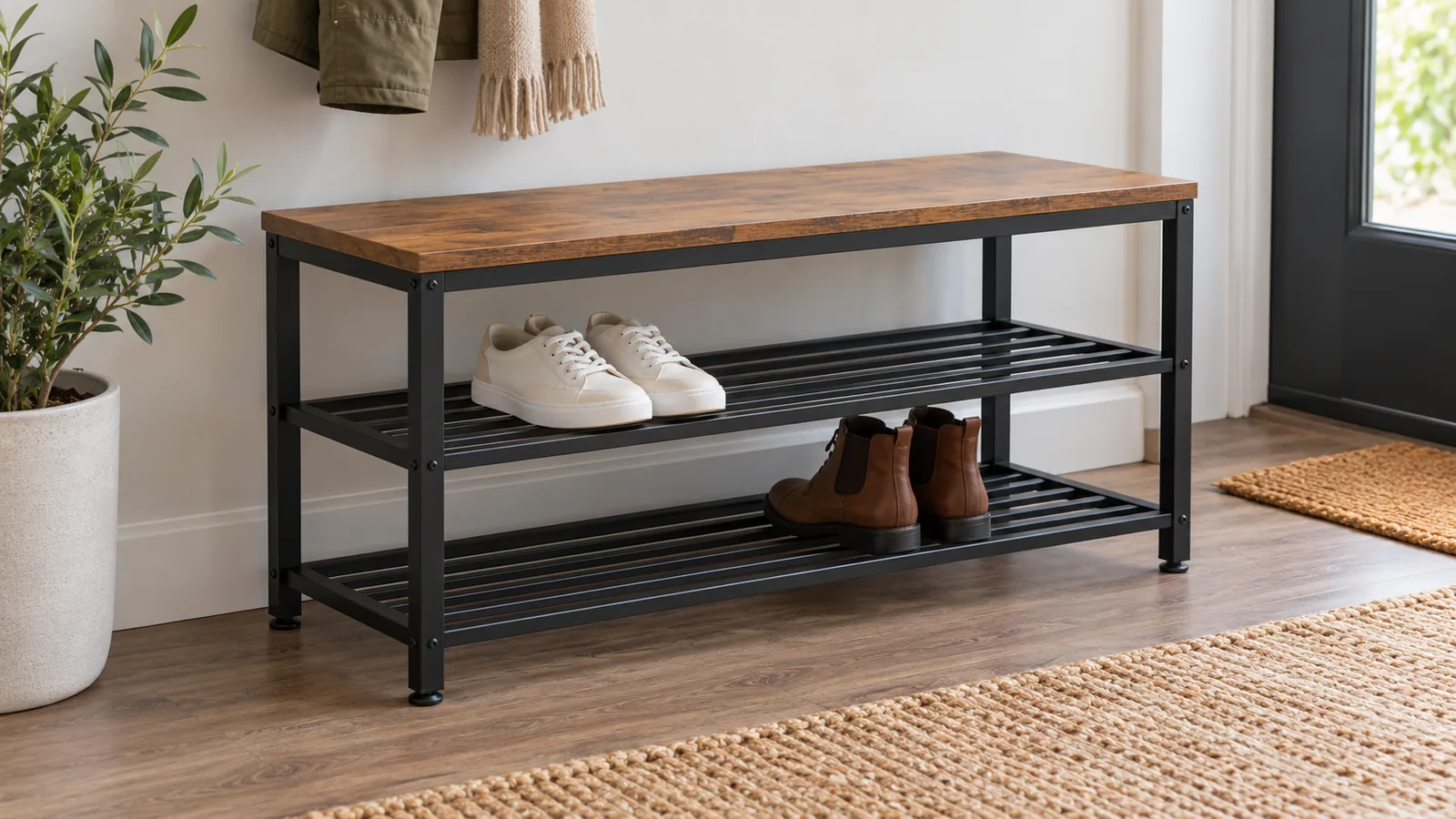
A shoe rack bench should be specified as two functions in one controlled product: a seat with a defined intended use, and a shoe-storage unit with named footwear and clear openings. Before approving a sample, record the entryway envelope, seat or top construction, frame-to-top interface, reference shoe sizes, shelf geometry, assembly kit, and carton configuration. A sample that looks right does not establish a safe seating capacity; any required structural evidence must be defined for the exact design and obtained from a qualified source.
What should an importer decide before requesting a quote?
The first decision is what the combined product is expected to do, and which parts of that promise need evidence. A shoe bench can serve as a place to sit while changing shoes, as a shoe rack, or as both. These uses create different requirements. A supplier cannot make comparable offers from the phrase “metal shoe bench” alone because it does not identify the top, frame, shelf layout, dimensions, finish, assembly or packaging.
Start with the assortment brief. State the sales channel and target market, intended room, expected product variants, and whether the seat is an everyday sitting surface or merely a top above storage. Avoid vague labels such as “heavy duty” or “large.” If a buyer needs the product to support a particular use, write that use and the required substantiation into the project brief. Do not copy a capacity number from another seller’s page: it belongs to that seller’s model and test conditions, if any.
Create one product record per SKU. For each record, identify the drawing or controlled reference image, revision date, top material and finish, frame material and finish, shelf count and construction, hardware kit, included accessories, labels, and pack-out. If the same frame is paired with two top finishes or different shelf arrangements, those are distinct configurations that need clear codes. A quotation, sample, approved drawing and carton specification should all point to the same code and revision.
The RFQ should also separate confirmed requirements from open questions. A useful format is “required,” “preferred,” and “to be reviewed,” with a named owner for every unresolved safety, regulatory or material-document request. This prevents a supplier’s assumption from becoming an unrecorded requirement. It also makes quotations easier to compare: each supplier answers the same product brief instead of interpreting a short product name differently.
How should the buyer define seat use and entryway fit?
Record the available floor footprint and the usable top dimensions separately. Overall width, depth and height describe the outside envelope; usable seat area describes the unobstructed surface where the intended user would sit. Note nearby doors, skirting boards, wall clearances, shoe cabinets and walking paths that can affect the actual placement. A visually compact bench may still interfere with a door swing or leave too little room to approach the shelves.
Specify the top construction rather than relying on a finish name. The top might be a wood-look board, a solid panel, a framed insert or another material. For the selected option, record thickness, edge treatment, corner shape, surface finish, visible faces, color reference and how the top attaches to the metal frame. If a board has a front/back orientation or a cosmetic face, mark it on the drawing. “Brown top” does not control grain appearance, edge finish or the location of fasteners.
Use the intended seating context to decide what must be reviewed. Is the product meant for one person at a time? Is it placed on a level indoor floor? Does the buyer require a stated capacity, durability test or a particular market document? Those are project-specific questions. Ask the responsible supplier or qualified testing party to identify the method, configuration, sample conditioning, acceptance criteria and report owner. A photograph, a heavier-looking tube or a successful assembly does not prove capacity. Koitor’s documented knowledge covers metal storage frames and project discussion, but current shoe-bench manufacture and seat-load testing are not confirmed.
Pay attention to how the top transfers its intended load into the frame. The drawing should show the number and position of fasteners, the attachment points, any brackets or cross-members, and the surfaces that meet. During sample review, check that the top sits in the intended position, fasteners can be reached with the specified tool, and there is no unexplained interference. If the buyer changes the top material, thickness, width, frame spacing or attachment, review the interface again; a change to one part can alter fit or assembly elsewhere.
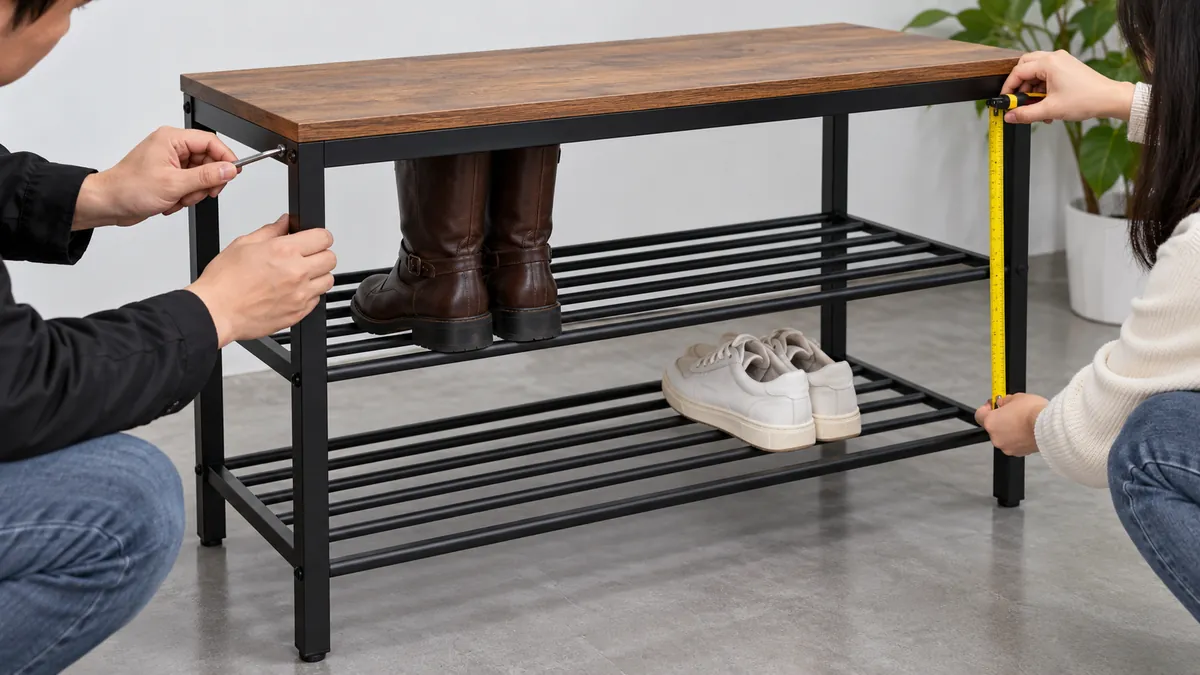
How can a buyer make shoe and shelf clearance measurable?
Define storage fit with reference footwear instead of relying on “fits most shoes.” Select representative items from the target assortment: for example, a low-profile shoe and the tallest boot the range is expected to accommodate. Record the measured length, width and height of those reference items, whether they are stored as pairs, and the intended orientation. The buyer should not assume that a shelf opening suitable for sneakers will also fit tall boots or bulky footwear.
For every shelf, distinguish the vertical clear opening from the usable depth and width. Measure between the surfaces that actually constrain the item, not merely the outside frame. If parallel rods form the shelf, record their spacing and the clear area between side rails. If a lip, crossbar, rear brace or side frame reduces the opening, show it on the drawing. A shoe can be short enough in overall length but still catch on a front rail or fail to sit flat across widely spaced bars.
Use a sample-fit matrix to turn these dimensions into an acceptance record:
| Buyer reference | Measurement or attribute | Sample question |
|---|---|---|
| Entryway location | Maximum width, depth, height and door clearance | Does the assembled unit fit the named space without blocking access? |
| Intended shoe pair | Length, width, heel shape and storage orientation | Can the pair sit within the shelf boundaries as intended? |
| Tallest intended boot | Height, shaft profile and toe projection | Does the clear opening accommodate the named boot without forcing it? |
| Top or seat | Usable width/depth, edge and surface reference | Does the top match the approved drawing and intended product variant? |
| Shelf geometry | Clear width, depth, vertical opening and bar arrangement | Are the actual usable dimensions consistent across shelves? |
| Model revision | SKU, drawing number and sample identifier | Are the measurements tied to the same approved configuration? |
Include the actual reference items or dimensioned silhouettes in the review when practical. If a buyer uses a digital envelope instead, identify its source and measurement basis. Write down whether the check is visual fit, measured clearance or a more formal product test. A sample-fit check answers a fit question; it does not establish structural performance, footwear compatibility across every brand, or a general quality rating.
What should the buyer inspect on the frame, joints and finish?
Review the frame against the drawing and intended assembly sequence. Check the leg locations, cross-members, shelf supports, corner geometry, floor-contact parts and any visible joints. For formed or welded details, define which surfaces are cosmetic, which edges must be smooth to the buyer’s stated standard, and which dimensions are critical to assembly. A buyer should not treat tube diameter, wire thickness, weld size or total product weight as a stand-alone measure of performance.
Inspect the top-to-frame and shelf-to-frame connections as interfaces. Confirm that holes align, fasteners are the listed type and size, the installation direction is clear, and the parts do not require an unapproved field adjustment. If a joint is hidden in normal use, record how it will be checked on the sample or production inspection. If a joint remains visible, specify the acceptable appearance and identify the viewing face. Avoid writing “perfect welding” without defining the relevant visual or dimensional criterion.
For finish, specify the substrate and finish option for each part, the color reference where applicable, and the faces that must be covered or left uncoated. Ask how the sample will be compared with the approved reference, including lighting and viewing conditions when color is important. Record any assembly clearance or masking area that could be affected by coating. A visual sample review can identify a mismatch in appearance, but it cannot by itself prove coating adhesion, corrosion performance or suitability for a particular environment.
If the product is intended for an entryway near moisture, state the actual expected environment: indoor dry area, frequently damp floor, coastal exposure, or another defined condition. Then ask the responsible technical party to review the material and finish evidence appropriate to that use. Do not infer corrosion resistance from a generic product title or from an unrelated seller’s material claim. Any test request should specify the method and what conclusion the buyer expects it to support; a test result has a defined scope and does not automatically prove long-term field life.
How should sample approval connect to assembly and packaging?
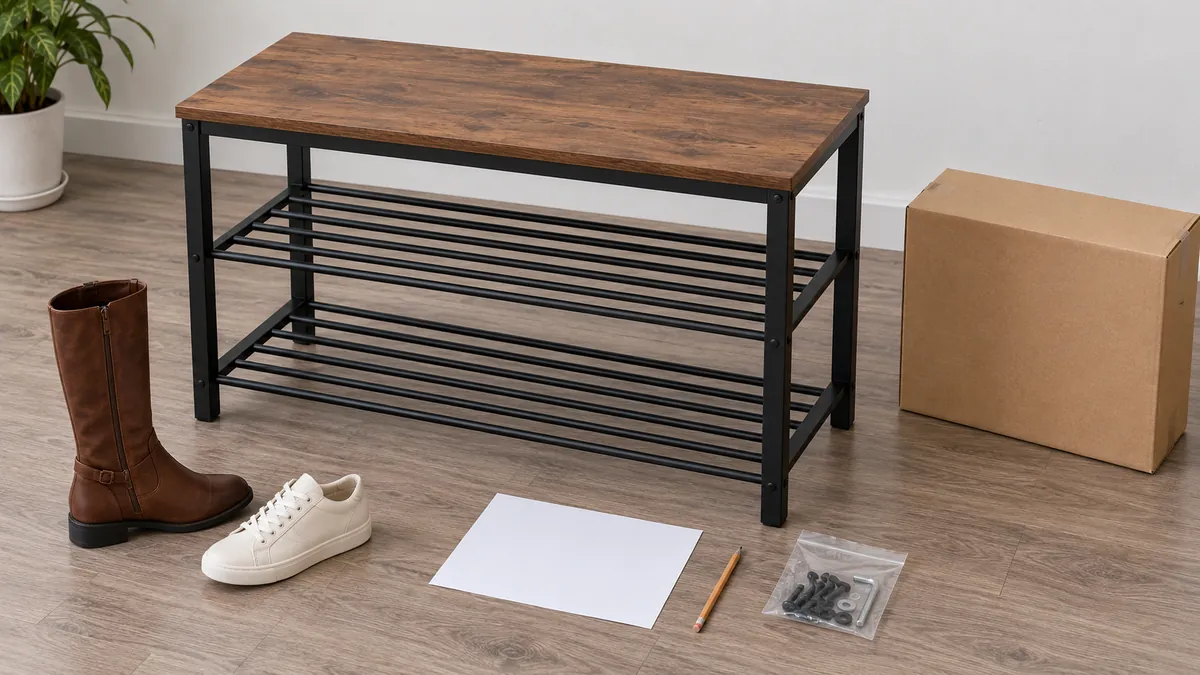
Approve the sample as a complete kit, not as an assembled display unit alone. Count and identify legs, shelves, top panel, braces, fasteners, feet, tools and instructions. Note whether fasteners are packed by assembly step, whether spares are included, and how the buyer’s private-label insert or barcode is applied. A complete component list makes missing parts visible before the item reaches a retailer or end user.
Observe the assembly sequence using the intended instructions and tools. Record whether two people are needed for a step, whether the frame must be squared before tightening, and whether the package protects the finished faces during assembly. These are observations for the approved configuration, not a guarantee that every user will assemble the product the same way. If the buyer changes a joint, screw or part count, review the instruction sequence and included kit again.
Packaging needs the same SKU-level control as the product. Specify whether the item ships assembled or flat-packed, the protection for the top and finished metal surfaces, separation between parts, bagging for hardware, carton orientation, label placement and the target pack quantity. Ask the supplier to provide actual unit-pack and master-carton dimensions and gross/net weights for the final configuration. Do not calculate freight or shelf allocation from a preliminary rendering or from a different model’s listing.
Where transport damage is a concern, define the buyer’s handling route and the test or inspection evidence needed. A carton drop or vibration method, if required, must be agreed for the particular package and acceptance criteria. Passing one test does not guarantee damage-free transport under every carrier, loading pattern or route. When cartons are stacked, consider how the top, frame corners and protruding hardware are protected from compression, abrasion and movement. The sample pack-out should be opened and reviewed, then linked to the same drawing and revision as the product sample.
Which sourcing shortcuts create avoidable approval problems?
The first shortcut is approving by overall appearance. A bench can look similar in a listing image while differing in usable top size, shelf opening, fastener access, frame geometry or pack-out. Tie approval to a dimensioned drawing, a named sample and written acceptance notes. If the buyer accepts a deviation, list it explicitly rather than assuming the supplier will remember a verbal discussion.
The second is borrowing a competitor’s capacity claim or supplier’s general statement. Those claims may describe a different product, support condition, test method or market. If the seat function requires proof, define the relevant load case and acceptance criteria with a competent party and keep the evidence associated with the exact revision. If the buyer has no evidence requirement, do not publish an unsupported number as a product promise.
The third is measuring only the outside size. Outside dimensions help with entryway planning, but footwear fit depends on clear shelf openings, and usable seat space depends on the top and frame arrangement. Measure both the product envelope and the relevant clearances. The fourth is treating a visual finish match as a technical performance test. Appearance, coating coverage, adhesion and environmental suitability are separate questions that may require different evidence.
The fifth is approving the product and packaging in separate rounds without configuration control. A frame revision may change how the bench fits in the carton; a thicker top may alter hardware length; an extra brace may affect assembly and packed dimensions. Record the revision on the sample, drawing, parts list, packaging specification and approval notice. When a change occurs, identify which checks must be repeated instead of assuming the earlier approval still applies.
How can an OEM supplier support a controlled review?
A capable supplier can review drawings, samples, dimensions, interfaces, finishing requirements and packaging questions within its confirmed production scope. Koitor Hardware is a family-owned custom metal hardware manufacturer with experience in bathroom and home-storage metal products. Buyers can use a project discussion to clarify metal frame details, drawings, sample revisions, finish expectations and pack-out questions; this does not establish that Koitor currently manufactures shoe benches or provides seat-load certification.
For an adjacent product such as a shoe rack bench, start by sharing the intended use, target dimensions, top and shelf concept, reference footwear, preferred construction, finish, target quantity and packaging route. Ask which elements are within the supplier’s demonstrated scope and which require another material, component or testing partner. A quote should identify assumptions and exclusions so that the buyer can compare it with other offers fairly.
Small-batch development can be useful when the buyer needs to review an assortment or sample before committing to a larger order, but flexibility depends on the specific design, material, process and supplier schedule. Ask whether any custom tooling or purchased components are involved, what sample round is included, how revisions are charged or handled, and what conditions would change the quoted price or lead time. Do not interpret a low MOQ or a free sample as proof of production capability.
The practical output of the review should be a small set of linked records: the RFQ, supplier quotation, controlled drawing, approved sample notes, component list, packaging data and unresolved evidence requests. Buyers looking for a relevant production scope can review Koitor’s home-storage hardware OEM information. This page explains the adjacent metal-storage context; it does not confirm shoe-bench production.
What should the buyer put on the sample-approval checklist?
Before approving a shoe rack bench, confirm that the team has documented the product’s intended use, fit, structure, assembly and pack-out. Use the following checklist for the selected SKU, then add any buyer-specific market or retailer requirements:
- Name the SKU, drawing number, revision and intended sales market.
- State whether the top is intended for sitting and what evidence is required for that use.
- Record the top material, thickness, surface, edge and frame attachment.
- Measure the overall entryway envelope and usable top area.
- Name representative low shoes and the tallest intended boot, with their relevant dimensions.
- Record each shelf’s clear width, depth, vertical opening and bar or panel arrangement.
- Check the frame, floor contacts, fastener access, included hardware and assembly sequence.
- Identify finish references, cosmetic faces, coverage expectations and any separate performance evidence required.
- Count every component and confirm the instructions and label for the sample revision.
- Verify flat-pack or assembled configuration, protective materials, carton dimensions, quantity and weights.
- Open the final pack-out sample and document any agreed deviations or outstanding questions.
- Keep supplier claims, buyer requirements and independently verified evidence clearly distinguished.
Does one sample prove every shoe will fit?
No. A sample can confirm fit for the named reference footwear and configuration. It does not prove fit for every shoe shape or brand. Use representative footwear or controlled dimensions and state the intended storage orientation.
Can another seller’s seat rating be copied into an RFQ?
No. A seller’s number applies to its own model and may depend on its design, support conditions and test method. Define the intended use and evidence required for the project; do not treat an unrelated listing as a universal benchmark.
Does a heavier metal frame automatically make a better bench?
No. Weight alone does not establish fit, strength, durability or finish quality. Buyers should review the specified geometry, connections, assembly, intended use and any required project-specific evidence.
Should a buyer approve packaging after product approval?
The buyer can review separate samples, but both approvals should refer to the same product revision and SKU. A change to the top, frame, hardware or pack-out can affect carton fit, protection and assembly, so record and review linked changes.
Can Koitor confirm it manufactures this shoe bench?
Current shoe-bench production and seat-load testing are not confirmed. Koitor can discuss relevant, documented metal-storage and OEM questions within its actual scope; buyers should confirm product-specific capability and any external testing responsibility before placing an order.
Trabalhe com a Koitor Hardware
Review a Custom Home-Storage Hardware Requirement
Share your drawing, sample, dimensions, finish, packaging plan and target quantity. Koitor can discuss the metal-storage requirements that fit its confirmed manufacturing scope and identify questions that need a separate technical reviewer.
OEM / MARCA PRÓPRIA
Transforme este guia de fornecimento num resumo do produto
Indique o produto pretendido, as dimensões, o acabamento, a quantidade a encomendar e os requisitos de embalagem. A sua equipa receberá uma análise prática da viabilidade de fabrico antes da apresentação do orçamento.

 English
 Español
 Português
 Français
 Deutsch
 العربية