
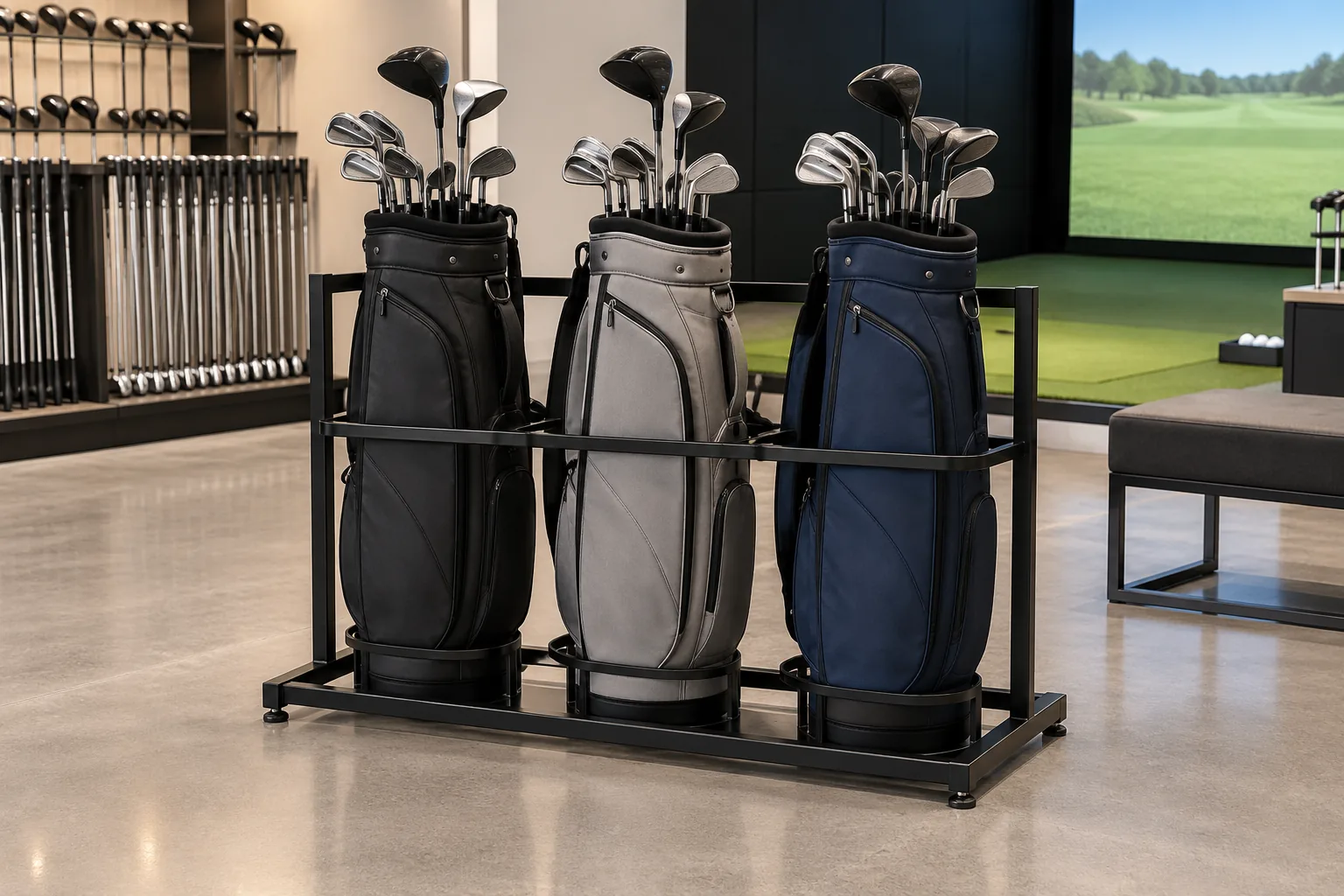
For procurement, the metal golf bag storage rack specification starts with the exact reference parts and intended arrangement. A metal golf-bag storage rack specification should start with the real bag geometry and the intended storage configuration. Buyers need to check how the bag base is supported, where side pockets project, whether stand legs fold or deploy in the rack, and whether adjacent accessories remain reachable. A listing that states a bag count does not establish that every bag model fits or that its pockets and legs remain accessible.
This guide is for importers and private-label buyers evaluating a metal floor storage concept. It does not recommend golf bags, establish a safe load or stability rating, or claim compatibility with a proprietary wall-track system. It gives buyers a way to define the interface before quotation and sample approval.
Why should the buyer start with a reference bag?
Golf bags vary in base outline, body diameter, pocket position, divider hood, straps and stand-leg arrangement. Even if two models are marketed for the same activity, their exterior envelope and access needs can differ. Choose representative bags from the intended assortment rather than assume that a generic image or one sample covers all future SKUs.
Record each reference bag’s maker, model, revision, dimensions and condition. Decide whether it is stored empty or with clubs and accessories, because the filled arrangement may change the bag’s shape and the space needed to reach pockets. If the rack is expected to hold multiple bags, identify which models share a bay and in what orientation. State whether a bag is lifted vertically into a ring, set onto a platform, leaned against a support, or secured through a strap or divider.
The Gladiator GarageWorks golf-caddy listing illustrates a product architecture combining bag support with storage for smaller items and a shoe shelf. Its catalog context demonstrates that buyers may evaluate the bag together with adjacent accessories. Its named wall-system attachment belongs to that product. It does not demonstrate compatibility with another system or prove universal bag capacity.
How do buyers check base and body support?
The base should meet the rack at the intended contact area. Compare the bag’s bottom outline with the platform, ring, cradle or other support shown on the rack drawing. Confirm that the bag does not rest on a small unintended edge or interfere with a frame member. If the design uses a perimeter ring, check its inside opening and contact height with the actual base. If it uses a platform, check the footprint and any lip or stop. Do not invent a minimum bearing width without product-specific engineering evidence.
Also examine the upper body. A lower cradle may keep a bag in position while a second contact point controls its lean, but the actual behavior depends on the geometry and loaded configuration. Buyers should identify the contact surfaces, protective pads or retainers, and the party supplying each part. Ask the supplier to document any purchased component and its revision. Avoid statements such as “will not tip” unless a qualified, product-specific assessment supports them.
A practical sample record can include:
| Interface | What to compare | Provas a conservar |
|---|---|---|
| Bag base | Outline, diameter, feet and contact face | Bag model and dated fit photos |
| Body support | Bag width at support height and intended lean | Drawing revision and contact points |
| Stand legs | Folded and deployed position | Use condition and clearance observation |
| Side pockets | Projection, zipper direction and opening path | Access check with reference bag |
| Top handling | Hood, clubs, straps and lifting path | Defined loading/removal sequence |
| Accessory shelf | Shoe or small-item dimensions and approach | Included-item list and fit record |
| Rack assembly | Joints, fasteners, pads and orientation | BOM and assembly revision |
| Mounting system | Named supplier and interface drawing | Separate compatibility approval |
These are comparison fields rather than universal dimensions. Populate the values from samples and controlled drawings.
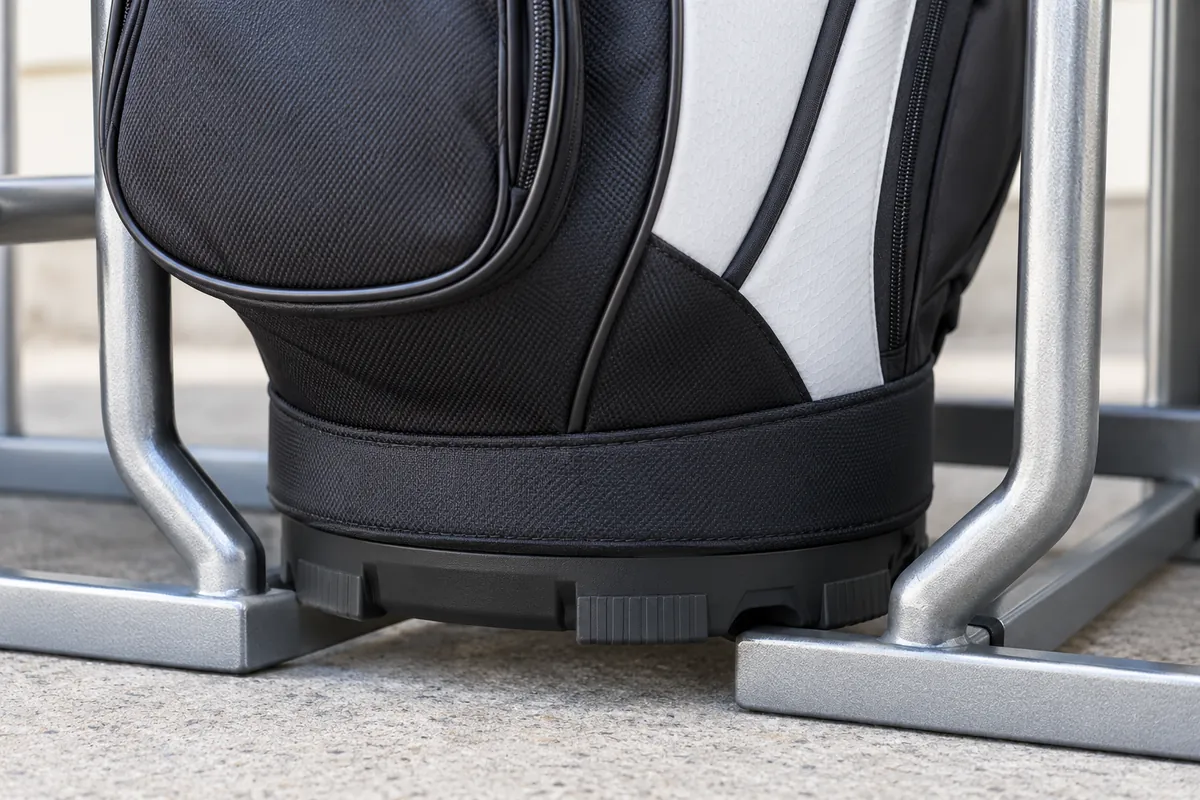
What is different about pockets and stand legs?
A bag may fit the frame while becoming difficult to use. Side pockets need room to open and withdraw the intended items. If the pocket faces a neighboring bag, wall, shelf or crossbar, the rack may technically store the bag but frustrate replenishment. Identify the pocket openings the buyer considers essential and check them with adjacent bays occupied.
Stand legs create another configuration question. Some bags have retractable legs that deploy when the bag is tilted; others may have distinct attachment points or leg shapes. Determine whether the rack expects legs folded or deployed. If folding is necessary, make sure the support does not obstruct the leg mechanism, press on a release part, or require the buyer to force the bag into position. Never claim that the rack preserves or protects a stand mechanism without testing the exact bag and design.
Check strap and hood movement as well. A top divider hood, shoulder strap or carry handle can extend above the bag body. Record the handling envelope and whether the user must rotate the bag before removal. A product image with an empty bag may omit the full assembly that dictates actual clearance.
How should accessory storage be specified?
A shoe shelf or small-item shelf is a separate interface. Specify intended items, quantity, dimensions and access direction. Ask whether accessories are included, sold separately or only shown in a lifestyle image. A shelf’s nominal width does not guarantee that footwear or a storage bin can be placed and removed when the bag occupies its bay.
If the rack contains hooks, straps, bins or an upper shelf, list each as an SKU or purchased component. Record its attachment method and any required wall rail or bracket. Do not imply fit with branded storage tracks because a similarly shaped hanger appears in a photograph. The official Gladiator catalog’s named system is product-specific; an importer must secure written compatibility for any different interface and must not copy protected hardware designs.
For products with multiple configurations, define the SKU matrix by the storage architecture: floor-standing versus wall-mounted, one versus multiple bag bays, accessory shelf included or omitted, and reference attachment system where applicable. Avoid combining variants under one generic description if the supplied parts differ.
How should the buyer assess access and use?
Inspect the complete rack with the intended bags and accessories in place. Load and remove each reference bag in the agreed sequence. Observe whether adjacent bags need to be removed first, whether pockets open, and whether straps or club tops catch. This is a usability observation for the specified arrangement, not a universal ergonomic or safety conclusion.
Record the floor footprint and surrounding clearance needed for the buyer’s own room layout. The rack manufacturer can provide product dimensions; the importer or project owner should assess the planned site and user route. Do not treat a product photo’s apparent spacing as a site-fit confirmation.
If the rack is shipped disassembled, confirm that assembly instructions identify orientation and fasteners. If it ships assembled, review how protective materials prevent finish-to-finish contact in the carton. Packaging should protect the product and separate loose parts, but no specific transit result can be promised without an agreed pack specification and relevant validation. Record substitutions to pads, straps, brackets, shelf inserts or fasteners before mass production.
For broader context about metal storage components, see Koitor’s fabrico de estantes metálicas de armazenamento à medida e Hardware de armazenamento doméstico OEM pages. These pages do not establish a current golf rack catalog or wall-track capability. Buyers can share drawings and samples through the contact page for a bounded metal-component feasibility discussion.
What belongs in the RFQ and golden-sample record?
Send the supplier a reference bag set, intended use configuration, rack footprint, room or bay constraints, accessory list, finish target and packaging requirements. Ask for a drawing showing support geometry, clear openings, shelf locations, assembly points and any retainer. Mark the exact faces that must remain visible and any areas where pads or brackets contact the bag.
Before approving the sample, record:
- Bag model, dimensions, condition and filled/empty state.
- Base support area and upper body contact points.
- Stand-leg position and deployment condition.
- Pocket access, strap handling and top removal envelope.
- Accessory shelf contents, orientation and access path.
- Floor-standing or wall-mounted configuration and supplier-specific attachment.
- Included components, purchased parts and SKU differences.
- Assembly method, fastener pack and drawing revision.
- Packaging configuration and loose-part identification.
- Approval date, reviewers and any accepted limitation.
When a bag supplier or rack supplier changes a model, repeat the relevant fit checks. An approved sample only represents the items and revisions recorded. It does not guarantee every bag in a size category will fit. A change to support width, pad thickness, shelf, strap, bracket or packaging can alter the interface and should trigger review.
How should a buyer compare variants without implying universal fit?
An assortment plan should make the differences between variants visible. One version may have a narrower support frame, another a shoe shelf, and a third a wall-specific attachment. Treat these as separate bill-of-material configurations and identify which reference bag set each one has been checked against. A shared product-family name does not mean the same accessories, hardware or clearances apply to every SKU.
Build a comparison sheet with fields for intended bag family, support layout, accessory shelf, mounting parts, finish, included hardware, carton quantity and sample status. Where a listing offers “one bag” or “multiple bags,” document the actual bay count and which sample arrangement was reviewed. Do not turn that configuration count into a weight capacity or a promise that all branded bags will fit. If the buyer cannot identify the exact reference models, label the range as unverified and keep the product copy narrow.
Variants also affect replenishment and after-sales handling. If hooks or straps are replaceable, identify their supplier and compatible revision. If a rack is supplied in multiple cartons, specify the number and contents for each SKU. If the buyer expects a replacement part, verify that it can be ordered separately instead of assuming the supplier’s standard assembly includes it. These details help distributors avoid mismatched parts and reduce confusion during receiving, without making claims about field failure rates.
What are the common review mistakes?
The first mistake is approving from a rendered picture. Perspective can hide the size of an opening, a contact edge or an accessory shelf. The second is checking only the bag’s empty base while ignoring its pockets, legs and top handling path. The third is using a single bag as evidence for an entire category. A sample is useful only when its identity and condition are recorded.
Another mistake is transferring claims from a catalog example. A wall-system attachment, bag count or stability statement belongs to the named supplier and configuration. It does not establish another rack’s interface. Similarly, seeing a shoe shelf in an image does not prove footwear is included or that a specific shoe size fits. Ask the supplier to separate observed facts, design assumptions and claims that require independent evidence.
When reviewers disagree, capture the exact point of interference and the item revision involved. A clear photo with a ruler or marked reference surface can support a drawing revision, but the photo does not replace dimensional control. Record whether the problem is a pocket blocked by a post, a bag base not seated, an accessory shelf obstructed by the stored bag, or a stand leg contacting the frame. A specific observation gives engineering and sourcing teams a practical correction to assess.
When is a rack ready for a buyer’s assortment?
The sourcing decision is ready when the buyer can identify the reference bag family, understand where the rack supports it, confirm how its pockets and legs behave in the intended configuration, and verify access to each included accessory. The listing should explain the included items and any system-specific attachment. Any capacity or performance statement needs its own product-specific evidence and approval.
A robust importer brief separates confirmed dimensions from open questions. It avoids converting one example bag into a universal compatibility promise and avoids transferring a branded supplier’s attachment or load claim to another design. This approach makes sample feedback actionable: the buyer can identify whether an issue belongs to base support, side clearance, stand legs, accessory access, packaging or assembly.
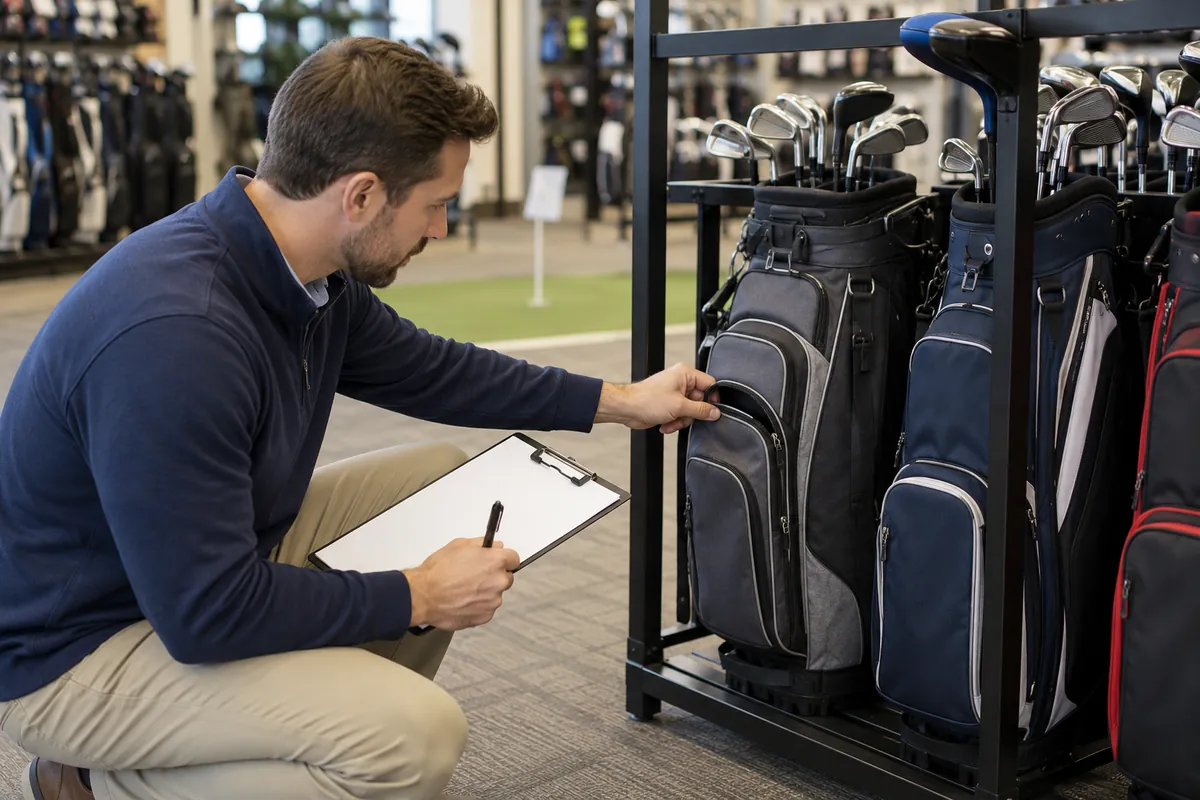
Source basis: Gladiator GarageWorks golf caddy e Gladiator hooks, baskets and bins assortment. These are examples of product architecture and catalog adjacency only; their attachment, capacity and performance data are not transferred.
Keep the metal golf bag storage rack specification tied to the named sample, drawing revision and included components.
Keep the metal golf bag storage rack specification tied to the named sample, drawing revision and included components.
Developing a Metal Storage Rack?
Share reference-item drawings or samples, required support points, accessory interfaces, finish expectations and packing scope for a bounded feasibility discussion.
OEM / MARCA PRÓPRIA
Transforme este guia de fornecimento num resumo do produto
Indique o produto pretendido, as dimensões, o acabamento, a quantidade a encomendar e os requisitos de embalagem. A sua equipa receberá uma análise prática da viabilidade de fabrico antes da apresentação do orçamento.



 English
 Español
 Português
 Français
 Deutsch
 العربية