
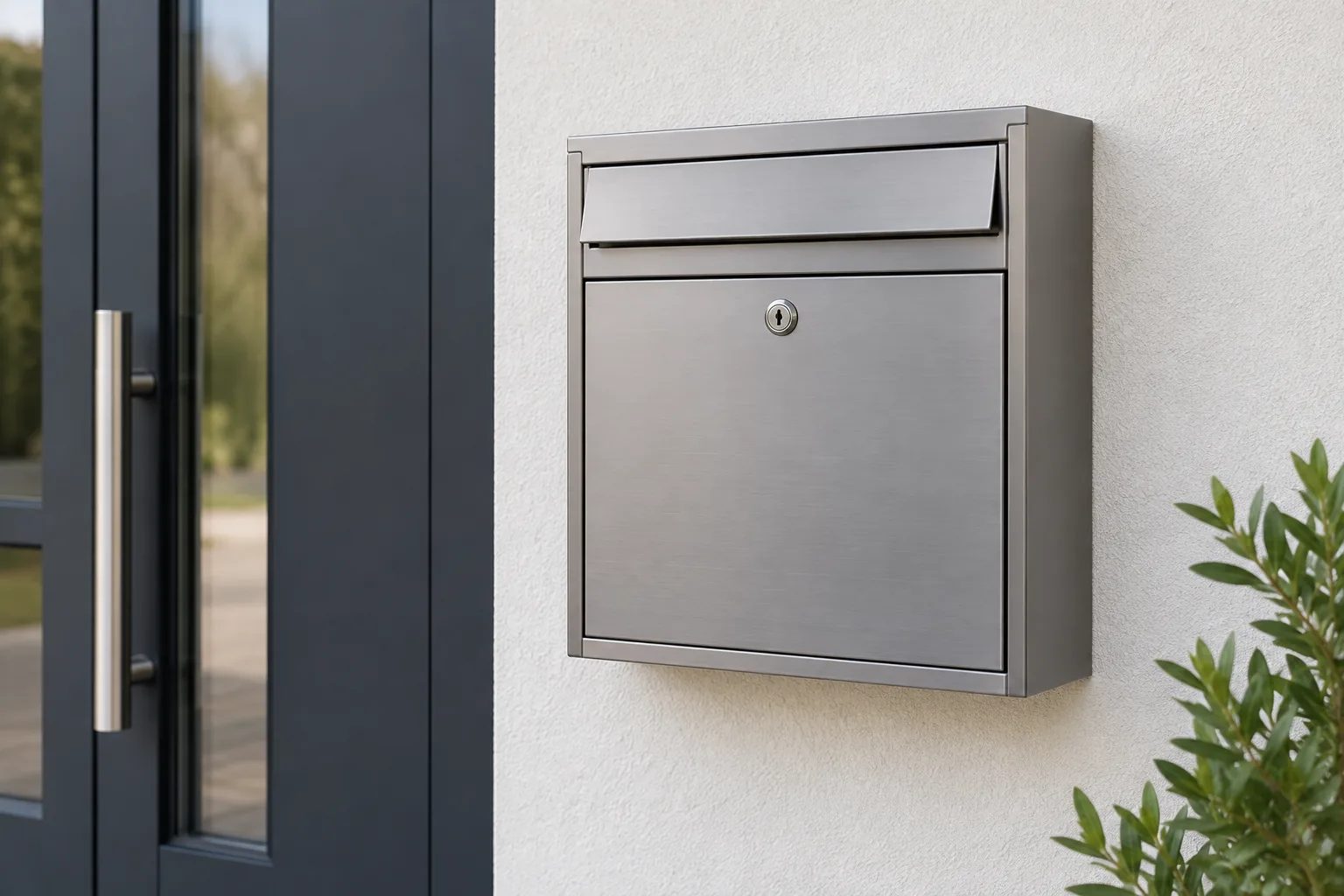
A metal letterbox buyer specification should identify the mail formats, deposit path, retrieval method and actual installation exposure before a sample is approved. “Mailbox” alone leaves unanswered whether an envelope must pass through a flap, whether parcels are excluded, how a recipient reaches the stored mail, and whether the proposed siting is sheltered or directly exposed. The buyer should approve the complete use sequence against the named model and installation location rather than infer performance from a coating description.
Which letterbox architecture is being purchased?
Start by defining the product boundary: a wall-mounted letterbox, a freestanding post box, an entry door slot with an interior collection box, or a combined deposit-and-retrieval enclosure. These arrangements have different mounting, access and service requirements. A product image may show the outer shell but not whether the mail enters through a front flap, top lid or door slot. The RFQ should state the intended architecture and whether keys, mounting hardware, labels or a stand are included.
The deposit and retrieval sides can be different interfaces. In one common arrangement, mail enters from the front through a flap or slot, while the recipient opens a separate locked door to collect it. That design should be reviewed as two paths. The slot needs to pass the target mail items; the collection door needs enough opening clearance for a hand to remove them without damaging the envelope or contacting a sharp edge. If both operations use one large door, the buyer should specify how unauthorized access is controlled, without assuming a security level that has not been tested.
Define the intended recipient and delivery pattern. A residential box receiving letters differs from a property manager receiving mixed items, notices or occasional larger envelopes. Do not assume the word “parcel” means any package will fit. List the largest intended mailpiece by dimensions and stiffness, whether it may be bent, and whether several items may accumulate before collection. If parcels are not part of the offer, state that prominently in product information and packaging.
The product boundary also includes ownership of the installation. The importer might sell the enclosure only; the retailer might bundle screws; or an installer may select anchors based on the wall. Decide which components are in the shipment and who validates the wall-fixing solution. A letterbox drawing should not quietly imply that one screw set suits every substrate.
How should buyers specify insertion and retrieval?
Specify the largest target mailpiece as a physical reference or a controlled dimensional envelope. Record width, thickness, stiffness, orientation and the approach direction. An envelope that passes when held flat might not pass if a flap or raised lip narrows the opening. A flexible flyer can behave differently from a rigid document wallet. Use actual samples when feasible and label the accepted formats by model or product family.
For a flap opening, record the clear passage after the flap is moved, not just the visible slot on the exterior. Note the direction of opening, hinge location, return behavior if relevant, and any restriction from a cover or surrounding trim. The buyer should review the mailpiece through the full route: approach, insertion, flap movement and closure. This is a fit review, not proof of weather sealing or forced-entry resistance.
For retrieval, load the enclosure with the agreed reference items and follow the intended collection sequence. Check door swing, key access, hand clearance and the path out of the opening. A shallow box can be easy to empty but may expose the contents; a deeper one can store more mail but make retrieval less convenient. These are design trade-offs to record, not universal rules about the “right” capacity.
An official BURG LETTER 5832 W product page lists model-specific opening and outer dimensions, describes a flap and gives a sheltered-installation recommendation for that product. The useful sourcing lesson is that opening, enclosure and siting are separate model details. The page does not define a universal letterbox dimension, guarantee weather performance for another construction, or replace the buyer’s check of the current version and installation guide.
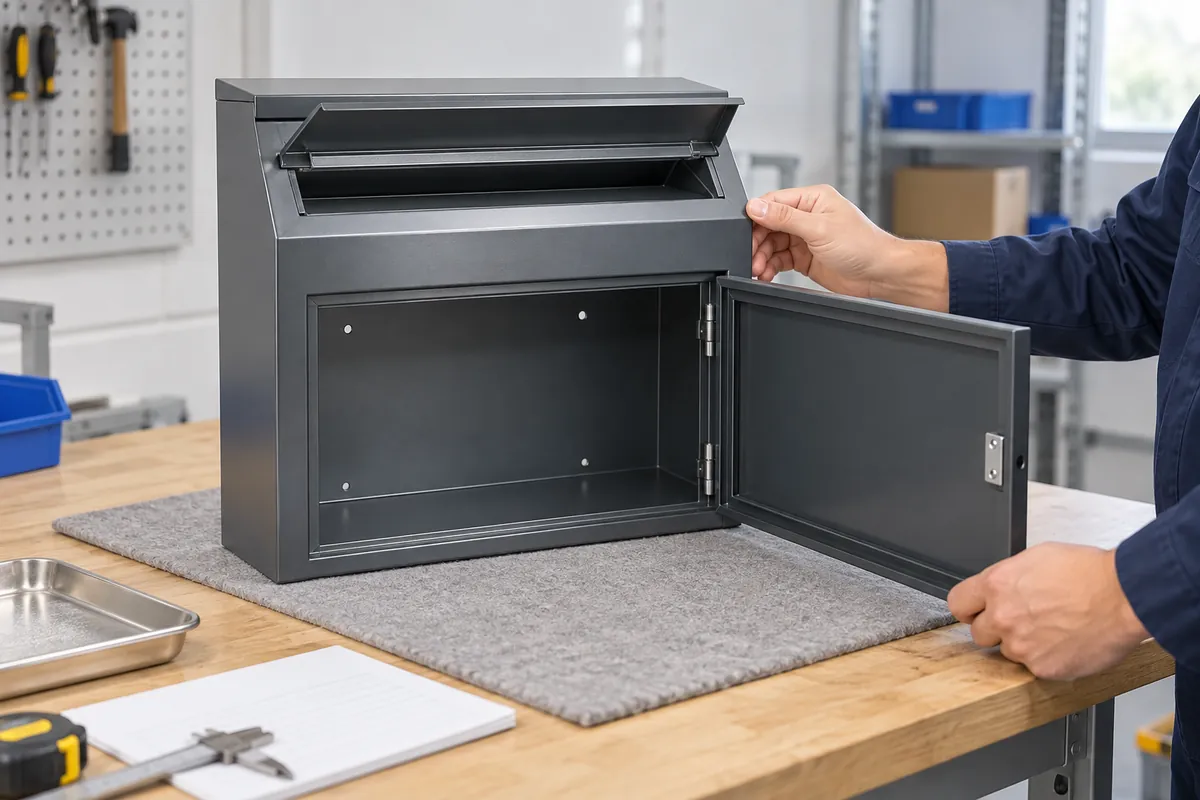
Use a sample to test the actual mailpath. Insert each listed reference item in the allowed orientation, close the flap or cover, then open the retrieval door and remove the contents. Record any snag, edge contact, collision, or need to rotate the item. If rotation is acceptable, state that as part of the intended user instruction; if a mailpiece must remain flat, make that clear in the acceptance criteria.
What installation exposure should the RFQ describe?
Describe the location in practical terms: fully indoors, inside a sheltered entrance, under a covered porch, beneath an open canopy, or directly exposed to rain and sun. “Outdoor” is too broad to define the conditions. The building overhang, wind direction, adjacent wall, drainage, cleaning practice and frequency of collection can all affect the way moisture and debris interact with the product. Buyers should not infer a rating from a material name or attractive finish.
Where the manufacturer gives installation guidance, preserve it in the sourcing file and consumer instructions. If a cited model recommends sheltered placement, that recommendation applies to that product; it is not a general statement that all coated metal letterboxes fail in exposed locations. Conversely, a coating description does not prove that water cannot enter the flap or that all joints resist corrosion. Specify the environment and ask the supplier to identify the basis for any environmental claim.
The buyer should identify the visible faces, underside, slot edges, hinges and fixings that matter for finish approval. A coating system may cover the external body while leaving other materials or parts in a different condition. The sample review should examine cut edges, folded returns, joints and the interface between dissimilar components. Do not call a finish “weatherproof” or assign a service life unless the exact supplier has supporting product-specific evidence and the buyer accepts the defined test or use conditions.
Installation instructions should identify the fixing points and the information the installer needs, while separating product hardware from substrate advice. The buyer may specify a mounting pattern, but wall anchors depend on the actual wall and are often selected by the installer. A product drawing can show the supplied screw, hole spacing and intended mounting orientation; it cannot confirm that an unknown masonry, timber or cladding substrate is suitable.
A complete metal letterbox buyer specification should connect the mail references, insertion path, retrieval access and installation location in one controlled record.
What should the drawing and sample record include?
Use a controlled drawing with an overall enclosure envelope, mail-slot clear opening, hinge axis, door swing, internal usable space and fixing pattern. Identify the datum for each measurement and mark any feature that affects insertion or retrieval as critical to fit. The drawing should match the intended revision of the sample and the supplier’s current product description.
| Requisitos do comprador | Evidence to record | Sample question |
|---|---|---|
| Mail format | Named samples and maximum envelope | Does each accepted item enter in its stated orientation? |
| Deposit path | Clear slot, flap movement and edge profile | Can the item pass without catching or being forced? |
| Retrieval path | Door opening, key access and internal reach | Can the recipient remove mail in the intended sequence? |
| Installation | Mounting pattern, orientation and location | Does the chosen location follow the product’s instructions? |
| Finish scope | Visible faces, edges and joint areas | Does the sample match the finish reference on relevant surfaces? |
| Included items | Keys, fixings, labels and instructions | Do the quotation, package and listing describe the same contents? |
| Revision control | Drawing, sample and model identifier | Can a later shipment be compared with the approved reference? |
Inspect the lock and key as an operational interface. Identify whether the lock is included, how keys are packaged, whether a spare key is expected, and what the recipient does if a key is lost. A demonstration that a key turns once does not establish security performance or long-term cycle life. If those claims matter, require an agreed product-specific evidence plan from the responsible supplier.
Check the condition of the door, flap, hinge and edges in both open and closed positions. If the design has a soft-return, spring or damping feature, identify its operation and its replacement responsibility. Keep such features out of the product description unless the actual model contains them. Request one approved reference sample or an agreed first-article approval record before bulk production if fit and finish are material to the launch.
Packaging review should protect the finish and preserve small parts. Confirm how keys and screws are kept with the correct model, how protruding hinges are protected, and whether the enclosure can rub against another unit in a multi-pack. Specify the carton label and item identification to support warehouse receiving. A strong-looking carton does not guarantee against transit damage; test the actual package using the buyer’s chosen protocol if that evidence is required.
How should supplier claims and sample deviations be handled?
Put every claim into a reviewable evidence field. If a product is described as suitable for a certain installation exposure, ask which model, location and instructions support that statement. If the claim concerns corrosion or water entry, request the relevant evidence and its limits. A product page can document what one supplier states, but it cannot verify an untested alternative design or establish Koitor capability.
Maintain a deviation log. Record the planned condition, the observed difference, the decision owner, the disposition and whether the drawing or packing list changes. A deviation to the flap opening may alter mail fit. A finish substitution may alter appearance or installation guidance. A key or screw substitution changes package contents. The buyer should approve or reject each specific deviation instead of relying on a general “equivalent” statement.
Do not allow a sample to become a moving target. Attach its model and revision, date the photos, and save the accepted slot dimensions, internal envelope and fixing pattern. If the supplier changes a hinge, latch, coating, panel or fabrication sequence that can affect the approved features, identify the change and repeat only the relevant checks. The purpose is controlled comparison, not testing every detail from scratch.
When a buyer has a new letterbox concept, Koitor’s published company context can help establish the factory’s current bathroom and home-storage focus, but it does not confirm a mailbox SKU, lock design or outdoor rating. Send drawings, material and finish needs through contacte a Koitor to ask whether the metal enclosure work is within its current capabilities. A capability question should be answered before the factory is treated as a product supplier.
The approved metal letterbox buyer specification should also identify keys and fixing components that belong to the sale, with excluded items named.
What should importers check before purchase?
Before quotation, supply the architecture, target mailpiece samples, installation location, intended recipient, quantity range, finish preference, package contents and destination-market labeling needs. Identify whether the supplier or buyer owns locks, keys, screws, anchors and instructions. If compliance, security or exposure claims are needed, name the evidence required and the exact product model covered.
Before sample approval, check insertion and collection with the actual mail references, flap and door operation, key access, installation orientation, visible finish, sharp edges and included components. Save a pass/hold/deviation record. Before shipment, verify the model and revision on the order documents, reconcile keys and fasteners with the packing list, inspect the packaging configuration and ensure the product instructions match the accepted use.
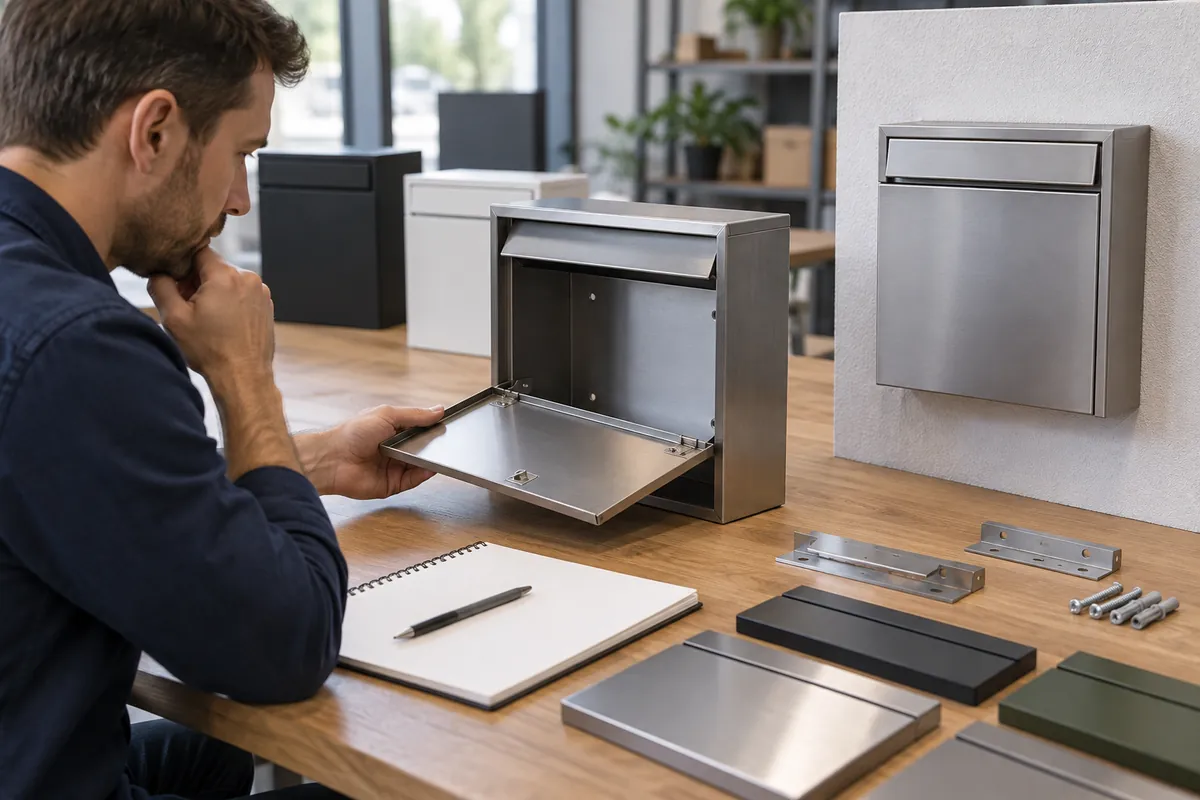
Use this checklist image to align the mail reference, opening, retrieval door and installation instructions before marking a model approved.
Does a coated steel letterbox automatically suit direct rain exposure?
No. Material and coating descriptions alone do not establish the performance of openings, joints, edges or the installation location. Use current model-specific guidance and evidence.
Should a letter slot be specified by its outside dimensions?
No. Record the usable clear opening and test it with the defined mailpiece. Exterior dimensions do not describe the whole insertion path.
Does a successful mail insertion check prove security?
No. It confirms only the specific fit criterion. Security claims require a relevant test or documented product evidence for the model being sold.
Who chooses wall anchors?
The sales specification should state what fixing hardware is included. The installer should select or validate anchors for the actual substrate unless the supplier has agreed a fully defined mounting system.
Reference example: BURG LETTER 5832 W demonstrates a model-specific opening and siting instruction; confirm current product details before using them in an offer.
Review a metal enclosure concept with Koitor Hardware
Send the drawing, installation context and target mail references. Koitor will confirm whether the metalwork fits its documented scope before a product capability is assumed.
OEM / MARCA PRÓPRIA
Transforme este guia de fornecimento num resumo do produto
Indique o produto pretendido, as dimensões, o acabamento, a quantidade a encomendar e os requisitos de embalagem. A sua equipa receberá uma análise prática da viabilidade de fabrico antes da apresentação do orçamento.


 English
 Español
 Português
 Français
 Deutsch
 العربية