
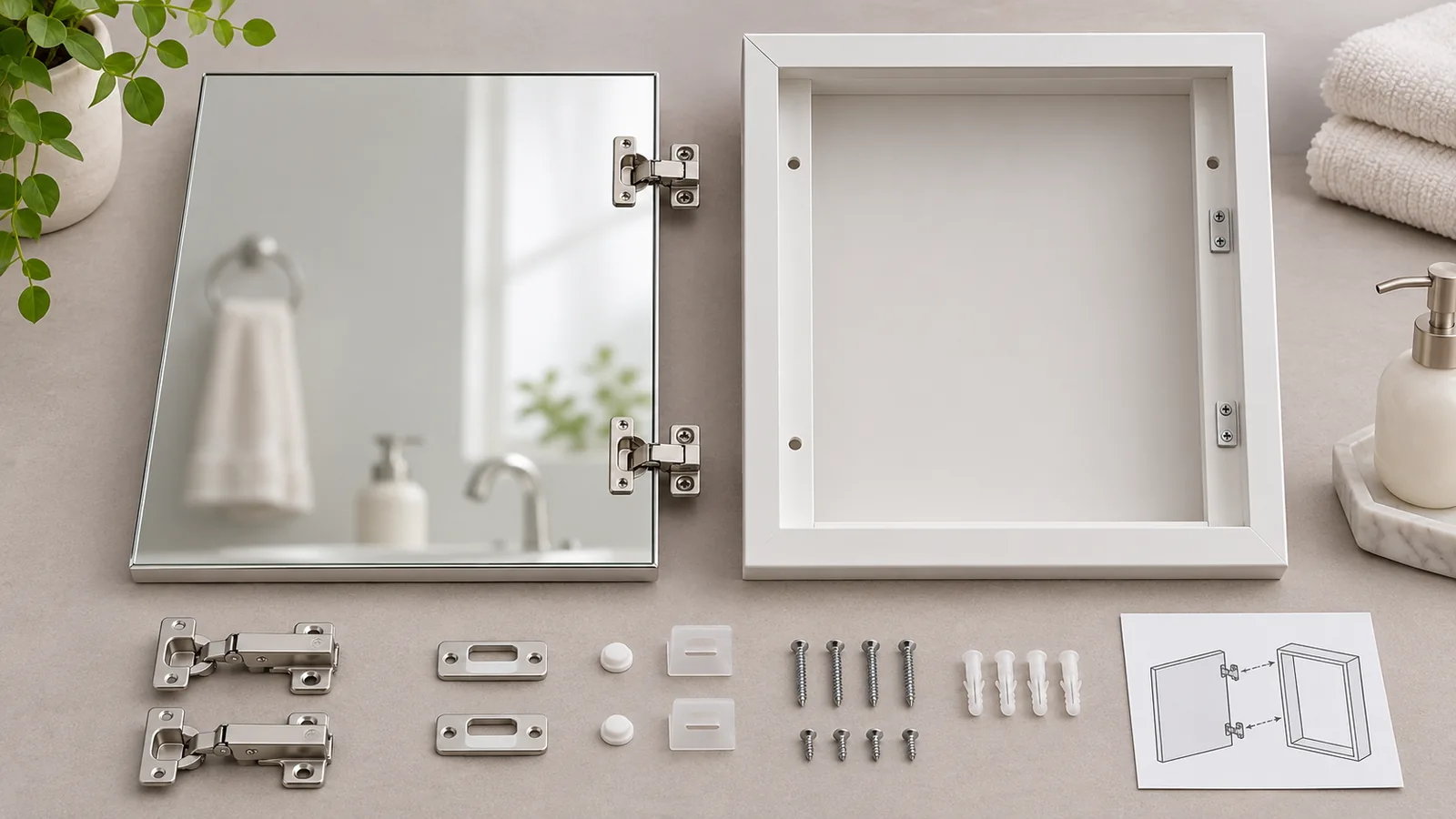
A replacement medicine cabinet door should be ordered against the exact cabinet model and door position, not by mirror width or appearance alone. A service part may be a mirrored door leaf, a complete door assembly with hinges, a hardware kit, or a model-specific assembly with an electrical connection. A distributor should confirm the orderable part number, cabinet revision, swing or handing, finish and included components with the cabinet maker before listing the part as compatible. If the model is unknown, keep the request open for identification rather than promising that a similar door will fit.
Why is a medicine-cabinet door a model-specific service part?
A medicine-cabinet door is one part of a cabinet assembly. Depending on the design, it may include a mirror, backing, frame or edge treatment, hinge leaves, opening hardware, a seal or a light connection. The service part could be just the door, a door-and-hinge assembly, or a complete replacement kit. The cabinet maker determines how it is supplied and what related components are required.
A visually similar mirror door may differ in width, height, thickness, edge construction, hinge position, swing, finish, number of doors or attachment method. In a multi-door cabinet, the middle and outer doors may not be the same. A nominal size shown in a retail listing does not identify the hinge interface or the cabinet revision. Confirm the part code against the actual cabinet model and its service documents.
Manufacturers themselves direct buyers to model-level identification. Kohler’s ELOSIS instructions state that buyers should contact customer service with the cabinet model number for body or door replacement. The instructions also list a specific family of cabinet models. Robern’s CL instructions cover named one-, two- and three-door model groups and explain that door shipments can include a defined hinge kit. Sterling lists a mirrored medicine-cabinet door as an orderable service part with its own product code. These examples establish that replacement doors exist as model-specific items; they do not establish cross-model or cross-brand fit.
The word “door” can hide different order scopes. A buyer may receive a mirror panel without hinges, a complete leaf with a hinge kit, a door with a connector or a broader assembly. A supplier photograph does not necessarily show everything included. Ask for a parts drawing or a written list of included and excluded pieces before approving a quote.
Some lighted cabinets have additional interfaces. A model’s instructions may include a door connector or service procedure, and electrical work is subject to the maker’s instructions and qualified personnel. This is not a universal feature. Do not assume a replacement door carries the correct wiring or that a non-lighted cabinet door can substitute in a lighted model.
For service-parts management, separate four statuses: original maker part confirmed for the exact model; manufacturer-approved supersession; specialist-supplier replacement documented for named models; and unverified candidate based on appearance or partial dimensions. Keep the status in product records and catalog language. “Fits most medicine cabinets” is not a valid substitute for documented model coverage.
This article covers identification, RFQ preparation and evidence control. It does not give instructions to remove or lift a mirror door, disconnect wiring, transfer bonded hinges or install a replacement. The cabinet maker or qualified service professional should handle physical work and confirm model-specific suitability.
What should buyers record about the cabinet and door?
Begin with the maker, exact cabinet model, series, revision, size code, door count and purchase or service reference. Locate the label or model marking according to the product instructions. A brand name or outside width alone is not sufficient. If a project has multiple cabinet types, identify each asset separately and preserve the model information in the buyer’s internal record.
Record which door is being replaced. It may be left or right, top or bottom in a special configuration, a center leaf, or one of several doors in a multi-door cabinet. Use the manufacturer’s diagram to identify position and swing. Do not infer handing from a photograph taken from an unknown side or from a customer using “left” in a different convention.
| Buyer field | O que fotografar | Por que é importante |
|---|---|---|
| Cabinet identity | Maker, model, series, revision and purchase record | Connects the door to the correct parent cabinet |
| Cabinet configuration | Door count, size code, lighted/non-lighted variant if documented | Identifies variant-specific assemblies |
| Door position | Left/right/center and location from the maker’s diagram | Prevents ordering another leaf from the set |
| Swing/handing | Maker-defined direction and viewing side | Affects hinge and assembly configuration |
| Original part | Door assembly code, hinge kit code or drawing reference | Supports exact manufacturer lookup |
| Concluir | Manufacturer finish code or approved sample reference | Keeps appearance separate from fit |
| Included items | Mirror, frame, hinges, opener, connector and hardware scope | Avoids an incomplete replacement |
| Service source | Manual revision, service page, supplier response and date | Creates a traceable approval |
| Unknowns | Mark unclear model, swing or connection as unresolved | Prevents assumptions entering the order |
Take photographs only as a supplement to the model and service record. A useful set may include the full cabinet, the door position, the visible hinge area, labels and the door edge. Keep images oriented and named so the supplier can tell which side is shown. A photograph may help locate an identifier, but it may not reveal the hidden hinge interface, mirror backing, connector or assembly details.
If the cabinet model label is missing, look for the original purchase record, project schedule, carton label, saved manual, maintenance ticket or installer documentation. Ask the maker what additional information it needs to identify the cabinet. If no authoritative source can confirm the model, mark the door as unverified and avoid a fit promise. Do not back-solve a model solely from exterior dimensions when several families share similar sizes.
Do not instruct an end user to remove the door to photograph a hidden hinge or connector. Some mirrored doors are heavy, and some lighted cabinets involve electrical components. If inspection requires physical access, refer the buyer to the product maker or a qualified service professional who can follow the exact manual.
Separate the observed fault from the requested part. A cracked mirror, failed hinge, loose opener, lighting problem or damaged cabinet body may have different service solutions. The buyer should ask whether the maker sells the door alone or expects a complete assembly or service kit. A full door replacement may not be the correct remedy for a hinge issue, and a hinge replacement may not solve damage to the cabinet body.
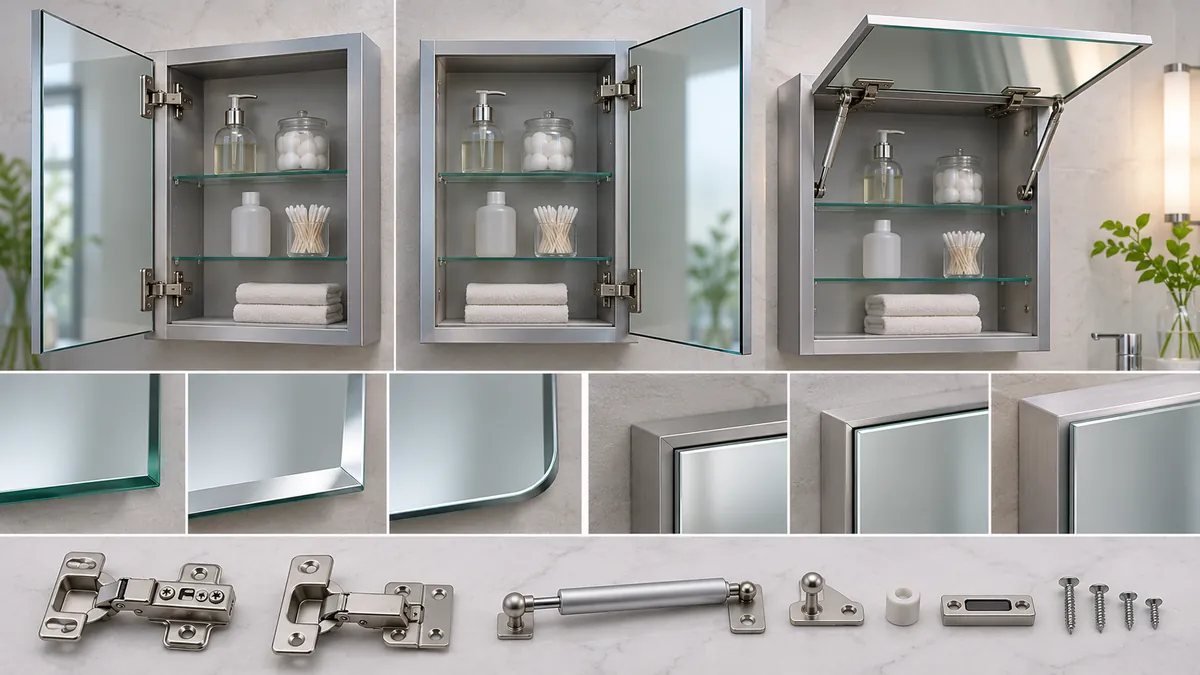
How should the buyer confirm door assembly scope and interfaces?
Request the current parts list or service document for the exact cabinet model. The document should identify the orderable door part, the door position and any associated hinge or attachment kit. If a model has multiple finish, size or lighting options, confirm the exact variant. Record the document date and revision because manufacturers may update product features or part availability.
Ask the supplier to define the quoted assembly in writing. Does it include only the mirror leaf, the hinge(s), mounting hardware, opener, edge trim, electrical connector or other model-specific parts? Does it ship as one assembly or multiple items? Which components are reusable only if the maker says so? A buyer should not assume that a set of hinges supplied with one cabinet will fit another.
Door swing and hinge arrangement should be taken from the maker’s documentation. Multi-door cabinets can have different leaf positions. A reversible door in one product family does not mean that another cabinet is reversible. If the cabinet maker provides a part number by model and door position, use that record rather than a generalized left/right description.
For a lighted or electrically connected door, request the exact model service information and confirmation from the cabinet maker. Do not assume wiring, connectors or lighting parts transfer between revisions. Electrical servicing and disconnection should be performed by qualified personnel following the manufacturer’s instructions and applicable local requirements. The article does not provide any wiring procedure.
| Scope being quoted | Questions to ask |
|---|---|
| Mirror leaf only | Does the part include its backing, edge treatment or preattached hardware? |
| Complete door assembly | Which hinges, opener or other components are included? |
| Door-and-hinge kit | Is it for one exact cabinet model and door position? |
| Lighted-door assembly | Does the maker confirm the connector and lighting interface for this revision? |
| Multi-door cabinet part | Which leaf is covered, and are adjacent leaves different? |
| Supersession | Which original part numbers and model revisions does the new code replace? |
| Aftermarket candidate | What model list, exclusions and fit evidence support the claim? |
If the maker has discontinued a model, ask whether an approved supersession exists and what service scope it covers. A later replacement code may have different packaging or hardware content. Preserve the maker’s response and do not extend its approval to other cabinets in the same range unless the documentation names them.
Avoid using the word “universal” unless the responsible supplier has a defined and documented coverage list. Even a replacement with the same external width and height may not line up with the cabinet hinge positions or mating features. A cross-reference should name the precise models covered and any limitations.
How should sample review and supplier confirmation work?
A sample review begins with a specific question. Is the buyer confirming the code against a parts drawing, comparing finish, or reviewing a complete assembly for a named cabinet? These checks answer different questions. A sample that resembles the old door does not prove the hinges, swing, connector or service fit.
For a model-specific part, request the supplier code, drawing revision, cabinet models covered, door position and included components. Ask the supplier to confirm whether the proposal is original, maker-approved or supplier-matched. If it is supplier-matched, require the evidence and the specific model list. If the model is not confirmed, keep the part in a candidate status.
A qualified review should follow the cabinet maker’s procedure. Do not direct a customer to lift a heavy mirror, disconnect electricity, detach a hinge, transfer hardware or test-fit a door based on this article. The cabinet maker or a qualified service provider should identify and perform physical work. Keep service safety and installation responsibility with the appropriate party.
The approval record should name the exact cabinet model and revision, replacement part code, drawing revision, finish, door position, sample identity, reviewer and result. Say what was checked and what was not. A finish comparison does not establish hinge compatibility. A parts drawing does not prove that an unlisted cabinet revision is covered. A supplier statement without model scope should not be converted into a broad listing claim.
| Evidence state | What the record should say |
|---|---|
| Original part confirmed | Exact maker code and named cabinet model |
| Maker-approved supersession | Old and new part numbers and covered revisions |
| Supplier-matched alternative | Supplier code, model list, exclusions and evidence |
| Sample under review | Sample ID, review question and unresolved checks |
| Unverified candidate | Appearance or partial dimensions only; no assured-fit claim |
A sample may be useful for visual appearance and packaging review, but it should not be treated as a substitute for a manufacturer’s fit confirmation. If a project requires a physical assessment, the responsible cabinet maker or qualified professional should define the safe method and acceptance conditions. Buyers should not invent their own installation test for a mirror door.
Preserve the original parts page, supplier response, sample label, quote and purchase order with the SKU record. When the door is reordered, the buyer can compare the current part code and kit contents with the approved record. If the maker changes the door, hinge, connector or finish, review whether reapproval is needed.
How should distributors manage replacement-door SKUs?
Each orderable door variant should have a separate service SKU when model, door position, finish, hinge kit or connector differs. A parent listing can help customers navigate a family, but each variant must retain its exact model coverage. Do not merge a one-door cabinet leaf with a center panel from a multi-door unit because their dimensions appear similar.
A service-parts matrix can include maker, model, revision, size code, number of doors, door position, part number, finish, hinge kit, connector status, package scope, evidence source, approval date and exclusions. Link the buyer SKU to the maker’s reference and the correct manual. For hotel or multifamily projects, an internal asset record can identify which model is installed at each location, while keeping property details controlled.
Mark whether the replacement is an original, approved supersession or supplier-matched alternative. Customer service should be able to explain the status and request the right model information. If a door is discontinued and the manufacturer offers no service part, state that in the record rather than listing an unverified substitute as compatible.
Packaging and logistics should be agreed for the actual assembly. Ask how the door is protected, whether hinges or hardware are packed separately, how the part is labeled and whether the carton identifies cabinet model and door position. The supplier should provide packing guidance and identify any special handling requirement. Do not promise that a specific package prevents mirror damage unless the claim is supported by the supplier’s evidence.
Track inquiries and returns by exact cabinet model and service part. Useful categories include “wrong model,” “wrong door position,” “hinge kit missing,” “finish mismatch,” “connector question,” “part discontinued,” “shipping damage” and “model unidentified.” A single return can identify a listing or packing issue, but it does not prove a recurring product failure. Use actual service records to improve the matrix.
When a manufacturer revises a cabinet or door, ask for a change notice and determine whether the old part relationship remains valid. Changes to hinge locations, connectors, size variants or kit contents may affect the service SKU. Keep historical part mappings for older installed cabinets, but mark superseded items and availability accurately.
What should the RFQ and buyer checklist include?
A strong RFQ gives the supplier enough evidence to identify an exact replacement without asking the buyer to perform unsafe work. Provide the cabinet maker, model, revision, number of doors, door position, original part code, manual or service page, available photographs, finish, required quantity and destination. Mark uncertain details clearly and request the supplier’s next identification step.
| Campo «RFQ» | Buyer request |
|---|---|
| Cabinet model | Confirm exact model, series and revision |
| Door position | Identify the maker-defined left/right/center or numbered leaf |
| Part scope | Quote mirror leaf, complete assembly or kit with included hardware |
| Hinge set | Identify included hinge code and model relationship |
| Concluir | Confirm manufacturer finish code or sample reference |
| Electrical interface | State whether this model has a door connector and how the maker confirms service scope |
| Evidence | Cite current parts list, drawing or maker response |
| Supersession | List old codes replaced and cabinet revisions covered |
| Sample | State what visual or document review will establish |
| Commercials | Quote sample, MOQ, lead time, packaging and order unit |
| Controlo de alterações | Explain how part or kit revisions are communicated |
Before approval, compare the quoted item to the cabinet’s current parts information. Resolve differences in model, door position, finish and kit contents. Keep a record of the approver and evidence source. If no authoritative match is available, keep the request unresolved and seek maker or qualified service support.
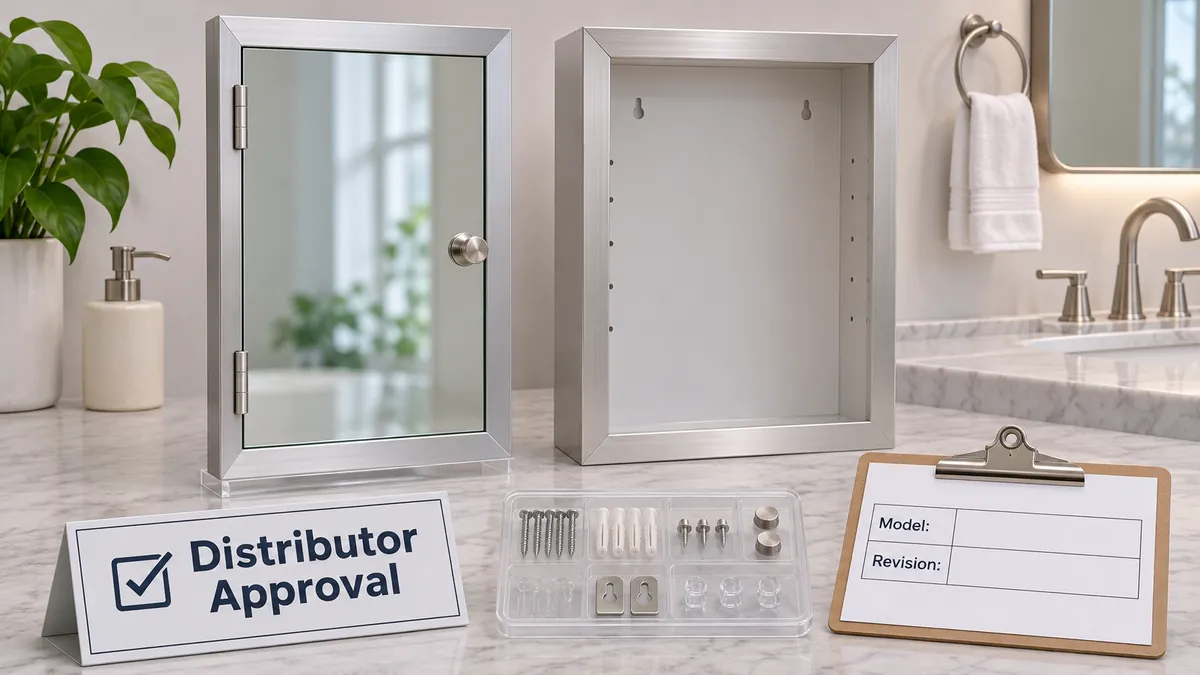
Buyer checklist for a replacement medicine cabinet door
- Record the exact cabinet maker, model, series and revision.
- Confirm the cabinet size variant and number of doors.
- Identify the door position from the maker’s own diagram.
- Obtain the current service parts page or installation manual.
- Ask whether the orderable item is a mirror leaf, complete door or hardware kit.
- Confirm hinge kit, opener, connector and other included components.
- Keep finish, swing/handing and electrical features tied to the exact model.
- Ask whether the proposed part is original, approved supersession or supplier-matched.
- Preserve the supplier’s model list, exclusions and evidence.
- Do not infer compatibility from nominal mirror dimensions or appearance.
- Route lifting, hinge transfer, electrical work and installation to qualified service personnel.
- Keep package labels linked to cabinet model and door position.
- Review the SKU after model, part or kit revisions.
- Use actual return and service data to improve the installed-base matrix.
The goal of a replacement medicine cabinet door record is a documented link between the installed cabinet and a specific orderable service part. If the cabinet model, door position or assembly scope remains uncertain, resolve identification with the maker before promising fit or ordering stock.
Perguntas frequentes
Can a replacement medicine cabinet door be selected by mirror size?
No. Mirror dimensions alone do not establish the hinge interface, door position, swing, finish or kit contents. Confirm the cabinet model and current service part.
Does the door part include hinges?
Not automatically. Some maker instructions describe a defined hinge kit shipped with certain doors, but the scope varies by model. Ask for a written bill of materials.
Can one door fit every cabinet in the same product range?
Not unless the maker confirms that coverage. A range may include different widths, door counts, revisions, finishes and connectors.
Can I move the hinges from the old door to a replacement?
This guide does not authorize hinge transfer. Follow the exact maker’s service instructions and use qualified personnel.
What if the cabinet model label is missing?
Check the purchase record, saved manual, service invoice or project schedule. Ask the maker what evidence is required. Do not approve a fit from a photo or exterior size alone.
Do lighted cabinets need a special door?
Some models have electrical or lighting-related interfaces, while others do not. Confirm the exact replacement assembly with the maker and route electrical service to qualified personnel.
Does Koitor make replacement medicine-cabinet doors?
The approved company information confirms metal bathroom and home-storage hardware, not medicine cabinets, mirror doors, glass or electrical assemblies. This article makes no claim that Koitor supplies or installs these parts.
Technical references
- Sterling/Kohler mirrored medicine cabinet door service part — an example of a named orderable door part.
- Robern CL cabinet instructions — model groups, door configurations and defined hinge-kit scope.
- Kohler ELOSIS mirrored cabinet instructions — directs door replacement inquiries to customer service using the model number.
- Kohler lighted medicine cabinet instructions — example of model-specific electrical and door service cautions.
- Koitor Hardware OEM information — verified metal-hardware sourcing context.
Discuss Your Bathroom Hardware Sourcing Requirements
Share a metal cabinet drawing, product sample, finish reference and assembly needs for a capability review. The cabinet maker or qualified service professional should confirm door, mirror, hinge and electrical interfaces.
OEM / MARCA PRÓPRIA
Transforme este guia de fornecimento num resumo do produto
Indique o produto pretendido, as dimensões, o acabamento, a quantidade a encomendar e os requisitos de embalagem. A sua equipa receberá uma análise prática da viabilidade de fabrico antes da apresentação do orçamento.


 English
 Español
 Português
 Français
 Deutsch
 العربية