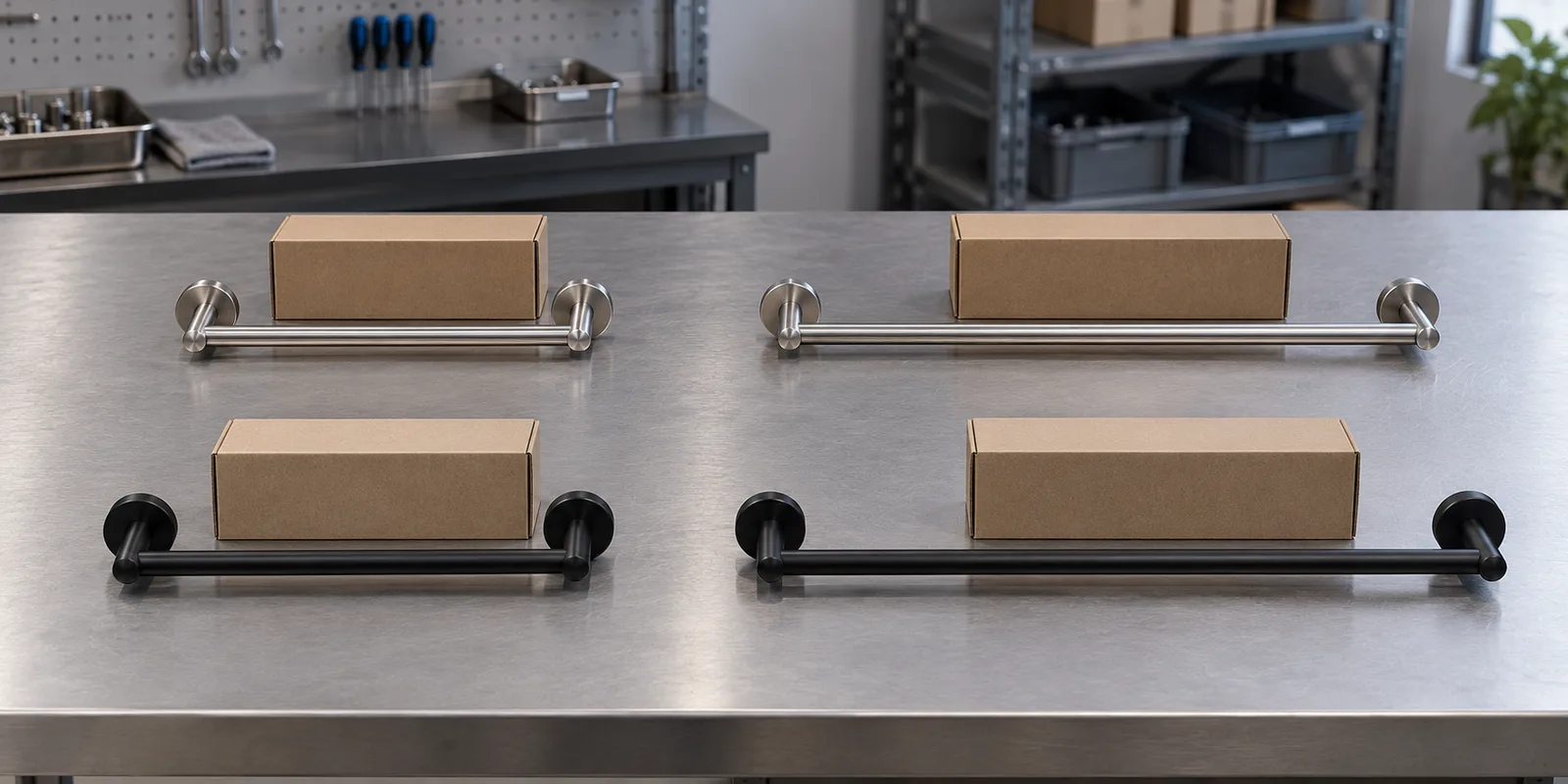
A reasonable MOQ for custom bathroom accessories is the smallest production quantity that a factory can make consistently at an acceptable total cost for your project. The number must be tied to a defined product, finish and packaging specification, rather than treated as a universal factory minimum. At Koitor Hardware, MOQ can start from 100 pieces depending on product structure, material, finish and packaging. Buyers should confirm whether that quantity applies per model, per color, per package version or to a combined order before comparing quotations.
What does MOQ cover in a custom bathroom hardware quotation?
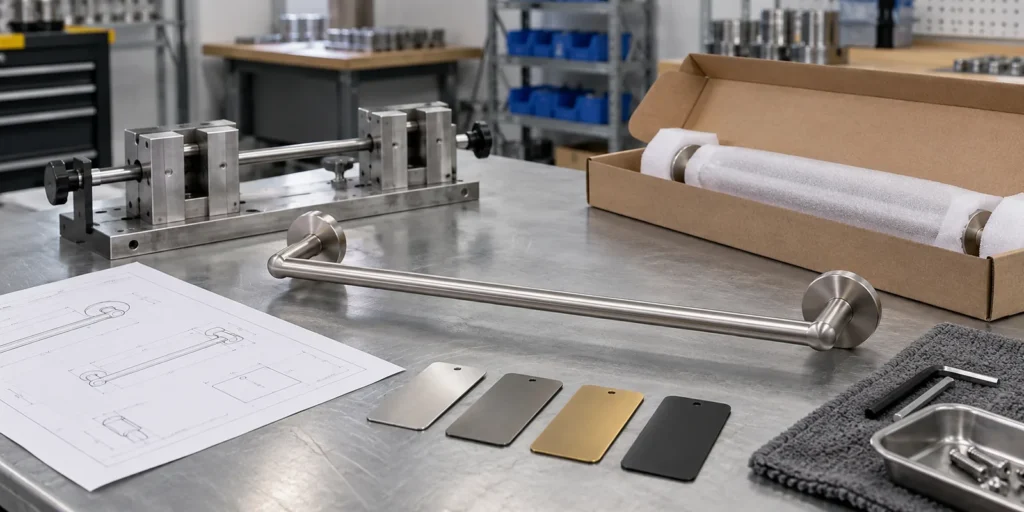
MOQ means minimum order quantity: the lowest quantity a supplier agrees to produce under a particular set of commercial and technical conditions. For custom bathroom hardware, the useful question is not simply how many pieces you must buy, but exactly which specification those pieces share.
A stock keeping unit, or SKU, identifies a sellable product variation in your inventory system. One towel bar in two lengths and two finishes may create four SKUs. A supplier may group some manufacturing operations across those variations, but the finished products still need separate identification and agreed quantities.
There can also be several minimums within one quotation. The metal product may have a production minimum, a special finish may involve a separate batch requirement, and printed packaging may have its own purchasing minimum. The largest constraint can determine the practical first order unless the parties agree on an alternative.
Ask the supplier to separate these boundaries in writing. An offer for 100 pieces per model is different from 100 pieces per model and color. Likewise, permission to combine two sizes does not automatically include different mounting plates, packaging artwork or accessory sets.
A sample is another distinct purchase. Making one sample to check dimensions and assembly does not establish the price or minimum for repeat production. Sample preparation can include individual adjustments that need a different arrangement when the approved design enters a batch.
For a private-label buyer, the clearest quotation identifies the product revision, quantity breakdown, finish reference, packing method, included components and any separate development charges. Without those details, a low minimum can become a higher commitment once the missing requirements are added.
Why do structure, material, finish and packaging change the minimum?
The practical minimum changes because each custom requirement affects preparation, purchasing or handling. A factory evaluates whether the proposed batch supports a repeatable production route for the specified bathroom accessory.
Product structure and production preparation
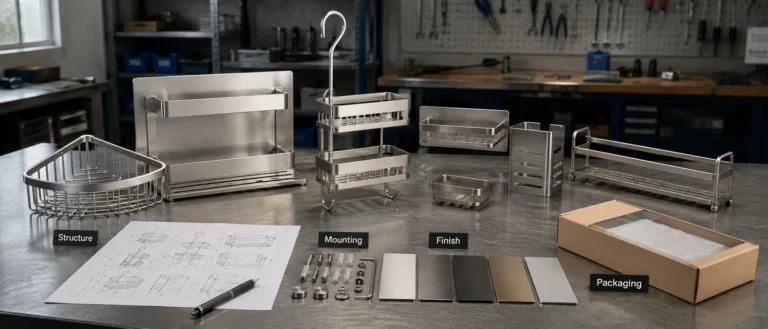
A simple bent towel bar and a multi-tier welded shower caddy involve different arrangements. Cutting, bending, locating components for welding, surface preparation and assembly all need to follow the chosen structure. A jig is a fixture used to locate or hold parts consistently during an operation.
Changing a basket width may require a review of the locating arrangement as well as the wire lengths. Adding a mounting bracket can introduce another part, another connection and another inspection point. Buyers should ask which requested changes create new preparation work and which can use an existing arrangement.
Material and finish choices
Material requirements include grade, wire diameter, tube size and other dimensions relevant to the design. Availability of the specified stock can affect a small order. Ask whether the quoted material is readily available for the planned production period and whether any alternative needs buyer approval.
Finish requirements need similar precision. A general request for black powder coating is less specific than an approved color, texture and gloss reference. A special finish may need separate purchasing or scheduling. Combining products in one finish may help some operations, but the supplier must confirm compatibility rather than assume it.
Packaging and component purchases
A plain protective box with an approved label can involve a different purchasing commitment from a custom printed box with an insert. Neither option is automatically right for every channel. Protection, identification and buyer requirements still need to be satisfied.
Purchased components also matter. Feet, caps, fasteners or mounting accessories can have different supply arrangements from the metal frame. Confirm whether extra packaging or components would remain after the production run, who would own them, and whether the quotation includes their cost.
Koitor Hardware can review product structure, welding points, surface finish and packaging before sample production. For a range containing baskets, racks and holders, the OEM home storage hardware manufacturing page explains the relevant product scope. A practical review starts with the actual drawing or physical sample, rather than a minimum copied from another item.
How should buyers calculate quantities across models and colors?
Calculate the order at the smallest variation level the supplier uses, then add those quantities to find your total commitment. This prevents a headline minimum from disguising an order that is much larger than your demand forecast.
The following examples are illustrative purchasing scenarios, not Koitor quotations or standard factory policies. Each assumes a stated minimum only to show how different quantity definitions change the result.
| Illustrative offer | Requested assortment | Quantity implication | What to confirm |
|---|---|---|---|
| 100 pieces per model, with colors mixable | One towel bar in two colors | 100 total, if the split is accepted | Minimum per color and any finish surcharge |
| 100 pieces per model and color | One towel bar in two colors | 200 total | Whether both finish batches are included |
| 100 pieces per size and color | Two lengths in two colors | 400 total | Four variation quantities and packaging allocation |
| 100 pieces per model | One towel bar and one tissue holder | 200 total unless mixed-model terms are agreed | Whether a shared finish changes either minimum |
| Product and packaging minimums differ | 100 products with a custom printed box | Product quantity alone does not define the full purchase | Packaging purchase quantity, storage and ownership |
For example, an importer may plan a 200-piece launch across two towel bar lengths and two finishes. If each of the four combinations requires 100 pieces, the proposed assortment implies 400 pieces. The buyer can then request a smaller accepted split, reduce the launch assortment, or decide whether the larger purchase is justified.
Do not assume that a total purchase value overrides these boundaries. Ordering more tissue holders may not resolve a minimum tied to a different shower caddy structure. Shared material or finishing steps can create discussion points, but they do not make unrelated models interchangeable.
A useful quantity sheet gives each variation a separate row: model code, dimensions, finish, package version, initial quantity and possible reorder quantity. Ask the supplier to return accepted quantities against the same rows. Any minimum that applies across rows should be explained explicitly.
When reviewing MOQ for custom bathroom accessories, separate a forecast from a firm order. You can share a credible estimate of future demand to support planning, but do not let an unconfirmed forecast appear as a committed purchase in the quotation.
How can importers negotiate a smaller first order?
Negotiate a smaller first order by reducing the requirements that create separate batches or purchases. Give the factory a clear account of what the market test must prove, and identify the specification choices you can adjust.
Start by fixing the product’s essential function. Mounting geometry, usable storage space, assembly fit and agreed quality criteria should remain clear. A reduced quantity is useful only if the delivered product represents what you intend to sell.
Then consider limiting the launch to one size and one finish. This makes sales feedback easier to interpret and reduces the number of variations requiring separate production or packing decisions. A low MOQ towel rack project is easier to discuss when the buyer can distinguish an essential length from optional color extensions.
Ask about standard material sizes and feasible existing component arrangements. A modest dimensional adjustment may simplify purchasing or preparation, but it needs to be checked against product use and your approved design. Do not approve an alternative solely because it reduces the quoted minimum.
Packaging can be phased where your channel permits it. For example, a first batch might use an agreed protective package and approved product label while a later order introduces printed packaging. This is a development option, not permission to omit required product information or protection.
Another option is to ask for a separate preparation charge rather than spreading all preparation cost across a larger quantity. The supplier may or may not accept this arrangement. Request the charge, its scope and any conditions for repeat orders in writing so that it can be compared with other offers.
For small order bathroom hardware, give the supplier a proposed quantity and an acceptable alternative. A request such as “please quote one finish at our trial quantity and at your practical minimum, with separate packaging costs” produces a more useful answer than repeatedly asking for a lower number.
Avoid demanding several custom models at a token quantity while expecting the same unit price as a settled production run. If the first proposal is uneconomic, narrow the specification and ask what changed in the revised quotation. The aim is a smaller workable purchase with clear obligations.
How do you compare low-MOQ offers without overlooking cost?
Compare total purchasing commitment for the same accepted specification, rather than unit price alone. A smaller production run can reduce inventory exposure while still carrying development, packing or delivery costs that affect the decision.
Start with the goods value: accepted quantity multiplied by unit price. Then identify separate charges for sampling, preparation, tooling if applicable, packaging purchases and agreed inspection arrangements. Check the delivery terms before comparing freight-related costs, since different offers may stop at different points in the shipment journey.
Suppose two offers meet the same product requirements. One has fewer finished units but requires a separate packaging purchase; the other includes packaging in a larger finished-product batch. Neither is necessarily cheaper for your business. Compare the cash commitment, expected sell-through and responsibility for unused materials.
Keep costs already incurred separate from the decision still ahead. A sample fee already paid is relevant to the project record, but it should not hide a large difference in the next production commitment. Conversely, a proposed sample credit should be included only when its conditions are confirmed.
Ask what happens on a reorder. Will the same minimum apply? Does a change in finish restart a separate minimum? Can stored packaging still be used after an artwork revision? A promise of a lower future price is not a substitute for a defined first-order quotation.
For a trial order custom hardware project, decide how the buyer will judge success before placing the order. Useful evidence can include assembly feedback, package condition on receipt, dimensional consistency and actual sales response. A reorder should follow that evidence rather than the appeal of an unused discount tier.
Koitor Hardware is a family-owned China OEM manufacturer specializing in bathroom and home storage hardware. Direct factory communication allows buyers to discuss which product details are fixed and which can be adjusted before sampling. For towel racks, wire baskets, shower caddies and tissue holders, that conversation should connect quantity to manufacturing and packing requirements.
Koitor’s sample timing is usually 5-7 working days after design and materials are confirmed. Bulk production usually takes 4-6 weeks depending on quantity, complexity, material availability, finish and packaging. These are planning references, not guaranteed dates; special requirements and revisions need project-specific confirmation.
What should an MOQ request include before quotation?
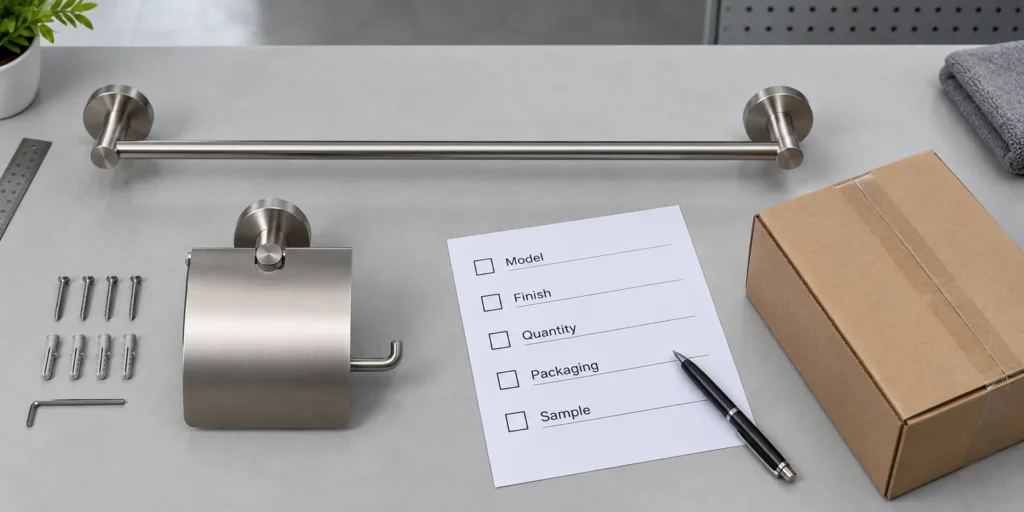
An MOQ request should include enough information to price one defined bathroom hardware project and explain acceptable alternatives. Use the checklist below to prevent different suppliers from quoting different assumptions.
- Product identity: provide a model code, product description and drawing or clear reference sample.
- Structure: state overall dimensions, mounting or standing arrangement, and any dimensions essential to fit.
- Material: identify the requested grade and relevant wire, tube or sheet dimensions; mark undecided details.
- Finish: include an approved reference or explain the color, texture and appearance that need sampling.
- Quantity matrix: list the initial quantity for every model, size, finish and package version.
- Packaging: distinguish protective packing, printed artwork, inserts, labels and carton requirements.
- Included parts: identify fasteners, caps, feet, brackets, instructions and other components supplied with each unit.
- Sample scope: explain what the sample must demonstrate and which details remain subject to approval.
- Commercial breakdown: request separate minimums and charges for products, finishes, preparation and packaging.
- Repeat-order assumptions: give a nonbinding forecast, preferred timing and questions about unused materials.
Add a short priority note. For example, a buyer may need the mounting dimensions and finish to remain fixed while accepting a plain labeled box for the first order. Another buyer may need retail packaging immediately but be flexible about launching only one length.
Keep an approval record when the quotation changes. Record the revision date, accepted specification, quantities and unresolved points. If a supplier proposes a substitute material or different package to meet the target quantity, approve the resulting specification before it becomes the production reference.
Frequently asked questions about bathroom accessory minimum orders
Bathroom accessory minimum orders depend on the agreed product and purchasing conditions. The answers below address common questions to resolve before accepting a quotation.
Is 100 pieces a realistic starting quantity?
It can be for some projects. Koitor’s MOQ can start from 100 pieces depending on structure, material, finish and packaging. Buyers need a project review to confirm whether that quantity applies to the requested model and variation. It is not a minimum promised for every custom product.
Can several colors share one MOQ?
Only when the supplier explicitly accepts the split. A model minimum and a finish minimum may apply separately. Request the quantity for each color, the combined total and any additional cost. Confirm that the quoted packaging can identify each finished variation correctly.
Does paying for a sample guarantee a small production order?
No. Sample preparation and batch production have different requirements. Confirm the expected production minimum before commissioning a sample, then reconfirm it if the design, material, finish or packaging changes during development. The approved sample and production quotation should describe the same product.
Should buyers choose the supplier offering the lowest minimum?
Choose the offer that supports the intended product test at an acceptable total commitment. Check specification completeness, packaging, sample review, communication and repeat-order conditions. A very low quantity is less useful if essential parts are excluded or the product differs from the planned retail version.
What is the fastest way to confirm MOQ for custom bathroom accessories?
Send a drawing or physical sample together with a quantity matrix, finish requirement and packaging plan. Identify essential requirements and flexible preferences. Ask the factory to state accepted quantities and any separate minimums, rather than request a single number without a defined product.
Discuss a practical first-order quantity with Koitor Hardware
Koitor Hardware can review your drawing or physical sample and discuss small-batch OEM production options for bathroom and home storage hardware. A defined product and variation list gives the factory a useful starting point for MOQ and quotation review.
Plan Your First Custom Hardware Order
Send Koitor your drawing, sample, target quantity by model and finish, and packaging requirements. Our team can review manufacturability and discuss a practical first-order quantity before preparing a quotation.
OEM / MARCA PRÓPRIA
Transforme este guia de fornecimento num resumo do produto
Indique o produto pretendido, as dimensões, o acabamento, a quantidade a encomendar e os requisitos de embalagem. A sua equipa receberá uma análise prática da viabilidade de fabrico antes da apresentação do orçamento.
 English
  Español
  Português
  Français
  Deutsch
  العربية