

Short answer: Open front storage bins should be specified by the way people will pick from them, replenish them and use any selected cover or divider. Before ordering, identify the exact bin family, its opening direction, the intended replenishment route, whether a divider is included, and whether a cover is removable or hinged in the chosen supplier’s design. Then verify the configuration against the actual rack or work area and a sample. The phrase “open-front bin” alone does not establish a universal access direction, stack arrangement, accessory fit or contamination-control performance.
This guide focuses on metal parts bins and related open-front storage products for B2B purchasing. It does not set a capacity, stack height, fire rating, dust seal, load limit or rack compatibility rule. Those fields are product-specific and must come from the responsible maker and project design. The purpose is to prevent a quotation or listing from combining a bin, cover, divider and rack interface that were never approved together.
A useful source example is Stackbin’s current family of steel stack bins and hopper boxes. The maker distinguishes hopper-style openings, enclosed box forms and different access options across its product family. Its named 804 hopper box describes a particular opening arrangement, while its hinged-cover product distinguishes a removable option from a hinged version that the maker says requires welding in that design. Its removable T-profile divider is a separate accessory. These are manufacturer-specific distinctions, not universal rules for every metal bin. See the Stackbin family page, the 804 hopper box page, hinged cover information e removable divider details. The wider maker marketing comparing materials, strength, fire or return on investment is not used as technical proof here.
Identify the actual bin family and opening
For open front storage bins, the selection still begins with the actual model and intended picking task; the category label does not define the sold configuration.
Start by separating the search term from the configured product. “Open front storage bins” can refer to small parts containers, shelving boxes, industrial hopper bins or other products with an accessible face. A buyer should capture the maker, family name, model or part number, revision, material description and the relevant product drawing. If the supplier offers several front or side openings, the selected option should be named rather than inferred from a photograph.
A front opening affects how the user reaches a part, but it does not by itself define how the container is replenished. A bin may be approached from the opening side for both picking and refill; another layout may replenish from above or from a different side. A stacked arrangement can add access constraints that are absent when a bin sits alone on a bench. Record the intended arrangement and the parts that must remain accessible during normal work.
Do not treat product-family labels such as “hopper,” “box,” “stackable” or “open front” as engineering guarantees. The maker’s named configuration governs the meaning. If a product description says that it has a front opening and a separate rear opening, that is evidence for that reference only. It does not prove that a similar bin shares both access paths, that a cover is compatible, or that a stack is approved. Check the selected drawing and parts list.
The buyer can clarify the operation with three questions: What is picked through the opening? From which side does replenishment occur? Which other containers, shelf lips or rack members remain in place during both tasks? If the answer changes between work cells or retail locations, treat those as separate use cases. A single sample review cannot cover a configuration that was not assembled or a path that was not observed.
Separate pick access from the refill route
Picking and replenishment are related but distinct motions. The picking side is where the user reaches into the bin to identify or retrieve a component. The refill route is how parts enter the bin without creating a blockage, damaging the container or mixing an incorrect item. Buyers should describe each direction separately, especially when an open-front bin sits on shelving or is surrounded by other containers.
A practical review begins with an identified sample and representative parts. The buyer can place the bin in the intended rack or on the planned work surface, label the opening side, and observe whether the selected parts can be reached and returned to the bin. For replenishment, mark the approach direction and note what must be moved or opened. If the bin is to be tilted, lifted or removed during refill, identify who performs that task and whether the operation is part of the normal work instruction. Do not infer a safe method from a product photo.
Representative parts should be chosen by the buyer and documented by type or part number. Avoid substituting arbitrary objects during review and then using the result to support a general claim. The size, shape, packaging and quantity of the stored item can affect what the user sees and touches. If the buyer needs separate compartments, document the part mix and divider arrangement. If the goods are supplied in bags or cartons, decide whether the packaging remains inside the bin or is removed before picking.
The distinction between access and protection matters. A cover may limit exposure in some circumstances, but an ordinary cover does not establish a dustproof, sealed, sanitary or fire-rated enclosure. A divider may create separate positions, but it does not automatically keep parts segregated during transport or handling. The buyer should state the actual operational need and ask the bin manufacturer which documented configuration addresses it. If a regulated or contamination-sensitive environment is involved, engage the qualified compliance owner rather than turning a general product feature into a suitability claim.
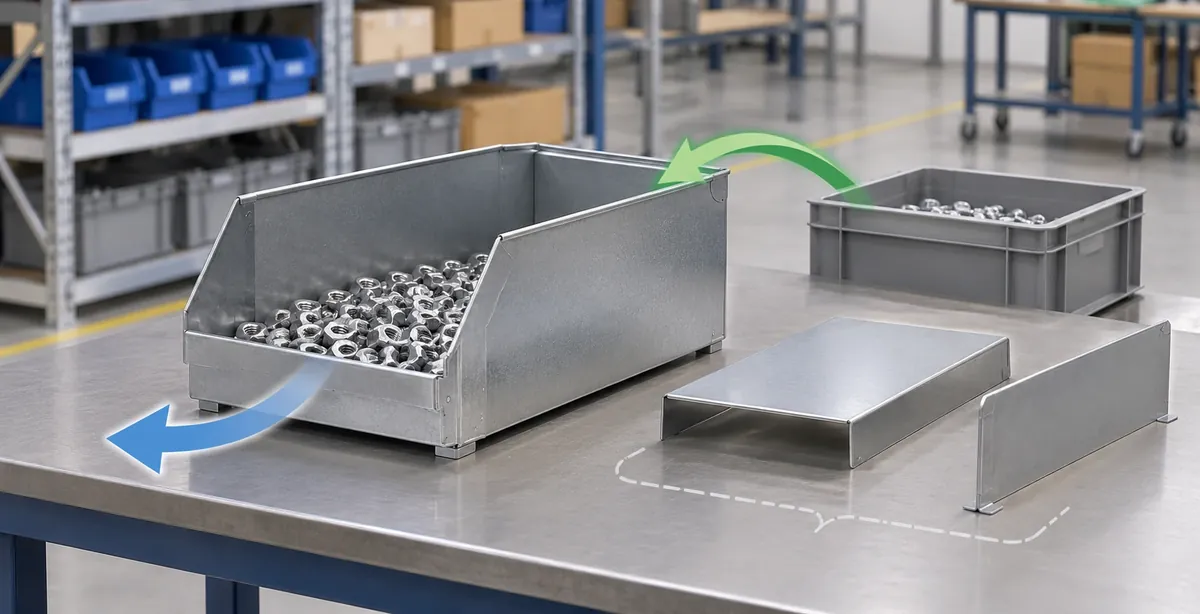
Decide whether the cover is removable, hinged or excluded
A “cover included” note leaves important scope questions unanswered. The buyer should identify the cover model, attachment method, movement, supplied hardware, whether it is included with the bin or sold separately, and whether the selected bin family has been confirmed for it. A removable cover and a hinged cover create different storage, handling and access tasks. Some product designs may require a manufacturing operation to add a hinge; the cited Stackbin page describes welding for its own hinged option. Do not generalize that detail to other manufacturers or to every hinged metal cover.
A removable cover may be lifted away as a separate component. The buyer should ask where it is stored during picking and refill, whether the user can identify which bin it belongs to, and whether the parts list assigns it a distinct reference. If the cover is frequently removed, the product team may want to confirm how it is handled and returned in the intended workflow. These are review questions, not claims that a given cover will be lost or cause a quality issue.
A hinged cover remains connected, but its hinge position and opening path may affect access, surrounding clearance and the attachment method. Verify the exact maker’s instructions and whether the hinge is part of the quoted configuration. If a supplier proposes to retrofit a hinge to a bin that was not designed for it, ask the responsible manufacturer to confirm feasibility and any drawing change. Do not assume a buyer can add a hinge without affecting the bin or its finish.
If no cover is required, state that clearly. This prevents a decorative image, optional accessory listing or earlier project from being taken as evidence that a cover is included. If the buyer wants to compare covered and uncovered variants, keep them on separate lines of the RFQ and compare the access path and supply scope for each. This also keeps artwork and product-detail-page claims aligned with the final SKU.
Specify divider positions and the exact accessory scope
Dividers are another component whose name can conceal important choices. Confirm whether the selected divider is fixed, removable or repositionable; how many are supplied; which bin references accept them; and whether they are part of the standard offer or an option. Stackbin’s named removable T-profile divider provides an example of an accessory that can be repositioned in that maker’s bin system. It does not prove universal compatibility or that loose items stay separated in every handling condition.
If the buyer needs compartments, describe the part grouping and the desired separation. Ask the supplier to mark the proposed divider arrangement on the bin drawing or to identify the selected slots or receiving features by current maker documentation. Do not invent a spacing value from a photograph. If small components can pass through or around a divider in the intended orientation, the buyer should make that a sample question and define the representative items to be checked.
A BOM should distinguish the container from each accessory. Use a separate line for the cover, hinge kit, divider, label holder or other selected part where one exists. State quantity per bin, whether installation is performed by the manufacturer or another party, and what packaging is required to protect small loose components. A bundle title should not replace a component list when the buyer needs to reorder an accessory later.
| Decision | Record before order | Provas a solicitar | Avoid assuming |
|---|---|---|---|
| Bin family | Maker, model, revision and opening option | Current product drawing or maker specification | That similar names share the same access |
| Pick route | Opening side and representative stored parts | Sample observation in the selected rack position | That the photo shows every work arrangement |
| Refill route | Approach side and required movement | Buyer-marked process sketch or sample review | That picking and refill use the same path |
| Cover | None, removable or specific hinged option | Exact cover reference and included parts | That an ordinary cover is sealed or dustproof |
| Divider | Type, quantity, position and status | Maker reference and sample arrangement | That it is included or fits another family |
| Supply scope | Who supplies and installs each part | BOM, quote and packaging schedule | That optional items appear in the base price |
Verify the configuration against the rack and sample
A bin that appears to fit on a product page may not be the same configuration used in the buyer’s rack or workstation. Confirm the rack reference, shelf or support arrangement, bin orientation and any adjacent boundary that affects picking. If the rack is supplied by another company, obtain its current drawing or installation information. A bin supplier’s product page does not automatically approve a third-party shelf, stack arrangement or load condition.
During the review, record the bin’s identification and orientation before placing representative parts inside. Check that the pick opening is on the intended side, the refill approach remains available, and the cover or divider can be used as specified. If the bin is to be stacked, use only the manufacturer’s documented arrangement and the project’s approved setup. This guide does not prescribe a safe stack count or any loading limit. Leave those fields to the manufacturer and qualified project designer.
If the buyer expects a user to change the divider or remove the cover during operation, include that task in the sample assessment. Observe whether the component can be identified, handled and returned under the defined conditions. Record any snag, interference or ambiguity without turning that observation into a design instruction. The supplier or product engineer should decide whether a change is technically appropriate and what else must be verified after a revision.
Save the accepted configuration as a set of records: sample label, product reference, rack reference, drawing revisions, accessory list, intended access directions and photographs of the assessed arrangement. One wide product photo is rarely enough to show the opening, rack boundary, cover and divider together. A few focused views make it easier for procurement and quality teams to compare future supply with the approved scope.
Prepare the RFQ, receiving record and product information
The RFQ should state the buyer’s use case in operational language. Describe the items to be stored, which side users pick from, how replenishment occurs, whether the bin is used individually or in a rack, and whether a cover or divider is required. Attach a marked drawing or sample photo where possible. Ask the supplier to return the exact maker family and model, options, included parts and any interface assumptions used in its quotation.
Have the supplier identify what its documentation actually supports. A catalog reference can establish available options; it may not establish a project-specific rack fit. A sample can confirm observed access in one setup; it does not establish capacity, long-term wear or a regulatory rating. Separate those evidence types on the review form, and list open questions next to the responsible person who must answer them.
At order release, freeze the chosen configuration and revision. If a cover changes from removable to hinged, or a divider is added or removed, treat that as a scope change and ask whether drawings, sample review, finish or packaging must be revisited. If a substitute bin is proposed because the original is unavailable, compare its opening, accessories and rack interface rather than carrying over the original approval by name alone.
At receiving, inspect against the order’s component schedule. Count the bins and accessories, check their references and photograph discrepancies with the carton or lot identifiers visible when available. Do not interpret a missing optional accessory as a product defect if it was excluded from the order; equally, do not assume it will arrive because it appeared in a marketing image. The buyer’s controlled BOM is the clearest basis for receiving and reorder decisions.
Keep product information specific to the evaluated reference. If a listing says “with cover,” confirm the pictured and sold cover are the same item. If the copy describes a divider, name whether one is supplied or merely available. Avoid statements such as dustproof, fireproof, universally stackable or compatible with every rack unless the exact product’s responsible source provides current supporting evidence and the intended context is clear.
The same reference discipline matters when a buyer moves from a pilot quantity to a replenishment order. A familiar bin name may remain on a quote even when the supplier proposes a revised opening, accessory or finish. Ask the supplier to show whether the model number or drawing revision changed. If the bin is used in several work cells, keep the work-cell configuration as a separate field rather than assuming the whole site uses the same shelf, cover and divider arrangement. This lets the buyer decide whether one standard SKU is practical or whether distinct configurations are needed.
If parts are stored as a kit, identify the kit boundary. A bin can hold several components without being the supplier of those components. List the parts that the bin manufacturer supplies, the items added by a distributor, and any labels or inserts added at the point of use. This distinction supports receiving and replenishment: a missing bin accessory, a missing stored part and a missing customer-added label are different discrepancies with different responsible parties. It also keeps a product description from implying that unrelated contents are part of the purchase.
When a rack or shelf is sourced separately, keep interface confirmation in the record. A buyer may be able to place the sample on the shelf during a review, but that observation is limited to the exact sample and setup. The rack maker remains responsible for its documented configuration, and the bin maker remains responsible for its product data. If a program relies on both suppliers’ components, route the identified references and drawings to each party and record any unconfirmed interface instead of assuming that one supplier’s approval covers the other’s product.
Finally, agree how a discrepancy will be described before the first shipment. The record can ask the receiver to note the bin reference, accessory reference, carton or lot mark, expected quantity and observed condition. This is not an inspection standard or a guarantee of zero discrepancies. It gives the commercial team a common way to compare the received goods with the order and to ask the supplier a precise follow-up question. Good records also make a later change easier to evaluate because the buyer can see which option was originally selected.
Buyer checklist before releasing an order
- Identify the exact bin family, part number, opening and current revision.
- Describe the pick side and the separate replenishment route.
- Confirm the rack or workbench reference and intended orientation.
- Name the representative items and packaging used during the sample review.
- Specify whether the cover is excluded, removable or a named hinged option.
- List each divider and accessory separately with quantity and supply responsibility.
- Ask the maker to confirm the selected bin and accessories as a documented combination.
- Record the sample identity and the observed pick, refill and return sequence.
- Keep stacking or loading requirements in the responsible maker’s documented scope.
- Link the approved drawing, quote, BOM and product information to the same revision.
Are all open-front bins designed for the same picking direction?
No. Opening architecture varies by manufacturer and model. Use the exact reference and drawing for the selected bin, then verify its orientation in the intended rack or work area.
Does an open-front opening also define the refill side?
Not necessarily. Picking and replenishment can have different paths. State both requirements and assess the actual sample with representative items.
Does a cover make an open-front bin dustproof?
The presence of a cover alone does not establish a seal, ingress rating or contamination-control result. Ask the responsible maker for evidence if such a performance claim is needed.
Is a removable divider always included with the bin?
No. The selected divider may be an accessory with its own reference and quantity. Confirm whether it is standard, optional or excluded in the quote and BOM.
Can a cover or divider from one product family fit another?
Do not infer compatibility from a similar appearance. Request the current maker confirmation for the exact bin and accessory references.
For broader metal home-storage project context, see Koitor’s OEM home-storage hardware scope. Buyers may share a drawing, sample and accessory schedule to define a project-specific discussion.
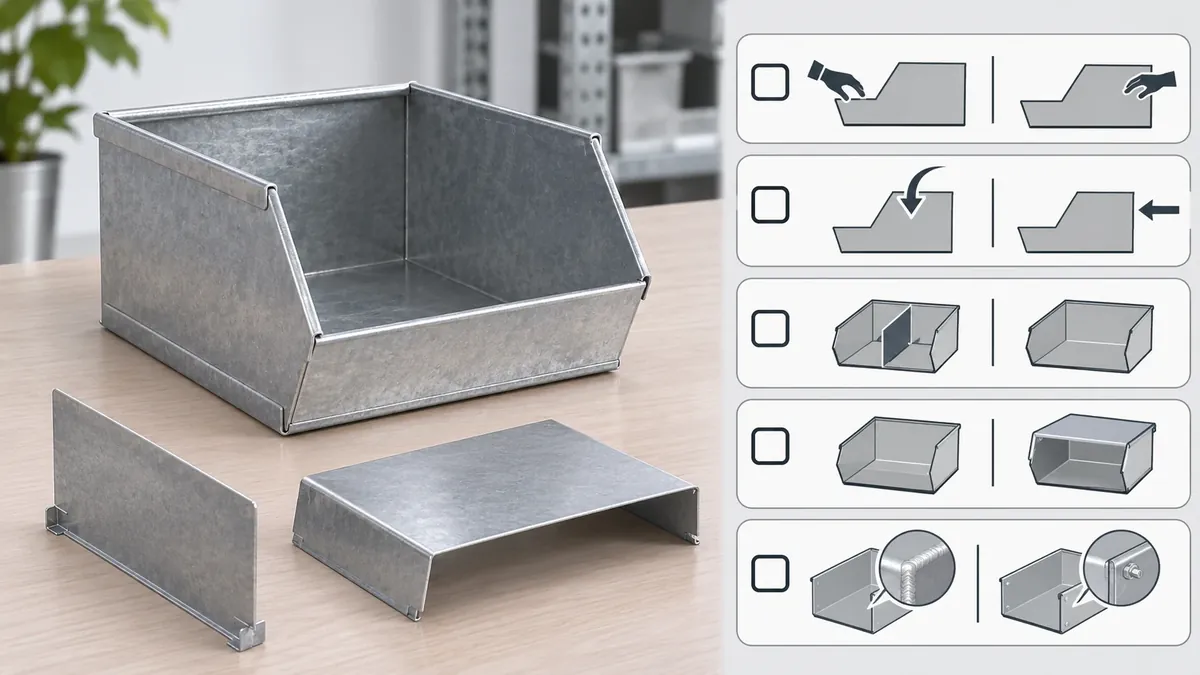
Review a Defined Home-Storage Hardware Scope
Share the bin and rack references, opening and refill needs, selected accessories, finish and packaging. Koitor can first confirm whether the defined metal scope fits its current capabilities before quotation.
OEM / MARCA PRÓPRIA
Transforme este guia de fornecimento num resumo do produto
Indique o produto pretendido, as dimensões, o acabamento, a quantidade a encomendar e os requisitos de embalagem. A sua equipa receberá uma análise prática da viabilidade de fabrico antes da apresentação do orçamento.


 English
 Español
 Português
 Français
 Deutsch
 العربية