
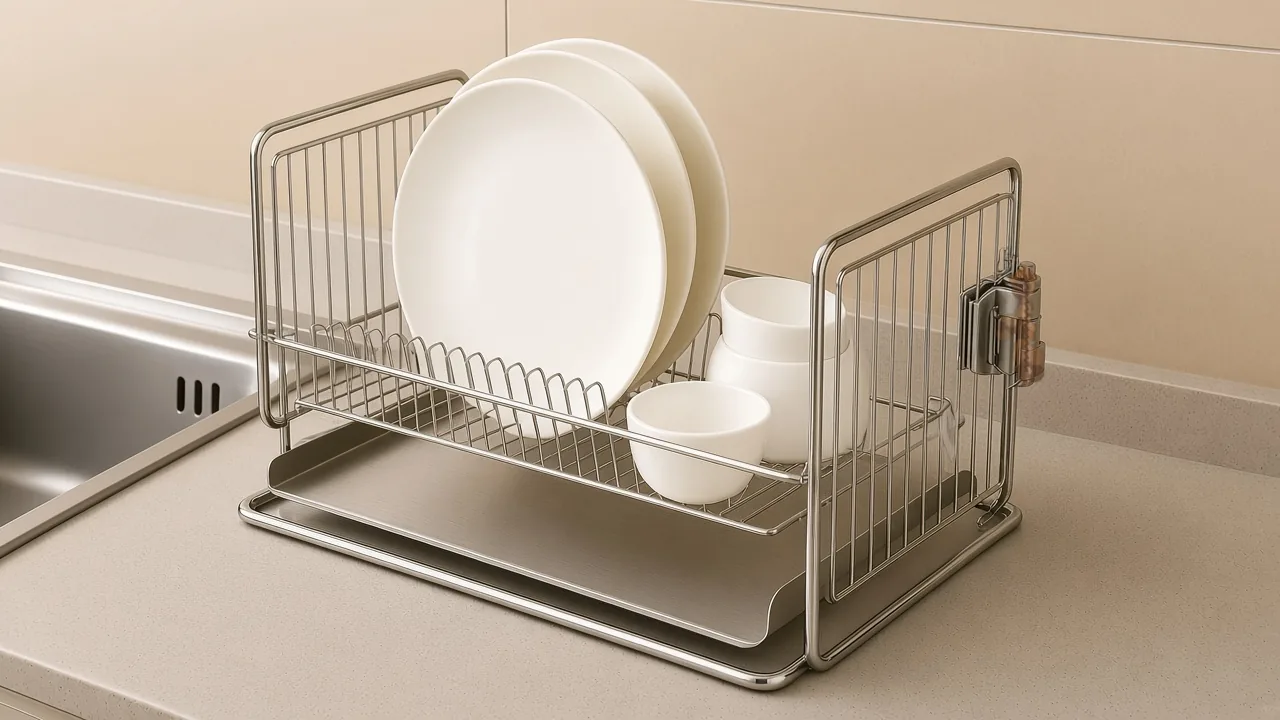
A rack that stays open can still fail on folding dish rack rust at the hinge. Open-position stability answers a different question. This file freezes coating-crack and rust observation at the pivot: the pin, the knuckle, the coating edge, and any water-holding crease. It does not rejudge whether the rack stays open, and it does not reuse a weld-nugget or tray rust file as the answer.
Repeated opening and closing, plus rinse water beside a sink, can break coating at the moving joint first. A rack may still latch or rest in the open position while the finish at the pin is already cracking. Freeze the finish order and the observation zones before a rust-resistant line is printed on a folding SKU.
This guide is for importers, distributors, and private-label teams writing first-article and after-sales acceptance for folding or collapsible metal dish racks. It is not a shopping guide, and it is not a roll-up rack page. Koitor is a family-owned custom metal hardware factory. We can review the hinge construction, the finish order, and the proposed wording. We do not invent a cycle count or a salt-spray hour.
Why does open-position stability not clear hinge rust?
The live hinge-stability file already discusses coating as something that can change joint feel, fill clearance, or leave a cosmetic rub. It also treats a detent as a stability feature. That is useful for the stay-open question. It is not a rust-acceptance section, and it should not be stretched into one.
Stability can pass while the finish is already failing. A detent may still catch. The side frames may still stand. A return may still say the paint cracked at the fold, or that rust appeared at the pin after a few weeks beside the sink. Those are coating and corrosion observations at a moving wet joint, not a collapse of the open position.
The other live rust file in this family is about weld nuggets, cut ends, tray contacts, and drain dead zones on a freestanding counter rack with a tray. That construction can appear on a folding rack too, but it is not this decision. If the complaint is a rust bloom at a weld or under a tray, use that file. If the complaint is at the pivot, stay here.
Shopping demand for folding dish racks is not rust demand. Neighboring transactional searches will show collapsible collections and, at times, roll-up SKUs leaking into the same head term. Do not treat that volume as proof that this exact rust phrase is a retail keyword, and do not turn this page into a shopping-collection roundup. The buyer question is whether the pivot finish is acceptable after movement in a wet environment.
A seized hinge is a later state of the same family, not a separate excuse to skip the early crack observation. If the joint is already stiff with rust or packed finish debris, record that, but still name the pivot zones. Do not wait for a seized joint before you write the file, and do not treat a still-moving hinge as an automatic pass.
Which pivot zones should be named as first-to-crack or first-to-rust sites?
Name the zones on the drawing or on a marked photograph of the sample hinge. Typical first sites are the pin or rivet, the knuckle or leaf edge where coating is thin or already flexed, the gap where two leaves meet, and any crease that can hold rinse water after the rack is folded or left open.
If a stop or detent sits in the same joint, include the contact face as its own zone, without turning this page into a stability file.

Ask how the hinge is built before you write the observation. Is the pin plated, stainless, or another material the drawing actually names? Is the joint open enough to drain, or does it cup water?
Was the part finished as a set of pieces and then assembled, or finished after the hinge was already put together? Those construction facts change where a crack or a bloom is likely to start. They are not an invitation to invent a Koitor pin specification.
Powder that fills a clearance and then flexes is a common mechanism to watch, not a guaranteed failure mode for every SKU. If the coating bridges a moving gap, the first crack may follow that bridge. Record whether the sample shows a filled gap, a masked pin, or a bare contact. Do not write a universal thickness number, and do not treat a pretty overall coat as proof that the knuckle was coated the same way.
Keep the rest of the rack in its own files. Tine pitch, plates falling off a rear stop, tip-over, and a folds-flat envelope are neighboring decisions. Latch material is also a neighboring file and should not be reopened here. You may note that a latch sits somewhere on the frame. You should not use latch rust or latch feel as a substitute for pivot-coating acceptance.
Roll-up racks are out of scope. A roll-up product is a different construction, and the roll-up sink drying rack ledge-fit guide already exists for that family. Do not let a shopping collection that mixes folding and roll-up SKUs pull this rust file onto the wrong product.
How should finish order and observation rules be frozen?
Freeze finish order in one of two plain families, or in a third family the drawing actually uses: mask the pin and moving faces and finish the parts before assembly, or finish the assembled hinge and then accept whatever coating sits in the joint. Mixed stories, in which a sample is finished one way and the listing photograph implies another, are how a rust complaint becomes a dispute.
If the pin is a different material or finish from the frame, write that split. A stainless pin in a coated frame is not automatically a rust-proof hinge. The coating edge at the leaf can still crack, and trapped water can still sit at the interface. Do not use the pin material as a slogan that the joint will not rust.
Agree an observation method without inventing a cycle count. You can specify that the hinge will be opened and closed, rinsed or allowed to see standing water in a sink-adjacent way the project names, and then examined at the named zones.
The project may adopt a method name such as ASTM B117 or ISO 9227 for an assembled-hinge specimen. Those names are methods only. They do not set hours, days, or years, and they do not turn a folding SKU into a rust-proof product.
Record what you will look for: a coating crack at the flex edge, a rust bloom at the pin or knuckle, staining that runs out of the crease, or a seized or gritty feel that appeared after the same observation. Photograph the starting state and the later state of the same zones. A beauty shot of a dry, unused rack on a counter does not clear folding dish rack rust at the hinge.
Do not bundle this observation with a lot-sampling plan in the same sentence. How you measure or look at a pivot is not the same decision as how many pieces you pull from a lot. If a project later writes a sampling plan, keep it in its own clause. This file only asks that the hinge, not a random weld, is the thing you looked at.
Drainage of the tray or the tine deck is a related wet-zone topic, but it is not a hinge-finish rule. If standing water on the tray is the real concern, use the kitchen sink dish rack drainage design discussion for that path. A dry tray does not prove the pivot crease is dry, and a rust bloom at the pin is not a tray-drain fail.
When you photograph the crease, include one view with the rack open and one with the rack folded far enough to see whether water is trapped at the pin. A single open-position close-up can hide a cup that only appears when the leaves close. Do not add a fabricated hour stamp or a pass sticker on that photograph.
If the rack is stored folded in a carton after a wet observation, say whether the observation includes that packed state. A hinge that looked acceptable while open on a bench can stain later if it was closed wet and left closed. That is still a pivot observation, not a packaging-imprint topic, and it should be written down if the program cares about it.
Incoming review should use the same zones as first article. A hinge that already shows a coating crack from assembly or from freight is a starting-state issue. Record it before you blame the wet observation. Mixing a transit crack with a later rust bloom is how a finish-order problem gets written up as an unexplained field failure.
What belongs on a stability, latch, or weld-rust file instead?
Send stay-open, detent feel, and open-position recovery to the hinge-stability file. If coating is mentioned there, it should stay in the language of friction, clearance, and cosmetic rub, unless that page is later revised. Do not copy this rust-acceptance checklist into a stability reply and call the job done.
Send latch material, latch corrosion as a latch question, and latch operation to the latch file. A folding rack can have both a latch and a pivot. They are different parts. A latch that still clicks does not clear a cracked knuckle, and a clean knuckle does not clear a latch that was never specified.
Send weld nuggets, raw cut ends, and tray-contact rust to the rust-proof rack acceptance file that already owns those zones. If a listing wants a rust-resistant line that covers the whole folding SKU, you will likely need more than one file, and you still should not print unbounded rust-proof language. A folding rack is not cleared because a weld looked acceptable on a non-folding cousin.
Tip-over, plate retention, and folds-flat pack size are also the wrong thesis. Those can matter to the same buyer, but they do not tell you whether the coating at the pin survived movement and rinse water. Keep the brief short when you point away, and keep the pivot on this page.
What should the importer freeze before a rust line is approved?
Use a written hinge-finish file for folding metal dish racks. The checklist and the matrix are reminders. They are not a substitute for the marked pivot zones, the finish-order note, and the before-and-after photographs of the same joint.
Do not approve a folding dish rack rust line, or any rust-resistant slogan on the folding SKU, until those zones and that observation exist. A style photograph of a dry rack on a sink deck is merchandising, not acceptance.

- Confirm the product is a folding or collapsible metal dish rack with a moving hinge, not a roll-up rack and not a non-folding counter rack used as a stand-in.
- Name the first-to-crack and first-to-rust zones: pin, knuckle, coating edge, water-holding crease, and any detent face in the same joint.
- Record hinge construction as it actually is: pin material or finish, whether the joint can drain, and whether parts were finished before or after assembly.
- Freeze finish order in plain language, including any mask of moving faces, without inventing a coating thickness.
- Agree an observation that includes movement and a wet-zone exposure the project names, without inventing a cycle count or a salt-spray hour.
- Photograph the same pivot zones before and after that observation.
- Keep stability, latch material, weld-nugget rust, tine pitch, plate retention, and tip-over on their own files.
- Do not print rust-proof, never-rusts, or a year-count on the folding SKU from this file, and do not treat neighbor shopping volume as rust demand.
- If a later lot changes pin, coating, or finish order, repeat the pivot observation before the old sentence is reused.
- If an official method name is used, treat it as a method for an assembled-hinge specimen, not as a printed hour or a product rating.
| Impulse on the artwork | What to freeze | What the sample should show | What to keep off the sentence |
|---|---|---|---|
| Rust-resistant folding rack | Pivot zones, finish order, and the observation you actually ran | Named hinge sites after movement and the agreed wet-zone look | Unbounded rust-proof language, or a year-count Koitor did not observe |
| It stays open, so the hinge is fine | A split between stability and pivot-coating acceptance | The joint can still be judged at the pin even if the rack stands open | A stay-open pass used as a rust pass |
| Stainless pin, so it will not rust | The actual pin and the coating edge at the leaf, written separately | The interface as built, including any trapped crease | A pin-material slogan that the whole joint will not rust |
| Passed a salt-spray test | The method name only if the project adopted it, and the specimen was an assembled hinge | The agreed method and the zones you photographed, with no invented hour | A test hour, a year claim, or a report on a different part used as hinge proof |
| Same rust rules as our regular dish rack | A split between weld, cut-end, or tray zones and the folding pivot | The hinge itself, not only a nugget or a tray contact | A non-folding rust file copied onto a moving wet joint |
Send Koitor the drawing or the sample, the intended listing claim or RFQ checklist, and the finish-order note you want to freeze. We can review the hinge construction and the acceptance wording. We will not invent a cycle count, a salt-spray hour, or a rust-proof slogan. A custom kitchen storage rack manufacturing review can still proceed while the claim is being narrowed.
If the program cannot name the pivot zones and cannot agree an observation, the safer path is to omit a rust line on the folding SKU, or to limit any wording to the zones you are actually prepared to look at. Shoppers may still use folding-rack language when they shop. Your file does not have to follow that shopping intent. It has to answer folding dish rack rust at the hinge, which a stay-open check does not close.
After-sales notes should use the same split. If a return says it rusted at the fold, ask for a photograph of the pin and the knuckle, not only a photograph of the rack standing open. If the bloom is on a weld or under the tray, send that evidence to the other rust file. A mixed photograph is how two careful pages get collapsed into one vague rust complaint.
If the buyer also wants a food-contact or cleaner-compatibility discussion, keep those in their own briefs. A cleaner that marks a coated frame is not automatically a hinge-rust fail, and a rust bloom at the pin is not a cleaner-compatibility result. Separate the evidence so the next lot can be changed in the right place.
Private-label artwork should use the same caution in every language version. A rust-resistant adjective that appears only in one market, or that is stronger in a translation than in the approved English sentence, is still a claim on the folding SKU.
Freeze the English wording first, then check that the translation has not turned a limited pivot observation into a broader slogan. If the translation cannot stay inside the frozen sentence, drop the rust line in that language rather than inventing a stronger claim in the translation.
Perguntas frequentes
The rack stays open. Does that clear the hinge finish?
No. Stability and pivot-coating acceptance are different files. A rack can stand open and still show a coating crack or a rust bloom at the pin. Freeze the pivot observation separately.
Can we print rust-proof on a folding dish rack if welds were already accepted?
Not from the weld file alone, and not as unbounded rust-proof language. Welds, cut ends, and trays are different zones from the moving pivot. This page will not support a never-rusts or rust-proof slogan.
How many open-and-close cycles should we require?
This file does not invent a count. Agree an observation that includes movement and a wet-zone look the project names, then photograph the named zones. If a project later adopts a count or a method name, write that in the project file, not as a Koitor standard.
May we cite ASTM B117 or ISO 9227 as proof of years of service?
No. Those names may be used only as method names for an agreed assembled-hinge specimen. They do not set hours or years, and they do not rate the SKU as rust-proof.
Does this page cover roll-up racks or latch rust?
No. Roll-up racks are a different product. Latch material and latch function belong on the latch file. Keep this brief on coating crack and rust at the folding pivot.
Can Koitor write the hinge-rust sentence for us?
We can review the drawing or sample, the finish-order note, and your draft wording. We will not invent a cycle count or a test hour. Send the hinge brief and the proposed sentence to Koitor when you want that review.
Trabalhe com a Koitor Hardware
Need a folding-rack hinge-finish brief reviewed?
Send Koitor the folding dish-rack drawing or sample, the intended listing claim or RFQ checklist, and the finish-order note you want to freeze. Our team can review the hinge construction and the acceptance wording, without inventing a cycle count or a salt-spray hour. MOQ can start from about 100 pcs depending on the product; samples usually take 5-7 working days after details are confirmed; bulk production usually takes 4-6 weeks depending on the project.
OEM / MARCA PRÓPRIA
Transforme este guia de fornecimento num resumo do produto
Indique o produto pretendido, as dimensões, o acabamento, a quantidade a encomendar e os requisitos de embalagem. A sua equipa receberá uma análise prática da viabilidade de fabrico antes da apresentação do orçamento.


 English
 Español
 Português
 Français
 Deutsch
 العربية