

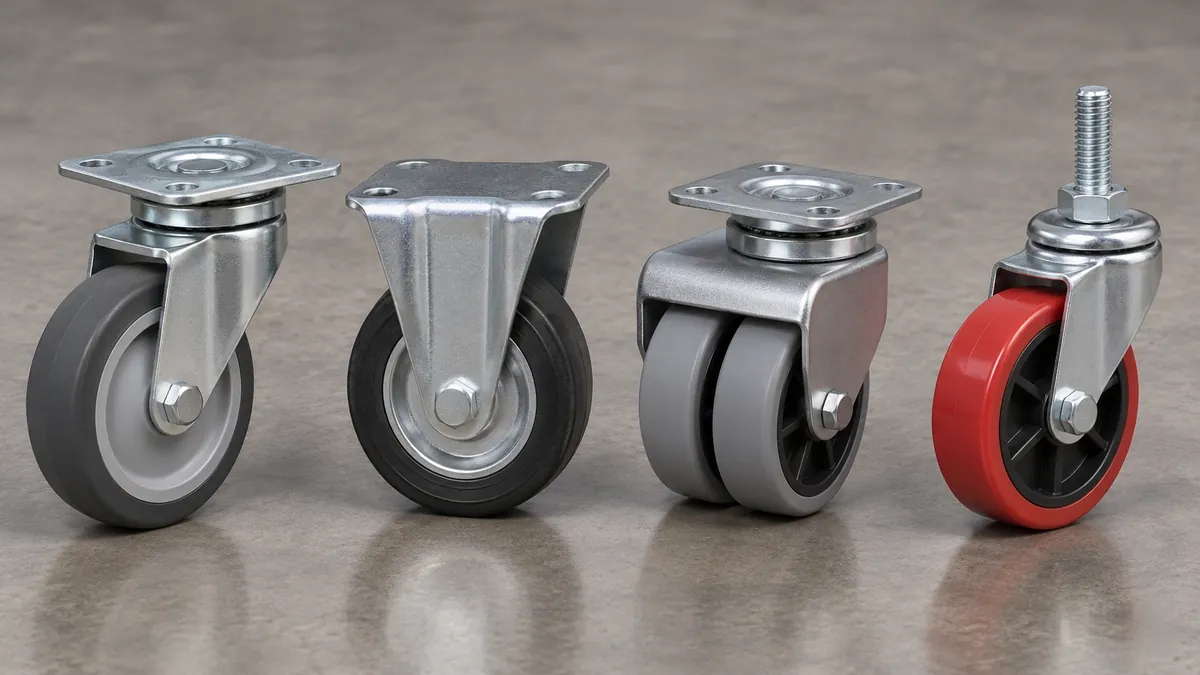
Types of casters are easier to compare when the buyer treats their labels as separate classification axes. Fixed or rigid versus swivel describes how the assembly moves; single versus twin describes wheel count; plate, stem or bolt-hole descriptions identify a mounting interface; and brake or levelling terms describe additional functions. These categories can overlap: a twin-wheel unit can also swivel, and an assembly may combine rolling with a separate levelling support. A caster type alone does not prove load capacity, floor compatibility, stability or fit with a particular rack.
For a buyer specifying a mobile storage rack, cart or hardware assembly, the useful question is not “Which one is best?” but “What motion, wheel arrangement, mounting interface and stationary function does the product require?” A controlled drawing or sample should identify the frame connection, available space, intended movement and any conditions that must be checked. Manufacturer classifications are helpful starting points, but dimensions, load ratings and performance claims must come from the actual caster maker and product data for the selected item.
What are the main types of casters?
Casters can be grouped by movement, wheel count, attachment and function. A rigid or fixed caster supports travel in a set direction because its wheel assembly does not swivel around a vertical axis. A swivel caster turns around that axis and can change direction. A twin-wheel caster uses two wheels in one assembly; “twin” describes wheel arrangement rather than whether the assembly swivels. Mounting forms such as top plate, stem or bolt interface describe how the caster attaches to the equipment. Brakes and levelling options add functions that are specified separately.
This multi-axis view is consistent with product-maker classification fields such as those used in Blickle’s caster product finder, which separates wheel, mounting, movement and other selection attributes. Blickle’s twin caster guide describes the two-wheel arrangement, while its levelling caster information illustrates one manufacturer’s combined rolling and support designs. These are examples of one maker’s products and terminology; they do not establish universal dimensions or performance for every caster brand.
| Classification axis | Common terms | What the term answers | What it does not answer |
|---|---|---|---|
| Movement | Fixed/rigid, swivel | Can the wheel assembly change direction? | Capacity, stability or floor suitability |
| Wheel arrangement | Single, twin/double | How many wheels are used in the assembly? | A universal load rating or footprint |
| Montagem | Plate, stem, bolt or hole pattern | How does the assembly attach to the frame? | Fit without matching dimensions and interface details |
| Stationary control | Brake, directional lock, floor lock | Which motion or support function is controlled? | A guaranteed stopping distance or no-movement result |
| Height/support adjustment | Levelling or adjustable support | Does the design include a separate support or adjustment feature? | Universal behavior across all makers’ products |
| Wheel material/profile | Maker-specific options | What wheel construction is offered? | Floor protection, noise level, life or compatibility without evidence |
The categories overlap, so a product description should combine the relevant axes. For example, a buyer may need a swivel caster with a top-plate interface and a brake, or a fixed caster with a stem mount. The combination is more informative than saying only “industrial caster” or “heavy-duty wheel.” Those broad labels do not tell the hardware manufacturer what to draw or the caster supplier which interface to quote.
How do fixed, rigid and swivel casters differ?
Fixed and rigid are commonly used for a caster assembly that rolls along a set direction without swiveling. A swivel caster rotates so the wheel can align with a changing direction of travel. That movement difference affects how the equipment is steered and how its frame or wheel layout should be considered. It does not by itself determine how easy a loaded rack will be to push or whether the rack will remain stable.
A design may combine fixed and swivel units to balance tracking and maneuverability, but the correct arrangement depends on the equipment, user path, floor, turning space, load distribution and caster design. The article does not prescribe a universal layout. A rack with an unusual center of gravity, high shelves or uneven load can behave differently from an empty compact cart. A buyer should not infer tipping resistance or safe load from the caster arrangement alone.
The frame connection also matters. The caster must match the rack’s available mounting surface, hole pattern, stem or other interface. A swivel assembly needs room to turn without hitting a leg, crossbar, foot or stored product. A rigid assembly may constrain movement but still requires appropriate clearances for the intended route. A picture can suggest approximate form, yet it cannot confirm mounting dimensions or a product’s operating envelope.
When requesting a quotation, show the manufacturer the underside or base drawing, including the caster attachment points and nearby structure. Identify whether the caster is fixed or swivel at each location, whether all units are intended to use the same mounting style, and whether a braking or levelling function is required. If the buyer has a sample, identify which dimensions and features are controlled. Do not substitute a caster based only on a similar appearance or a matching wheel diameter.
What do wheel count and mounting type tell you?
Wheel count and mounting type answer different questions. Single versus twin indicates the number of wheels in the assembly. A twin caster can distribute contact across two wheels, but the classification alone does not establish its load capacity or behavior on a particular floor. A plate or stem designation describes the mounting approach. It does not guarantee that two items with the same broad mounting label have identical dimensions.
Common mounting interfaces include a top plate secured to a frame, a stem inserted into a matching socket, or a threaded stem that engages a compatible connection. Some product makers offer other attachment arrangements. Buyers should use the exact maker’s drawing or product specification to confirm dimensions, fasteners, hole spacing, stem size, insertion depth and retention method. Do not rely on a generic term such as “stem caster” when the product has a specific tube socket or threaded interface.
| Requisitos do comprador | Information to identify | Provas a solicitar |
|---|---|---|
| Top-plate mount | Plate outline and hole arrangement | Maker’s dimensional drawing and confirmed frame interface |
| Stem mount | Stem type and receiving socket | Exact caster and socket specification from responsible suppliers |
| Threaded stem | Threaded interface and retention | Compatible thread details and installation instructions |
| Twin-wheel assembly | Wheel arrangement and bracket envelope | Selected maker’s product drawing and rated data |
| Swivel clearance | Rotation space near the rack base | Assembly drawing or physical sample fit review |
| Brake or lock | Which movement or support function is intended | Maker’s stated function and project-specific confirmation |
The list is a selection prompt, not a universal engineering specification. The buyer should not infer that any particular mounting configuration is appropriate for a given rack without matching it to the drawing and product maker’s information. If a stem socket, adapter or threaded interface comes from a separate supplier, confirm who owns the compatibility check and which revision controls the assembly.
For metal storage hardware, caster integration may require a mounting plate, tube, cross-member, reinforcement or clearance change. That is a product-structure decision as well as a caster catalog decision. If the base structure changes, the selected caster’s interface and the buyer’s acceptance drawing may need review. Koitor Hardware’s approved scope includes custom metal bathroom and home-storage products, drawing/sample development and practical manufacturing review; the brand does not claim to manufacture casters. Any caster, wheel, brake or levelling component must be confirmed with its actual supplier.
What is the difference between brakes and levelling features?
A caster brake or lock controls a stated movement or rotation function; a levelling design may add a support or adjustment element that changes how the equipment is supported when stationary. The terms are not interchangeable. Manufacturer designs vary, and a product-specific description is needed to know exactly which parts move or contact the floor. Do not assume that every brake stops every kind of movement or that every levelling caster transfers the full load away from its wheel.
Some makers offer a levelling feature that raises or supports the equipment when it is parked. Another device may lock wheel rotation, swivel rotation, or a specified motion. A floor lock may be a separate accessory rather than part of the caster. The buyer should define the desired outcome: easier movement, direction control, resistance to rolling, height adjustment, stationary support or another function. Then ask the component maker how the selected product operates.
For a detailed distinction between stationary rack functions, see Koitor’s existing guide to floor locks versus caster brakes. It addresses the difference between a floor lock and a brake; this article focuses on classifying caster types and their independent selection axes. That separation avoids using a brake label as a substitute for a floor-lock requirement.
The project may need additional review for floor contact, incline, load, movement frequency and user handling, but this article does not set a safety requirement or capacity. A caster supplier’s product data and instructions are the appropriate sources for its own ratings and use conditions. If a buyer needs a stopping or stationary performance claim, it should be defined and confirmed for the actual assembly and environment rather than inferred from the term “brake.”
How should buyers select types of casters for a rack?
Select a caster by starting with the equipment requirement, then match the component’s dimensions and functions to that requirement. Do not begin with a catalog adjective. The process should identify the intended movement, rack interface, desired stationary function, environment and evidence source. The caster maker can provide product-specific data; the hardware manufacturer can coordinate the metal structure and assembly interface within its confirmed capabilities.
- Describe how the equipment moves. Identify straight-line travel, turns, tight aisles or repositioning frequency.
- Define the mounting interface. Show the base drawing and exact plate, stem or threaded connection.
- State the stationary function. Distinguish rolling brake, swivel lock, floor lock or levelling support.
- Provide the complete product context. Include the rack dimensions, expected contents, center-of-gravity considerations and floor conditions as project inputs, without guessing a rating.
- Review the maker’s data. Confirm the selected part’s own dimensional drawing, material and stated rating or use limits with its responsible supplier.
- Check physical fit. Review clearance, fasteners, assembly access and how the complete unit behaves under the buyer’s agreed evaluation.
- Control substitutions. Record the approved maker and part reference or the equivalent acceptance requirements for any alternate.
The manufacturer and buyer may need to exchange a drawing, sample or underside photograph at the concept stage. A photo can help identify the broad form but may not show a thread, socket depth, hole pattern or clearance. If those details matter, request the supplier drawing or verify the sample. Record any gap rather than filling it with an assumed dimension.
For product development, keep the caster supplier’s component specification separate from the metal rack drawing. The rack drawing should show the interface and assembly position; the caster documentation should identify the component and maker-defined characteristics. If a caster is changed after sample approval, check whether the base, clearances, total height or stationary function also changes. Do not assume a substitute is equivalent because it looks similar or carries a broad label such as “twin.”
Da Koitor’s OEM home-storage hardware overview describes the metal-product project context. It does not claim Koitor’s caster catalog or wheel-manufacturing capability. Buyers should identify which supplier provides each component and which party confirms the complete assembly.
One more useful check is whether the catalog language describes the complete assembly or only one subcomponent. A supplier may call a component a swivel caster while the buyer is also evaluating a brake, plate, wheel material or mounting stem. The drawing and quotation should identify the complete selected reference and any option codes that affect the assembly. If a caster has a separate brake or levelling part, ask whether it is included, attached by the caster maker or supplied as another component.
Buyers should also compare caster labels against the product’s actual movement pattern. A rack that moves only in a straight aisle may have different steering needs from a cart that turns frequently in a tight space. A rack that stays in one place may not need mobile hardware at all, or may need a distinct stationary feature. Those observations help describe the function, but they do not prescribe a safe arrangement. The equipment designer must consider the full structure, loaded condition, users and environment before approving a layout.
If a caster substitution is proposed, review more than the visible wheel. Compare the assembly height, mounting interface, swivel envelope, wheel arrangement, attachment hardware and any stated brake or support function. A visually similar assembly can have a different plate, stem or clearance. A substitution can also change the rack’s overall height or how components interact with a base frame. The selected component maker’s drawing and a sample fit check are better evidence than a product photo alone.
Record maker and model references for the approved component when available. If the supplier changes the part, request the new data and determine whether it still matches the buyer’s acceptance criteria. Any stated load or application ratings should be checked against the exact product, mounting configuration and use conditions with the component maker. This article does not reproduce numerical ratings or convert a general classification into a capacity judgment.
For an OEM project, identify responsibility for the wheel, bracket, fasteners and frame connection. The caster maker may supply the component data; the metal hardware factory may fabricate the rack base; the buyer may own the complete product requirement. A clear responsibility map prevents one party from assuming that another party has checked compatibility. It also gives the buyer a traceable point of contact if the approved part or drawing changes.
What should go on a caster-selection checklist?
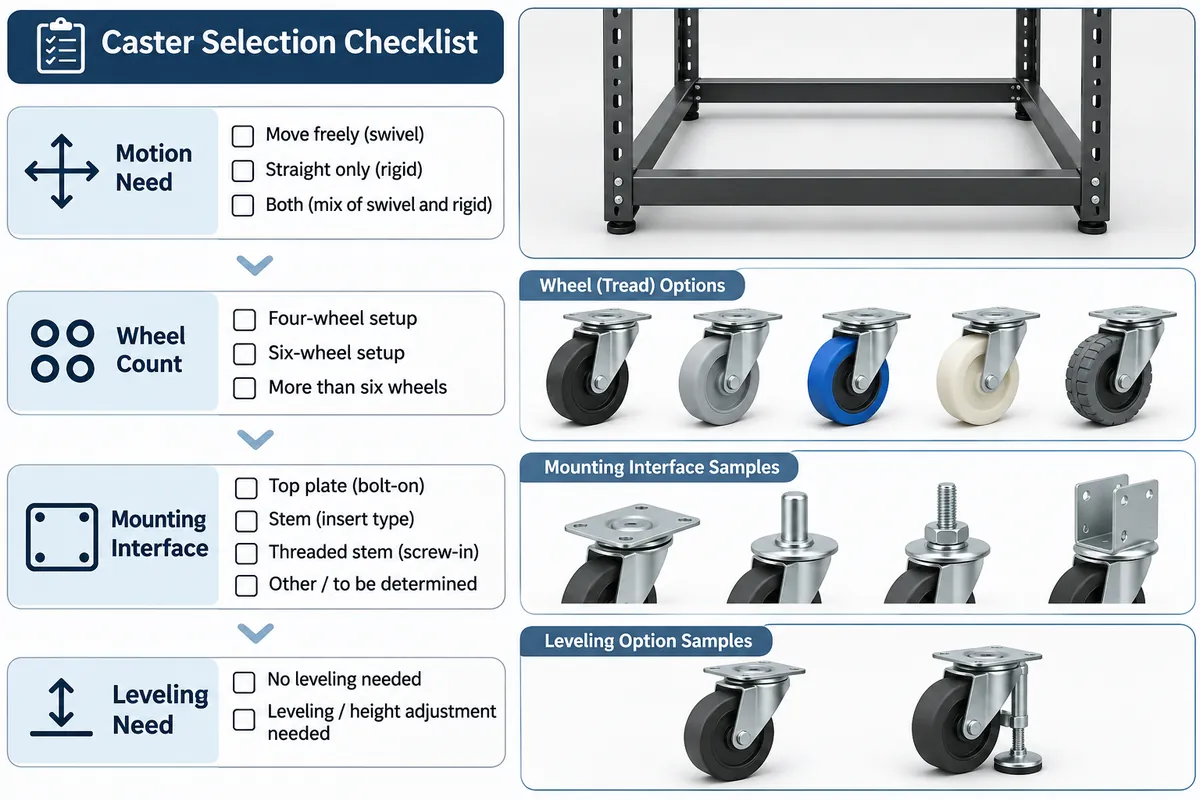
The checklist should combine the distinct classification axes without treating them as mutually exclusive. It should also distinguish descriptive labels from product evidence. A buyer can use the following fields during RFQ, sample review or engineering change:
| Checklist field | Decision to record |
|---|---|
| Movement | Fixed/rigid, swivel or a defined combination by position |
| Wheel count | Single, twin or another maker-described arrangement |
| Montagem | Exact plate, stem, threaded or other interface and drawing reference |
| Function | Brake, directional control, floor lock or levelling need |
| Space and fit | Clearance, frame attachment, fasteners and assembly access |
| Application | Intended route, floor and operating conditions supplied by the buyer |
| Product data | Maker, model, dimensional drawing and applicable rating source |
| Approval | Sample, drawing revision and substitution/change-control path |
| Responsibility | Who supplies the caster and who verifies the rack interface |
The image below illustrates that movement, wheel arrangement and mounting are separate choices. It does not prove capacity, floor protection or stability, and its pictured examples are not a product recommendation. Use the selected caster maker’s data and project-specific review for any performance requirement.
If a buyer needs a brake comparison, use the linked floor-lock guide and then return to the exact caster model’s instructions. If a buyer needs mounting compatibility, obtain the component drawing from the maker rather than using a generic checklist as the specification. The checklist organizes a question; it does not answer every engineering detail.
A useful RFQ can separate the buyer’s functional request from the component terminology. For example, state whether the equipment must roll, turn in a confined aisle, remain fixed in direction or sit stationary after repositioning. Then identify the available frame interface and ask the caster maker to propose a named assembly with a drawing. This keeps the buyer from selecting a catalog label before confirming that the plate, stem, mounting height and turning envelope can fit the product. If the proposed design changes one of those dimensions, route the change through the drawing and sample approval process rather than treating it as an invisible component substitution.
The buyer can also define how the selected caster will be evaluated without inventing a universal test. A project may need a fit review on the intended frame, a check that the assembly clears nearby structure, or confirmation that the documented component matches the approved reference. If rolling resistance, noise, floor marking or stationary performance matters, write the required condition and evidence source into the project specification. Ask the component supplier what its published data covers and what remains unverified for the complete loaded rack. The article’s classification framework helps formulate those questions; it does not replace the engineering review of the assembled product.
Perguntas frequentes
Are fixed and rigid casters different?
The terms are commonly used for a caster that does not swivel and rolls along a set direction. Confirm the maker’s definition for the exact product because naming can vary.
Can a twin caster swivel?
Yes. Twin describes the wheel arrangement, while swivel describes movement. They are separate classification axes and can appear together in one assembly.
Does a caster brake stop the rack from moving in every direction?
Not necessarily. A brake’s function depends on the maker’s design. Confirm whether it controls wheel rotation, swivel rotation or another motion, and do not assume it replaces a floor lock.
Does a levelling caster always raise the rack off its wheels?
No universal behavior should be assumed. Designs differ. Review the selected maker’s product description and instructions for the exact support action.
Can I select a caster by wheel diameter alone?
No. Mounting, movement, clearances, wheel construction, functional requirements and product-specific data also matter. Wheel diameter alone does not confirm fit or capacity.
Does Koitor manufacture casters?
This article does not claim that Koitor manufactures casters. Koitor’s approved scope is custom metal bathroom and home-storage hardware; any caster component and its capabilities require confirmation from its actual supplier.
Trabalhe com a Koitor Hardware
Plan a Mobile Metal Storage Product
Share the rack drawing or sample, base interface, intended movement and the caster component information available from its supplier. Koitor can review the confirmed metal structure and manufacturing questions for a custom hardware project.
OEM / MARCA PRÓPRIA
Transforme este guia de fornecimento num resumo do produto
Indique o produto pretendido, as dimensões, o acabamento, a quantidade a encomendar e os requisitos de embalagem. A sua equipa receberá uma análise prática da viabilidade de fabrico antes da apresentação do orçamento.


 English
 Español
 Português
 Français
 Deutsch
 العربية