

A frase fillet weld vs groove weld compares two weld forms, not an automatic ranking of strength, quality, speed or cost. A fillet weld commonly has an approximately triangular cross-section in the corner between two meeting surfaces. A groove weld is made in a groove between workpieces or their edges; that groove can be square or prepared into another shape, so it does not always require a bevel. The drawing must separately clarify the joint arrangement, weld form and any penetration requirement. The word “groove” alone does not establish complete penetration or a finished-part strength.
For buyers of metal bathroom and home-storage hardware, this distinction helps prevent a familiar label from substituting for the actual drawing note. A bracket corner, tube junction or formed-sheet interface may be described with weld terms, but a buyer should not select a weld for a real product from a general comparison article. Material, thickness, loading, geometry, access, process, inspection and applicable engineering review matter. This article explains how to read the terms and identify missing information; it does not provide a welding procedure, design value or acceptance limit.
What is the difference between a fillet weld and a groove weld?
A fillet weld is commonly associated with the corner between two surfaces that meet at an angle, such as a T, lap or corner arrangement. Its cross-section is often described as roughly triangular. A groove weld is deposited in a groove formed between workpieces or edges. The groove may be square, or it may have a prepared shape such as a bevel, V, U or another configuration. The weld-form name describes the weld region; it does not by itself define every joint detail or its required penetration.
Miller Electric’s explanation of fillet and groove welds in structural steel field welding illustrates common arrangements and distinguishes weld form from penetration terminology. That source concerns structural steel field work; it is not a Koitor process specification, capability statement or design rule for bathroom accessories. Its terminology is useful for general orientation, while the actual drawing and qualified technical review govern a product decision.
| Question | Fillet weld | Groove weld |
|---|---|---|
| Where is the weld commonly placed? | In the corner between meeting surfaces | In a groove between workpieces or their edges |
| What may the cross-section look like? | Often approximately triangular | Follows the prepared or square groove geometry |
| Does the name itself define penetration? | No | No; a separate penetration requirement may apply |
| Does the name prove finished-part strength? | No | No |
| Does the name determine the welding process? | No | No |
This table is a vocabulary guide. It deliberately avoids recommending one form for a bracket or specifying a weld size. A fillet can be used in several joint arrangements; a groove can be square or prepared. The project drawing must make the needed features clear enough for the responsible manufacturer and reviewer to understand what is being requested.
The distinction can be confusing because buyers may use “joint,” “weld” and “welding process” as if they described the same thing. They do not. A joint arrangement is how the parts meet, such as a lap, T, corner or butt arrangement. Weld form describes the shape or location of deposited weld metal. A process describes how the welding operation is performed. A penetration requirement concerns how far the weld is required to extend into the joint under the specification. The drawing may need to address more than one of these dimensions.
What does the joint arrangement tell you?
The joint arrangement describes the geometry of the parts before or during joining. A T arrangement brings one part against another at approximately a right angle; a lap arrangement overlaps parts; a corner arrangement brings edges or faces together at a corner; and a butt arrangement brings edges into a common plane or alignment. These arrangement names do not alone tell a reader which weld form is specified or how much penetration is required.
A fillet weld can be associated with a T, lap or corner joint. A groove weld may be used between edges prepared or left square, depending on the design and applicable requirements. A product drawing that says only “weld bracket to tube” may identify the parts but still leave open the actual joint and weld details. Whether the note is sufficient depends on the product, drawing standard, material, load path and responsible engineering review.
The buyer should identify the actual parts and the purpose of the connection. A hook welded to a backplate, a wire intersection in a basket, and a bracket attached to a tube can have different geometry and visual requirements. A cosmetic surface may constrain where visible welds appear or how finishing follows. A connection may also be difficult to access for a tool or inspection. These factors do not let an article reader prescribe a weld; they reveal why the drawing and supplier review need product-specific information.
| Drawing element | What it communicates | What it does not automatically communicate |
|---|---|---|
| Joint arrangement | How the parts meet geometrically | The weld process, penetration or acceptance limit |
| Weld form | The specified weld type or region | Complete penetration or finished strength |
| Edge preparation | Whether edges are shaped or left in a specified condition | That a particular preparation is always required |
| Penetration requirement | The specified extent of joint penetration when stated | That the joint meets a design load without supporting analysis |
| Process note | A selected welding method or procedure reference | That the operator, equipment or quality system is qualified for every application |
| Inspection/acceptance note | How the actual work will be reviewed | A universal pass/fail criterion unless the governing specification says so |
Separating these fields helps a buyer find omissions early. It does not mean every consumer-facing storage product requires a complicated weld callout. It means that the amount of detail should fit the engineering decision and the governing requirements. A supplier should raise questions where a drawing is ambiguous rather than silently infer a structural requirement from a generic product photograph.
Does a groove weld always need a bevel or complete penetration?
No. A groove can be square or prepared into a shape, so a groove weld does not always require a bevel. A bevel is one possible edge preparation, not the definition of every groove weld. Likewise, the word “groove” does not mean the joint is automatically complete joint penetration. The drawing or specification must state the applicable penetration requirement when that requirement matters.
Miller Electric’s structural-steel discussion describes groove configurations and distinguishes partial joint penetration from complete joint penetration terminology. These distinctions are context-sensitive. This article does not translate a symbol, choose a preparation, state an acceptance level or say when a partial or complete penetration design is appropriate. Those decisions belong to the responsible engineer and the applicable drawing, specification and qualified welding procedure.
The buyer’s risk is treating a familiar term as a hidden promise. If a quote says “groove weld,” ask whether the drawing specifies the groove shape and penetration requirement. If the drawing does not, ask the design owner whether the missing detail is intentional or needs clarification. If a supplier proposes a change in preparation, require the appropriate approval and revised drawing or process documentation before production. A visually filled groove does not prove the penetration condition or internal fusion required by the design.
The same principle applies to square-groove configurations. A square groove may be suitable in some defined applications, but this article cannot determine where. Material, thickness, fit-up, process, access and the intended joint performance all matter. Do not turn a general illustration into a project prescription or assume that a bevel is unnecessary just because some grooves can be square.
For a buyer, a concise clarification can ask: “The drawing identifies a groove weld but does not state whether edge preparation or a penetration requirement applies. Please confirm the design owner’s intended weld form, preparation and penetration callout before quotation or sample approval.” That wording distinguishes the open question without suggesting an unverified technical answer.
Why does visible weld appearance not prove effective throat or fusion?
A visible weld face is only the surface that can be seen. It does not by itself establish the effective throat, internal fusion, penetration condition or structural capacity required by a design. A smooth or large-looking bead is not automatically stronger, and a visually acceptable fillet face does not replace the drawing’s specified measurement or inspection method. The relevant evidence depends on the joint and acceptance criteria.
This is important when a finished metal accessory is polished or coated. Surface finishing can alter what remains visible, and some joint regions may be difficult to inspect after assembly. A photo can document appearance but cannot establish an internal condition. If the product requirement depends on a weld characteristic, the buyer and responsible technical party need to agree on how that characteristic will be controlled and verified before production.
Avoid claims such as “a larger bead is stronger,” “groove welds always penetrate fully,” or “a fillet weld is always faster.” These statements are not universal. Weld quality and suitability depend on material, fit-up, access, process selection, procedure, operator, design and applicable requirements. A weld form name is not a substitute for those details.
For small metal bathroom or home-storage products, weld locations may affect appearance, grinding access, coating, assembly order and packaging. Those are practical manufacturing considerations, not a basis to assert that one weld form is suitable. A supplier reviewing a drawing may identify questions about access, part positioning or finish sequence. The buyer should record the response and route design changes to the authorized owner.

How should buyers review a weld note before approving a sample?
Review the weld note with the product, joint geometry, material, process owner and inspection requirement in view. If the drawing calls for a weld but does not identify a necessary feature, request clarification from the design owner. If the supplier proposes an alternative, keep the proposal separate from the approved drawing until the responsible party accepts the change. Do not let a general comparison article decide the design.
The review can follow these steps:
- Identify the parts and revision. Confirm the drawing or sample revision and the components being joined.
- Describe the joint arrangement. Determine how the parts meet: lap, T, corner, butt or another defined configuration.
- Read the weld form. Identify whether the drawing calls for a fillet, groove or another weld form.
- Check preparation and penetration notes. Confirm whether an edge preparation or penetration requirement is specified where needed.
- Confirm the responsible process owner. Identify who will establish the applicable procedure and control the joining operation.
- Define acceptance evidence. Ask what inspection or record applies to the actual design requirement.
- Coordinate finish and assembly. Review how welding, grinding, polishing, coating and packaging interact with the visible product surfaces.
- Control any change. Record the design approval, sample review and revised document before bulk production.
This sequence is a communication checklist, not a welding procedure or engineering standard. A product may not require every listed item in the same level of detail. The design owner and qualified technical reviewer determine what applies. Buyers should not demand a test result, certification or inspection plan that is unrelated to the agreed requirement, but should not accept an unsupported guarantee in place of one either.
Koitor Hardware’s approved capabilities include metal forming and joining processes such as resistance welding, laser welding and TIG welding in project context, along with grinding, polishing, finishing and assembly. This does not imply that Koitor performs structural-steel field welding, holds a welding certification, operates a certified testing lab, or can meet every penetration requirement. A buyer’s actual drawing, material, joint and acceptance requirements must be reviewed before confirming a particular manufacturing approach. See the OEM home-storage hardware overview for the product and project context.
A drawing review should separate the feature that joins the parts from the evidence used to accept the weld. The joint arrangement describes how the members meet; the weld form describes the deposited weld configuration; a symbol or note communicates specified requirements; and an inspection plan states what characteristics are checked, by whom and at what stage. A buyer should avoid compressing all four into a short note such as “strong weld” or “full weld,” because those words may not identify a measurable acceptance condition. The design owner should clarify the required geometry and any applicable code or project standard before a production drawing is released.
For formed bathroom and home-storage hardware, access can be as important as the nominal joint type. A bracket close to a tube end, a corner near a cosmetic face or a part that must be polished after joining can constrain the sequence. The manufacturer should review whether the joint can be prepared, reached, welded, inspected and finished in the intended order. If the product has a visible face, define which areas are cosmetic and what appearance is acceptable after the specified finishing route. A visual review can identify an obvious mismatch to an approved sample, but it cannot establish hidden fusion or penetration.
When comparing sample and drawing, record the exact revision, material and joint location. If a supplier proposes replacing a groove detail with a fillet, or the reverse, treat it as a design change requiring approval. The change may affect preparation, fit-up, access, distortion, finishing allowance or the evidence needed for acceptance. The buyer should request a marked drawing or change note that identifies what changed and which requirements remain the same. Do not infer that a different weld form is acceptable because the exterior bead looks similar. Any strength, fatigue or structural conclusion needs an appropriately qualified design review and project-specific evidence.
What should go in a fillet-weld versus groove-weld checklist?
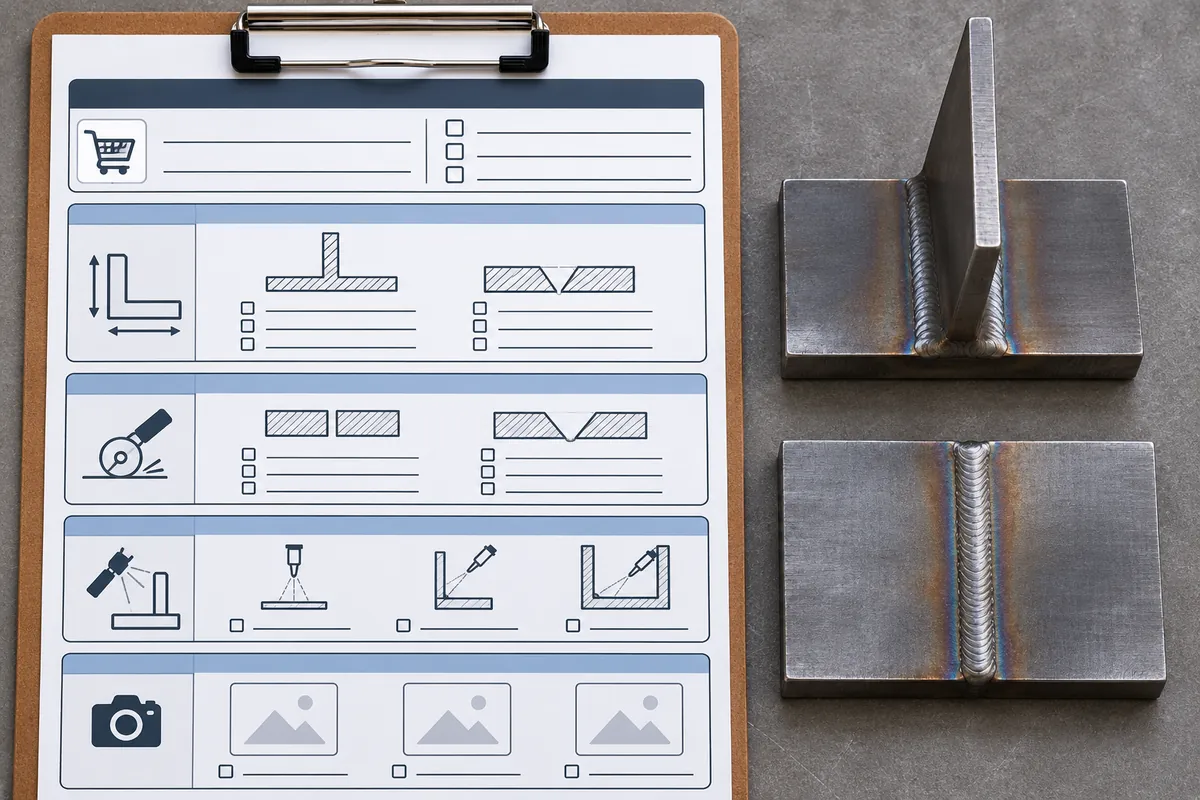
Use a checklist that separates what the drawing states from what still needs confirmation. This reduces the chance that the buyer, supplier and inspector use one word to mean different things.
| Review field | Verificação do comprador |
|---|---|
| Product and revision | Does the weld note refer to the controlled part and assembly revision? |
| Joint arrangement | Are the meeting parts and geometry clear? |
| Weld form | Is the specified form named or shown in the controlling drawing? |
| Groove preparation | If a groove is used, is the required square or prepared condition identified where necessary? |
| Penetration | Is partial or complete penetration specified when the design needs it? |
| Process responsibility | Which supplier or qualified technical owner controls the actual process? |
| Inspeção | What feature will be checked, by whom, and against which approved criteria? |
| Finish interaction | Could weld location, grinding or coating affect a cosmetic or mating surface? |
| Sample approval | Does the sample represent the approved joint, finish and assembly? |
| Controlo de alterações | Who approves a proposed weld or preparation change? |
This illustration is a visual prompt only; it does not define a drawing symbol, weld size, penetration requirement or acceptance limit. Use the actual product drawing and responsible technical review for any specification. Keep the checklist’s unanswered fields open until the design owner resolves them.
For a project-specific discussion, send the controlled drawing and sample context to the supplier and request clarification on the exact open item. A source description, weld photo or catalog image should not override a drawing. Keep any regulatory or standard reference tied to its actual jurisdiction and current applicability; this article does not declare compliance with a standard or set a legal requirement.
A fillet weld vs groove weld discussion should finish with an agreed record of the decision, not only a verbal description. The drawing owner can identify the selected joint and weld form, the required preparation, the location and extent, and any acceptance standard that applies. The supplier can then confirm whether the proposed manufacturing sequence can produce and inspect that definition. If the project changes the material, thickness, joint access or finishing sequence, the parties should revisit the approved detail rather than assume the old decision still applies.
The buyer should also separate evidence of process control from evidence of product acceptance. A welding procedure or operator qualification may be relevant where the project or applicable standard requires it, but such documentation does not by itself prove that an individual part meets its drawing. Conversely, a visual sample can show fit and appearance without proving internal characteristics. The required evidence depends on the design, risk and governing specification. Ask the responsible engineering or quality owner to define what is necessary, and do not request certificates or tests as generic substitutes for a clear acceptance criterion.
For a prototype review, mark the joint locations on the drawing and compare them with the actual sample. Note whether preparation, weld access, finishing and assembly match the intended sequence. If a concern appears, record the location and observed condition, then ask the design owner whether it is a drawing deviation, cosmetic issue or acceptable variation under the agreed criteria. This keeps the conversation tied to observable facts and avoids inferring structural performance from a photograph or a single bead. A production release should identify the approved revision and disposition of any open question.
A buyer can frame the fillet weld vs groove weld question in the RFQ by providing a drawing reference and asking the design owner to identify any unresolved joint detail. If the weld form is intentionally left to the manufacturer, the acceptance criteria and change approval route still need to be explicit before production.
Perguntas frequentes
Is a fillet weld always triangular?
A fillet weld is commonly described as having an approximately triangular cross-section, but the appearance of a visible weld face does not establish every internal dimension or performance requirement.
Does a groove weld always need a bevel?
No. A groove can be square or prepared into another shape. The drawing and responsible technical review determine whether a particular edge preparation is required.
Does a groove weld automatically mean complete penetration?
No. Penetration must be specified separately when it matters. The word “groove” alone does not establish complete joint penetration.
Is a fillet weld stronger than a groove weld?
There is no universal answer based on the form name alone. Design, material, dimensions, penetration, process and acceptance requirements determine the actual joint performance.
Can a visible weld bead prove the required penetration?
No. Surface appearance alone does not prove internal fusion or the penetration condition. Use the inspection evidence appropriate to the approved design requirement.
Does this article specify how Koitor welds every product?
No. It explains buyer terminology. Koitor’s process and product capability must be confirmed for the actual drawing, material, joint and project requirements.
Trabalhe com a Koitor Hardware
Review a Welded Metal Hardware Drawing
Share the controlled drawing or sample, material, joint location and the acceptance question that needs clarification. Koitor can review the confirmed custom hardware scope and manufacturing sequence before quotation or sample development.
OEM / MARCA PRÓPRIA
Transforme este guia de fornecimento num resumo do produto
Indique o produto pretendido, as dimensões, o acabamento, a quantidade a encomendar e os requisitos de embalagem. A sua equipa receberá uma análise prática da viabilidade de fabrico antes da apresentação do orçamento.


 English
 Español
 Português
 Français
 Deutsch
 العربية