
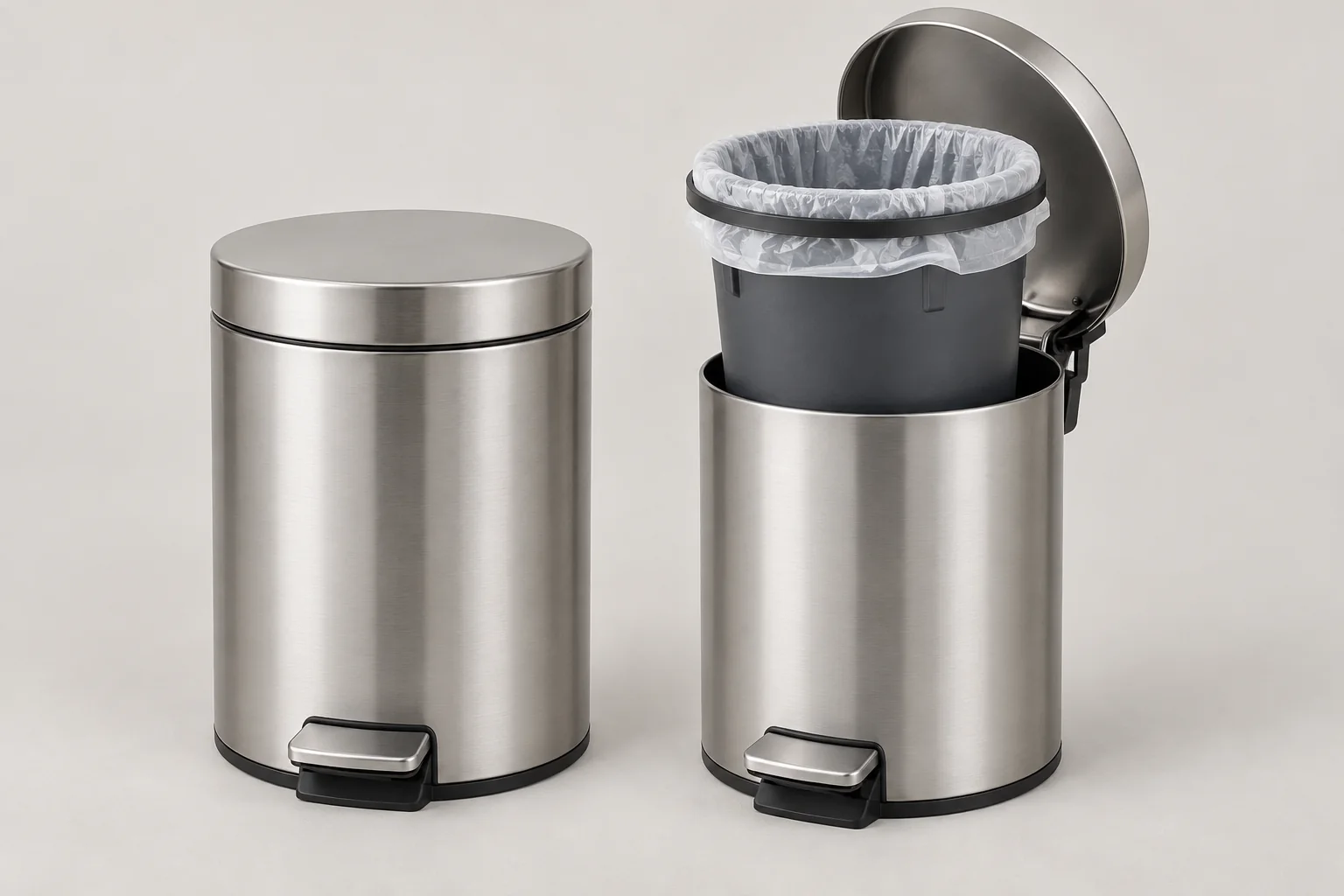
A bathroom wastebasket liner bag retention rim should be specified as an interface among the bin opening, removable bucket, chosen bag and lid—not as a single ring dimension. Buyers should define which liner sizes are intended, how the bag is retained, how much overhang is acceptable, and whether a filled bag can be removed without the bucket catching. Approve the assembled combination with representative samples. Product examples show different solutions, so no one retention arrangement or universal bag-fit claim should be assumed.
This guide is for importers, distributors and private-label bathroom-accessory teams deciding how to develop or source a compact bin. It focuses on the product and supplier decisions behind a clean-looking liner fit while keeping the wastebasket itself distinct from Koitor’s confirmed product range. For an OEM team, bathroom wastebasket liner bag retention rim is therefore a complete product-interface specification, not simply a request for a loose retaining ring.
Why does liner retention belong in the product specification?
A liner that slips below the bucket rim can become difficult to remove, while excess film may remain visible or interfere with a lid. A retention system that works with one bag material or size may not work with another. These are interface questions: the buyer is approving the bin, bucket, bag and lid together, not buying an isolated “fixer.”
The issue also affects the product promise. A retailer may want buyers to use readily available bags; another brand may choose model-specific liners and sell or bundle them separately. Those are different assortment and customer-support decisions. The chosen approach influences the opening geometry, inner-bucket profile, storage space, instructions and replacement-liner plan.
Official product pages illustrate two approaches without establishing a universal standard. EKO’s Eva 5L page describes a removable PP inner bucket with a bag fixer intended to hold liners in place and avoid messy overhang. Joseph Joseph’s EasyStore 5L page describes a removable inner bucket and a rear pocket for its specified custom-fit liner roll. The latter is a liner-storage and compatibility approach, not evidence that its model uses EKO’s fixer. These are model-specific examples, not recommendations or performance guarantees.
Which liner-retention approach should a buyer choose?
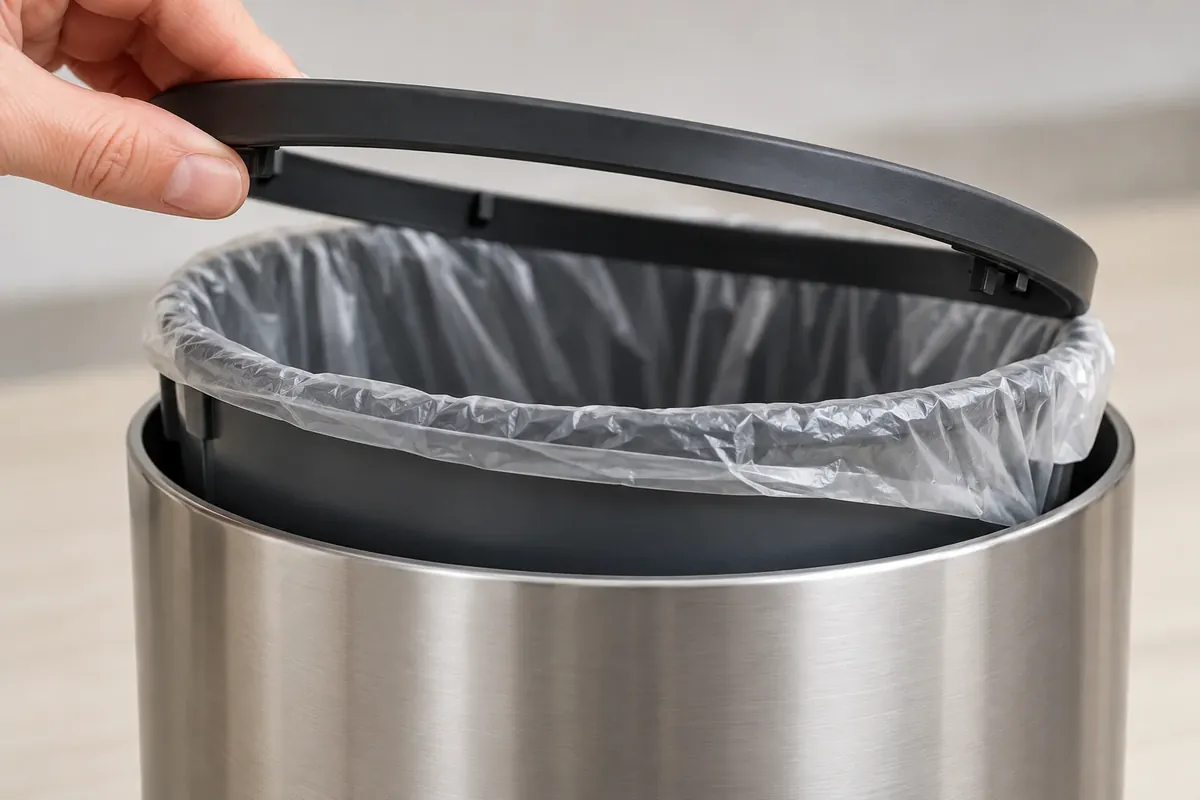
Choose based on the intended assortment and how the product will be used. A retaining ring or fixer can aim to hold a bag at the bucket opening while allowing the user to replace it. A custom-fit-liner program can make the intended bag match the product, but then buyers need to define the replenishment path, pack quantity and compatibility information. A simple tuck-over arrangement may be adequate for some products, but it should not be described as secure until tested with the selected bucket and bags.
| Product approach | Buyer benefit to evaluate | Trade-off or question to resolve | Exemplos de provas a solicitar |
|---|---|---|---|
| Removable fixer or retention ring | May help hold the liner edge at the bucket opening | How is the ring installed and removed? Does it fit the selected bag range without excessive force? | Fit and removal with each agreed bag size and material |
| Model-specific liner | Can align bag shape with a particular bin opening | How will buyers identify, stock and replace the matching liner? | Exact liner reference, pack details and product compatibility wording |
| Bag tucked over the bucket rim | Fewer dedicated interface parts may be needed | Does the intended bag stay in place and remain acceptably concealed? | Repeated installation and filled-bag removal on the approved bucket |
| Integrated liner storage | Makes spare bags part of the product configuration | Does the storage feature change the outer envelope or consume useful space? | Storage fit, access, refill and packaging review |
What dimensions and components should appear in the RFQ?
Start with the complete assembly. Record the bin’s nominal capacity only as a product descriptor; it does not define the dimensions of every usable liner. A buyer should identify the bucket opening in plan view, its perimeter shape, the usable internal depth, the bucket’s top edge, the outer-shell opening and the lid’s closed and open positions. If a separate ring or clip is used, identify its part number or drawing revision and the surfaces it contacts.
A useful fit record includes:
- The target liner reference or a defined range of commonly sourced bag sizes.
- Bag material or construction when it affects stretch, thickness or folded bulk.
- The bucket opening’s overall width and depth, or diameter for a round opening, plus the measurement datum.
- The bucket rim profile and any ledge, groove, lip or locating feature used by the retainer.
- The retainer’s installed position, removal direction and any tool-free expectation.
- The intended visible overhang or concealment requirement, shown with an approved sample or photo.
- The lid’s sweep, hinge path and closing contact areas.
- The removal path for the inner bucket and the bag when it is filled to the buyer-defined test condition.
Do not specify only “fits standard bags.” The word “standard” can mean different dimensions, materials and closure styles in different countries and sales channels. If the product will be sold across several markets, nominate representative bag references for each target assortment or explicitly narrow the compatibility claim. If the buyer cannot name the intended bags yet, state that the claim remains provisional and agree how the final selection will be made.
The drawing should make clear which dimensions are controlled and which are informational. For example, the bucket mouth may control bag fit, while the outer shell’s decorative seam may not. A retainer that locates from the bucket rim needs its interface geometry controlled; measuring only the outside of the bin may miss the key fit condition. Make the datum and measurement method visible to both the supplier and the buyer.
How should buyers review the bucket, retainer and liner fit together?
Fit should be judged on the assembled product. The bucket must seat consistently in the shell, the liner must fold over the intended rim area, and the retaining feature must stay in its intended position without distorting the bucket or tearing the bag. If the ring is removable, the sample review should show how the user removes it, changes the bag and reinstalls it.
Consider the variation that can occur in the proposed assortment. Bags with the same nominal capacity can have different widths, gusset shapes, film thicknesses, seams or drawstrings. A drawstring or folded seam may create a thicker local section at the rim. A retainer that works with a smooth thin bag may have a different feel with a thicker one. The buyer does not need to test every bag sold worldwide; the buyer should define a representative set and keep the compatibility claim within that evidence.
Inspect these interfaces during sample approval:
- Does the bag reach the intended depth without stretching it unusually?
- Can the liner edge be positioned around the full rim, including corners or hinge-side areas?
- Does the retainer remain seated while the user opens the lid and disposes of typical waste?
- Does the bag pull free when a filled liner is lifted, or does it remain retained as intended?
- Can the bucket be lifted out without the liner catching on the outer shell, pedal linkage or lid hardware?
- Can the liner be replaced and the bucket returned to its normal position without folding or trapping the bag in the lid path?
These are observation questions, not universal pass/fail force limits. If a buyer needs a quantitative acceptance threshold, define the test setup, representative contents, handling direction and measurement method before testing. Do not report a result from an improvised check as a certified load, durability or hygiene test.
What lid and pedal interactions can cause avoidable problems?
The liner interface does not operate alone. The lid may close over the bucket opening, and a pedal mechanism may occupy space near the front or sides. Excess bag material can be pinched between mating surfaces. A retainer or bag fold can also project high enough to contact the lid or prevent a consistent closure. These possibilities should be inspected on the actual design; they are not inherent failures of every bin.
Ask the supplier to show the bin with the lid closed, fully open and moving through its normal path. Confirm whether the bag edge remains outside the mechanism’s sweep. Check the rear hinge region and any internal linkage, not only the front edge visible to a customer. If the bin uses a soft-close lid, evaluate the intended liner configuration during normal operation and do not assume that an empty-bucket demonstration proves the loaded or bagged setup.
If the buyer wants a low-profile product, the design team may need to balance rim depth, bucket wall, retainer thickness and lid clearance. That balance depends on geometry. Adding a thicker ring is not automatically a better solution: it could make the liner easier to retain but could also reduce clearance, complicate removal or alter the appearance. The approved sample should embody the chosen compromise.
How should filled-bag removal and replacement be checked?
A bag that installs easily may be difficult to remove once it contains waste. Define a representative fill condition using the intended product’s use and the buyer’s own acceptance method. Avoid invented weight values or claims about maximum capacity. The check is about the sequence and interfaces: opening the lid, removing any retainer, lifting the bag, removing the inner bucket if needed, fitting a replacement and putting the product back into service.
Observe whether the user must hold the bucket down while lifting the liner. If that is expected, the instructions should say so. If a removable ring is part of the arrangement, determine whether it can be removed with one hand, whether it is easy to misplace and whether the bag can be replaced without fully removing the bucket. Those choices affect usability and spare-part planning.
Record what happened rather than writing a vague note such as “easy to change.” For example: “The approved bag can be fitted over the full bucket rim; the retainer seats without visible bag damage; the filled representative bag can be lifted out without pulling the bucket from the shell.” Keep the wording tied to the tested sample, bag reference and revision. If the team changes the bag supplier, film construction, bucket mold or rim geometry, review whether the previous approval still applies.
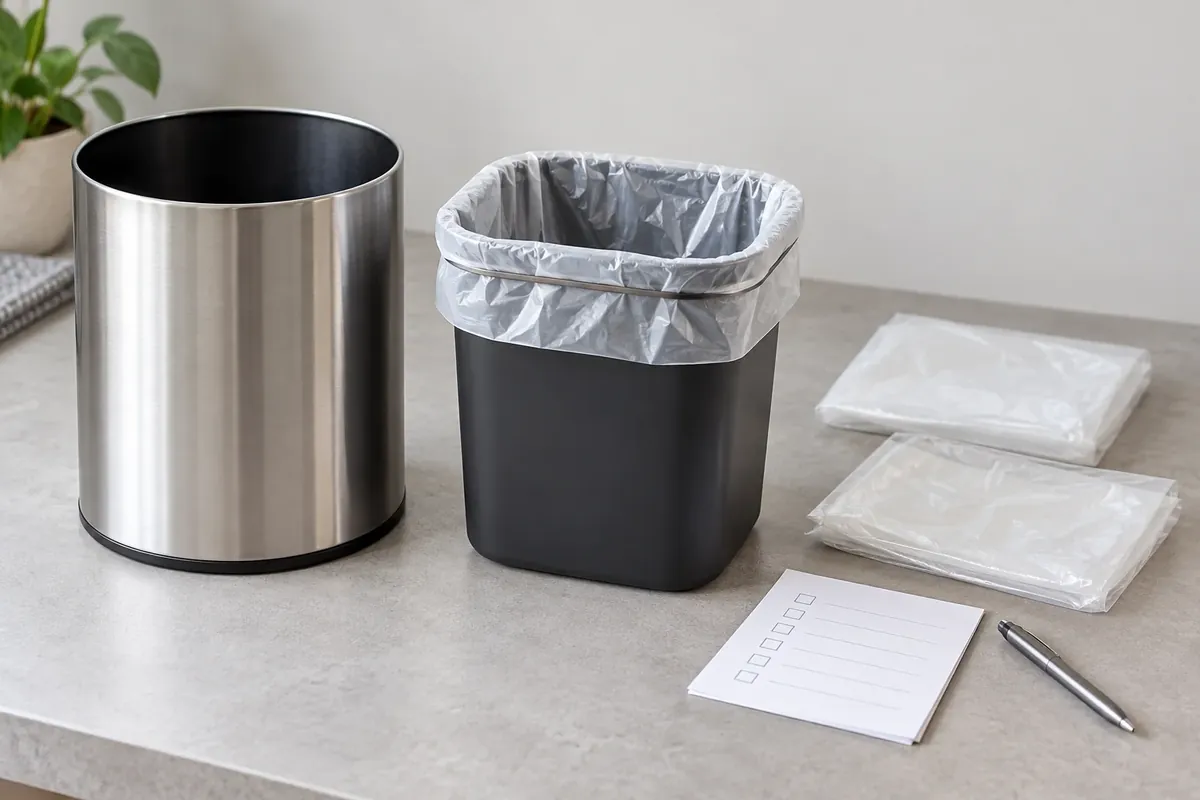
For sample approval, bathroom wastebasket liner bag retention rim should be treated as a named three-part match: liner, bucket and retention feature.
What should be included in a buyer’s sample-approval record?
A good approval record lets a second person repeat the same evaluation. Keep the bin model, bucket and retainer revisions together with the liner references tested. Include clear photos of the installed liner at the front, sides and hinge side; the lid closed; the inner bucket removed; and the filled-bag removal step. If the brand has an appearance standard for visible overhang, include an approved reference photo rather than relying on memory.
Capture the following:
- Product and component drawing revisions.
- Liner supplier, reference, dimensions and material information available to the buyer.
- The exact bin and bucket sample identifiers.
- Whether the retainer is included, optional or replaced by a custom liner approach.
- Fit observations for installation, retention, lid movement and removal.
- Any hand position or sequence required by the approved use instructions.
- Cosmetic acceptance at the rim and outer shell.
- Open questions, deviations and the person approving each one.
Separate the sample result from a broad product promise. A sample with Bag A passing the agreed fit review does not demonstrate universal compatibility with any bag. If packaging or marketing says “fits standard bags” or “works with any liner,” require the buyer to define and substantiate that phrase. The narrower wording “tested with the listed liner references” is often more verifiable when the product is meant for a defined assortment.
How do metal-shell and assembly choices affect the interface?
For a metal-bodied accessory, the shell opening, edge finish and assembled position of the bucket can influence how the product feels and looks. The shell may be formed, finished and assembled around purchased or separately sourced components; the exact route depends on the product design. Koitor is a family-owned custom metal hardware factory focused on bathroom and home storage hardware, and its approved capabilities include metal forming, finishing, basic assembly and sample development from drawings or physical samples. Current pedal-bin production, plastic bucket molding, pedal mechanisms and dedicated liner manufacture are not confirmed Koitor capabilities.
That distinction matters in an RFQ. A buyer can request a metal shell or related metal component review while separately identifying who supplies the bucket, retainer, pedal and liner. If the sourcing model is a complete assembly, list which party owns each component, fit decision, final inspection and product compatibility statement. Do not assume one supplier’s metal-work capability proves that it controls every interface in the finished bin.
For a metal part, the buyer should describe visible edges and finish expectations around the opening. A sharp or inconsistent edge may affect handling or bag contact, while an added rolled edge or trim may change the usable opening. This is a design and inspection conversation, not a claim that one edge construction is always required. Show the intended product appearance, identify the contact area and inspect the production-intent sample.
A custom metal hardware manufacturer can also review whether proposed geometry is practical to form, finish and assemble, but the buyer remains responsible for approving the final functional combination and any third-party components. For a new private-label assortment, start with a clear drawing, a physical sample when available, expected order quantity, target finish and packaging idea. Discuss which components are custom, which are standard or purchased and which facts remain unverified before a quotation is treated as complete.
What mistakes should private-label teams avoid?
The first mistake is choosing the bin before choosing the liner strategy. If the retail offer depends on custom-fit bags, storage and replenishment should be part of the product plan from the beginning. If the promise is broad bag compatibility, the buyer needs a representative test set and bounded wording.
The second is approving only a loose bucket or a digital rendering. The interface includes the outer shell, lid, retainer and the exact liner. A component may fit on a bench yet catch after the assembly is installed. The third is accepting “fits standard bags” without stating what was tested. The fourth is checking appearance but not removal, or checking installation but not a filled representative bag.
After approval, changes to the bag reference, bucket rim, retainer, shell opening or lid path should trigger a documented review. Record whether the previous approval still applies.
Finally, do not ask a factory to guarantee a universal result that the buyer has not defined. Provide the product and liner references, intended market, acceptable appearance, handling sequence and packaging assumptions. That makes the request answerable and helps distinguish an engineering issue from a missing purchasing decision.
Buyer checklist before requesting an OEM quotation
- Identify whether the assortment uses a general liner, a defined liner set or a model-specific bag.
- Share the target liner reference, dimensions and material information, if selected.
- Provide a bin drawing or sample and show the bucket, rim, retainer, lid and relevant clearances.
- State whether the bag should be retained by a separate fixer, by the rim shape or through a custom-fit bag system.
- Define acceptable visible overhang and how it will be judged.
- Specify what the filled-bag removal demonstration should include.
- Identify which parts are buyer-supplied, factory-sourced or still under development.
- Clarify desired metal material and surface finish without assuming that those choices determine liner performance.
- State target order quantity, sample requirements, private-label packaging and target market.
- Request confirmation of the product, component and drawing revisions used for sample approval.
A clear RFQ can ask the supplier to quote the agreed metal and assembly scope separately from unconfirmed buckets, mechanisms or custom liners. If the buyer wants a complete finished product, ask for a component responsibility list and a sample plan before assuming that every interface is covered.
Perguntas frequentes
Does a removable inner bucket guarantee that the liner will stay in place?
No. A removable bucket supports emptying and cleaning, but retention depends on the bucket rim, bag and any separate holding feature. Specify and sample the combination that will be sold.
Is a separate bag fixer better than a custom-fit liner?
Neither approach is universally better. A fixer may support a broader bag assortment if the tested bags fit the interface. A custom liner may match a particular bin but creates a replacement-supply decision. Compare cost, replenishment and sample fit for the intended market.
Can a buyer approve liner fit from product dimensions alone?
Dimensions help define the interface, but they do not reveal every material and handling effect. Approve a representative physical assembly with the named liner references and record the observed installation, lid and removal steps.
What should happen if the bag supplier changes after approval?
Review the new bag against the approved bucket, retainer and lid configuration. Compare dimensions and construction, repeat the affected sample checks and update the approved references or compatibility wording if needed.
Does Koitor currently manufacture bathroom pedal bins or plastic buckets?
The approved company profile confirms metal bathroom and home-storage hardware, metalworking and basic assembly capabilities. It does not confirm current pedal-bin, bucket-molding or pedal-mechanism production. Those capabilities should not be assumed in a sourcing discussion.
Review the Metal and Assembly Scope for Your Bathroom-Accessory Project
Share your drawing or physical sample, target metal finish, expected order quantity and packaging idea. Koitor can discuss the confirmed metal-hardware scope and identify which third-party components or fit requirements need separate confirmation.
OEM / MARCA PRÓPRIA
Transforme este guia de fornecimento num resumo do produto
Indique o produto pretendido, as dimensões, o acabamento, a quantidade a encomendar e os requisitos de embalagem. A sua equipa receberá uma análise prática da viabilidade de fabrico antes da apresentação do orçamento.
 English
 Español
 Português
 Français
 Deutsch
 العربية